Search results for The

Call for Papers:

  • I’m looking for recommendations for fantastic blog posts addressing gender and its intersections for a book project.   Self-nominations are welcome!  Please send ideas to lwade@oxy.edu.

SocImages News:

Elsewhere on the Web:

You like!  Here are our most appreciated posts this month:

Thanks everybody!

Editor’s Pick!

Social Media ‘n’ Stuff:

Finally, this is your monthly reminder that SocImages is on TwitterFacebookTumblrGoogle+, and Pinterest.  I’m on Facebook and most of the team is on Twitter: @lisawade@gwensharpnv@familyunequal, and @jaylivingston.

Lisa Wade, PhD is an Associate Professor at Tulane University. She is the author of American Hookup, a book about college sexual culture; a textbook about gender; and a forthcoming introductory text: Terrible Magnificent Sociology. You can follow her on Twitter and Instagram.
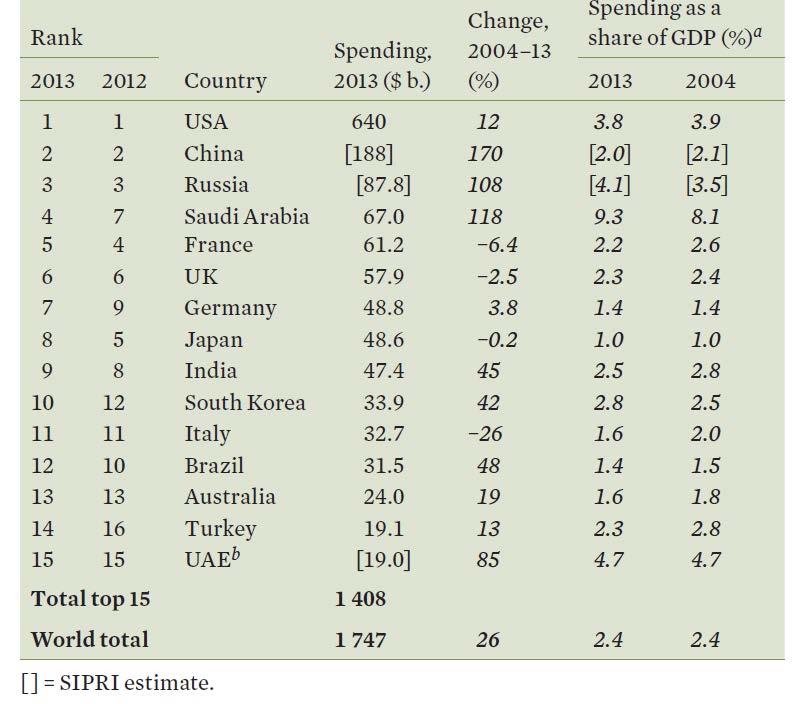
According to the Stockholm International Peace Institute, the United States remains the world’s top military spender. In fact, U.S. military spending equals the combined military spending of the next ten countries.  And most of those are U.S. allies.

1 (2) - Copy

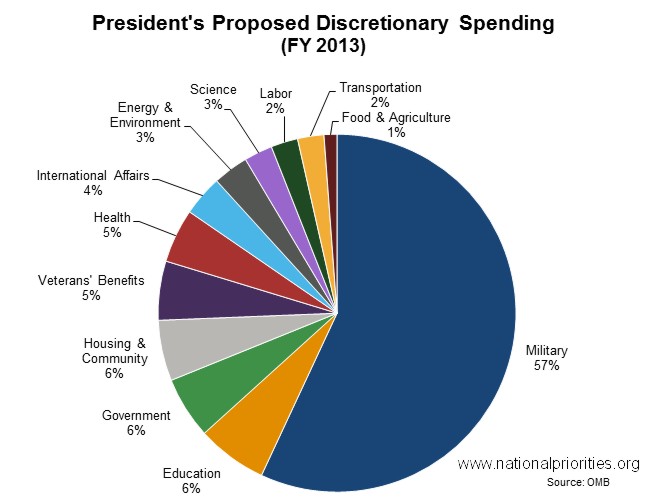
Although declining in real terms, the U.S. military budget remains substantial and a huge drain on our public resources.  As the following chart shows, military spending absorbs 57% of our federal discretionary budget.

1 (2)

 Notice that many so-called non-military discretionary budget categories also include military related spending. For example: Veteran’s Benefits, International Affairs, Energy and the Environment, and Science.   We certainly seem focused on a certain kind of security.

Martin Hart-Landsberg is a professor of economics at Lewis and Clark College. You can follow him at Reports from the Economic Front.

We’re 7 years old today!  To celebrate, check out this picture of seven capybaras.

Thanks to everyone who has visited over the last seven years!  This is our 5,226th post and I can hardly believe it.  Ready to charge on for another!

Here are some highlights from the last year. The blog never ceases to surprise!

Lisa Wade, PhD is an Associate Professor at Tulane University. She is the author of American Hookup, a book about college sexual culture; a textbook about gender; and a forthcoming introductory text: Terrible Magnificent Sociology. You can follow her on Twitter and Instagram.
Conspicuous consumption refers to the practice of ostentatiously displaying of high status objects.  Think very expensive purses and watches.  In the last few decades, as concern for the environment has become increasingly en vogue, it has become a marker of status to care for the earth.  Accordingly, people now engage in conspicuous conservation, the ostentatious display of objects that mark a person as eco-friendly.

Driving a Prius and putting solar panels on visible roof lines, even if they aren’t the sunniest, are two well-documented examples.  Those “litter removal sponsored by” signs on freeways are an example we’ve featured, as are these shoes that make it appear that the wearer helped clean up the oil spill in the gulf, even though they didn’t.

Well, welcome to the opposite: conspicuous pollution.

Elizabeth Kulze, writing at Vocativ, explains:

In small towns across America, manly men are customizing their jacked-up diesel trucks to intentionally emit giant plumes of toxic smoke every time they rev their engines. They call it “rollin’ coal”…

It’s a thing. Google it!

1a

This is not just a handful of guys.  Kulze links to “an entire subculture” on Facebook, Tumblr, and Instagram. “It’s just fun,” one coal roller says. “Just driving and blowing smoke and having a good time.”

It isn’t just fun, though. It’s a way for these men — mostly white, working class, rural men — to send an intrusive and nasty message to people they don’t like. That includes Prius drivers, cops, women, tailgaters, and people in vulnerable positions.

[youtube]https://www.youtube.com/watch?v=_gcb84qn3mU[/youtube]

[youtube]https://www.youtube.com/watch?v=rYPMbLO4pAY[/youtube]

Kulze reports that it costs anywhere between $1,000 and $5,000 to modify a pickup to do this, which is why the phenomenon resonates with conspicuous consumption and conservation.  It’s an expensive and public way to claim an identity that the owner wants to project.

Lisa Wade, PhD is an Associate Professor at Tulane University. She is the author of American Hookup, a book about college sexual culture; a textbook about gender; and a forthcoming introductory text: Terrible Magnificent Sociology. You can follow her on Twitter and Instagram.

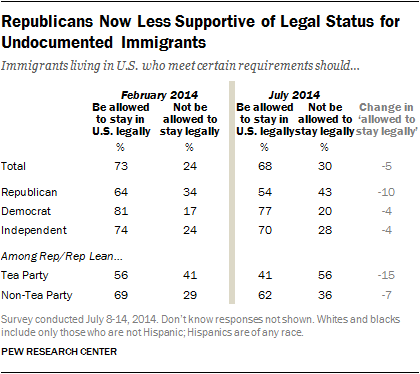
This year tens of thousands of Central American children, fleeing violence and poverty, have been arriving in the U.S. seeking refuge.  It’s a stunning story that has been covered widely in the media and Americans’ opinions about immigration have taken a hit.

The Pew Research Center collected data regarding American leniency toward undocumented immigrants in February and July, before and after media coverage of this crisis began.  The results show that members of all political parties, on average, are less inclined to allow “immigrants living in U.S. who meet certain requirements” to stay legally (see far right column).

The strongest opponents are Republicans and members of the Tea Party.  These groups were more opposed to enabling undocumented immigrants to stay legally to begin with and they showed the greatest change in response to this new crisis.

1

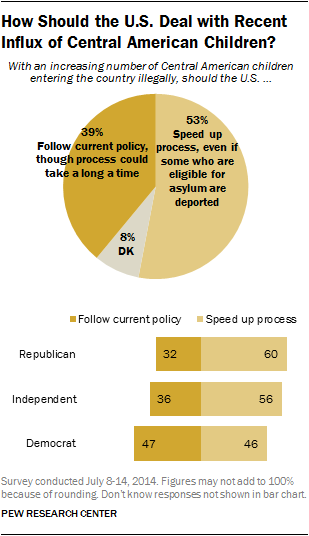
Republicans and Independents are also more likely than Democrats to think that we should speed up the deportation process, even if it means deporting children who are eligible for asylum.

2

Lisa Wade, PhD is an Associate Professor at Tulane University. She is the author of American Hookup, a book about college sexual culture; a textbook about gender; and a forthcoming introductory text: Terrible Magnificent Sociology. You can follow her on Twitter and Instagram.
There is one similarity between the Israel/Gaza crisis and the U.S. unaccompanied child immigrant crisis: National borders enforcing social inequality. When unequal populations are separated, the disparity creates social pressure at the border. The stronger the pressure, the greater the military force needed to maintain the separation.

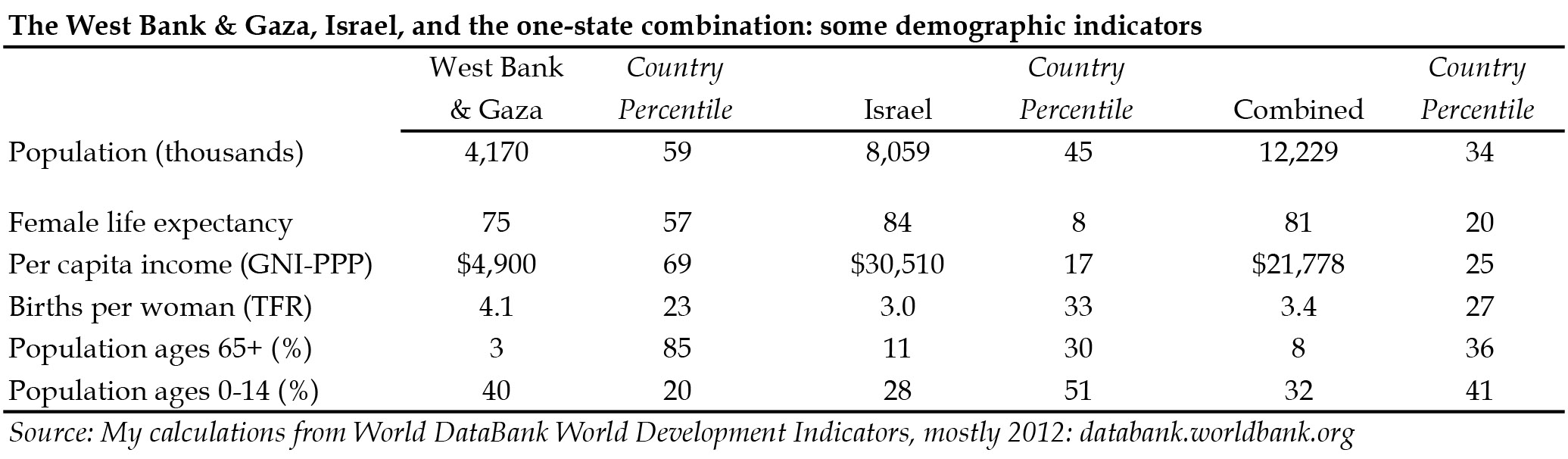
To get a conservative estimate of the pressure at the Israel/Gaza border, I compared some numbers for Israel versus Gaza and the West Bank combined, from the World Bank (here’s a recent rundown of living conditions in Gaza specifically). I call that conservative because things are worse in Gaza than in the West Bank.

Then, just as demographic wishful thinking, I calculated what the single-state solution would look like on the day you opened the borders between Israel, the West Bank, and Gaza. I added country percentiles showing how each state ranks on the world scale (click to enlarge).

1

Israel’s per capita income is 6.2-times greater, its life expectancy is 6 years longer, its fertility rate is a quarter lower, and its age structure is reversed. Together, the Palestinian territories have a little more than half the Israeli population (living on less than 30% of the land). That means that combining them all into one country would move both populations’ averages a lot. For example, the new country would be substantially poorer (29% poorer) and younger than Israel, while increasing the national income of Palestinians by 444%. Israelis would fall from the 17th percentile worldwide in income, and the Palestinians would rise from the 69th, to meet at the 25th percentile.

Clearly, the separation keeps poor people away from rich people. Whether it increases or decreases conflict is a matter of debate.

Meanwhile

Meanwhile, the USA has its own enforced exclusion of poor people.

3
Photo of US/Tijuana border by Kordian from Flickr Creative Commons.

The current crisis at the southern border of the USA mostly involves children from Guatemala, Honduras, and El Salvador. They don’t actually share a border with the USA, of course, but their region does, and crossing into Mexico seems pretty easy, so it’s the same idea.

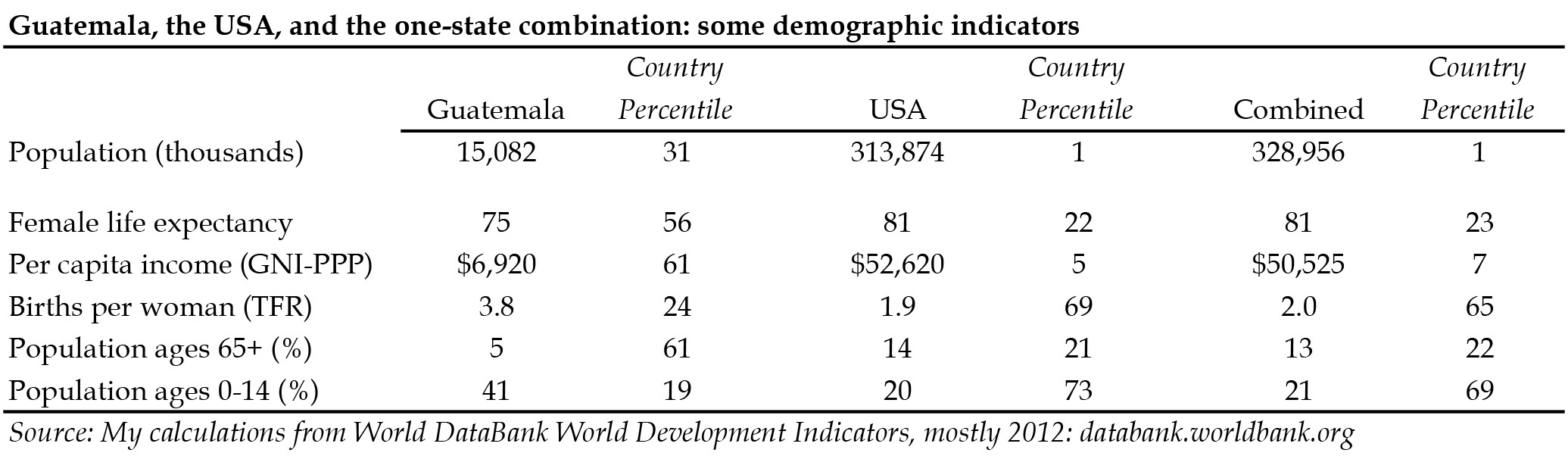
To make a parallel comparison to Israel and the West Bank/Gaza, I just used Guatemala, which is larger by population than Honduras and El Salvador combined, and also closest to the USA. The economic gap between the USA and Guatemala is even larger than the Israeli/Palestinian gap. However, because the USA is 21-times larger than Guatemala by population, we could easily absorb the entire Guatemalan population without much damaging our national averages. Per capita income in the USA, for example, would fall only 4%, while rising more than 7-times for Guatemala (click to enlarge):

4

This simplistic analysis yields a straightforward hypothesis: violence and military force at national borders rises as the income disparity across the border increases. Maybe someone has already tested that.

The demographic solution is obvious: open the borders, release the pressure, and devote resources to improving quality of life and social harmony instead of enforcing inequality. You’re welcome!

Cross-posted at Family Inequality.

Philip N. Cohen is a professor of sociology at the University of Maryland, College Park, and writes the blog Family Inequality. You can follow him on Twitter or Facebook.

If you stop and think about it, alcohol is just the worst. Almost every one who drinks has experienced the pain of a mean morning hangover (at least once). Also, the experience of being drunk… why is that enjoyable? When drunk you slur your words, it’s hard to think straight, you’re liable to say or do something that will offend the people around you, and you can’t legally drive a car. Why does any of that sound like a good way to spend a Friday night?

To a sociologist, the reason people drink alcohol is that they have been socially taught to. That is, we like alcohol because we’ve been taught to overlook the negative side effects or we have redefined them as positive. If that’s confusing, don’t worry. Let’s talk about another drug people abuse (marijuana) and how the sociologist Howard Becker argues we socially construct getting high and being a stoner.

Becoming a Marijuana User

In 1953 Becker set out to answer what appears to be a simple question: how does a person become a marijuana user. After interviewing fifty marijuana users Becker (1953: 235) concluded that:

An individual will be able to use marihuana for pleasure only when he (1) learns to smoke it in a way that will produce real effects; (2) learns to recognize the effects and connect them with drug use; and (3) learns to enjoy the sensations he perceives. This proposition based on an analysis of fifty interviews with marihuana users, calls into question theories which ascribe behavior to antecedent predispositions and suggests the utility of explaining behavior in terms of the emergence of motives and dispositions in the course of experience.

The first point should be pretty obvious. You can’t get high if you don’t inhale when you smoke marijuana (like President Bill Clinton). So the first step to becoming a pot smoker is learning to properly smoke pot. Most often this takes place when an experienced smoker socializes (i.e. trains) a novice smoker in the mechanics of the task.

Becker’s second point might be harder to understand. Drugs inherently alter your physiology… that’s what makes them drugs. Being in a chemcially alterted state can be disorienting. But don’t believe me, watch this:

David, the little boy in the movie, had not been socialized to how anesthesia works. Similarly, when you ingest any drug you have to be taught to recognize the effects. So for marijuana maybe that would include heightened senses, food cravings, and possibly a sense of anxiety or paranoia. When you haven’t been socialized it’s easy to go into a panic or ignore the effects altogether.

For instance, around 2007 a police officer in Dearborn Heights Michigan stole marijuana from a drug arrest, baked it into brownies, and then consumed the brownies to get high for what he said was his very first time. He then called 911 because he thought he was dying. Becker would likely say that if he had been socialized and knew what effects he should expect, the police officer wouldn’t have likely freaked out and incriminated himself.

After you’ve learned to inhale properly, learned to recognize how the substance will alter you, then the last step to becoming a marijuana user is to redefine potentially negative experiences as positive. As we talked about above, smoking marijuana can lead to anxiety, paranoia, insatiable food cravings, hyper sensitivity, confusion, etc.

To see an example of this, we need look no further than the comment section under the video I just showed you.  What WeBeChillin420’s comment does is reframe a panic attack into a desirable thing. S/he seems to be nostalgic for his or her first time consuming freak out quantities of marijuana.

Becker and the scholars he inspired to research marijuana communities further point out that it’s common among smokers to say that “coughing gets you higher.” Actually, coughing after smoking is your body’s way of telling you that you inhaled something it didn’t like. It’s your body literally gasping for air. It seems just as likely that marijuana users could think of coughing as a bad thing or as a sign they inhaled too much. Instead smokers socially construct coughing as a positive and desirable thing.

All Drugs Are Socially Constructed

While Becker focused on marijuana, we can extend his ideas to every type of drug. For instance let’s look at caffeine. Coffee and Red Bull are said to be “acquired tastes.” Doesn’t this mean that you have to learn to like them? You have to learn to like to feel a slight jitteriness? What you can take from Becker’s research is that how we think about drugs, how we react to any drug or medicine we ingest, and how we feel about others who’ve used drugs are all social constructs.

Nathan Palmer, MA is a visiting lecturer at Georgia Southern University. He is a passionate educator, the founder of Sociology Source, and the editor of Sociology in Focus, where this post originally appeared.

Everyone!

Well, almost.

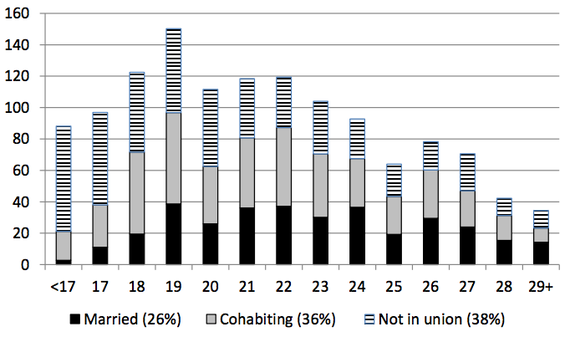
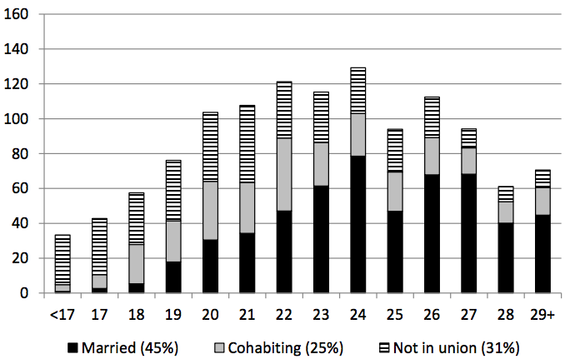
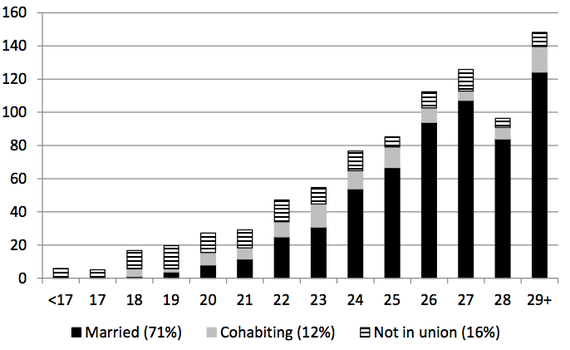
Andrew Cherlin and his colleagues report that 64% of women and 63% of men have had at least one child out of wedlock.  The dominance of non-marital births is true for everyone, except people with four-year college degrees.

Cherlin’s charts each present the same data — births by age and relationship status — for women who didn’t finish high school (figure one), high school grads (figure two), women with some college (and so on), and women with a bachelors (etc).  There’s some differences between the first three graphs, but the big leap comes with the last.

Didn’t finish high school:

1.jpg

High school grads:1 Some college:2 College grads:3

“There are two clear paths through adulthood,” Cherlin told The Altantic, “one for people who have a bachelor’s degree and one for people who don’t.”

Thanks for the link @theologybird!

Lisa Wade, PhD is an Associate Professor at Tulane University. She is the author of American Hookup, a book about college sexual culture; a textbook about gender; and a forthcoming introductory text: Terrible Magnificent Sociology. You can follow her on Twitter and Instagram.