Search results for The

At Sociological Images, we make research methods fun!

Not really.

But here we go!

Scholars testing a research hypothesis have to be worried about two kinds of errors. Type I is failing to reject a false hypothesis.  The hypothesis is wrong, but it looks right to you.  That’s a false positive.

Type II is rejecting a true hypothesis incorrectly.  In fact, your hypothesis is correct, but your data suggests that it’s false. That’s a false negative.

Test time!

Which one is which?

1

You’re welcome everybody!

Here’s as far back as I could trace the source. If anyone knows where this came from, please let me know. :)

Lisa Wade, PhD is an Associate Professor at Tulane University. She is the author of American Hookup, a book about college sexual culture; a textbook about gender; and a forthcoming introductory text: Terrible Magnificent Sociology. You can follow her on Twitter and Instagram.
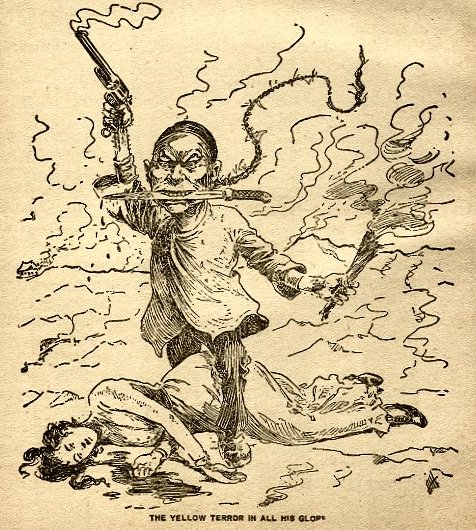
In the late 1800s, male Chinese immigrants were brought to the U.S. to work on the railroads and as agricultural labor on the West Coast; many also specialized in laundry services. Some came willingly, others were basically kidnapped and brought forcibly.

After the transcontinental railroad was completed, it occurred to white Americans that Chinese workers no longer had jobs. They worried that the Chinese  might compete with them for work. In response, a wave of anti-Chinese (and, eventually, anti-Japanese) sentiment swept the U.S.

Chinese men were stereotyped as degenerate heroin addicts whose presence encouraged prostitution, gambling, and other immoral activities.  A number of cities on the West Coast experienced riots in which Whites attacked Asians and destroyed Chinese sections of town. Riots in Seattle in 1886 resulted in practically the entire Chinese population being rounded up and forcibly sent to San Francisco. Similar situations in other towns encouraged Chinese workers scattered throughout the West to relocate, leading to the growth of Chinatowns in a few larger cities on the West Coast.

The anti-Asian movement led to the Chinese Exclusion Act of 1882 and the Gentlemen’s Agreement (with Japan) of 1907, both of which severely limited immigration from Asia.  Support was bolstered with propaganda.

Here is a vintage “Yellow Peril” poster. The white female victim at his feet references the fact that most Chinese in the U.S. were male–women were generally not allowed to immigrate–and this poster poses them as a threat to white women and white men’s entitlement to them:

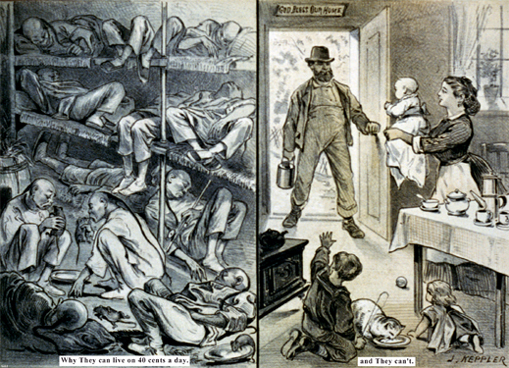
“Why they can live on 40 cents a day…and they can’t,” this poster says, referring to the fact that white men can’t possibly compete with Chinese workers because they need to support their moral families.  The Chinese, of course, usually didn’t have families because there were almost no Chinese women in the U.S. and white women generally would not marry a Chinese man.

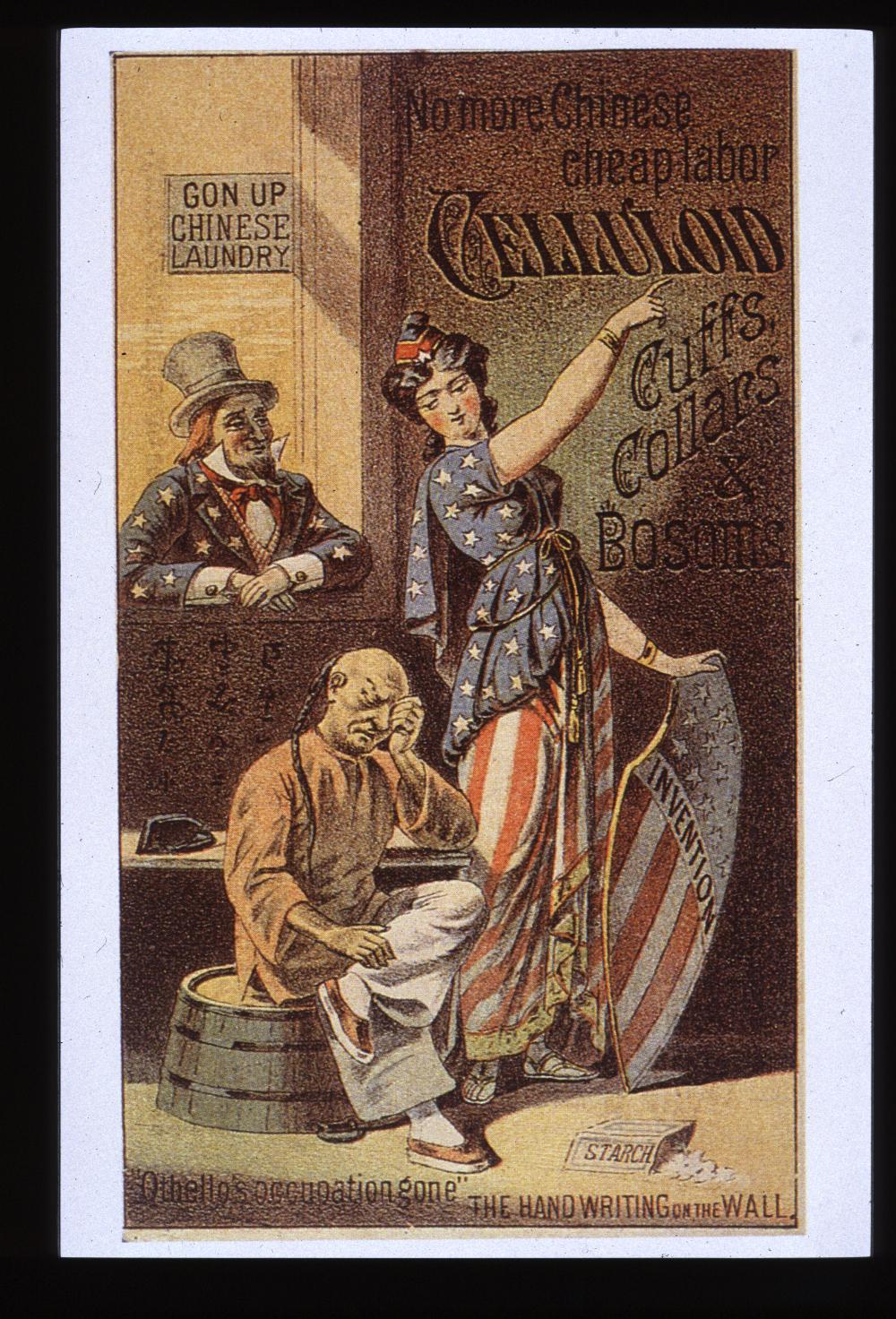
The following images were found at the The History Project at the University of California-Davis.

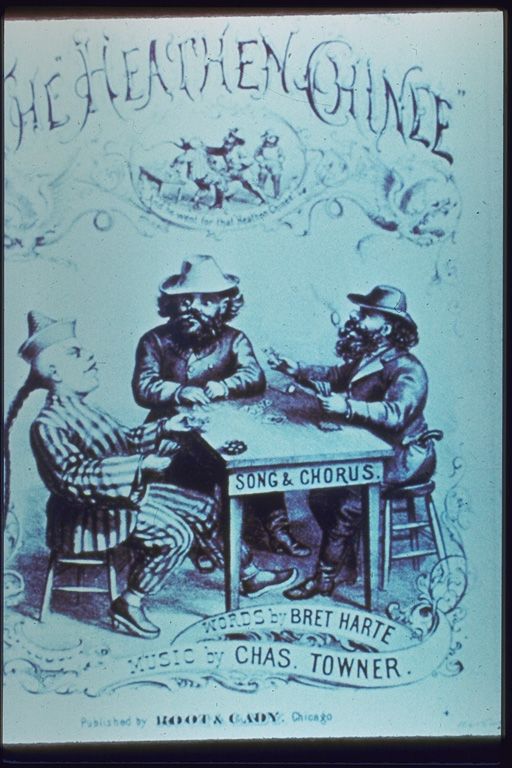
This is the cover for the song sheet “The Heathen Chinese”:

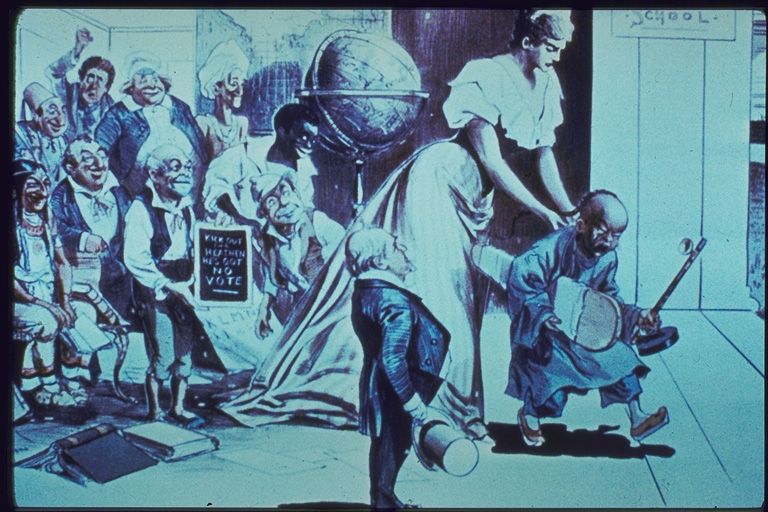
According to the History Project, this next image was accompanied by the following text:

A judge says to Miss Columbia, “You allowed that boy to come into your school, it would be inhuman to throw him out now — it will be sufficient in the future to keep his brothers out.” Note the ironing board and opium pipe carried by the Chinese. An Irish American holds up a slate with the slogan “Kick the Heathen Out; He’s Got No Vote.”

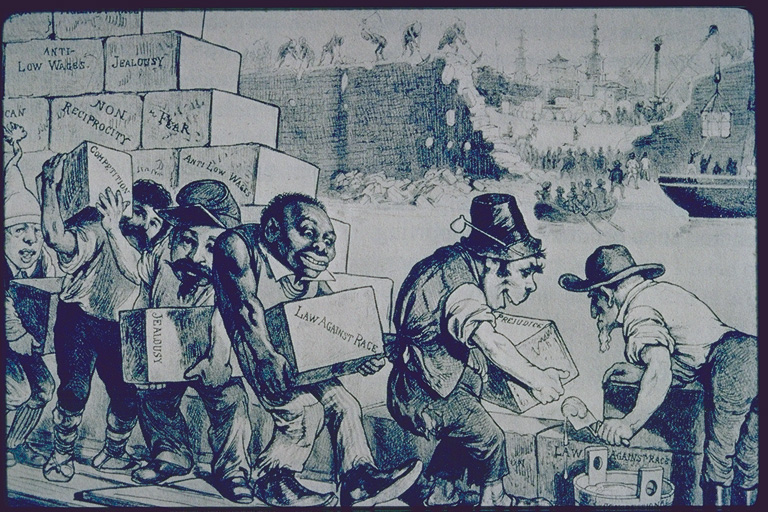
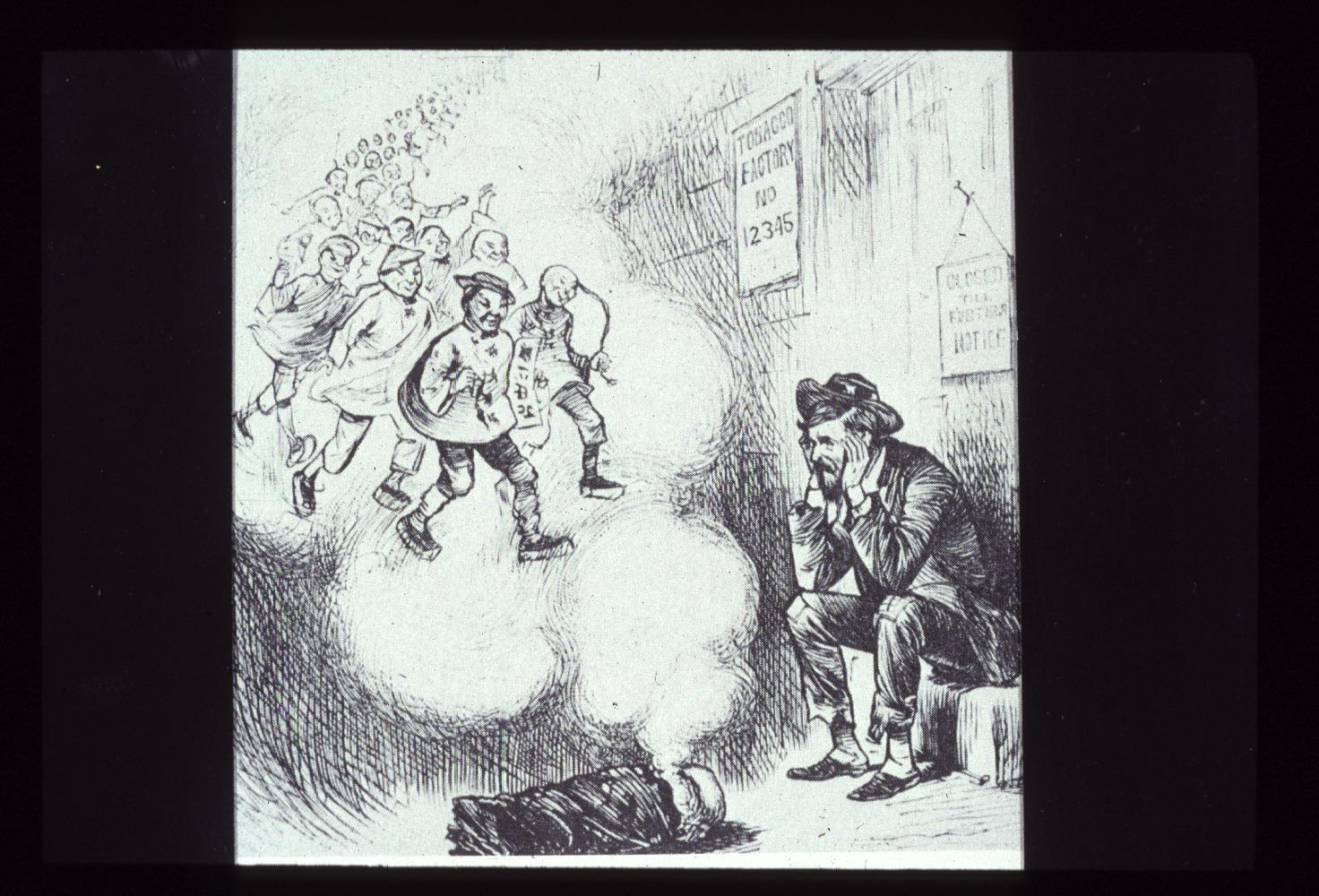
The following counter-propaganda pointed out how immigrants from other countries were now working to keep Chinese immigrants out. The bricks they’re carrying say things like “fear,” “competition,” “jealousy,” and “non-reciprocity.”

During World War II, attitudes toward the Chinese shifted as they became the “good” Asians as opposed to the “bad” Japanese. However, it wasn’t until the drastic change in immigration policy that occurred in 1965, with the passage of the Immigration and Nationality Act, that Asia (and particularly China) re-became a major sending region for immigrants to the U.S.

This post originally appeared in 2008.

Gwen Sharp is an associate professor of sociology at Nevada State College. You can follow her on Twitter at @gwensharpnv.

Earlier this year, Barbie posed for Sports Illustrated, triggering a round of eye-rolling and exasperation among those who care about the self-esteem and overall mental health of girls and women.

Barbie replied with the hashtag #unapologetic, arguing in an — I’m gonna guess, ghostwritten — essay that posing in the notoriously sexist swimsuit issue was her way of proving that girls could do anything they wanted to do.  It was a bizarre appropriation of feminist logic alongside a skewering of a feminist strawwoman that went something along the lines of “don’t hate me ’cause I’m beautiful.”

Barbie is so often condemned as the problem and Mattel, perhaps tired of playing her endless defender, finally just went with: “How dare you judge her.”  It was a bold and bizarre marketing move.  The company had her embrace her villain persona, while simultaneously shaming the feminists who judged her.  It gave us all a little bit of whiplash and I thought it quite obnoxious.

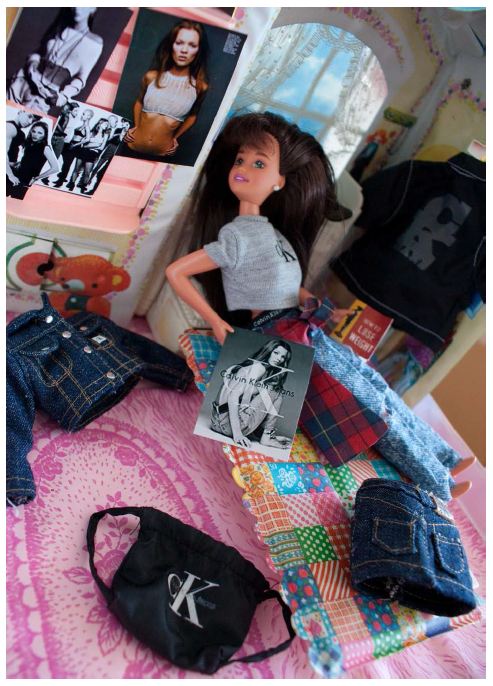
But then I came across Tiffany Gholar’s new illustrated book, The Doll Project.  Gholar’s work suggests that perhaps we’ve been too quick to portray Barbie as simply a source of young women’s self-esteem issues and disordered eating.  We imagine, after all, that she gleefully flaunts her physical perfection in the face of us lesser women.  In this way, Mattel may be onto something; it isn’t just her appearance, but her seemingly endless confidence and, yes, failure to apologize, that sets us off.

But, maybe we’re wrong about Barbie?

What if Barbie is just as insecure as the rest of us?  This is the possibility explored in The Doll Project.  Using a mini diet book and scale actually sold by Mattel in the 1960s, Gholar re-imagines fashion dolls as victims of the media imperative to be thin.  What if  Barbie is a victim, too?

Excerpted with permission:

14 1a 53Forgive me for joining Mattel and Gholar in personifying this doll, but I enjoyed thinking through this reimagining of Barbie. It reminded me that even those among us who are privileged to be able to conform to conventions of attractiveness are often suffering.  Sometimes even the most “perfect” of us look in the mirror and see nothing but imperfection.  We’re all in this together.

Cross-posted at Pacific Standard and Adios Barbie.

Lisa Wade, PhD is an Associate Professor at Tulane University. She is the author of American Hookup, a book about college sexual culture; a textbook about gender; and a forthcoming introductory text: Terrible Magnificent Sociology. You can follow her on Twitter and Instagram.
A few days ago, Juliano Pinto kicked off the World Cup with a first kick.  It was a media stunt designed to make us verklempt.  Pinto is a paraplegic who wore a mind-controlled robotic exoskeleton to make his move.

We were to be awed by the technology, too, of course, which is being developed by the Walk Again Project, a scientific consortium.  Says the leading scientist on the project, “With enough political will and investment, we could make wheelchairs obsolete.”

Red Nicholson isn’t having it.

Ask any wheelchair user, particularly one who’s been in the game a while, and they’ll tell you that they’re far too busy living their life to sit there worrying about whether or not they’ll ever walk. We just get on and do.

From his point of view, the exoskeleton is for people who aren’t in wheelchairs.  Getting “non-walkers to walk again,” he says, is about making everyone else happy.  As for him, he says, he’s fine:

My wheelchair is a very capable tool and to be honest, the last thing I want is to be strapped to a District 9-esque robot and become a puppet in some corporation’s half-baked execution of an obsession…

In the meantime, he says, everyone’s concern with getting him to walk again suggests that he, and everyone else who uses a wheelchair, is living a pitiable life.  “These stories,” he says, “are unwittingly invalidating a unique way of life for millions of people around the globe who are really happy with their wheelchairs.”   So, he goes on record: “This is not my dream.”

William Peace, an anthropologist who also uses a wheelchair, goes further, arguing that the exoskeleton is harmful to people who are newly paralyzed.  The scientists developing the exoskeleton are “sell[ing] the dream of walking to newly paralyzed people who cannot imagine life as a wheelchair user.”  This is bad, he says, because it encourages people to reject their new body instead of accept it.   He writes: “the exoskeleton is symbolically and practically destructive to a newly paralyzed person.”

Instead of focusing on the one thing people using wheelchairs can’t do, Peace argues, we should focus on all the things they do everyday:

Work, make a decent living, and be autonomous. Own a home even. Have a family. Get married. In short, be ordinary. Walking is simply not required for all this nor should it be glorified.

Nicholson concurs: “My life as a wheelchair-user is a very good one.”

So hey, able-bodied media: quit making me feel like wheelchairs are a shitty, sub-par option. Stop beating your exoskeleton drum. And most of all, let go of your obsession with walking, because it’s totally overrated.

Cross-posted at Pacific Standard.

Lisa Wade, PhD is an Associate Professor at Tulane University. She is the author of American Hookup, a book about college sexual culture; a textbook about gender; and a forthcoming introductory text: Terrible Magnificent Sociology. You can follow her on Twitter and Instagram.
We have the money and the know how to tackle most of our social problems.  Certainly unemployment, houselessness, and poverty.  So, why don’t we?

In large part it is because our socially created wealth remains outside social control.  Critical economic decisions are driven by private interests not the public good.  One result is hipster economics.

If you are not familiar with the concept, I recommend Sarah Kendzior’s The Perils of Hipster Economics. Here is the first part:

On May 16, an artist, a railway service and a government agency spent $291,978 to block poverty from the public eye.

Called psychylustro, German artist Katharina Grosse’s project is a large-scale work designed to distract Amtrak train riders from the dilapidated buildings and fallen factories of north Philadelphia. The city has a 28 percent poverty rate – the highest of any major U.S. city – with much of it concentrated in the north. In some north Philadelphia elementary schools, nearly every child is living below the poverty line.

Grosse partnered with the National Endowment of the Arts and Amtrak to mask North Philadelphia’s hardship with a delightful view. The Wall Street Journal calls this “Fighting Urban Blight With Art.” Liz Thomas, the curator of the project, calls it “an experience that asks people to think about this space that they hurtle through every day.”

The project is not actually fighting blight, of course – only the ability of Amtrak customers to see it.

1
Flickr creative commons, Knight Foundation.

“I need the brilliance of colour to get close to people, to stir up a sense of life experience and heighten their sense of presence,” Grosse proclaims.

“People,” in Grosse and Thomas’s formulation, are not those who actually live in north Philadelphia and bear the brunt of its burdens. “People” are those who can afford to view poverty through the lens of aesthetics as they pass it by.

Urban decay becomes a set piece to be remodeled or romanticised.

The rest of the article is here.

Martin Hart-Landsberg is a professor of economics at Lewis and Clark College. You can follow him at Reports from the Economic Front.

Usually, you want to match up with someone at about your level, or a little higher.  The trouble is that many people overestimate their own level.  Maybe that’s especially true of men.

One summer many years ago at the tennis courts, a guy I didn’t know  came over and asked me if I’d like to play. I hadn’t arranged a game with anyone, but I didn’t want to wind up playing some patzer.

“Are you any good?” I asked. He paused.

“Well, I’m not Jimmy Connors,” he said (I told this was many years ago), “but neither are you.”

In chess and other games, serious players have ratings. Give a roomful of possible partners, they can sort through the ratings and find a match with someone at roughly the same level.  It’s called assortative mating, though that term usually refers to the other kind of mating, not chess.  It’s the basis of the conflict in this poignant scene from “Louie.”

Vanessa is not a ten, neither is Louie.  According to principles of assortative mating, the tens will wind up with other tens, the nines with nines, and so on down the attractiveness scale. One problem in the “Louie” scene is that Louie seems to have an inflated view of his own attractiveness.  He’s aiming higher than Vanessa.  That’s typical.  So is the importance that Louie, the man, places on physical attractiveness. This excerpt begins with Louie telling Vanessa that she’s a really beautiful . . . . He can’t bring himself to say “girl”; he’s probably going to say “person.” But he’s obviously not saying what he thinks.

Or as Dan Ariely and colleagues concluded from their study of HotOrNot members:

[Men] were significantly more influenced by the consensus physical attractiveness of their potential dates than females were. [Men also] were less affected by how attractive they themselves were . . .  In making date choices, males are less influenced by their own rated attractiveness than females are.

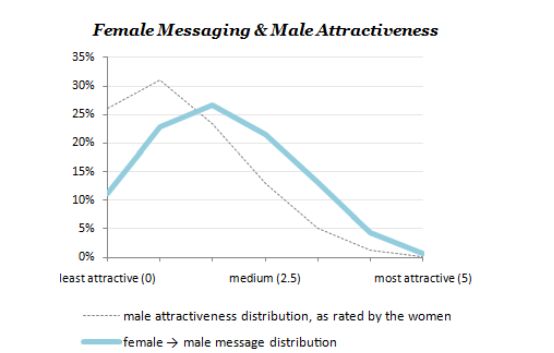
Another dating site, OK Cupid, found a similar pattern when they looked at data about who gets messages.  They asked their customers to rate profile photos of the opposite sex on a scale of 0 to 5. They then tracked the number of messages for people at each level of attractiveness.  The graph below shows what women thought and what they did – that is, how attractive they found men, and who they sent messages to.

1 (2) - Copy

Men who were rated 0 or 1 got fewer messages than their proportion in the population.  That figures. But even men who were only moderately attractive got more than their share. Generally, the fewer men at a level of attractiveness, the fewer total messages women sent. The 4s, for example, constituted only 2% of the population, and they got only 4% of all the messages.  The Vanessas on OK Cupid are not sending a lot of inquiries to guys who look like George Clooney.

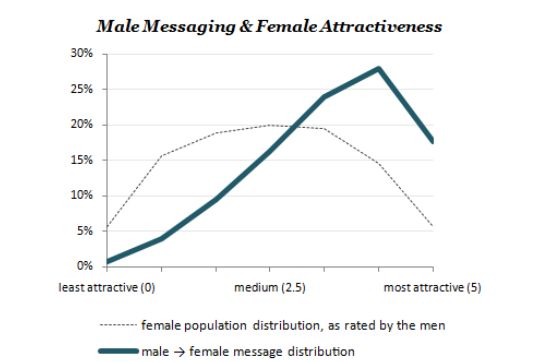
But look at the men.

1 (2)

Men are more generous in their estimates of beauty than are women. But they also ignore the Vanessas of the world (or at least the world of OK Cupid) and flock after the more attractive women.  Only 15% of the women were rated as a 4, but they received about 26% of the messages.  Women rated 5 received messages triple their proportion in the population.

What about those with so-so looks?  Women rated as 2s received only about 10% of the messages sent by men. But men at that same level received 25% of the messages women sent.  The women seem more realistic.

Vanessa too has no illusions about her own attractiveness. She refers to herself as “a fat girl,” and when Louie, trying to be kind, says, “You’re not fat,” she says: “You know what the meanest thing is you can say to a fat girl? [pause] ‘You’re not fat.’” But it’s only when she challenges Louie’s view of his own attractiveness that their relationship starts to change.

Y’know if you were standing over there looking at us, you know what you’d see?

What?

That we totally match. We’re actually a great couple together.

She doesn’t explain what she means by “totally match.” It could be their interests or ideas or personalities, but the imaginary stranger looking at them from over there couldn’t know about any of that. What that generalized other could see is that they are at roughly the same place on the assortative mating attractiveness scale.

Cross-posted at Pacific Standard.

Jay Livingston is the chair of the Sociology Department at Montclair State University. You can follow him at Montclair SocioBlog or on Twitter.

1a

PhD Comics.

Lisa Wade, PhD is an Associate Professor at Tulane University. She is the author of American Hookup, a book about college sexual culture; a textbook about gender; and a forthcoming introductory text: Terrible Magnificent Sociology. You can follow her on Twitter and Instagram.
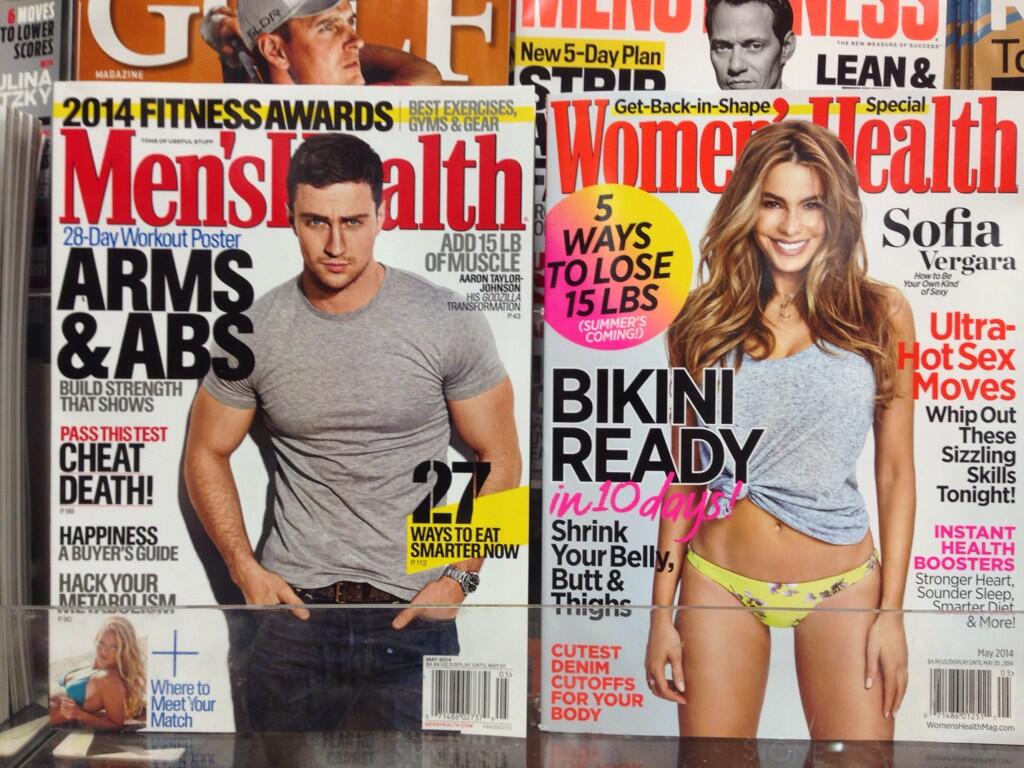
We commonly hear claims that men are naturally more muscular and physically intimidating than women.  “It’s a biological fact,” someone might say.  If that were true, though, we wouldn’t have to work so incredibly hard to make it so.

@IllMakeItMyself sent in this great example of the way in which we are pushed to force our bodies into a gender binary that we pretend is natural.  On the upper right part of the Men’s Health cover, it reads: “Add 15lb of muscle” and, right next door on the Women’s Health cover, it reads “5 ways to lose 15 lbs.”

If we have to try this hard to make it true, maybe we’re not as different as we think we are.

1

Lisa Wade, PhD is an Associate Professor at Tulane University. She is the author of American Hookup, a book about college sexual culture; a textbook about gender; and a forthcoming introductory text: Terrible Magnificent Sociology. You can follow her on Twitter and Instagram.