Search results for The

The Nation sparked a robust discussion last week with its incisive online conversation, Does Feminism Have a Class Problem? The panelists addressed the “Lean In” phenomenon, articulating how and why Sheryl Sandberg’s focus on self-improvement – rather than structural barriers and collective action to overcome them – angered quite a few feminists on the left.

While women of different economic backgrounds face many different realities, they also share similar work-life balance struggles. In that vein, the discussants argue that expanding family-friendly workplace policies – which would improve the lives of working women up and down the economic ladder – could help bridge the feminist class divide.

A growing body of research indicates that there are few other interventions that improve the economic prospects and work-life balance of women workers as much as unions do. A new report from the Center for Economic and Policy Research (CEPR), which I co-authored with my colleagues Janelle Jones and John Schmitt, shows just how much of a boost unions give to working women’s pay, benefits and workplace flexibility.Photo Credit:Minnesota Historical Society
For example, all else being equal, women in unions earn an average of 13 percent – that’s about $2.50 per hour – more than their non-union counterparts. In other words, unionization can raise a woman’s pay as much as a full year of college does. Unions also help move us closer to equal pay: a study by the National Women’s Law Center determined that the gender pay gap for union workers is only half of what it is for those not in unions.

Unionized careers tend to come with better health and retirement benefits, too. CEPR finds that women in unions are 36 percent more likely to have health insurance through their jobs – and a whopping 53 percent more likely to participate in an employer-sponsored retirement plan.

Unions also support working women at those crucial times when they need time off to care for themselves or their families. Union workplaces are 16 percent more likely to allow medical leave and 21 percent more likely to offer paid sick leave. Companies with unionized employees are also 22 percent more likely to allow parental leave, 12 percent more likely to offer pregnancy leave, and 19 percent more likely to let their workers take time off to care for sick family members.

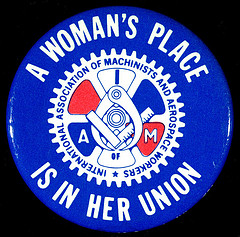
Women make up almost half of the union workforce and are on track to be in the majority by 2025. As women are overrepresented in the low-wage jobs that are being created in this precarious economy – they are 56.4% of low-wage workers and over half of fast food workers – unions are leading and supporting many of the campaigns to improve their situations. In an important sense, the union movement already is a women’s movement.

Education and skills can get women only so far. It’s a conundrum that women have surpassed men when it comes to formal schooling, yet women have made little progress catching up on pay. Many women who do everything right — getting more education and skills — still find themselves with low wages and no benefits.

With unions already playing a central role in helping to meet the needs working women and their families in the 21st century economy, anyone concerned about the well-being of women should also care about unions.

Nicole Woo is the director of domestic policy at the Center for Economic and Policy Research.  This post is based on her new study,  “Women, Working Families, and Unions,” and originally appeared at Girl w/ Pen!
Mean and median are two measures of “average.”  The mean is the average as we typically think of it: the sum of things divided by the total number of things.  The median, in contrast, is literally the number in the middle if we align all the quantities in order.  People often use median instead of mean because it is insensitive to extreme outliers which may skew the mean in one direction or another.

For a quick illustration of the difference, I often use the example of income. I choose a plausible average (mean) for the classroom population and review the math. “If Bill Gates walks into the room,” I say, “the average income is now in the billions. The median hasn’t moved, but the mean has gone way up.” So has the Gini coefficient.

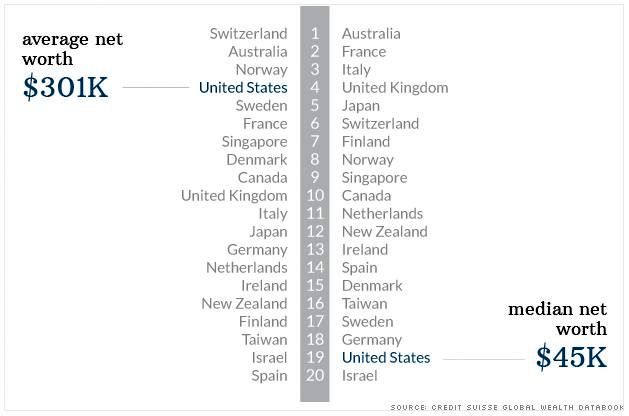
Here’s a more realistic and global illustration – the net worth of people in the wealthier countries.  The U.S. ranks fourth in mean worth – $301,000 per person…

1 (2) - Copy

…but the median is far lower – $45,000, 19th out of the twenty nations shown.  (The graph is from Credit Suisse via CNN.)

The U.S. is a wealthy nation compared with others, but  “average” Americans, in the way that term is generally understood, are poorer than their counterparts in other countries. 

Jay Livingston is the chair of the Sociology Department at Montclair State University. You can follow him at Montclair SocioBlog or on Twitter.

Flashback Friday.  

In his book by the same name, Michael Billig coined the term “banal nationalism” to draw attention to the ways in which nationalism was not only a quality of gun-toting, flag-waving “extremists,” but was quietly and rather invisibly reproduced by all of us in our daily lives.

That we live in a world of nations was not inevitable; that the United States, or Sweden or India, exist was not inevitable.  I was born in Southern California.  If I had been born at another time in history I would have been Mexican or Spanish or something else altogether.  The nation is a social construction.

The nation, then, must be reproduced. We must be reminded, constantly, that we are part of this thing called a “nation.”  Even more, that we belong to it and it belongs to us.  Banal nationalism is how the idea of the nation and our membership in it is reproduced daily.  It occurs not only with celebrations, parades, or patriotic war, but in “mundane,” “routine,” and “unnoticed” ways.

The American flag, for example, casually hanging around in yards and in front of buildings everywhere; references to the nation on our money; the way that the news is usually split into us and everyone else (e.g., US News and World Report); the naming of clubs and franchises, such as the National Football League, as specific to our country; and the performance of the pledge of allegiance in schools and sports arenas:

So, what?  What could possibly be the problem?

Sociologists have critiqued nationalism for being the source of an irrational commitment and loyalty to one’s nation, a commitment that makes one willing to both die and kill.  Billig argues that, while it appears harmless on the surface, “banal nationalism can be mobilized and turned into frenzied nationalism.”  The profound sense of national pride required for war, for example, depends on this sense of nationhood internalized over a lifetime.  So banal nationalism isn’t “nationalism-lite,” it’s the very foundation upon which more dangerous nationalisms are built.

You can download a more polished two-page version of this argument, forthcoming in Contexts magazine, here.  

Lisa Wade, PhD is an Associate Professor at Tulane University. She is the author of American Hookup, a book about college sexual culture; a textbook about gender; and a forthcoming introductory text: Terrible Magnificent Sociology. You can follow her on Twitter and Instagram.

I’d hope that someone who has written a book about “What Shapes Our Fortunes” would have had Sociology 101 where he would have learned the fundamentally different ways that income and wealth work in our economy.  But apparently not.

In Rags to Riches to Rags Again,  Mark Rank writes that because of a great deal of turbulence in household earning over a lifetime “we have much more in common with one another than we dare to realize.”

One of the reasons for such fluidity at the top is that, over sufficiently long periods of time, most American households go through a wide range of economic experiences, both positive and negative. Individuals we interviewed spoke about hitting a particularly prosperous period where they received a bonus, or a spouse entered the labor market, or there was a change of jobs. These are the types of events that can throw households above particular income thresholds.

Ultimately, this information casts serious doubt on the notion of a rigid class structure in the United States based upon income. It suggests that the United States is indeed a land of opportunity, that the American dream is still possible — but that it is also a land of widespread poverty. And rather than being a place of static, income-based social tiers, America is a place where a large majority of people will experience either wealth or poverty — or both — during their lifetimes.

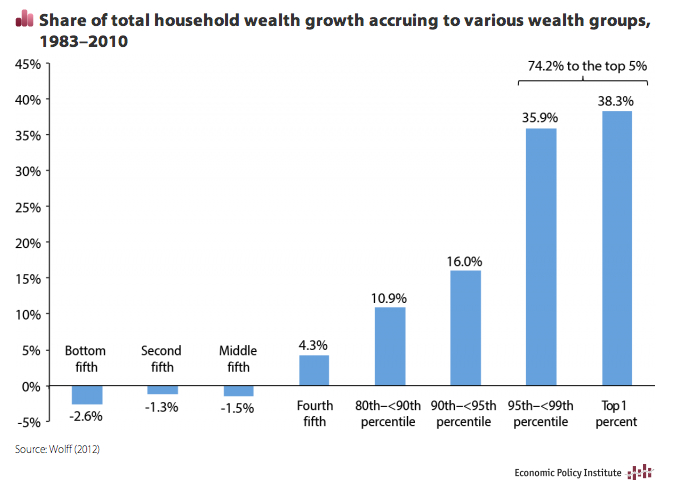
All together now:  Income, that comes in *household* paychecks, regardless of how many earners are contributing to that household income, is not wealth.  Wealth is how much money a household has in the bank and in investments and the assets they own, like real estate, businesses, land, cars, boats, and planes.

Wealth inequality is much greater than income inequality. It looks like this:

1

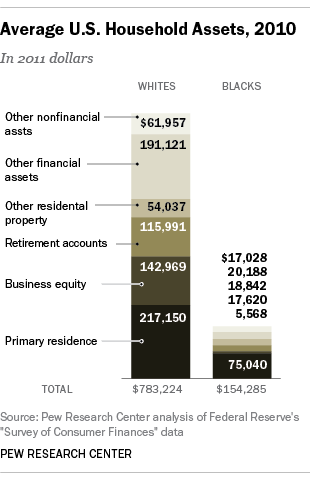
And breaking it down by race:

1

It is no small thing for any household to attain an annual income of a million dollars for even one year.

But it is an entirely different experience to have enough wealth that one can no longer worry about income at all, can work the tax system to mask enormous amounts of income,  can essentially withdraw from everyday contact with everyday Americans, can use one’s wealth to leverage political and economic power, and can know that the children in one’s household will never, ever want for a thing.

The “1%” was never about income alone.

Jane Van Galen, PhD, is a professor of education at the University of Washington, Bothell.  Her research focus is on socioeconomic class, education, and digital media. She writes for Education and Class, where this post originally appeared.

Emotional Contagion is the idea that emotions spread throughout networks. If you are around happy people, you are more likely to be happy. If you are around gloomy people, you are likely to be glum.

The data scientists at Facebook set out to learn if text-based, nonverbal/non-face-to-face interactions had similar effects.  They asked: Do emotions remain contagious within digitally mediated settings? They worked to answer this question experimentally by manipulating the emotional tenor of users’ News Feeds, and recording the results.

Public reaction was such that many expressed dismay that Facebook would 1) collect their data without asking and 2) manipulate their emotions.

I’m going to leave aside the ethics of Facebook’s data collection. It hits on an important but blurry issue of informed consent in light of Terms of Use agreements, and deserves a post all its own. Instead, I focus on the emotional manipulation, arguing that Facebook was already manipulating your emotions, and likely in ways far more effectual than algorithmically altering the emotional tenor of your News Feed.

First, here is an excerpt from their findings:

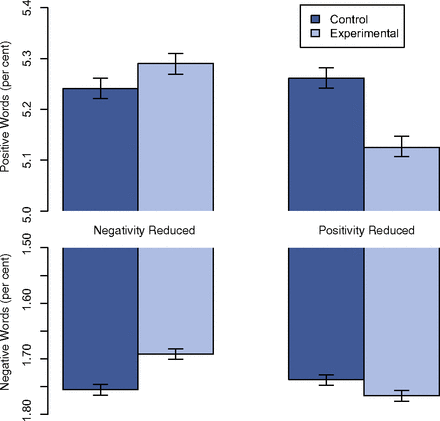
In an experiment with people who use Facebook, we test whether emotional contagion occurs outside of in-person interaction between individuals by reducing the amount of emotional content in the News Feed. When positive expressions were reduced, people produced fewer positive posts and more negative posts; when negative expressions were reduced, the opposite pattern occurred.

In brief, Facebook made either negative or positive emotions more prevalent in users’ News Feeds, and measured how this affected users’ emotionally expressive behaviors, as indicated by users’ own posts. In line with Emotional Contagion Theory, and in contrast to “technology disconnects us and makes us sad through comparison” hypotheses, they found that indeed, those exposed to happier content expressed higher rates of positive emotion, while those exposed to sadder content expressed higher rates of negative emotion.

Looking at the data, there are three points of particular interest:

  • When positive posts were reduced in the News Feed, people used .01% fewer positive words in their own posts, while increasing the number of negative words they used by .04%.
  • When negative posts were reduced in the News Feed, people used .07% fewer negative words in their own posts, while increasing the number of positive words by.06%.
  •  Prior to manipulation, 22.4% of posts contained negative words, as compared to 46.8% which contained positive words.

1 (1)

Let’s first look at points 1 and 2 — the effects of positive and negative content in users’ News Feeds. These effects, though significant and in the predicted direction, are really really tiny. None of the effects even approach 1%. In fact, the effects are all below .1%. That’s so little! The authors acknowledge the small effects, but defend them by translating these effects into raw numbers, reflecting “hundreds of thousands” of emotion-laden status updates per day. They don’t, however, acknowledge how their (and I quote) “massive” sample size of 689,003 increases the likelihood of finding significant results.

So what’s up with the tiny effects?

The answer, I argue, is that the structural affordances of Facebook are such users are far more likely to post positive content anyway. For instance, there is no dislike button, and emoticons are the primary means of visually expressing emotion. Concretely, when someone posts something sad, there is no canned way to respond, nor an adequate visual representation. Nobody wants to “Like” the death of someone’s grandmother, and a Frownie-Face emoticon seems decidedly out of place.

The emotional tenor of your News Feed is small potatoes compared to the effects of structural affordances. The affordances of Facebook buffer against variations in content. This is clear in point 3 above, in which positive posts far outnumbered negative posts, prior to any manipulation. The very small effects of experimental manipulations indicates that  the overall emotional makeup of posts changed little after the study, even when positive content was artificially decreased.

So Facebook was already manipulating your emotions — our emotions — and our logical lines of action. We come to know ourselves by seeing what we do, and the selves we perform through social media become important mirrors with which we glean personal reflections. The affordances of Facebook therefore affect not just emotive expressions, but reflect back to users that they are the kind of people who express positive emotions.

Positive psychologists would say this is good; it’s a way in which Facebook helps its users achieve personal happiness. Critical theorists would disagree, arguing that Facebook’s emotional guidance is a capitalist tool which stifles rightful anger, indignation, and mobilization towards social justice. In any case, Facebook is not, nor ever was, emotionally neutral.

Jenny Davis is an Assistant Professor of Sociology at James Madison University and a weekly contributor to Cyborgology, where this post originally appeared. You can follow her on Twitter.

You like!  Here are our most appreciated posts this month:

Thanks everybody!  And congrats to Lauren Kascak with Sayantani DasGupta, the co-authors of this month’s big winner!

Editor’s picks:

San Francisco!

I’ll be at the American Sociological Association meetings in August.  If any visiting sociologists or locals would like to get together for a drink some evening or afternoon, I’m game! Send a note to socimages@thesocietypages.org with ASA in the subject line.

Lisa Wade, PhD is an Associate Professor at Tulane University. She is the author of American Hookup, a book about college sexual culture; a textbook about gender; and a forthcoming introductory text: Terrible Magnificent Sociology. You can follow her on Twitter and Instagram.

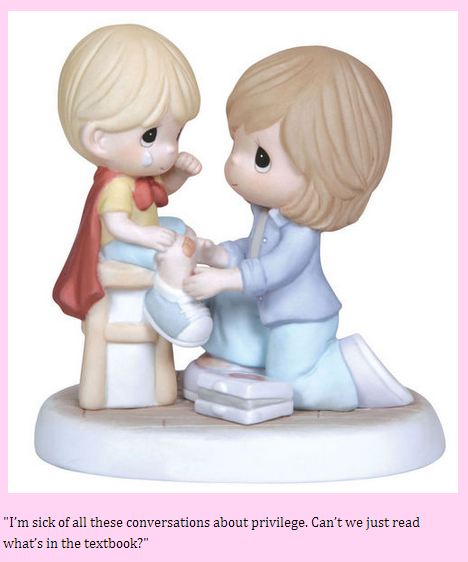
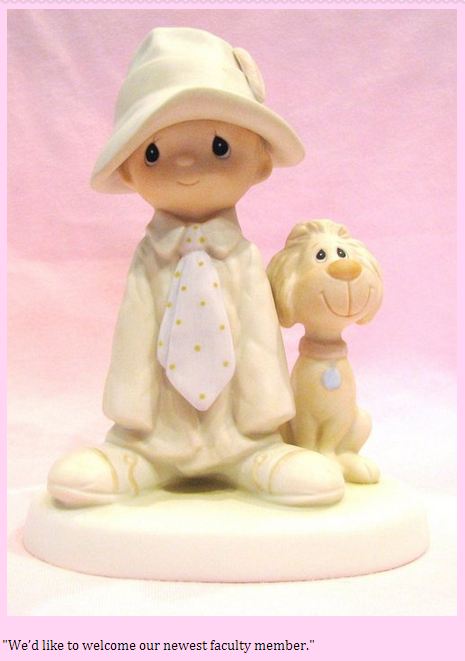
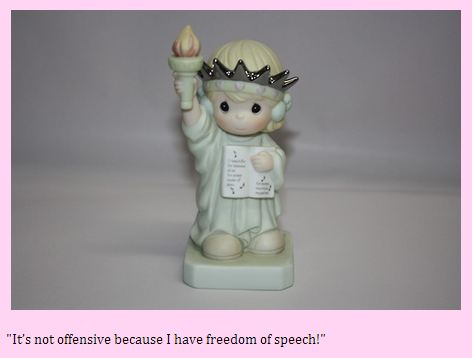
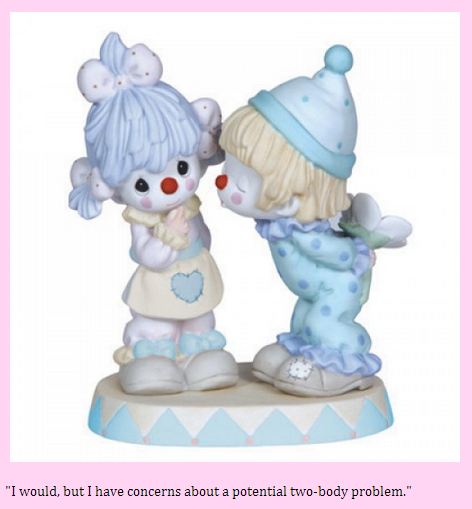
Thanks to someone for this mash up of academia and Precious Moments figurines! About him or herself, he or she writes:

I’m the sort of person who (a) constantly saw, and was occasionally given, Precious Moments figures as a kid, despite finding them creepy; and (b) now makes a living in, and constantly thinks about, academia, despite finding it creepy.

Scroll through some of my favorites below or see them all!

1 1a 4 5 6 82

Lisa Wade, PhD is an Associate Professor at Tulane University. She is the author of American Hookup, a book about college sexual culture; a textbook about gender; and a forthcoming introductory text: Terrible Magnificent Sociology. You can follow her on Twitter and Instagram.

While there has been significant attention to recruiting women into STEM fields, what about the converse – recruiting men to female-dominated fields?  My recent article in Gender & Society analyzes the recruitment strategies of key health care players, examining themes of masculinity in text, speech, and images.

Some recruitment items, like this early poster from the Virginia Partnership for Nursing, asked viewers “Are you man enough to be a nurse?” Aspects of hegemonic masculinity — characteristics associated with being the culturally defined “ideal man” — are common themes in the poster, including sports, military service, risk-taking, and an emotionally-reserved demeanor:

1 (3)

Since the “Are You Man Enough?” campaign in the early 2000’s, nurse leaders have tried to make recruitment messages less ostensibly gendered. In discussing the American Assembly for Men in Nursing’s (AAMN) new campaign, Don Anderson notes:

Nursing recruitment efforts needed to evolve from asking men if they were masculine enough to be a nurse to something less gender specific

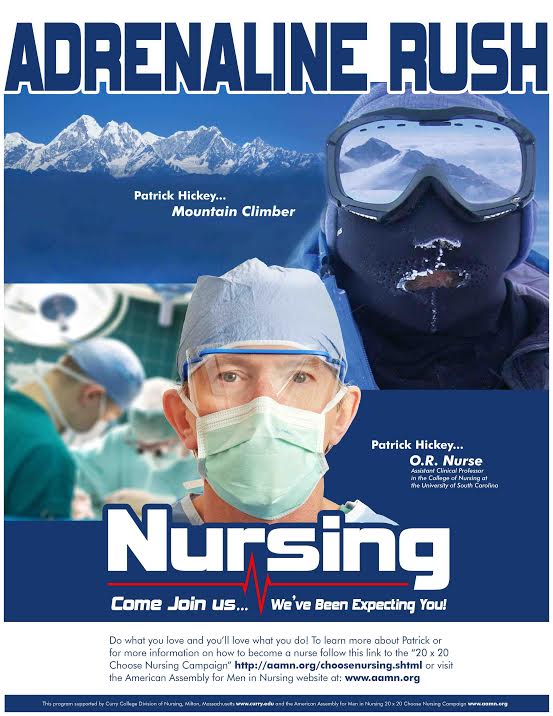
Despite the effort to “de-genderify” nursing (Anderson’s word), masculinity is still front and center. Though the slogan is different, materials continue to emphasize culturally idealized forms of masculinity. One of the AAMN’s newest posters, “Adrenaline Rush,” avoids the “man enough” rhetoric, but maintains the theme of a stoic, emotionally-detached masculinity through visual cues.  Most of the nurse’s face is covered – limiting emotional expression—while risk-taking is emphasized.

1 (2) - Copy

But not all recruitment materials employ a macho form of masculinity. Johnson & Johnson’s 30-second clip “Name Game” portrays a caring and emotionally competent nurse:

Key health care players, including an international organization (Johnson & Johnson), urban hospital systems, nursing programs, and organizations like the American Assembly for Men in Nursing (AAMN) have devoted resources to recruiting men into nursing. Analyzing their recruitment strategies reveals as much about contemporary tensions within masculinity as it does about the profession’s push for gender diversity.

Check out more of the recruitment materials and a more in-depth analysis in the article, “Recruiting Men, Constructing Manhood: How Health Care Organizations Mobilize Masculinities as Nursing Recruitment Strategy.”  For a free copy, contact me at cottingham@unc.edu.

Marci Cottingham is a postdoctoral fellow in the department of Social Medicine at the University of North Carolina – Chapel Hill. She received her Ph.D. in sociology from the University of Akron. Her research spans issues of gender, emotion, health, and healthcare. For more on her work, visit her site.

Cross-posted at Pacific Standard.