Search results for The

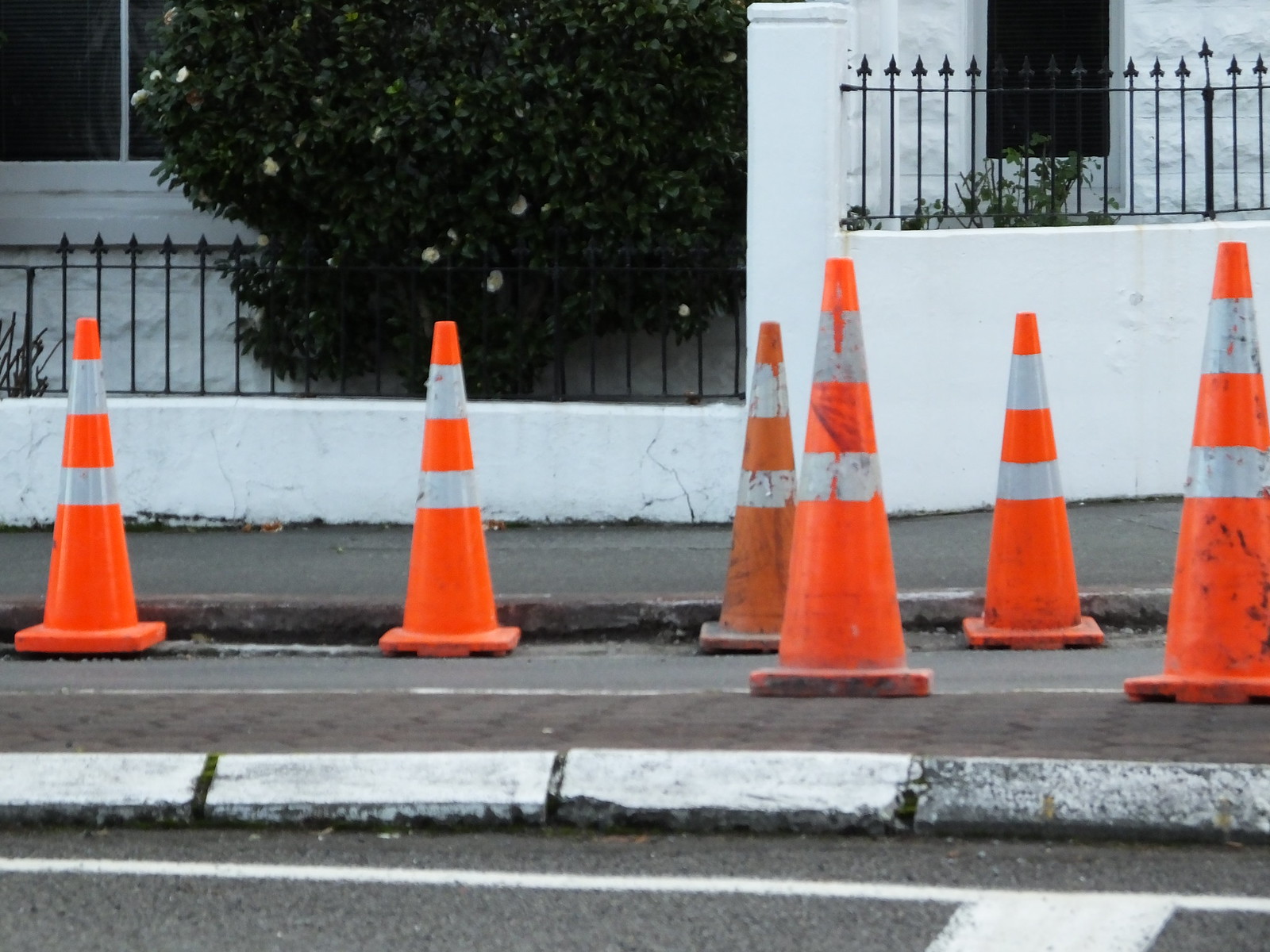
A few years ago, I bought two orange traffic cones at a hardware store for twenty bucks. It was one of the best, most stress-relieving purchases I made.
“Traffic Cones” by Jacqui Brown, Flickr CC

Parking space is scarce in big cities. In our car-centered culture, the rare days you absolutely need a large truck in a precise place can be a total nightmare. These cones have gotten me through multiple moves and a plumbing fiasco, and they work like a charm.

The other day, in the middle of saving space to address said plumbing fiasco, a neighbor walked up to me and politely asked what was going on. They were worried their car was going to get towed. I reassured them that I was the only one having a horrible day, and I started thinking about how much authority two cheap plastic cones had. There was nothing official about them (they even still have the barcode stickers attached!), but people were still worried that they were trespassing.

The point of these cones wasn’t to deceive anyone, just to signal that there is something important going on and that people might want to stay clear for a little while. The same thing happens when a neon vest and an unearned sense of confidence let people go wherever they want.

Saving parking spaces like this is a great case of social theorist Max Weber’s distinction between power and legitimate authority. I can’t make anyone choose not to park where my plumber will need to be. What I can do is use a symbol, like a traffic cone, that indicates this situation is special, there is a problem, and we need space to deal with it. If people accept that and choose not to run over the cones, they have successfully conveyed some authority even if I actually have none. My neighbor accepts some legal authority, because they know people can be ticketed or towed, and they accept some traditional authority, because orange cones and traffic markers have long been a way we mark restricted spaces.

At this point, it is easy to say this is silly or superficial. You would be right! It is totally absurd that anyone would “listen” to the cheap plastic cones, but I think that is exactly the point. When you can’t force people to do things, social signaling like this becomes really important for fostering cooperative relationships. Symbols matter, because they help us confirm that we are willing to cooperate with each other, and they give us the ability to take each other at our word. If only there was a way to use them for something larger, like a global health emergency. From sociologist Zeynep Tufekci:

Telling everyone to wear masks indoors has a sociological effect. Grocery stores and workplaces cannot enforce mask wearing by vaccination status. We do not have vaccine passports in the U.S., and I do not see how we could…In the early days of the pandemic it made sense for everyone to wear a mask, not just the sick…if only to relieve the stigma of illness…Now, as we head toward the endgame, we need to apply the same logic but in reverse: If the unvaccinated still need to wear masks indoors, everyone else needs to do so as well, until prevalence of the virus is more greatly reduced.

Sociological Song of the Day: JD McPherson – “Signs & Signifiers”

Evan Stewart is an assistant professor of sociology at University of Massachusetts Boston. You can follow his work at his website, or on BlueSky.
“W. E. B. Du Bois and his Atlanta School of Sociology pioneered scientific sociology in the United States.”

– Dr. Aldon Morris

I had the good fortune to see Dr. Morris give a version of this talk a few years ago, and it is one of my favorites. If you haven’t seen it before, take a few minutes today and check it out.

Also, go check out the #DuBoisChallenge on Twitter! Data visualization nerds are re-making Du Bois’ pioneering charts and graphs on race and inequality in the United States.

https://twitter.com/asociologist/status/1363827706538975232?s=20

Evan Stewart is an assistant professor of sociology at University of Massachusetts Boston. You can follow his work at his website, or on BlueSky.
One of the goals of this blog is to help get sociology to the public by offering short, interesting comments on what our discipline looks like out in the world.

A sociologist can unpack this!
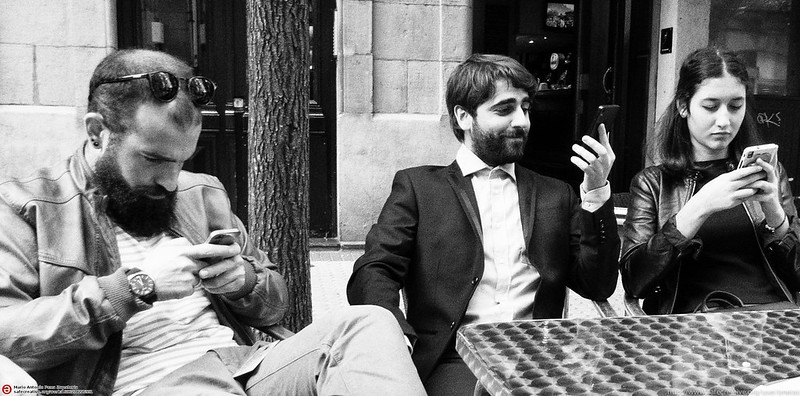
Photo Credit: Mario A. P., Flickr CC

We live sociology every day, because it is the science of relationships among people and groups. But because the name of our discipline is kind of a buzzword itself, I often find excellent examples of books in the nonfiction world that are deeply sociological, even if that isn’t how their authors or publishers would describe them.

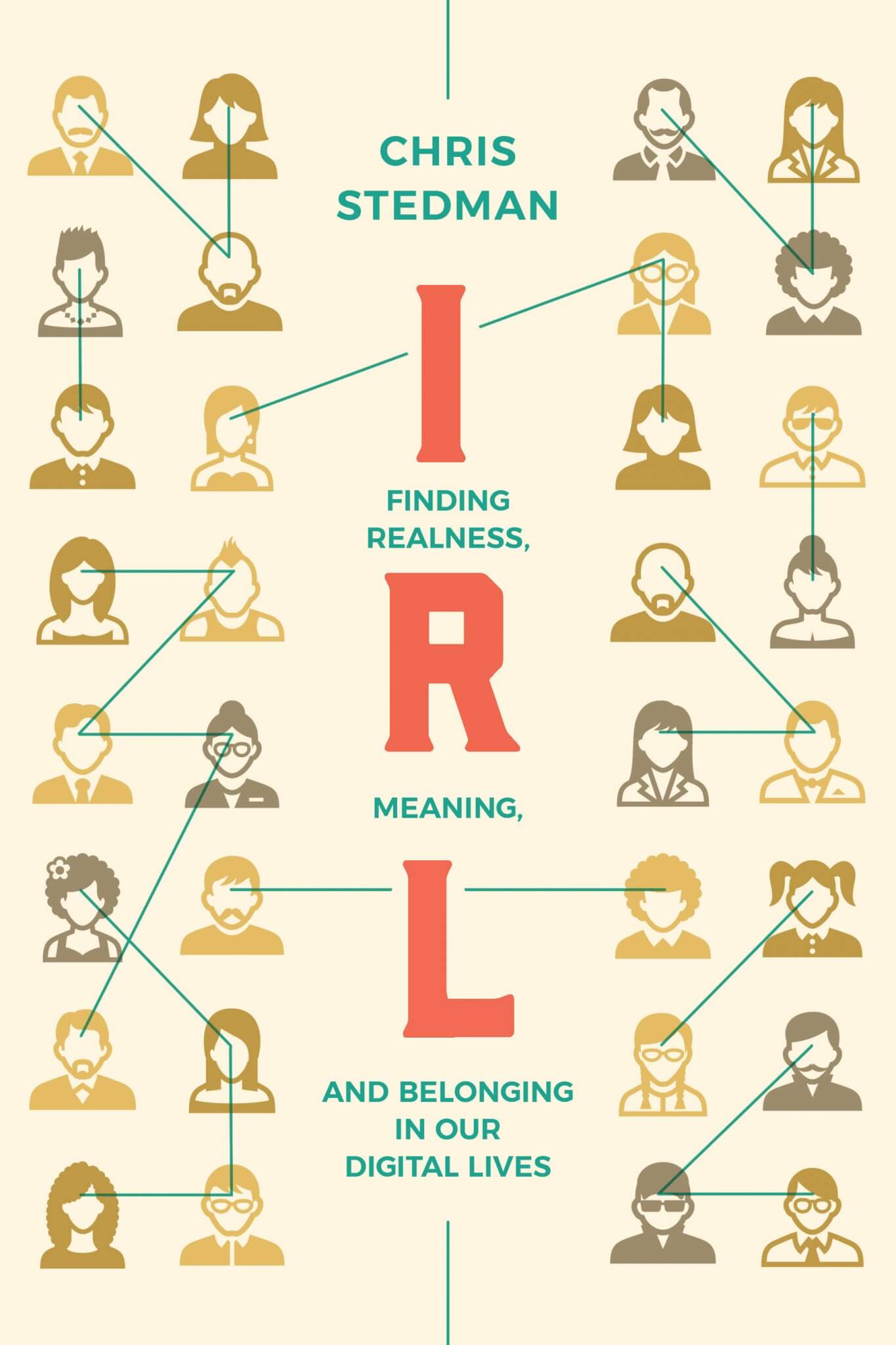
Last year, I had the good fortune to help a friend as he was working on one of these books. Now that the release date is coming up, I want to tell our readers about the project because I think it is an excellent example of what happens when ideas from our discipline make it out into the “real” world beyond academia. In fact, the book is about breaking down that idea of the “real world” itself. It is called IRL: Finding realness, meaning, and belonging in our digital lives, by Chris Stedman.

In IRL, Chris tackles big questions about what it means to be authentic in a world where so much of our social interaction is now taking place online. The book goes to deep places, but it doesn’t burden the reader with an overly-serious tone. Instead, Chris brings a lightness by blending memoir, interviews, and social science, all arranged in vignettes so that reading feels like scrolling through a carefully curated Instagram feed.

What makes this book stand out to me is that Chris really brings the sociology here. In the pages of IRL I spotted Zeynep Tufekci’s Twitter and Tear Gas, Mario Small’s Someone to Talk To, Nathan Jurgenson’s work on digital dualism, Jacqui Frost’s work on navigating uncertainty, Paul McClure on technology and religion, and a nod to some work with yours truly about nonreligious folks. To see Chris citing so many sociologists, among the other essayists and philosophers that inform his work, really gives you a sense of the intellectual grounding here and what it looks like to put our field’s ideas into practice.

Above all, I think the book is worth your time because it is a glowing example of what it means to think relationally about our own lives and the lives of others. That makes Chris’ writing a model for the kind of reflections many of us have in mind when we assign personal essays to our students in Sociology 101—not because it is basic, but because it is willing to deeply consider how we navigate our relationships today and how those relationships shape us, in turn.

Evan Stewart is an assistant professor of sociology at University of Massachusetts Boston. You can follow his work at his website, or on BlueSky.

The #MeToo movement that began in 2017 has reignited a long debate about how to name people who have had traumatic experiences. Do we call individuals who have experienced war, cancer, crime, or sexual violence “victims”? Or should we call them “survivor,” as recent activists like #MeToo founder Tarana Burke have advocated?

Strong arguments can be raised for both sides. In the sexual violence debate, advocates of “survivor” argue the term places women at the center of their own narrative of recovery and growth. Defenders of victim language, meanwhile, argue that victim better describes the harm and seriousness of violence against women and identifies the source of violence in systemic misogyny and cultures of patriarchy.

Unfortunately, while there has been much debate about the use of these terms, there has been little documentation of how service and advocacy organizations that work with individuals who have experienced trauma actually use these terms. Understanding the use of survivor and victim is important because it tells us what these terms to mean in practice and where barriers to change are. 

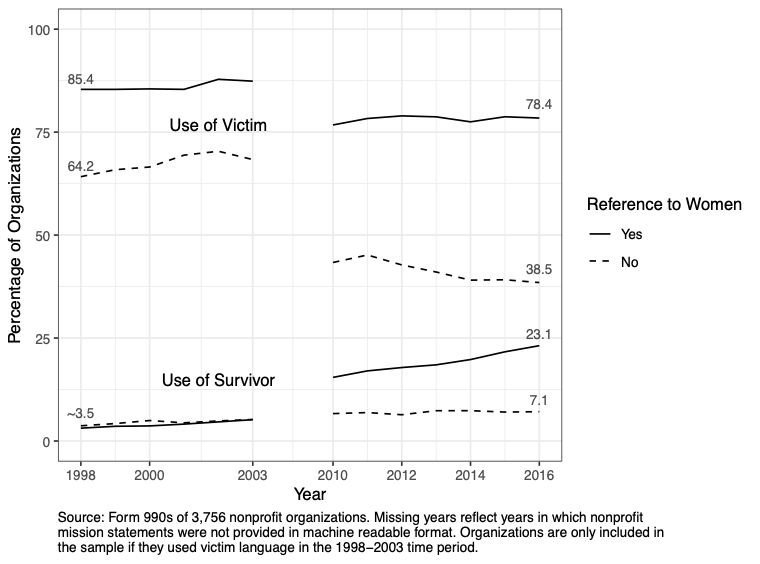
We sought to remedy this problem in a recent paper published in Social Currents.  We used data from nonprofit mission statements to track language change among 3,756 nonprofits that once talked about victims in the 1990s.  We found, in general, that relatively few organizations adopted survivor as a way to talk about trauma even as some organizations have moved away from talking about victims.  However, we also found that, increasingly, organizations that focus on issues related to women tend to use victim and survivor interchangeably. In contrast, organizations that do not work with women appear be moving away from both terms.

These findings contradict the way we usually think about “survivor” and “victim” as opposing terms. Does this mean that survivor and victim are becoming the “extremely reduced form” through which women are able to enter the public sphere? Or does it mean that feminist service providers are avoiding binary thinking? These questions, as well as questions about the strategic, linguistic, and contextual reasons that organizations choose victim- or survivor-based language give advocates and scholars of language plenty to re-examine.  

Andrew Messamore is a PhD student in the Department of Sociology at the University of Texas at Austin. Andrew studies changing modes of local organizing at work and in neighborhoods and how the ways people associate shapes community, public discourse, and economic inequality in the United States.

Pamela Paxton is the Linda K. George and John Wilson Professor of Sociology at The University of Texas at Austin. With Melanie Hughes and Tiffany Barnes, she is the co-author of the 2020 book, Women, Politics, and Power: A Global Perspective.

Many of us know the Officer Friendly story. He epitomizes liberal police virtues. He seeks the public’s respect and willing cooperation to follow the law, and he preserves their favor with lawful enforcement.

Norman Rockwell’s The Runaway, 1958

The Officer Friendly story also inspired contemporary reforms that seek and preserve public favor, including what most people know as Community Policing. Norman Rockwell’s iconic painting is an idealized depiction of this narrative. Officer Friendly sits in full uniform. His blue shirt contrasts sharply with the black boots, gun, and small ticket book that blend together below the lunch counter. He is a paternalistic guardian. The officer’s eyes are fixed on the boy next to him. The lunch counter operator surveying the scene seems to smirk. All of them do, in fact. And all of them are White. The original was painted from the White perspective and highlighted the harmonious relationship between the officer and the boy. But for some it may be easy to imagine a different depiction: a hostile relationship between a boy of color and an officer in the 1950s and a friendly one between a White boy and an officer now.

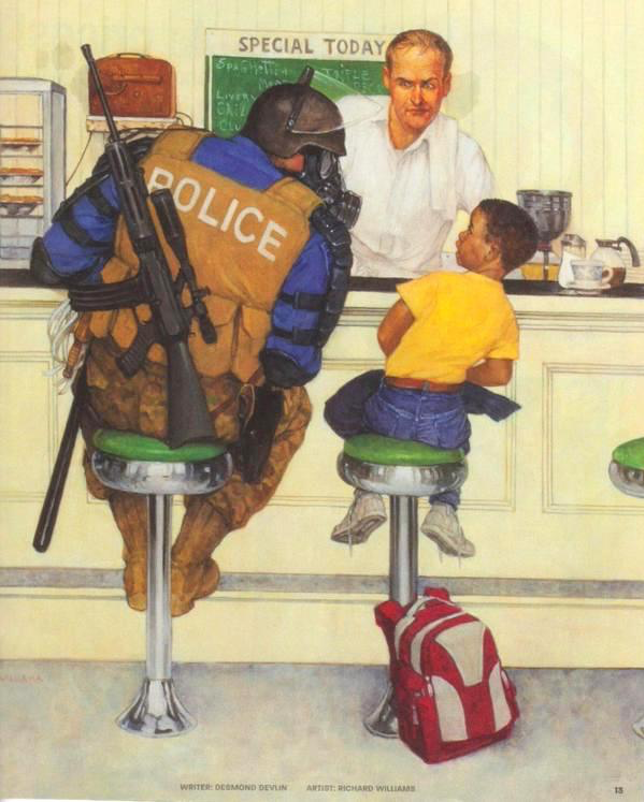
Desmond Devlin (Writer) and Richard Williams’s (Artist) The Militarization of the Police Department, a painting parody of Rockwell’s The Runaway, 2014

The parody of Rockwell’s painting offers us a visceral depiction of contemporary urban policing. Both pictures depict different historical eras and demonstrate how police have changed. Officer Unfriendly is anonymous, of unknown race, and presumably male. He is prepared for battle, armed with several weapons that extend beyond his imposing frame. Officer Unfriendly is outfitted in tactical military gear with “POLICE” stamped across his back. The images also differ in their depictions of the boy’s race and his relationship to the officer. Officer Unfriendly appears more punitive than paternalistic. He looms over the Black boy sitting on the adjacent stool and peers at him through a tear gas mask. The boy and White lunch counter operator back away in fright. All of the tenderness in the original have given way to hostility in this parody.

Inspired by the critical race tradition, my new project “Officer Friendly’s Adventures in Wonderland: A Counter-Story of Race Riots, Police Reform, and Liberalism” employs composite counter-storytelling to narrate the experiences of young men of color in their explosive encounters with police. Counter-stories force dominant groups to see the world through the “Other’s” (non-White person’s) eyes, thereby challenging their preconceptions. I document the evolution of police-community relations in the last eighty years, and I reflect on the interrupted career of our protagonist, Officer Friendly. He worked with the Los Angeles Police Department (LAPD) for several stints primarily between the 1940s and 1990s.

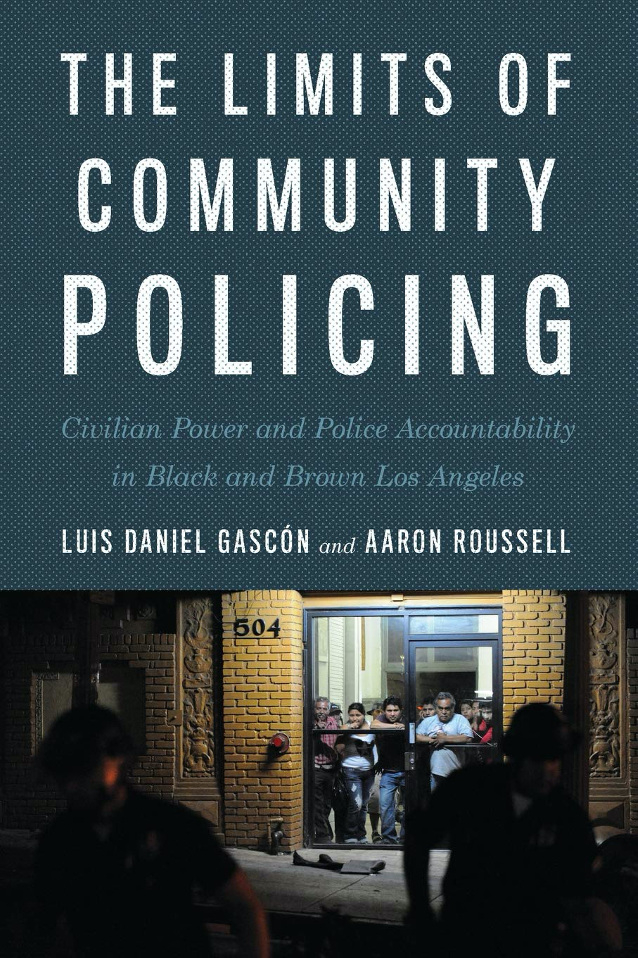
My story focuses on Los Angeles, a city renowned for its police force and riot history. This story is richly informed by ethnographic field data and is further supplemented with archival and secondary historical data. It complicates the nature of so-called race riots, highlights how Officer Friendly was repeatedly evoked in the wake of these incidents, and reveals the pressures on LAPD officials to favor increasingly unfriendly police tactics. More broadly, the story of Officer Friendly’s embattled career raises serious questions about how to achieve racial justice. This work builds on my recently published coauthored book, The Limits of Community Policing, and can shape future critical race scholarship and historical and contemporary studies of police-community relations.

Daniel Gascón is an assistant professor of sociology at the University of Massachusetts Boston. For more on his latest work, follow him on Twitter.

Despite calls to physically distance, we are still seeing reports of racially motivated hate crimes in the media. Across the United States, anti-Asian discrimination is rearing its ugly head as people point fingers to blame the global pandemic on a distinct group rather than come to terms with underfunded healthcare systems and poorly-prepared governments.

Governments play a role in creating this rhetoric. Blaming racialized others for major societal problems is a feature of populist governments. One example is Donald Trump’s use of the phrase “Chinese virus” to describe COVID-19. Stirring up racialized resentment is a political tactic used to divert responsibility from the state by blaming racialized members of the community for a global virus. Anti-hate groups are increasingly concerned that the deliberate dehumanization of Asian populations by the President may also fuel hate as extremist groups take this opportunity to create social division.

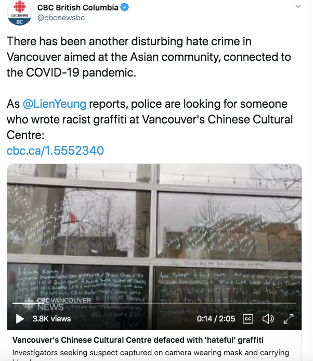
Unfortunately, this is not new and it is not limited to the United States. During the SARS outbreak there were similar instances of institutional racism inherent in Canadian political and social structures as Chinese, Southeast and East Asian Canadians felt isolated at work, in hospitals, and even on public transportation. As of late May in Vancouver British Columbia Canada, there have been 29 cases of anti-Asian hate crimes.

In this crisis, it is easier for governments to use racialized people as scapegoats than to admit decisions to defund and underfund vital social and healthcare resources. By stoking racist sentiments already entrenched in the Global North, the Trump administration shifts the focus from the harm their policies will inevitably cause, such their willingness to cut funding for the CDC and NIH.

Sociological research shows how these tactics become more widespread as politicians use social media to communicate directly with citizens. creating instantaneous polarizing content. Research has also shown an association between hate crimes in the United States and anti-Muslim rhetoric expressed by Trump as early as 2015. Racist sentiments expressed by politicians have a major impact on the attitudes of the general population, because they excuse and even promote blame toward racialized people, while absolving blame from governments that have failed to act on social issues.     

Kayla Preston is an incoming PhD student in the department of sociology at the University of Toronto. Her research centers on right-wing extremism and deradicalization.


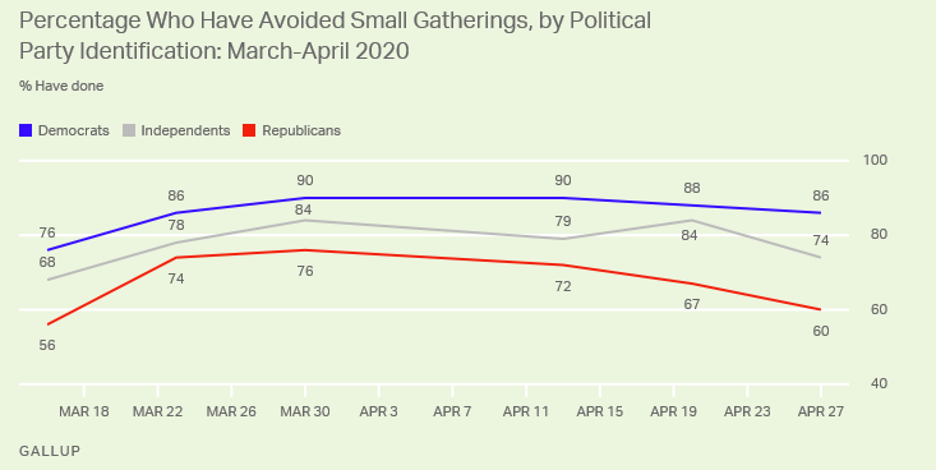
Since mid-March 2020, Gallup has been polling Americans about their degree of self-isolation during the pandemic. The percent who said they had “avoided small gatherings” rose from 50% in early-March to 81% in early April, dropping slightly to 75% in late April as pressures began rising to start loosening stay-at-home orders.

What makes this curve sociologically interesting is our leaders generally made the restrictions largely voluntary, hoping for social norms to do the job of control. Only a few state and local governments have issued citations for holding social gatherings. Mostly, social norms have been doing the job. But increasingly the partisan divide on self-isolation is widening and undermining pandemic precautions. The chart, which appeared in a Gallup report on May 11, 2020, vividly shows the partisan divide on beliefs in distancing as protection from the pandemic. The striking finding is the huge partisan gap with independents leaning slightly toward Democrats.  

Not only did the partisan divide remain wide, but the number of adults practicing “social distancing” dropped from 75% in early April to 58%. This drop in so called self-reported “social distancing” occurred in states both with and without stay-at-home orders. Elsewhere I argue that “social distancing” is a most unfortunate label for physical distancing.

Republicans have been advocating for opening up businesses early, but it is not a mere intellectual debate. Some held large protests while brandishing firearms; others appeared in public without masks and without observing 6-feet distances. Some business that re-opened in early May reported customers acting disrespectful to others, ignoring the store’s distancing rules. In another incident, an armed militia stood outside a barbershop to keep authorities from closing down the newly reopened shop.

Retail operations in particular are concerned about compliance
to social norms because without adequate compliance, other customers will not
return. Social norms rely on social trust. If retail operations cannot depend
upon customers to be respectful, they will not only lose additional customers
but employees as well.

The Sad Impact of Pandemic Partisanship    

American society was highly partisan before the pandemic, so it is not surprising that partisan signs remain. For a few weeks in March and April, partisanship took a back seat and signs of cooperation suggested societal solidarity.

We are only months away from the Presidential election, so we do not expect either side to let us forget the contest. However, we can only hope that partisans will not forget that politics cannot resolve the pandemic alone. Without relying heavily on scientists and health system experts, our society can only fail.

Unfortunately, lives hang in the balance if there is a partisan failure to reach consensus on distancing and related precautions. Economists at Stanford and Harvard, using distancing data from smartphones as well as local data on COVID cases and deaths, completed a sophisticated model of the first few months of the pandemic. Their report, “Polarization and Public Health: Partisan Differences in Social Distancing during the Coronavirus Pandemic,” found that (1) Republicans engage in less social distancing, and (2) if this partisanship difference continues, the US will end up with more COVIC-19 transmission at a higher economic cost. Assuming the researchers’ analytical model is accurate, the Republican ridicule of social distancing is such an ironic tragedy. Not only will lives be lost but what is done under the banner of promoting economic benefit, is actually producing greater economic hardship.

Ron Anderson, Professor Emeritus, University of Minnesota, taught sociology from 1968 to 2005. His early work centered around the social diffusion of technology. Since 2005, his work has focused on compassion and the social dimensions of suffering.

Because everything is currently terrible, I binge-watched Love is Blind. In case you are planning to do the same, this is a spoiler-free post.

You probably know the premise: contestants in this romantic reality romp go on speed dates in little pods. They can’t see their conversation partners, and at the end of the dates they decide whether to get engaged before seeing each other. The question is whether love can flourish when we cast aside our assumptions about appearances, including race, wealth, and sexuality.1 It is a mess. I couldn’t look away.

What struck me most about the show isn’t actually what unfolded, but instead how it is based on an interesting assumption about the way biases work: if you can’t see anything to make a snap judgment, you have to be genuine and objective, right? This reminded me of how people use the term “colorblind” to signal that they don’t feel racial bias. Scholars are critical of this colorblindness because it suggests that ignoring social differences is the same as reducing biases against those differences.

Does limited information actually make us less likely to make snap judgements? Social science findings are a pretty mixed bag. 

On the one hand, taking information away in some cases has been shown to give people a fair shot. One big example is the “ban the box” movement. This policy reform effort works to remove the initial reporting of felony convictions on applications, based on the fact that people with criminal records often face high rates of discrimination when they try to get jobs or go to school

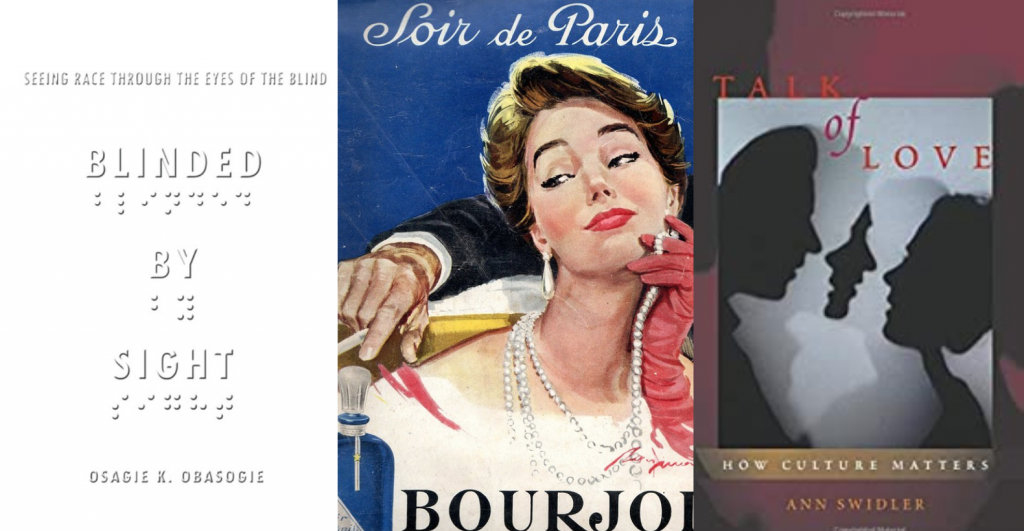
On the other hand, “blindness” doesn’t necessarily reduce bias. Our brains are pattern-making machines ready to fill in any gaps with our own best guesses. One of the most interesting findings on this is that people who are blind still understand race in visual terms. Experimental studies show that people can “smell” social class, matching perfume scents alone to our assumptions about taste and wealth. Jumping to conclusions is exactly what the mind does when you give it an incomplete picture, and you can see this lead to some particularly cringe-worthy moments early in the show.

Love may be blind, but all our senses give us social signals.

Implicit biases are implicit for a reason: they happen whether or not you are trying to stop them. The important part is to recognize them and consciously work to set them aside, rather than thinking they can be cast out by cutting off your information or attention. Again, avoiding spoilers, I think the most successful couples on the show were self-aware enough to know how much work they would have to put in after leaving the pods. For the couples who thought the experiment made this “meant to be”—that their relationship was somehow special, pre-ordained, or protected by the process—well, we got our fair share of drama.


1 They kept calling the show an “experiment.” The scientist talked about “testing hypotheses.” This irked me, because you know IRB would absolutely freak out if one of us tried to propose this as a study.

Evan Stewart is an assistant professor of sociology at University of Massachusetts Boston. You can follow his work at his website, or on BlueSky.