
From PostSecret this week:
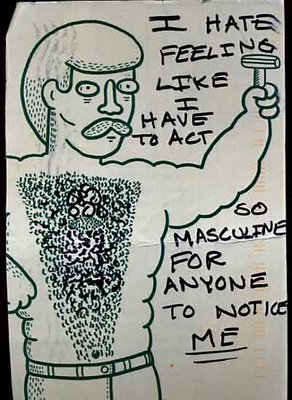
From PostSecret this week:
These two pictures were in the same slide show released by AP and picked up all over the mass media. After instant outrage from various quarters, they were taken down… but some of us got copies before they were able to erase history. Here are the pictures with their original captions, note that the white couple “find[s]” and the black individual “loot[s].”

Caption: Two residents wade through chest-deep water after finding bread and soda from a local grocery.
Caption: A young man walks through chest deep flood water after looting a grocery store in New Orleans.
Click here for a fascinating 7 minute video in which a man interviews pro-life activists and asks: “If abortion was illegal, should women who have abortions go to jail?”
The Great Happiness Space is an amazing full-length documentary (available in full online) about “host” clubs in Japan. These clubs service women, mostly sex workers, who buy time with men (hosts, who also get a cut of all the money the women spend on alcohol) who pretend like they love them. The women establish long-term relationships with their hosts, spend sometimes 10s of thousands of dollars in a night, all to have the feeling that someone cares for them. So they earn tons of money giving sex to men and then they turn around and give that money back to men who give them affection (and sometimes sex). The hosts make between 10,000 and 50,000 a month. Also a great study in cross-cultural gender differences.
To see where Sociological Images and its authors are appearing around the internet and in print, visit our list of Interviews (podcasts, radio, and print), Reviews, Essays and Posts published elsewhere, and instances in which we’ve been Quoted (in news articles, industry pages, etc.).
APPEARANCES IN ONLINE AND PRINT MEDIA
This past summer was hot, hotter than it used to be, and this is causing a lot of new challenges for work, infrastructure, our social lives, and our health. Air conditioning was back in style and even a new public policy, with more cities working to require that landlords provide it as a basic part of a habitable apartment.
Of course the stakes are much higher than just a new AC unit. Sociologists have long known that unequal heat exposure is a serious challenge to our collective health and social wellbeing. Eric Klinenberg’s famous study of the 1995 Chicago heatwave, for example, found that social isolation was a key factor in explaining why people were vulnerable to heat sickness and even death, because they didn’t have places to go or people to check in on them to stay cool. Recent work has linked excessive heat to deaths among people who are incarcerated and learning loss in schools. Heat risks are unevenly distributed in our society, and so addressing the risks of a warmer planet is going to require expanded access to building cooling and air conditioning.
The challenge is that the status of air conditioning is changing. Heat has long been considered a necessity for safe, healthy living – often part of the basic, legal requirements for habitable homes on the rental market across the country. But states are much more inconsistent about whether they require air conditioning, which is often marketed to the general public as a “luxury good.” Look at any vintage ad for AC and you’ll find wealthy, well-dressed homeowners splurging on a new system that lets you wear a suit inside.

Do people today actually support aid to help others access cooling? In a new study recently published in Socius, I investigated this with an original survey experiment. In a sample of 1200 respondents drawn from Prolific, I asked about support for government utility assistance programs for people with lower incomes. The questions had a key difference: some respondents got a question about utility assistance in general, some got a question specifically about home heating, and some got a question specifically about home air conditioning.
Support for the heating question was the strongest on average, in line with the theory that we see heating as a necessity. Air conditioning received the lowest support, however, significantly different from both heat and general utility assistance in the sample. To make sure these results held, I went back to Prolific and sampled more Black and Hispanic respondents to repeat the experiment. The strongest results in these tests came from white respondents.

Why might this be the case? We have long known that attitudes about social welfare programs of all kinds are tied up with race. Research finds these differences because of stereotypical thinking – some people are deeply concerned that others who receive aid need to “deserve” it by working hard and only using aid on necessities, not luxuries. We also know that these beliefs are often linked to racial stereotypes. Previous work on food stamps, disaster relief, guaranteed income, and other social aid programs often finds these social forces at work.
These results show that stereotypical thinking about who “deserves” help may be an important public policy hurdle as we work on adapting to climate change. As policymakers face an increasing need for adequate cooling to address public health issues, they will need to account for the fact that the public may still be thinking of air conditioning as a luxury or comfort good. Making policy to survive climate change requires updating our thinking about the status of goods necessary to weather the crisis.
Evan Stewart is an assistant professor of sociology at University of Massachusetts Boston. You can follow his work at his website, or on BlueSky.

One of the biggest challenges and joys I have in teaching Introduction to Sociology is making ideas like social construction, cultural objects, or bureaucracy visible and intuitive to students. A big part of our value as a general education course is in showing students how to use these ideas in the world. I make a point to focus on bureaucracy, for example, because drawing attention to the unique skills and challenges of navigating a large bureaucratic system like a university is one way sociology can help students across many different majors.
Max Weber plays a big role here, of course, but one of the challenges in teaching his work is the “This is Water” problem — students are so steeped in bureaucracy that it is hard to recognize its unique traits. George Ritzer’s The McDonaldization of Society is a classic example, but the point-of-sale system is now so normal in the service industry that it can be difficult to wrap your head around any other way to organize a business. That’s why I love the charming 2004 documentary Hamburger America, by George Motz.
How do you make a cheeseburger? Ask your students and you will probably get a pretty standardized answer. At least one of these segments will turn that question on its head.
Not only do we get an intuitive sense of how much rich, unexpected variation there is in a cheeseburger, but this documentary also works in so many interesting insights about different regions and local cultures in the U.S. There are hooks here into lived experiences with segregation, de-industrialization, urban planning, and food systems. People are engaging with tradition, history, and economic change. This documentary is a fantastic way to show how culture is embedded in objects — the burgers pair well with Wendy Griswold’s cultural diamond!
All of these anchors give students an intuitive sense of how wildly different social arrangements can emerge without the systematizing force of bureaucracy or large scale, franchised restaurants. It is a great way to spur discussion – just don’t show it right before lunch.
Evan Stewart is an assistant professor of sociology at University of Massachusetts Boston. You can follow his work at his website, or on BlueSky.
Societies grow and change all the time, but it can be tough to think about big-picture shifts when you’re living through the practical details of the day to day. Take the recent popularity of large language models (LLMs). In the short term, we face important sociological questions about how they fit into the norms of everyday life. Is it cheating to use an LLM to help you write, or to generate new ideas? How will new kinds of automation change work, or will they take jobs away?
These are important questions, but it is also useful to take a step back and think about what rapid developments in technology might do to our foundational social relationships and core beliefs. I was fascinated by a recent set of studies published in PNAS that suggest automated work and LLMs could even change the way we think about religion.

In the article “Exposure to Automation Explains Religious Declines,” authors Joshua Conrad Jackson, Kai Chi Yam, Pok Man Tang, Chris G. Sibley, and Adam Waytz review the findings from five studies. In one, their analysis of longitudinal data across 68 countries from 2006 to 2019 finds nations with higher stocks of industrial robots also tend to have lower proportions of people who say religion is an important part of their daily lives in surveys.

I was most surprised by the results of their fifth study—an experiment teaching people about recent advances in science and AI. Respondents who read about the capabilities of LLMs like ChatGPT showed “greater reductions in religious conviction than learning about scientific advances” (8).
The authors suggest one reason for this pattern is that “people may perceive AI as having capacities that they do not ascribe to traditional sciences and technologies and that are uniquely likely to displace the instrumental roles of religion” (2). This is important for us, whether or not you’re personally religious, because religion is a socially powerful force – people use shared beliefs to accomplish things in the world and solve problems, even to cope with hardships like losing a job.
But these results show that new changes in technology, like the advent of LLMs, might be expanding people’s imaginations about what we can do and achieve, possibly even changing the core beliefs that are central to their lives over the long term.
Evan Stewart is an assistant professor of sociology at University of Massachusetts Boston. You can follow his work at his website, or on BlueSky.