Search results for The

Dubi K. sent in these two images (found here) and some commentary. This first image came from an ultra-orthodox Israeli newspaper:

Dubi says,

As you can easily see, it was heavily photoshopped – kids are
duplicated all over the place. Originally, the people who posted this
image on an Israeli forum thought that the publishers of the paper
were trying to make it look more crowded, as it was an event sponsored
by the paper.

But here is the original, non-photoshopped image:

Again, here’s Dubi:

A careful comparison will show that all duplicated children are there to hide girls…It’s commonplace in ultra-orthodox papers that pictures of women are not shown (including Israeli foreign minister Livni and US Secretary of State Rice), to prevent impure thoughts in the minds of the readers. Here they simply took this idea to its logical extreme. It’s the obverse case of the sexualizing of women that you normally discuss in your blog: rather than take women and present them as merely sexual beings, these “traditional” papers assume that women are merely sexual beings in the eyes of men, and so they completely eliminate them from view.

Awesome images and analysis, Dubi! And if you just happen to read Hebrew, you can read Dubi’s original post about this here.

In this ad for Union Carbide is an excellent example of the dichotomization of “tradition” and “modernity” and the conflation of “modernity” with the West.  Text:

Science helps build a new India.

Oxen working the fields . . . the eternal river Ganges . . . jeweled elephants on parade.  Today these symbols of ancient India exist side by side with a new sight–modern industry.  India has developed bold new plans to build its economy and bring the promise of a bright future to its more than 400,000,000 poeple.  But India needs the technical knowledge of the western world.  For example, working with Indian engineers and technicians, Union Carbide recently made available its vast scientific resources to help build a major chemicals and plastics plant near Bombay.  Throughout the free world, Union Carbide has been actively engaged in building plants for the manufacture of chemicals, plastics, carbons, gases, and metals.  The people of Union Carbide welcome the opportunity to use their knowledge and sills in partnership with the citizens of so many great countries.

UPDATE:  In the comments, Village Idiot mentioned the imagery which I, ironically, lost sight of in favor of the text.  The great white hand (of God?) pouring what looks like blood out of a scientific beaker onto a scene of dark figures!  Wow!

Found at Vintage Ads thanks to Ben O.

Here is an ad put out by the McCain campaign that associates Obama with Britney Spears and Paris Hilton:

What struck me about it is that associating Obama with some young women is a way to imply he’s not a serious candidate (see this post from yesterday on a similar theme). I mean, they could have used, say, Tom Cruise of one of the examples of overwhelming celebrity, but part of the image of the Obama campaign is that many of his followers are sexy but vapid young women. (Also, as far as I’m aware neither Britney Spears nor Paris Hilton have actually been connected to Obama, unlike Scarlett Johansson, who sent him emails; the media frenzy over the idea that he was her “email buddy” eventually forced him to distance himself from any association with her. Why this was such a big deal, I do not know, since there was no indication that the emails were inappropriate in any way.)

Also: Paris Hilton has now become part of our political discourse? Really?

NEW: Marc S. sent in a link to the humorous response from Paris Hilton. It might be a humorous intro to a discussion of the way that we assume that certain types of femininity (particularly the type associated with tanning and liking the color pink) are incompatible with being intelligent or politically aware.

Thanks, Marc!

Gwen Sharp is an associate professor of sociology at Nevada State College. You can follow her on Twitter at @gwensharpnv.

Today I saw an interesting talk about public reaction to the Humane Society (HSUS) video of cruel treatment of cattle at the Westland/Hallmark slaughterhouse in Chino, California. As you may recall, someone from the Humane Society took a job at the plant and secretly videotaped the practices there for about four months. In late January, 2008, HSUS released the video. Here is a video from the HSUS website that shows images from the original video footage (and yes, it’s a disturbing video, even by my Oklahoma-ranch-raised standards):

The talk I saw today, titled “Westland/Hallmark: When You Don’t Care Enough to Send the Very Best,” by David Holt and Michelle R. Worosz (presented at the 71st Annual Meeting of the Rural Sociological Society in Manchester, NH) provided an interesting analysis of how issues get framed in the public. The HSUS undertook this investigation, and released the video, primarily because of concerns about animal cruelty and the mistreatment of cattle, particularly those that could not stand or move on their own.

But as sociologists studying framing and social movements have often noted, once an issue gets out there, organizations can’t control what the public, lawmakers, or the media will make of it, and this case is a good example. Once the news broke, what came to the forefront were food safety issues, particularly the idea that so-called “downer cows” (that is, cows that can’t stand or walk on their own) might have made it into the food supply. Downer cows are a concern because of the (very small) risk that they might be suffering neurological damage from BSE, or Mad Cow disease. After an outcry several years ago downer cows were barred from human consumption, but back in 2007 the USDA quietly relaxed the standards so that downer cows can be slaughtered for human consumption if a Food Safety and Inspection Service (FSIS) veterinarian inspects and passes them.

Anyway, it turns out that this particular meat processor was a major supplier of beef to the nation’s school lunch program. This exacerbated concerns about the (remote) possibility of BSE-infected meat getting into the food supply. And that quickly overwhelmed the animal-cruelty concerns that had motivated the HSUS investigation in the first place. The Congressional hearings and (superficial) changes to processing practices that occurred as a result of the video focused primarily on improving food safety, with little discussion of how animals bound for slaughter are, or should be, treated.

It reminded me of how Upton Sinclair said that, when he wrote The Jungle, that he “aimed for the public’s heart, and by accident I hit it in the stomach,” meaning that he’d meant to bring attention to the horrific conditions immigrant workers faced at work but what the public outcry centered on was the idea of rats in their meat.

I thought this might be a good example of how activists try to frame issues but have incomplete control of the framing process once it enters the public domain and may find that media depictions and public discussions of the issue take a very different path than they would have liked.

The presence of lead paint on toys made in China this year brought the threat of lead poisoning to the forefront of the American mind. Parents, pundits, and politicians called on the U.S. government to DO SOMETHING. But lead poisoning was a problem for low-income families long before the China toy scandal and there was little to no outcry in the popular press.

Lead poisoning in children can increase the risk of cognitive delay, hyperactivity, and antisocial behavior. Many older homes and apartments available for rental in low-income neighborhoods still have lead paint and ingesting paint dust and paint chips is the most common way to get lead poisoning. Blood tests show that children living in poverty show much higher exposure to lead than other children.

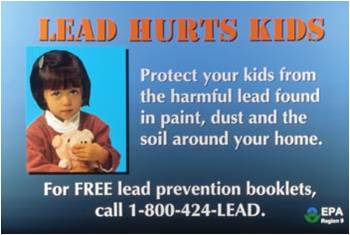
According to William Ryan, if you are a landlord, renting out a residence with lead paint without making tenants aware of it is a crime. But, instead of enforcing compliance among landlords, the most common response to the threat of lead poisoning has been to warn mothers. Here is a representative poster:

Ryan writes that, while lead poisoning is often described as a problem involving negligent or ignorant mothers, it:

…is more accurately analyzed as the result of a systematic program of lawbreaking by one interest group in the community [landlords], with the toleration and encouragement of the public authority charged with enforcing that law.

So as long as the threat of lead poisoning was more-or-less restricted to the poor in the U.S., it was considered the problem of individuals (mothers) and the state refrained from doing much more than promoting individual responsibility. But, as soon as the lead poisoning threat affected middle class children through the toys from China, state intervention seemed appropriate.

Ryan again:

To ignore these continued and repeated law violations [by landlords who rent residences with lead paint], to ignore the fact that the supposed law enforcer actually cooperates in lawbreaking [by ignoring landlord infractions], and then to load a burden of guilt on the mother of a dead or dangerously ill child is an egregious distortion of reality. And to do so under the guise of public-spirited and humanitarian service to the community is intolerable.

CITATION: Ryan, William. 1998. Blaming the Victim. In Race, Class, and Gender in the United States. See also his book.

Dwight D. Eisenhower was the first presidential candidate to use television commercials. Below is one of his commercials, made by Disney, from 1952.

Eisenhower was skeptical about using television and his opponent, Stevenson, wouldn’t appear on television because he thought it demeaning to a man ascending to the presidency. Eisenhower won.
This and campaign commercials since can be found at The Living Room Candidate.

In her book Gender Play: Girls and Boys in School, Barrie Thorne looks at how children play an active role in socializing themselves and one another. It’s an interesting insight because we often portray children as these passive, empty vessels who are acted upon by adults, the media, and so on, but who play no role in defining or interpreting the world around them (sometimes in ways that are much more rigid and cruel than what adults do).

An example of this is the way that kids often play with toys in ways that aren’t, um, intended by the manufacturers or parents. I mean, Barbie may represent a certain type of femininity, and kids may receive that message and be affected by it…but they often also make Barbie have an awful lot of casual sex, have superpowers, or become horribly deformed after being mutilated (my cousins and I played a game where we tried different ways of popping Barbie’s head off). My point is simply that kids aren’t just passive recipients of a set of messages about the world and, thus, that we can’t always assume that because a toy is “supposed” to reflect a certain cultural ideal that kids are always unambiguously getting that message.

Elizabeth Z. sent in a good example of this when she describes how her daughter plays with some Playmobil figures. Here is a picture of the Silver Knight:

A description from a website selling the figure:

The Playmobil Silver Knight is a perfect addition to your world of Playmobil Toys. He is as strong and valiant as knights come! Riding a black horse and carrying his flag of honor, the Playmobil Silver Knight is ready to take on any battles and enemies that get in his way – and of course he’ll be successful! The Playmobil Silver Knight set includes a knight dressed in silver/purple armor, a black horse in black/purple riding gear, shield, and battle flag.

While this company has very clearly gendered this figurine, on the Playmobil website, the gender is not given–it’s just “Silver Knight.”

Now, my guess is that a lot of parents buying this toy are going to interpret it as a male knight for the simple reason that, you know, knights are guys. The princesses they save are girls. I have no idea what Playmobil intended–if this is supposed to be a gender-ambiguous figure that could be male or female or not (Elizabeth points out the hair is long, and thus “feminine,” by our standards but would have been pretty clearly an acceptable hairstyle for men in medieval times).

But regardless of what Playmobil “means” this toy to be (that is, whether or not they manufactured it to be gender-neutral), kids such as Elizabeth’s daughter are going to do their own interpreting:

I noticed that my daughter’s micro castle world…had two knights, and she called them the boy and the girl. They didn’t to my eye appear to be a boy and a girl — the “girl” had hair in a cut that’s called a “pageboy” for a reason, you know — but I could see why she thought of that way…my [daughter] has an answer she’s happy with to the question about where the princess is; not captive, not sitting at home in a dress, but riding on a horse with a big sword. That works for her.

When we’re talking about kids, toys, and socialization, we should keep in mind that kids can be awfully creative and smart and might not be seeing things the way us adults do.

Thanks, Elizabeth!

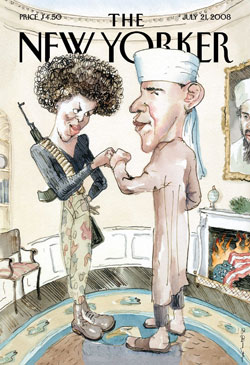
Breck sent in a link to this post about the controversial New Yorker front cover depicting Barack and Michelle Obama as Muslim extremists (I found the full-size image here):

As you may guess, there have been some quite negative reactions to this cartoon. The Obama campaign did not particularly like having him portrayed as an American flag-burning Muslim, oddly enough. And apparently this has gotten wide enough press coverage that even my mom had heard about it and was distressed, and my mom doesn’t follow politics too closely.

I’m kind of fascinated by this entire situation. When I went to Oklahoma last month to visit my family, my uncle informed me that Obama is a Muslim with some secret evil motive for wanting to be president that the rest of us can’t even imagine because we aren’t diabolical enough to think of it. When I pointed out that Obama is not a Muslim, my uncle said he used to be, which is the same thing, and that if Obama really loved America he would change his middle name from Hussein. I gave up on the conversation at that point and returned to pulling ticks off the dog, since that was a lot more pleasant.

What I’m saying is, I have first-hand knowledge of the people out there who honestly believe Obama is some type of Muslim extremist with an evil plot for when he gets into office. Fox News reported on the “fist bump” as a possible terrorist gesture. This distrust of Obama is out there. So this cartoon could spark a really interesting discussion of political humor/satire and the boundaries between “appropriate” and “inappropriate.” I assume–and I’m just assuming here–that this cover was supposed to be a commentary on the fact that some people (and Fox News) are convinced Obama has a connection to Muslims and/or terrorists and, as a result, has evil plans for the future of America. But the cover could also simply reinforce those ideas–I really hope my uncle doesn’t suddenly take up reading and pass by a magazine rack in the near future, because this cover will prove to him that he’s been right all along. So what’s the line between social commentary that points out and/or ridicules issues such as these and just reinforcing the misconceptions or stereotypes that you claim to be undermining?

It could also be used for a discussion of how we read things into images based on our own assumptions. I mean, I have no evidence this cover is supposed to be a commentary (however misguided, dumb, or inappropriate it might be) on misconceptions about Obama; I’m just presuming based on what I know about The New Yorker, its liberal slant, and my recent experience with my uncle. If you showed me the exact same image and told me it came from Fox News, I am certain my reaction would be different because of my assumptions about what Fox News would be trying to say with the image. I can check that tendency to make assumptions about the intention of the creators of an image, and I try to, but I think it’s always good to point out to students that we don’t just passively see an image; our own experiences, assumptions, and so on influence how we interpret them. This is part of the reason that, once an image is put out there, the intention of the creator doesn’t necessarily have much to do with how people interpret or use it.

Thanks, Breck!

On an unrelated note: If you’ve noticed my absence from posting the last few days, I can only say that the first 2 seasons of “Buffy the Vampire Slayer” turned out to be way more compelling than I was expecting and watching them can be quite the time sucker.