Search results for The

Elizabeth A. at blogofstench sent us her post on this ad for “Disaboom, a site of news, networking and such for people with disabilities and their hangers-on.” 

She notes how the site and the ad challenge the stereotype of disabled people as asexual but, much like Viktoria in Bizarre magazine, does so by conforming to normative standards of attractiveness.  But I really liked her observations regarding the extent of his disability. She writes:

…not only is this guy the picture of modern white bourgeois hegemonic masculinity, but I can’t shake the feeling that he’s also passing as non-disabled. Tattoos aside, he looks like a non-disabled guy sitting down in a chair that just happens to have wheels. While some people indeed use wheelchairs with no back and no handlebars and a low-slung profile, other people with disabilities have much more obvious tools that they use; an electric wheelchair, for example, can have six wheels, headlights and tail lights, a control box with joystick and horn, storage pouches on either side, footrests, leg braces, head rest, reclining seat, adjustable cushions and posture support, a backpack on the back and an obvious computer on board, all of which are much more obvious than a discreet little set of wheels under your butt… I feel that the Disaboom ad downplays the unavoidable obviousness of some mobility aids in its attempt to make the guy in the picture seem more stereotypically “non-disabled.”

Not to mention, I might add, a disability that interferes with urination and defecation or one that caused involuntary body movements.
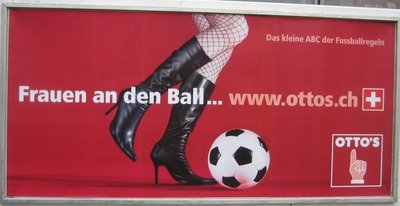
Andrea G. sent this Swiss billboard in after posting about it on her blog:

In her post, she said,

It seems to be related to the the UEFA08 European Soccer Championship which is being hosted here in Switzerland this month. My off-the-cuff translation of “Frauen an den Ball” was “women on the ball”…But when I actually looked closer, I realized that “an” is being used in the accusative, which (in German) implies motion or movement from one place to another rather than fixed location, so the translation is closer to “women coming to the ball”. It turns out if you go to the website advertised, you can download a brochure (pdf) which includes several similar images and a several page summary of the rules of soccer (“das kleine ABC der Fussballregeln” = “the small ABCs of football rules”) apparently targeted towards women to bring them up to speed on the game so they can enjoy the games too. The intro text, which I can’t entirely translate, discusses surprising your man with your knowledge of football so you can talk with him (rather than avoiding the topic as in years past). It certainly seems targeted towards enhancing his pleasure of the games by having an enthusiastic female at his side (rather than a party-pooper who doesn’t care about the games).

Thanks for the post and your encouraging comments, Andrea!

Daniel F. (who has a blog here) sent us this Temptation cookie ad from Mexico, which plays on the idea that men fear independent, strong women:

Daniel’s translation:

Host: Gentlemen, what we feared has happened. You have the new Mexican woman; she is more independent and gives more importance to what she wants.
First man: But, does she cool our beers?
Host: No, never again. And that’s not all. She also wants us to take our children to the pediatrician.
Second man: What’s that?
Host: Pediatrician is the doctor for kids.
Second man: No, the other thing, “children.”
Host: Children are the little people who call us dad.
Third man: And what is that she has in her hand?
Host: This, my friends, is the new Temptation cookie, because the new Mexican woman has her pleasures without guilt and, what’s worse, she doesn’t share.
Woman: Gentlemen, I’m leaving. I have things to do.
Narrator: There’s a new woman and she has new cookies.

The ad also connects sex and food and, in fact, replaces sexual pleasure (and men) with food, a theme Jean Kilbourne mentions in “Killing Us Softly 3”–that women are encouraged to use food to replace sex or console themselves when they have romantic troubles.

It’s also interesting that the ad plays on the idea of old-fashioned Mexican men who expect women to serve them.

Thanks, Daniel!

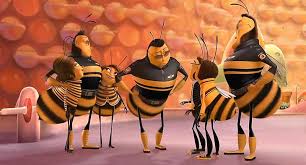
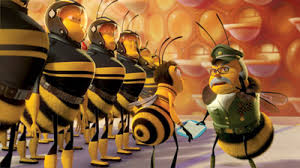
Vesko J. sent in several images from “Bee Movie,” the cartoon with Jerry Seinfeld as the voice of the main bee character, Barry. He says:

Female bee workers exist in the movie, but are hardly visible (unless sexual presence is needed.) They can be seen only for a few seconds in the distant background and don’t have any lines of dialogue (as opposed to random male bee workers, who are clearly visible and have lines of dialogue).

Even the bees, that pollinate the flowers, are male. They are called “pollenjocks” and all the female bees fall for these strong, muscular, brave guys.

These are the pollenjocks. In case you didn’t know, it’s actually female bees who collect pollen.

The pollenjocks are big, muscular male figures who tower over the females, who, as far as I can tell, could be called pollengroupies. They aren’t really individuals with personalities; they exist as background to show how awesome the pollenjocks are. On the other hand, the female characters that are treated as individuals tend to be in the home, such as Barry’s mom. Barry’s love interest is not a female bee but a human female, a florist.


Now, I get it. It’s a kids’ movie, and there’s going to be a lot of anthropomorphizing and such. But how animals are anthropomorphized tells us a lot about our social assumptions and what we’re comfortable with. There’s no reason the worker bees’ sex has to be changed, except that it makes more “sense” to us that the hard-working providers would be male. The choices to make the males the center of the story, to make them bigger than the females, and to portray female bees as fawning groupies desperate for male attention tells us an awful lot about the gender stories we tell ourselves about humans, and that they’re important enough to us that even children’s movies have to recreate those stories, no matter how much fiddling with reality it takes. And even though this is an animated children’s movie about bees that talk, flirt, and wear clothes, I bet an awful lot of people will think the gender hierarchy in the movie is fairly accurate.

Thanks, Vesko!

Gwen Sharp is an associate professor of sociology at Nevada State College. You can follow her on Twitter at @gwensharpnv.

Dawn A. sent us these posters for The Sarah Connor Chronicles.  Notice how, in three out of four posters, the women are not making eye-contact and, in all of them, they are in a passive pose with a passive facial expression.  Dawn adds:

I’m alarmed by the disembodiment of the character.  While she may be a part of the Terminator series, would we ever see Arnold Schwarzenegger (or other male characters) portrayed like this in posters?

Thanks Dawn!

NEW: After a discussion with my friend Jason, I decided to offer some more images and commentary as food for thought.

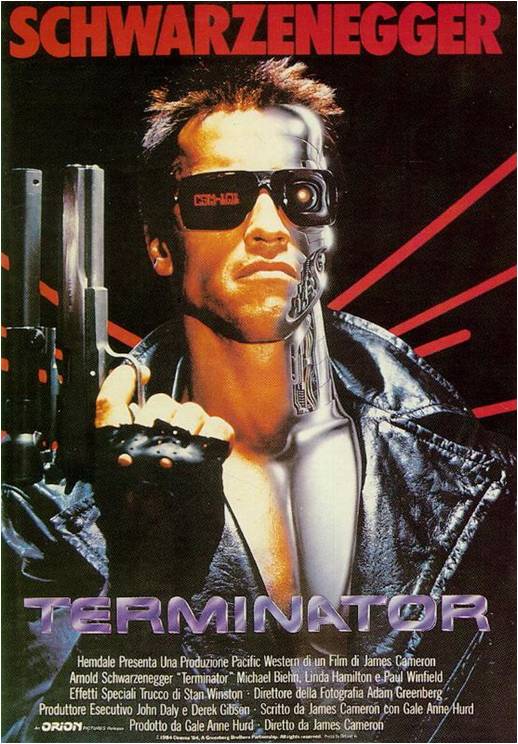
Here are the Terminator posters I could find featuring Schwartzenegger.  There are a lot of things separating and potentially separating these posters from those above other than gender: about 20 years, maybe the moral of the movies/series or the feeling of the show, and surely producers/directors etc.  Even so, I think it’s worth putting up the images for contrast.

Back to The Sarah Connor Chronicles:  Below are some additional promotional images that do not reproduce the passivity we see in the first set.  Word on the street is (or so I have heard some people say), the women are not as feminized in the series as they are in the promotional material (which, if true, is interesting in itself).

Still, Jason notes that the empowerment of the women in the series as protectors, comes at the cost of disempowering John Connor and that disempowerment is achieved, in part, through his feminization.  His task, then, as the series progresses, is to finally become a “man.”  At that point, supposedly, he would no longer need the protection of women. 

So, femininity is still associated with weakness.  And, insofar as femininity is equated with weakness, and women are more-or-less required to do at least some femininity (lest they be called “dykes” or “bitches”), women are more-or-less required to appear at least a little bit weak in their daily lives. 

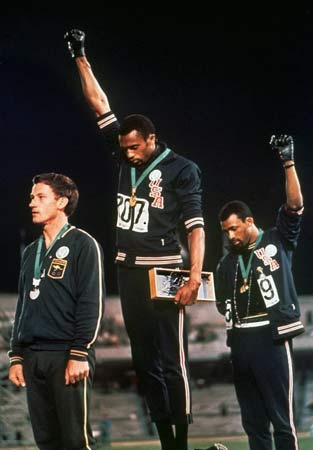
This is the iconic photo of Tommie Smith and John Carlos (found here) from the 1968 Olympics in Mexico City. They raised their arms, wearing black gloves, in a symbol of protest against racism in the U.S. Less often noticed is that they were wearing beads to symbolize victims of lynching and went barefoot to protest the fact that the U.S. still had such extreme poverty that some people went without basics, such as sufficient clothing. Peter Norman, the Australian 2nd-place winner, grabbed a button produced by the Olympic Project for Human Rights (see below) when he found out what the other two were going to do and wore it in solidarity (if you look closely you can see that all three are wearing matching white buttons).


The reaction was immediate and negative. Carlos and Smith were stripped of their medals, ejected from the Olympic Village, and returned to the U.S. to widespread anger. In David Zirin’s book What’s My Name, Fool? Sports and Resistance in the United States (2005, Chicago: Haymarket Books), several black athletes discuss the difficulties they faced as a result of their actions. This 2003 interview with Tommie Smith covers some of the same issues.

Below is a button like the ones they were wearing. Much like we often think Rosa Parks spontaneously decided not to give up her seat on the bus (ignoring the fact that she attended training with other African Americans determined to protest inequality in the South), the assumption is often that Smith’s and Carlos’s gesture was something they decided on at the moment. In fact the Olympic Project for Human Rights, organized by Black U.S. athletes, had tried to organize an athletes’ boycott of the 1968 Olympics. When that was unsuccessful, tactics switched to making statements at the Olympics. This was part of an organized plan on the part of a number of Black athletes who were tired of representing the U.S. but being expected to stay silent about racism in the U.S.

Some of these buttons are for sale ($300 each!) on Tommie Smith’s website.

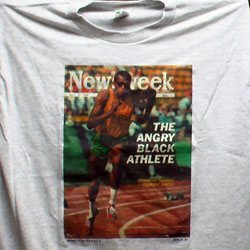
A t-shirt with the cover of the July 15, 1968, issue of Newsweek about “the angry black athlete.”
I looked for a photo of the cover itself but could not find one online. Clearly the nation was anxious about the attitudes of Black athletes even before the Olympics (in October) caused such a stir.

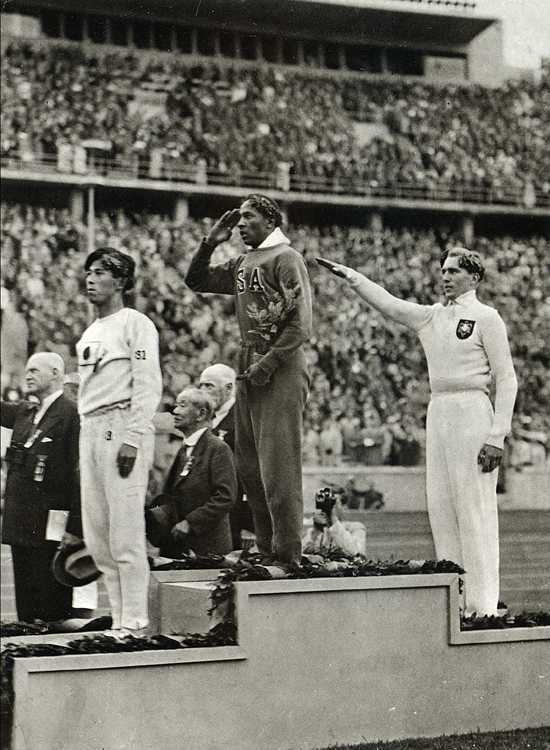
I think these images are useful in a couple of ways. I use them to undermine the idea of the individualistic protester and to bring attention to the ways Civil Rights activists organized and planned their actions. It could also be useful for discussions of politics in sports–the ways in which athletes have at times used their position to bring attention to social inequality, as well as the repercussions they may face for doing so. It might also be interesting to ask why this image caused so much furor, and how the Olympics is constructed as this non-political arena for international cooperation (a topic I cover in my Soc of Sports course). You might compare the image from the 1968 Olympics to this image (found here) from the 1936 Olympics in Germany:

Here we also see the Olympics being used to make a political statement, but in this case the athlete was not thrown out of the Olympic Village or stripped of his medals. What is the difference? Just that time had passed and attitudes toward political statements at the Olympics changed? In the 1936 pose, the athlete was showing pride in and support for his country, whereas Smith and Carlos meant their gesture as a protest of conditions in the U.S.–thus shaming their nation in an international arena (this was a major cause of the anger they faced when they returned to the U.S.–the idea that they were airing the nation’s “dirty laundry,” so to speak, for others to see). Could that be part of the difference in the reaction?

Of course, a cynical person might argue that these seemingly ungrateful, misbehaving black athletes who refused to smile and play along were being publicly punished in the media for getting “uppity” (in a time period where white Americans were also wearying of minorities’ continued demands for equality and social change).

In case you hadn’t seen it already, this is the ad that is causing all the hullabaloo about Rachel Ray and Dunkin’ Donuts being in bed with Muslim terrorists (via lawgeek):

The incident might be useful in illustrating the social construction of social problems, moral panic, and racial politics after 911.