Search results for The

Robin B. sent us a link to a story in the New York Times magazine chronicling one woman’s decision to have a surrogate carry her biological child.  Surrogacy is, from one perspective, extremely expensive and, from another perspective, extremely lucrative.  The photos accompanying the story illustrate, almost as if by design, how “mothering” is being spread out in systematic ways to different kinds of women. Robin note that the accompanying article bought up lots of issues, but did little to think them through.   In contrast, she points to a set of letters written in response.

Lisa Wade, PhD is an Associate Professor at Tulane University. She is the author of American Hookup, a book about college sexual culture; a textbook about gender; and a forthcoming introductory text: Terrible Magnificent Sociology. You can follow her on Twitter and Instagram.

Jo B. sent us a link to Icebreaker, a New Zealand clothing company. One of their products is wool underwear. As she pointed out, there are some distinct differences in how the men’s and women’s underwear lines are depicted.

The men’s line is called beast. When you go to the site, there’s a little intro part. The following phrase shows up on the banner at the top:

As Jo says,

The overall idea seems to be that men have some kind of innate, primordial aggression (thought I’m not sure how this is supposed to relate to woollen underwear).

Indeed, socialization “cages” men’s true nature, but just barely–its hold is “frail and fragile” and, I presume, could burst forth if you aren’t really careful. I don’t quite follow how the city “brings the beast alive,” or how reconnecting with nature “balances” the beast; since the beast is supposedly men’s real nature, I think reconnecting them with nature would bring out the beast, but whatever. I’m clearly applying too stringent a level of logic. Also, for the record, if all it takes to reconnect with nature is a natural material (made from a domesticated source), then cotton, angora, and mohair would work just as well.


The women’s line is called Nature. When you go to its site there’s also an intro, but without any useful summary of what women are like to compare to the Beast.

Again from Jo:

The female models are slim, delicate, and tend to pose in a way that suggests passivity (static poses, arms held behind body…) and instability (balancing on her toes).  The images in the female range focus more on being attractive, while the men’s range is about being active and aggressive.

The marketing campaign also reinforces the difference in the way we talk about men and women and their association with nature. When we connect men to nature, it’s in an aggressive, predatory sense (the beast). When women are associated with nature, it’s often in a way that implies harmony, an appreciation for the natural world, perhaps some intuitive sense that women have (or, you know, their connection to the moon and stuff because of menstrual cycles). The background is part of this; the grey background of the men’s line doesn’t look nearly as peaceful as the serene white background for the female models.

Thanks, Jo!

FYI:  Jo sent an email to the company complaining and this was their response:

Hi Josephine,

Apologies for the delayed reply. I am writing on behalf of Jeremy Moon to thank you for taking the time to give us your views about Icebreaker’s marketing of its underwear lines for men (Beast) and women (Nature). We understand your concerns, and we really appreciate the level of thought you have put into sharing them with us.

Gender representations are a sensitive issue in marketing, and Icebreaker certainly had no intention of promoting negative or damaging images of men or women in our Winter 08 campaign.

In most of our collections, our marketing approaches to men and women are almost identical. We aim to make Icebreaker garments as stylish as possible, but our clothes are based on performance above all – regardless of the gender of the wearer.

In our Bodyfit, Icebreaker_GT and Superfine collections, for example, women are photographed in exactly the same way as men – pushing their physical boundaries in the outdoors. Our marketing for the garments in these core collections centre on photographs of athletic-looking women skiing, hiking and climbing mountains. None of the images are of women in a passive or decorative role: they’re of women who are confident, independent, adventurous and strong.

We chose a different approach for our underwear ranges. For obvious reasons, we couldn’t adopt our usual approach of showing women taking part in outdoor sports – clearly they wouldn’t play sport in their underwear alone. The other factor we took into consideration is that Nature and Beast, although both underwear collections, are very different ranges.

Men tend to buy underwear for its practical benefits. Our aim was to position Beast as a premium range that has the same performance factors (such as breathability, a critical benefit for underwear) as Icebreaker’s outdoor clothing and yet is sufficiently stylish to be worn at work. Our marketing approach refers not to aggression, but to energy – the same energy (or performance benefits) that works equally well in both outdoor and urban environments. You’ll notice our marketing refers to “creative energy” and also the “harmoniousness” of nature.

The Nature range is our most feminine range by far, and much of our marketing focuses on the way it looks – its styles and its nature-inspired designs. Nature is made from the lightest, most luxurious grade of 100% pure merino, as we understand customers’ concerns against wearing traditional wool (rather than merino) against their skin, so our marketing talks about concepts like “100% pure”. While the photography for the rest of our collections is based around the outdoors, Nature images are designed to show off the styling and softness of the garments.

Our campaigns are designed to be edgy, and we’re very sorry if in this instance you feel our approach conveyed the wrong messages. Please be assured this was not our intention. Thank you for writing, and be assured we will bear your concerns in mind when planning future campaigns. I hope this email helps lesson your disappointment with our brand,

Regards
Alice

Gwen Sharp is an associate professor of sociology at Nevada State College. You can follow her on Twitter at @gwensharpnv.

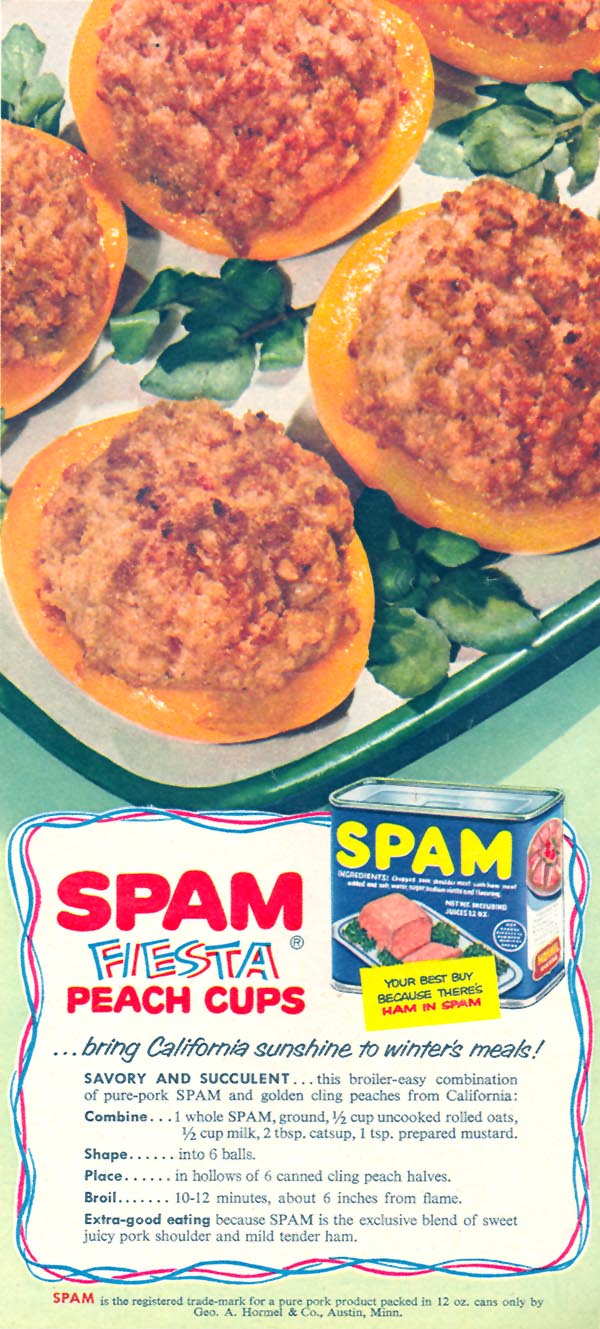
Spam Fiesta Peach Cups, Family Circle, 1956

I can safely say that most readers of this blog probably think that broiled Spam + canned peaches looks and sounds unappetizing.  But this is only one of many creative food combinations that appeared in advertisers’ recipes and cookbooks during the 1950s and 1960s. Here’s another:

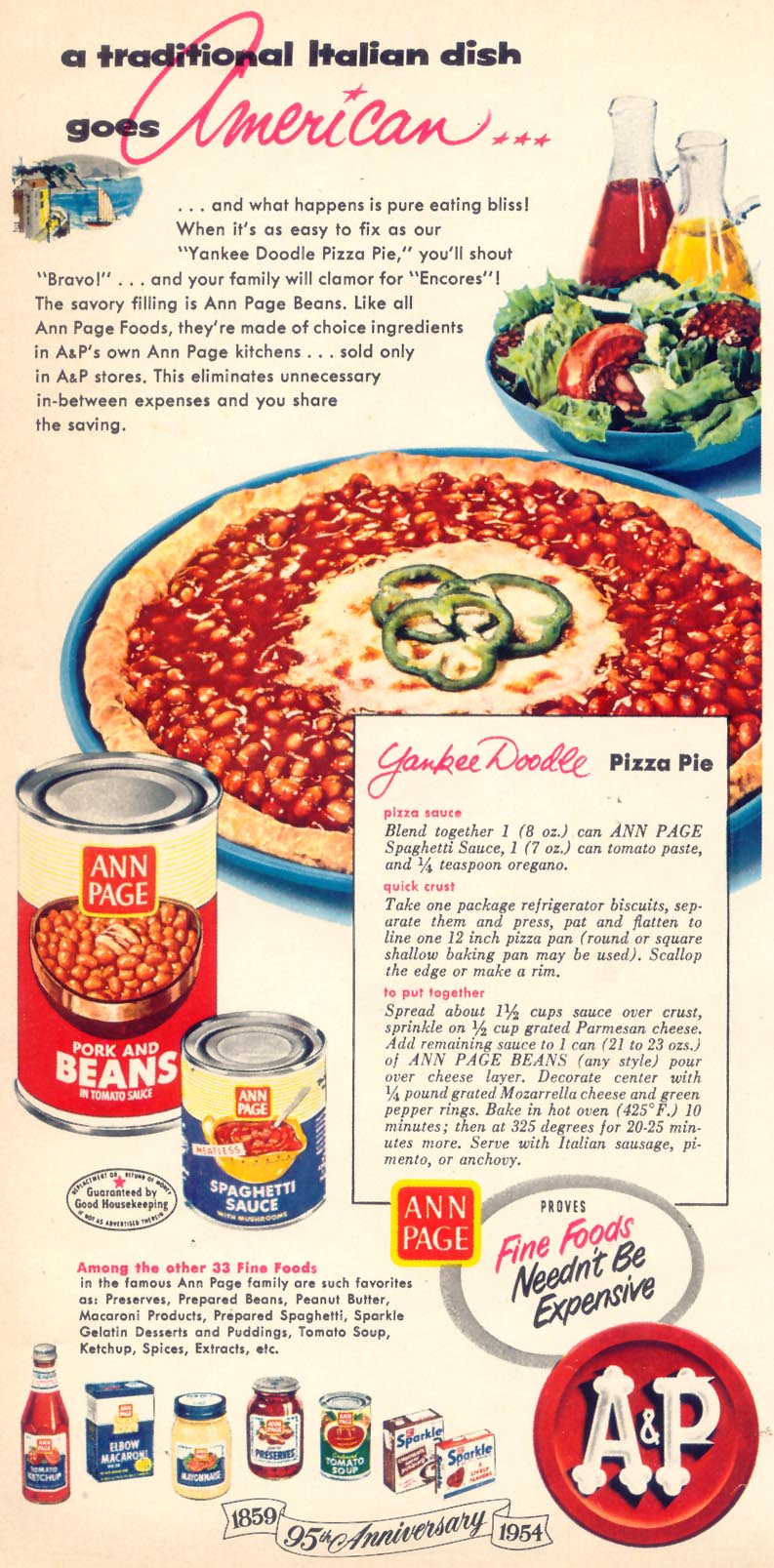
Yankee Doodle Pizza Pie, Women's Day, October, 1954


Why, yes, those are baked beans on pizza.

While there are plenty of interesting angles on these old recipes, from their use of color to their emphasis on saving money, I’d like to bring up the way that modern writers treat recipes from this period. James Lileks, for example, has an entire site, The Gallery of Regrettable Foods, which eventually spawned a book covering much of the same material.

As the index page to The Gallery of Regrettable Foods says,

What were they thinking? How did they eat this bilge? Good questions, but you won’t find them answered here. This is a simple introduction to poorly photographed foodstuffs and horrid recipes. It’s a wonder anyone in the 40s, 50s and 60s gained any weight; it’s a miracle that people didn’t put down their issue of Life magazine with a slight queasy list to their gut, and decide to sup on a nice bowl of shredded wheat and nothing else.

This [admittedly funny] type of snarky commentary has inspired other Web sites, such as Wendy McClure’s mockery of 1970s Weight Watchers recipe cards. The vintage_recipes community on LiveJournal frequently contains less formal versions of the snark.

Such modern commentary erases much of the historical significance and interest of these recipes. The radio program Engines of Our Ingenuity recently commented on the cookbook in episode 2403, with a special focus on recipes such as those shown above. As the transcript of episode 2403 suggests, many of these recipes relied on canned, gelled or prepared foods, highlighting both the Atomic Age’s fascination with technologically advanced cookery. But the mockery is way more popular these days.

These images could be used in a discussion about how “retro” images are regularly reappropriated as “cool” with little regard for their historical context.

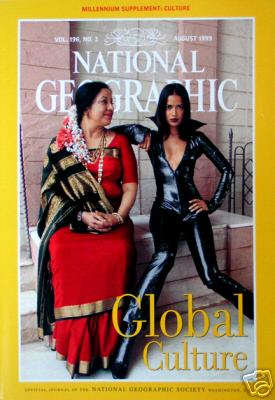
Parameswaran (2002) writes:

The [National] Geographic’s August 1999 cover dramatically deploys women’s bodies as detailed blueprints, maps that busy readers could use to instantly trace the passage of non-Western cultures from tradition to global modernity…

More of her description of this cover after the image (found here):


An older middle-aged Indian woman, with streams of white and orange flowers pinned to her hair at the base of her neck, symbolizes tradition. The deep red silk sari with a gold border, the gold necklaces around her neck, and the thick gold bangles on her wrists clearly mark her as a traditional upper-class woman… The older Indian woman’s body and posture also announce her alignment with tradition. She is heavyset, almost stocky, and her sari demurely covers her large breasts. Her feet are placed moderately close together and her folded hands rest in her lap. Avoiding the direct eye of the camera, her face, with the trademark dot of the Hindu tradition etched between her eyes, is turned sideways as she bestows a tender maternal gaze on the young woman sitting beside her…

In contrast to the gentle passivity and the slack middle-aged body that index tradition, bold assertiveness, feminine youthfulness, and an androgynous firm body register cosmopolitan modernity in the cover of image. These biological and emotional transformations in the modern, non-Western woman’s physical appearance and personal demeanor appear to be wrought by Westernization. The young, slender Indian woman sitting next to the middle-aged woman has short, shoulder length hair framing her face. The marked absence of the dot on her forehead as well as her clothing, instantly herald her identity as a modern woman. She is dressed in a black, shiny PVC catsuit, unzipped down to the middle of her chest to display her small, almost flat breasts, while her feel are encased in sharply pointed black boots. Disdaining the gaze of the older woman directed towards her, she defiantly stares at the camera and claims her personal space with arrogant confidence. Her legs and felt, unlike the older woman’s feet, are splayed wide apart and her knees point in opposite directions. Her left arm is poised akimbo style while her left palm grips her hip in a strong masculine gesture.

In the magazines sharply polarized, binary rendering of the “new and hip” as radically different from the “old and outmoded,” one woman symbolizes ethnic tradition and the other global modernity…

Citation:  Parameswaran, Radhika. 2002. Local Culture in Global Media: Excavating Colonial and Material Discourses in National Geographic. Community Theory 12, 3: 287-315.

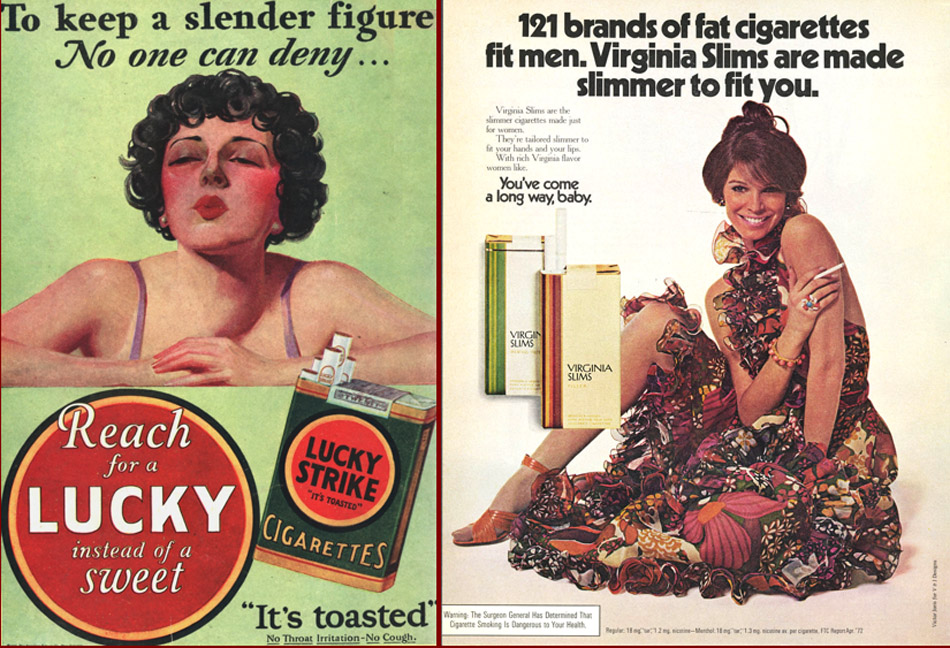
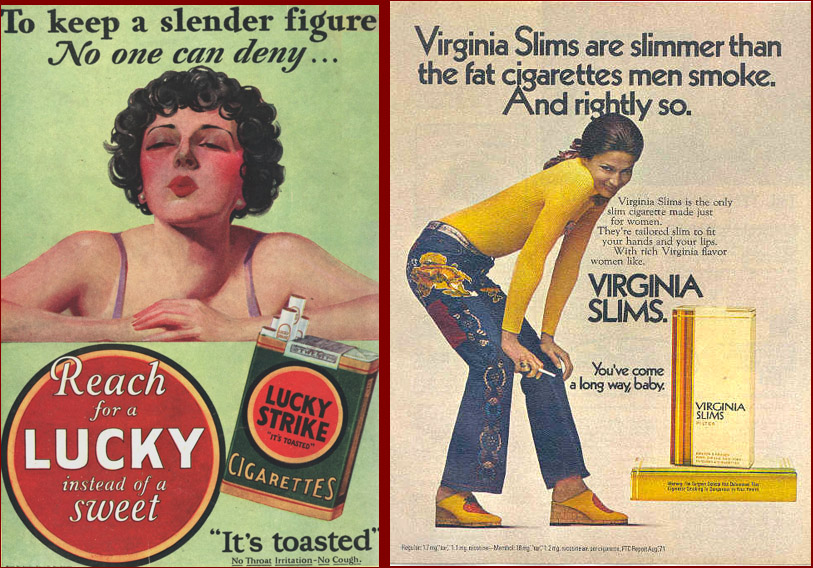
This archive of cigarette commericals, sent in by Kay W., makes some interesting comparisons of vintage and contemporary cigarette ads.

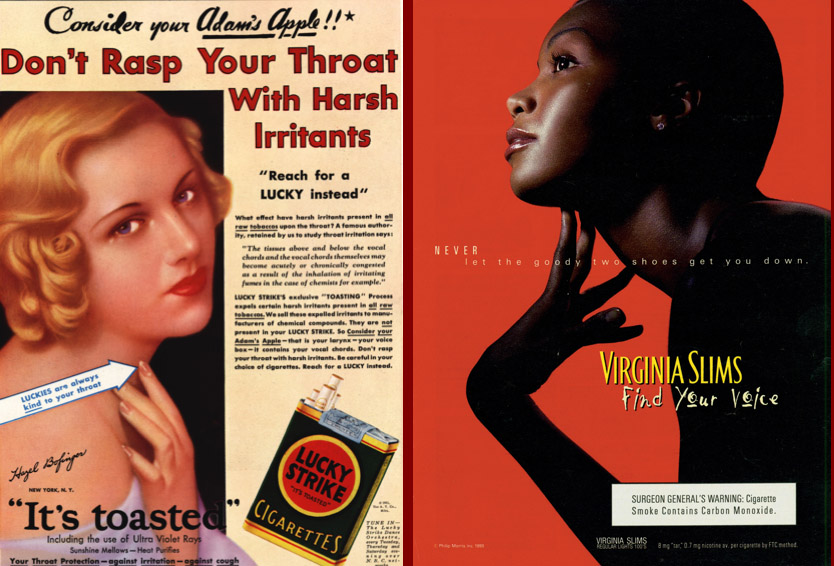
First, they compare vintage ads that try to sell cigarettes by pointing to the fact that they suppress your appetite with contemporary-ish Virginia Slims ads which seem to suggest so indirectly.

Second, they compare vintage advertisements that argue that some brands are smooth and good for your voice with the contemporary “Find Your Voice” campaign:

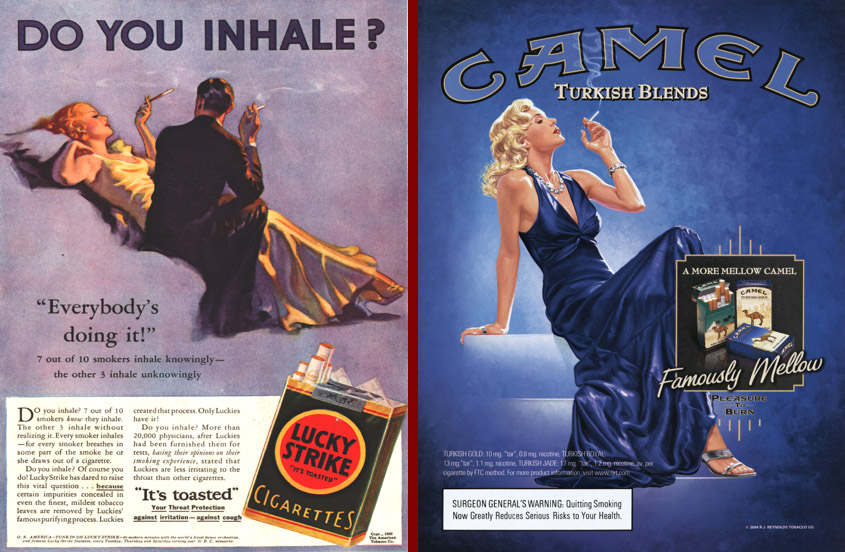
Third, this set of ads nicely shows how the association of glamour with cigarette smoking has transcended history:

Josh M., Christine F., and Eric Q. brought my attention to the Medal of Honor series of video games. As far as I know, this is every version of the game currently on the market (that’s twelve total; all images found at this Medal of Honor website). In the game, you are a U.S. soldier fighting in World War II. Notice anything? In every version of the game, thus far, a white man is featured on the cover. I suppose it’s possible that some of the people in the far background in a couple of the games might be non-White, but I don’t think so. The image here is that World War II was an all-White war (or that gamers will only identify with a White soldier).

It is true that during most of WWII, Black soldiers were segregated in their own units. Initially they were not allowed to fight on the front lines, but that policy changed.  According to this National Geographic article, Eisenhower desegregated the army for a while toward the end of the war out of desperation for more soldiers on the front lines. Tuskegee Airmen pilots also flew with White pilots on missions. Voice of America says that over a million Black soldiers served in WWII (about half a million were in Europe).

There were also 22 Asian American soldiers fighting for the U.S., according to this New York Times article. Medals of Honor were belatedly awarded to several in 2000 (though at least some had received Medals at the time of the war, unlike African American soldiers). And the Department of Veteran’s Affairs estimates that up to half a million Hispanic soldiers served (the exact number is unknown because the government did not keep track of “Hispanic” ethnicity in the Armed Forces at that time). Finally, 44,000 American Indian soldiers joined the war effort (and according to the Department of Defense, that was out of a population of only 350,000 at the time).

Ok, so it’s a video game. Fine, whatever. It’s probably not a place to look for accurate depictions of anything. And of course there were more White soldiers in the war (though minorities were over-represented compared to their percentage of the overall U.S. population). But not even one non-White soldier on any of the covers? Really?

On the other hand, no African American soldiers were given the Medal of Honor for service during WWII due to racial discrimination. In 1993 the Army commissioned a study on racial disparities in rates of medal awards and concluded that 7 Black soldiers would be given the Medal of Honor, which they received in 1996. So I guess maybe it’s fitting that they’re missing from the Medal of Honor games.

Thanks to Josh, Christine, and Eric!

Gwen Sharp is an associate professor of sociology at Nevada State College. You can follow her on Twitter at @gwensharpnv.

Bern K. and Megan P. sent us another example of androcentrism (see herehere, here, and here), one that is nicely combined with the representation of women as annoying naggers, and the social construction of diamonds as men’s best friend.  Bern writes:

It starts off with promise, showing that it’s ridiculous for a man to buy his wife a vacuum cleaner for their anniversary. It finishes, unfortunately, by suggesting that the only way to get out of the doghouse is to buy his wife diamonds.

In the 5-minute commercial, men are punished by their wives for being insensitive or insulting by being sent to the “doghouse.”  In this five minute advertisement for JC Penney, men who have been sent to the doghouse are punished by being forced to do feminine tasks: fold laundry, eat quiche, and drink chai lattes.  There is some irony in that the main dude was sent to the doghouse for buying his wife a vacuum for their anniversary.  Apparently he wouldn’t want to be caught dead vacuuming… which is exactly why the gift might be considered insulting.  After all, when you give a woman a cleaning product for a gift, it means you think it’s HER JOB.

The video:

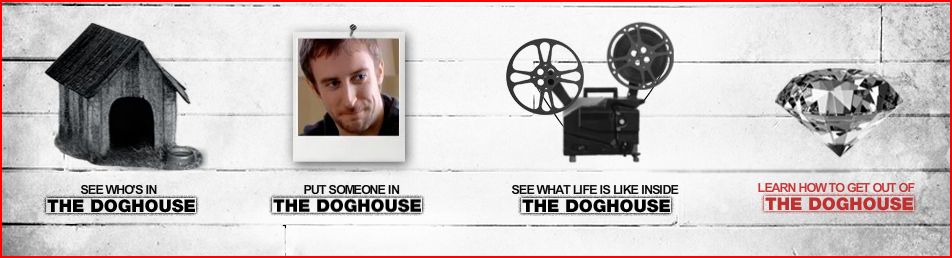
The website include the sound of a woman nagging and giving inconsistent orders (“speak less,” “talk more”).

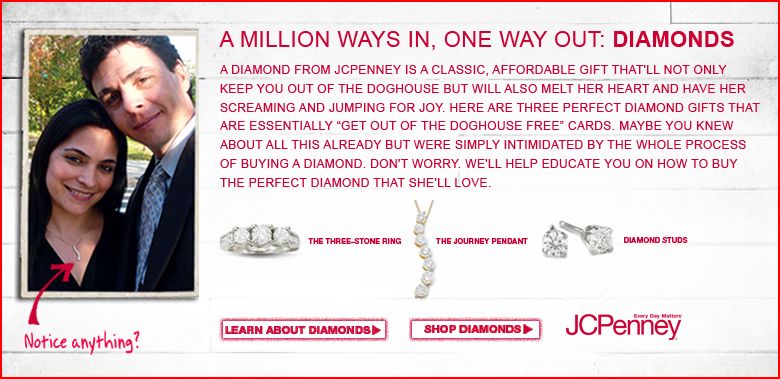
How to get out of the doghouse? Buy your wife diamonds (at JC Penney):

I like how it says that she’ll be “screaming and jumping for joy.”  Gah, women are so shallow and annoying.

There’s more!  The website is interactive.  You can actually put people in the doghouse.  If you are on Facebook, you can upload someone’s profile picture and have it show up on the website.  A fascinating new way to merge advertising and social networking sites.

NEW (Jan. ’10)!  JC Penney apparently thought this campaign was so delightful that they updated it. Joel P. sent us the link. It’s really quite obnoxious (for all the reasons discussed above):

[youtube]https://www.youtube.com/watch?v=_U45oxUyiMc[/youtube]

Jezebel also has a nice analysis.

Lisa Wade, PhD is an Associate Professor at Tulane University. She is the author of American Hookup, a book about college sexual culture; a textbook about gender; and a forthcoming introductory text: Terrible Magnificent Sociology. You can follow her on Twitter and Instagram.
Emily K. sent me a link to this story about a soccer team in Amsterdam, Ajax, known as the Jews. According to this New York Times article, the team got the nickname from opposing teams, who began calling the club the Jews because of the supposed history of Jews on the team. There isn’t any particular connection between the Jewish community and the team today–the team doesn’t have a large number of Jewish players, nor is the fan club made up of a higher number of Jews than other soccer teams.

This leads to some interesting situations. Most notably, fans (the vast majority of whom are non-Jewish) have adopted symbols of Judaism and Israel to show team spirit. Here’s a fan wrapped up in an Israeli flag:

And this fan has tattooed the Ajax logo along with a Star of David on his arm:

(Both images from the NYT article.)

Fans sometimes display gigantic Israeli flags in the stands during games (image found here):

This brings up some interesting issues about the appropriation of cultural symbols. When I first saw the pictures, I thought it was a bit disturbing that people use the Israeli flag as a prop to express support for an athletic team. But then I remembered that people do this all the time–I’ve seen pictures of soccer fans wrapped up in, for example, the Spanish flag, or wearing shirts with pictures of flags on them (not to mention people wearing clothing with American flags). Of course, that is often by people who are citizens of those countries. So is it weird to have non-Israelis using the Israeli flag in this way? I’ve thought about it, and I think maybe the strong association between Israel and Judaism makes this seem a little different than those other examples, since it then appears to be the appropriation of a religious symbol, even though the Israeli flag is not, technically speaking, itself a religious item (as opposed to, say, if fans were wearing yarmulkes or something). And clearly the people using the flag in this way are doing so because of its association with Jewishness, not because they have any particular interest in Israel or like an Israeli team.

The other problem that arises is opposing fans’ heckling. Because Ajax is nicknamed the Jews, fans of other teams often use anti-Semitic chants during games. Some examples (found at the Ajax USA site):

Ssssssssssssssssssssssssss… (the hissing sound of gas)

We’re hunting the Jews!

There is the Ajax train to Auschwitz!

Sieg! Sieg! Sieg! (German for ‘victory’, yelled while performing the Hitler’s Salute)

According to the NYT article, they have also yelled “Hamas! Hamas!”, a reference to the Palestinian political party. And there’s this, from Ajax fans themselves:

…during a game against a German team late last year, a group of Ajax supporters displayed a banner that read “Jews take revenge for ’40-’45,” a reference to the Holocaust.

Some Jewish fans now report that they have stopped attending games because they find the behavior offensive.

This would be a great example to use in a discussion of sports mascots, particularly how it compares to American Indian mascots (for examples, see this post) and Notre Dame’s Fighting Irish mascot (see post here). Critics of American Indian mascots often ask questions along the lines of “What would happen if a team called itself the Fighting Jews?” (see here and here for examples of this rhetorical strategy), but it’s always presented as an unimaginable, completely hypothetical situation. And yet it turns out not to be so hypothetical after all. My guess is students would generally have a much more negative reaction to the Ajax Jews than to teams like the Washington Redskins, and it would be useful to discuss why that might be (keeping in mind that fans of teams playing against teams with Indian mascots sometimes use images that depict violence against Indians).

And of course there’s also the whole issue of the appropriation of Jewish culture and the trivialization of the Holocaust and Nazism by both Ajax and opposing fans. The whole thing is creepy.

Thanks, Emily!