Search results for The

Last year, Fender Guitars unveiled the new Joe Strummer Signature Series ™, a pre-stressed replica of Strummer’s beloved guitar: a 1966 Fender Telecaster, which he played in the 101ers, the Clash, and with the Mescaleros from 1975 until his death in 2005. Here’s Strummer with his guitar:
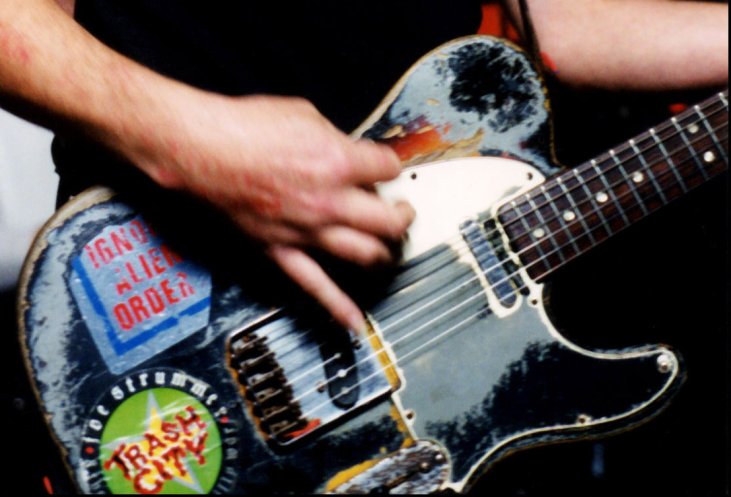
Here are some screenshots of the replica from the website:

Some of the items available for customization:


A customized version:

Let’s just pause for a moment and appreciate the irony of that one. (For those of you with little knowledge of the Clash, let’s just say that they were pretty much the exact opposite of this guitar, ideologically speaking.)

According to Fender’s write-up, this guitar is cool because “All his life, [Strummer] vigorously championed individuality, self-expression and change-tenets often reflected in the constantly altered look of his favorite instrument – his Telecaster” and this guitar was built “to celebrate Strummer’s fierce sense of individuality.” Buy the thing and you can champion individuality and self-expression just like Joe! Well. . .just like Joe and the 1,499 other folks who buy the limited edition with the stickers.

But perhaps a more interesting question is this: does any of this affect what you can actually do with it? The kinds of songs you could write with it? The kinds of shows you could play? It probably wouldn’t, or at least no more so than any other Telecaster would by virtue of its technical specifications. But put it in the context of a room full of other musicians, who tend to hold strong ideas about the art/commerce relationship, and you may find yourself the proud owner of a Fender Stigma-caster, depending on the room and the musicians.

On the other hand, Strummer – an artist whose work often wrangled around the intersection of art and commerce  – was by many accounts a complex person who disdained orthodoxy in all its forms. He might have been tickled pink by the tensions and artistic possibilities inherent in such a symbolically loaded guitar. The Clash did, after all, write songs about their recording contracts. (Also, the surviving Strummers have to eat and how they manage their husband’s/father’s estate is no business of mine.)

What else can we unpack from this guitar? Pretty much the history of modernity. You start with “the guitar” – an instrument traditionally produced by artisans called luthiers. But this particular style of guitar – the Fender Telecaster – is the first commercially successful mass-produced solidbody electric guitar. (Henry Ford:Driving::Leo Fender:Rocking.) Introduced in 1950 as the Esquire,* renamed after slight design changes and then a lawsuit re: the name Broadcaster being property of Gretsch Instruments, assembled on a factory line from mass-produced interchangeable parts, sold in stores and catalogs, heard most often via media and broadcast for most music consumers, the 1966 Fender Telecaster is truly a Modern guitar.

But this particular model of the genus Telecaster is Late Modernity to its elusive core:  a simulacrum of a particular instrument that trades on symbols of authenticity. With its “road worn” look, its namesake’s reputation and artistic output, and the genre of music it evokes, it’s a composite replica of the idea of the guitar wielded by a working musician known to most of us as mass-mediated collective representation. It’s also worth remembering that the idea of “Joe Strummer” is itself an elusive symbol, one of a number of names and personas adopted by John Graham Mellor over the course of his lifetime, that has now taken on a life of its own.

Sure, there are more properly postmodern guitars out there, but they all belong to Sonic Youth.

* Technically speaking, the Esquire and the Broadcaster/Telecaster are different guitars – the former has one pickup and the latter two, and there are some refinements to the design – basically, the Telecaster is the “finished” product. But to the average eye – and especially so when they debuted, given their shared differences from 99% of the other guitars out there at the time –  they’re pretty much the same guitar. [Editor’s note: Potts can really geek out sometimes, as evidenced in this footnote.]

———————–

Brady Potts is an entirely awesome sociologist specializing in soc of culture, co-editor of the book The Civic Life of American Religion, and the person we can always count on to geek out about “Buffy the Vampire Slayer” and the Drive-By Truckers.

If you would like to write a post for Sociological Images, please see our Guidelines for Guest Bloggers.

For other examples of the commodification of sub- (counter?) cultures, see here and here.

Wheelchair use equated with terminal misery (click to enlarge):

Wheelchair use will keep you from EVER having fun. So implies this ad for Goodyear Tires from the August 2, 1937 issue of Life. Everyone looks depressed about the fact that the boy’s in a wheelchair, from the boy himself to his sister and even the dog. I’d be kind of depressed too if I were teetering on the edge of a porch [notice that Sis has one leg up on a step] without a guard rail. This image could be used in a discussion of how perceptions of persons with disabilities have changed over the years…and also how they have stayed the same [witness the stubborn popularity of “wheelchair-bound” as a descriptor for wheelchair users].

Many of you may have seen the image below. It compares the 2004 to the 2008 vote and shows, by color, how much more Democratic (blue) or Republican (red) each county leaned in 2008. In essence, compared to 2004, in this election Democrats increased the proportion of the vote that they received in most counties.

You may not have seen, however, this next image. This next image shows the same data but compares 1992 to 2008. Looking across those sixteen years it is clear that, while this last election may have looked good for Democrats, the last five have moved the country significantly to the right. If you are a Democrat, then, this election is one step forward after 10 steps back. And, if you are a Republican, it may very well be a very small setback.

(Data from the New York Times; images found here.)

Breck C. encouraged us to post about photographs of body building women from a new book.  When Feministe and Boing Boing posted about them it, predictably, prompted a rash of comments to the effect of “those women are gross/disgusting/unattractive.”

I think Roy at No Cookies For Me says it best:

It doesn’t matter if you find those women attractive or not. They’re very likely not doing it for you. That you find body building “grotesque” is completely beside, behind, or even miles away from the point. Nobody gives a shit that you find it disgusting. If you find it disgusting? Don’t do it. [And n]obody is trying to make you become or date a body builder…

Nicely put.  This reflexive judging of women’s attractiveness reveals the entitlement that many feel to be aesthetically pleased by women’s appearance and, thus, the expectation that women owe it to the world to be attractive (as the world defines it, of course).  It also demonstrates the related idea that women are, first and foremost and no matter what else they do, sexual objects.

Lisa Wade, PhD is an Associate Professor at Tulane University. She is the author of American Hookup, a book about college sexual culture; a textbook about gender; and a forthcoming introductory text: Terrible Magnificent Sociology. You can follow her on Twitter and Instagram.

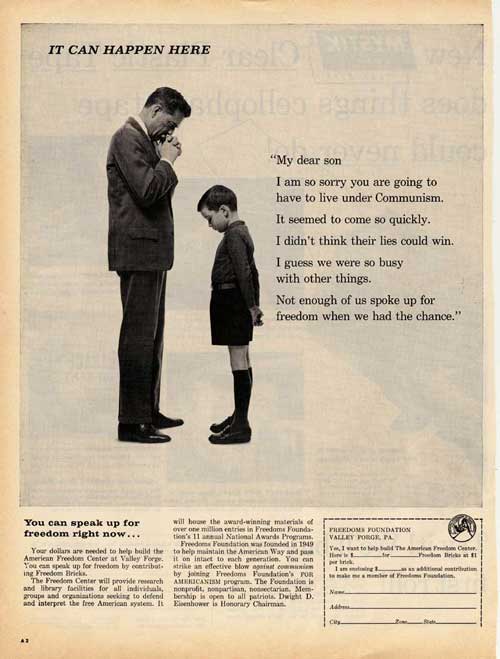
In this ad American Freedom Center at Valley Forge asks for donations to support the fight against terrorism:


Via Vintage Ads.

The belief that men and women are “opposite sexes” doesn’t come out of thin air.  It doesn’t, very often, come out of our life experience either, as most people most of us know are not living stereotypes.  No, in fact we are TOLD that men and women are “opposite sexes” constantly.  Consider this submission from Andrea G.:

You can now buy One-A-Day vitamins for teens, boy and girl teens that is (and in case you can’t tell which one is which, they’re color-coded).  According to Women’s Health News, the vitamins “for him” have more magnesium and the vitamins “for her” have more calcium and iron.

(1) Notice the obnoxious invisibility of dad (my emphasis):

Did you know there are gender specific teen multivitamins to address the top health concerns of moms and teens?

This is annoying, of course, because it reproduces the idea that dads don’t care about or aren’t paying attention to their kids.  But it’s also kind of ridiculous because, as long as we’re going by stereotypes, if there’s one social group less concerned with health than men, it’s teenagers.

(2)  I will leave aside whether teenaged female and male bodies are so dramatically different that they need different vitamins and minerals (I am not convinced), and instead just point out that One-A-Day has gendered what vitamins are for.  Check out the first bullet point in the close-up (in case you can’t tell which is which, the “For Him” is in block letters with stripes across his torso and the “For Her” is in cursive with spirally curves):

So boys need vitamins for muscles and girls need vitamins for clear skin?

I bet these vitamins will sell like hotcakes.

Thanks Andrea!

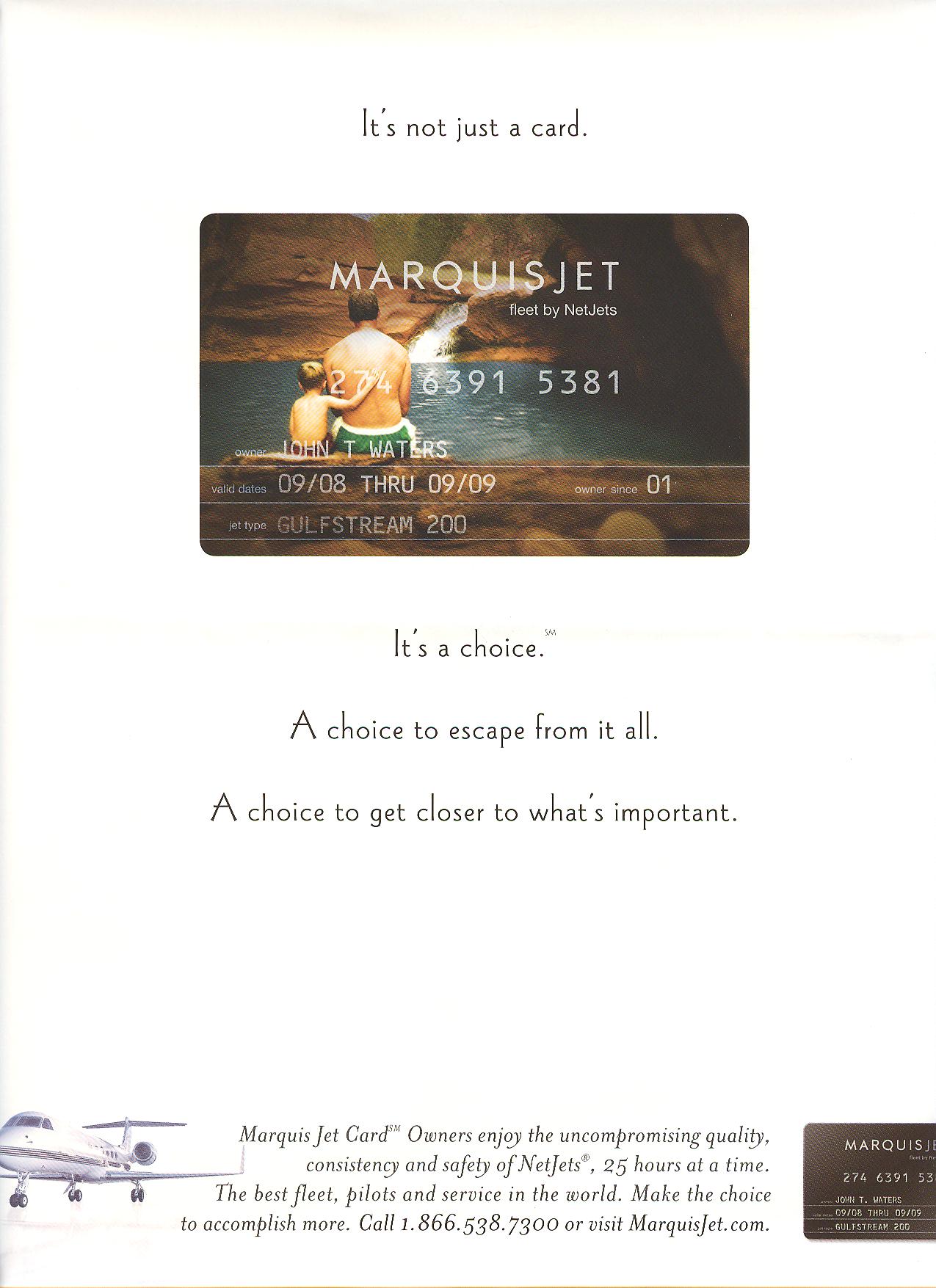
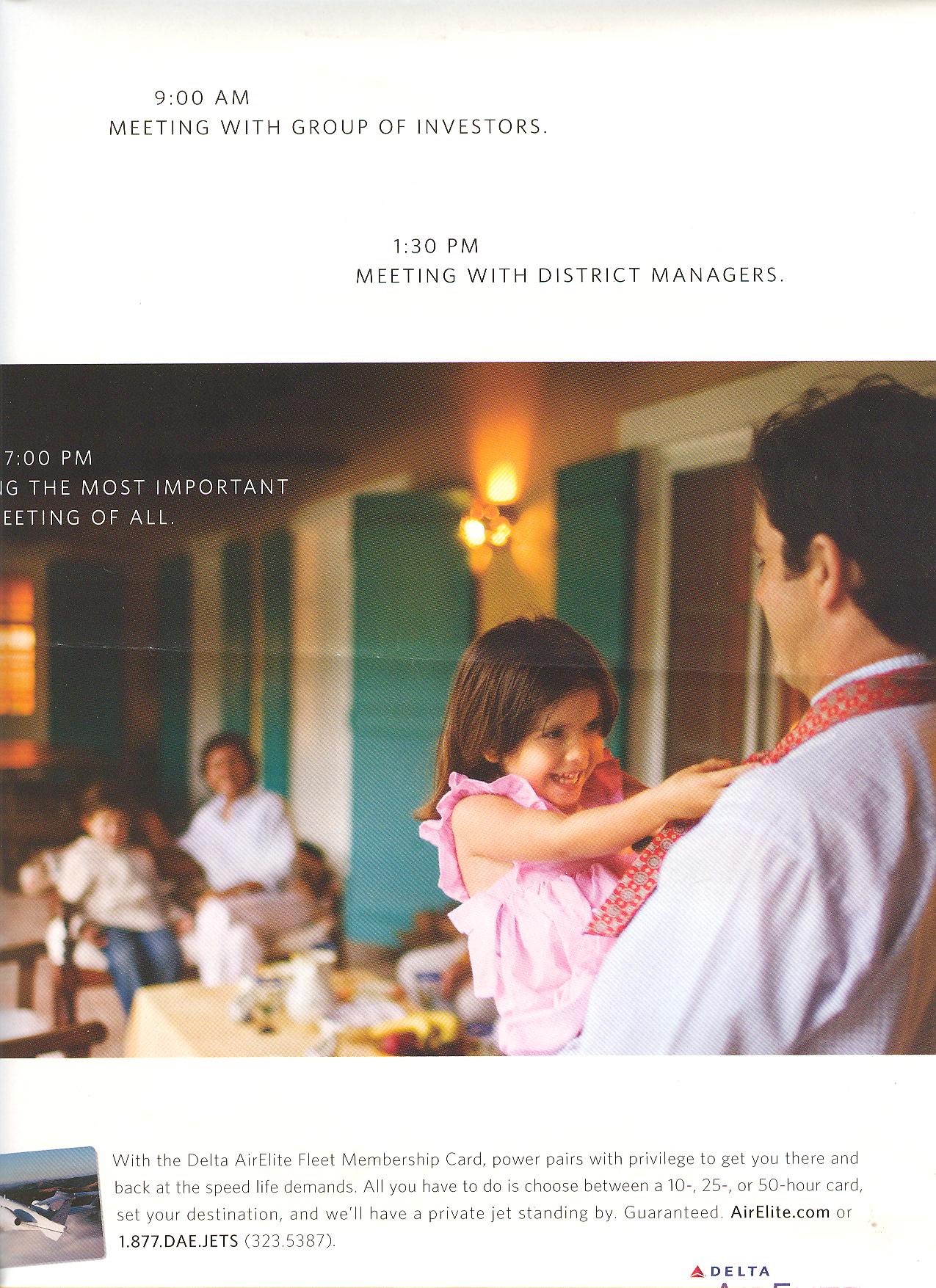
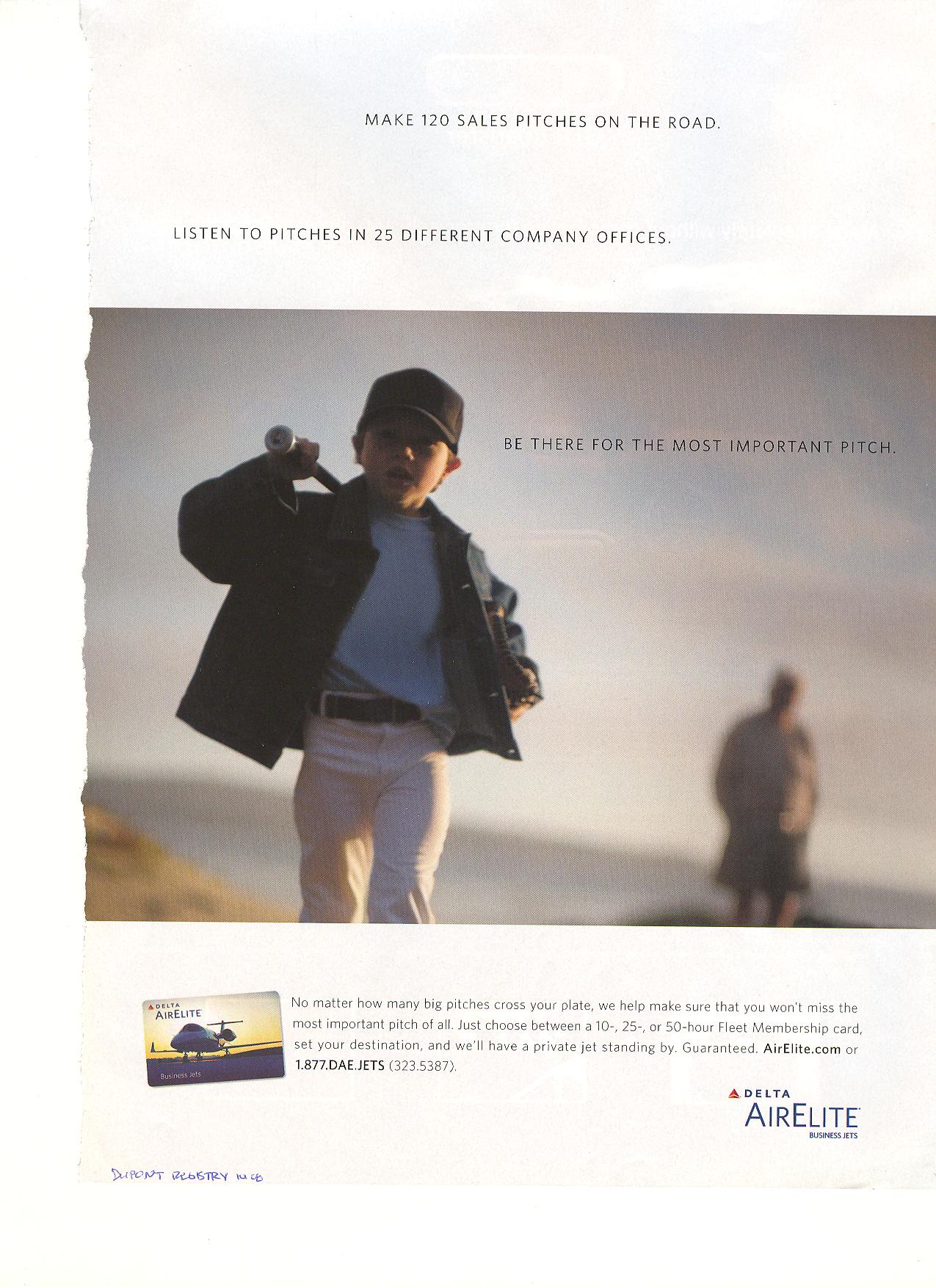
I found these three ads for a private jet service in those magazines for excrutiatingly excruciatingly rich people that I’ve been posting from lately. Each ad–one for Marquis Jet and two for Delta AirElite–are pitching their service by suggesting that having a membership in their private jet service will help them be a good Dad because they can get home–for dinner, the game, or some quality time–from anywhere fast. Comments below.

Text:

It’s not just a card.

It’s a choice.

A choice to escape from it all.

A choice to get closer to what’s important.


Text:

9:00AM.   Meeting with group of investors.

1:30PM.  Meeting with district managers.

7:00PM.  The most important meeting of all.

Text:

Make 120 sales pitches on the road.

Listen to pitches in 25 different company offices.

Be there for the most important pitch.

It’s pretty unusual to see ads that highlight a Dad’s relationship with his children. And that’s pretty neat. But, second, the implication is that only men at the extremes of economic success can “afford” to be an ideal father. Hypothetically, I wonder how many people working for that Dad have the privilege of taking a private jet and getting home in time for dinner? My guess would be: Very few. In that sense, these ads uphold the idea that men’s primary role in their children’s lives involves bringing home the bacon and, if you’re really, really, really good at that (and really, really lucky and, likely, very privileged to begin with), you get to be a part of their lives too.

Lisa Wade, PhD is an Associate Professor at Tulane University. She is the author of American Hookup, a book about college sexual culture; a textbook about gender; and a forthcoming introductory text: Terrible Magnificent Sociology. You can follow her on Twitter and Instagram.

Blanca and Stephanie brought this video, called “The Race Flag,” to my attention. In it, a referee penalizes African Americans who use “the race card” too eagerly (go here if the video doesn’t show up right):

See more funny videos at Funny or Die

It’s an interesting clip that plays on the idea of African Americans as over-sensitive, bitter whiners who see racial insult (or at least claim to) where none was intended. It might be useful for sparking a discussion about what we mean by “playing the race card.” For instance, what’s the difference between playing the race card…and pointing out actual incidents of discrimination? Obviously the difference, based on this video, is that playing the race card means the person is over-reacting and making ridiculous accusations. But “over-reacting” is a subjective term, and the idea of playing the race card assumes that there wasn’t any actual discrimination or prejudice. But most of the time we don’t have video cameras that can clearly catch everyone’s intentions and actions on tape for review. Concerns about playing the race card tend to ignore the very real fact that minorities often do face discrimination and prejudice (as well as backhanded compliments like “You’re so articulate!”) in the workplace. While I’m sure there are African American workers who make unwarranted accusations of racism (just as there are examples of almost any behavior you can think of), I’m also quite certain that there are employers and coworkers who engage in discriminatory actions but then deny any racist intent and accuse anyone who complains of playing the race card.

I’d also point out that Whites use the race card, too: I cannot tell you how many of my White students have told me that they did not get a job, into a particular college, etc., because they are White. Sometimes they say a manager/friend/etc. told them the company “had” to hire a minority “to meet quota.” Other times they’ve simply inferred, from the fact that they can see no other possible explanation for not getting said job/college acceptance letter/etc., that it must have been because they are White.

You might pair this with the chapter “‘Racing for Innocence’: Whiteness, Corporate Culture, and the Backlash against Affirmative Action,” by Jennifer L. Pierce, from White Out: The Continuing Significance of Racism (2003).

Apparently the same people who made that video made this one, which laughs at the idea of the Republican Party trying to woo African Americans (found here):

See more funny videos at Funny or Die

I’ll leave the commentary on that one to our readers, if they feel so inclined.

Thanks, Blanca and Stephanie!