
Via Alas a Blog.
Search results for The
Matt S. has pointed us to the controversy over the casting of The Last Airbender (to be released 2010). One blogger, comic book artists Derek Kirk Kim, describes the Nickelodeon cartoon series on which the life-action movie is based as follows:
[The cartoon is] wholly and inarguably built around Asian (and Inuit) culture. Everything from to the costume designs, to the written language, to the landscapes, to martial arts, to philosophy, to spirituality, to eating utensils!—it’s all an evocative, but thinly veiled, re-imagining of ancient Asia. (In one episode, a region is shown where everyone is garbed in Korean hanboks—traditional Korean clothing—the design of which wasn’t even altered at all.) It would take a willful disregard of the show’s intentions and origins to think this wouldn’t extend to the race of the characters as well.
The series–which I have never seen–does indeed seem to be inspired by various Asian cultures. Here are some images from the cartoon series (from the same blog post):




The controversy is regarding the casting of the lead characters. All four leads are white (imdb).
Jackson Rathbone (image at imdb):
Jesse McCartney (image here):

Nicola Peltz (image here):

I couldn’t find a picture of the fourth lead, Noah Ringer.
Kim quotes Gene Yang saying:
It’s like a white Asian fetishist’s wet dream. All the Asian culture they want, without any of the Asian people.
Ampersand, at Alas a Blog, puts it nicely:
…the best roles for people of color are reserved for actors who appear white — and the best roles for white people are also reserved for actors who appear white.
In agriculture, monoculture is the practice of relying extensively on one crop with little biodiversity. In the 1840s, a famine in Ireland was caused by a disease that hit potatoes, the crop on which Irish people largely relied. At Understanding Evolution, an article reads:
The Irish potato clones were certainly low on genetic variation, so when the environment changed and a potato disease swept through the country in the 1840s, the potatoes (and the people who depended upon them) were devastated.
The article includes this illustration of how monocultures are vulnerable:
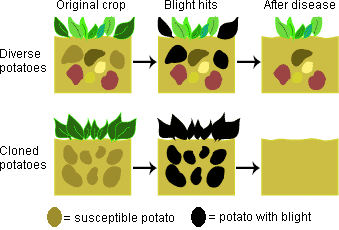
The Irish potato famine reveals how choices about how to feed populations, combined with biological realities, can have dramatic impacts on the world. In the three years that the famine lasted, one out of every eight Irish people died of starvation. Nearly a million emigrated to the United States, only to face poverty and discrimination, in part because of their large numbers.
The article continues:
Despite the warnings of evolution and history, much agriculture continues to depend on genetically uniform crops. The widespread planting of a single corn variety contributed to the loss of over a billion dollars worth of corn in 1970, when the U.S. crop was overwhelmed by a fungus. And in the 1980s, dependence upon a single type of grapevine root forced California grape growers to replant approximately two million acres of vines when a new race of the pest insect, grape phylloxera (Daktulosphaira vitifoliae, shown at right) attacked in the 1980s.
Gwen adds: The Irish potato famine is also an example of a reality about famines that we rarely discuss. In most famines there is food available in the country, but the government or local elites do not believe that those who are starving have any claim to that food. In the years of the Irish potato famine, British landowners continued to export wheat out of Ireland. The wheat crop wasn’t affected by the potato blight. But wheat was a commercial crop the British grew for profit. Potatoes were for Irish peasants to eat. We might think it would be obvious that when people are starving you’d make other food sources available to them, but that’s not what happened. In the social hierarchy of the time, many British elites didn’t believe that starving Irish people had a claim to their cash crop, and so they continued to ship wheat out of the country to other nations even while millions were dying or emigrating. Similarly, in the Ethiopian famines of the 1980s, the country wasn’t devoid of food; it’s just that poor rural people weren’t seen as having a right to food, and so available food was not redistributed to them. Many people in the country ate just fine while their fellow citizens starved.
So famine is often as much about politics and social hierarchies as it is about biology.
In early American history, male circumcision was very uncommon. In the 1950s, however, about 90% of newborn boys were circumcised in the U.S. Today, the number is just over 50%.
The International Coalition for Genital Integrity has put together a slideshow that traces developments in research and argumentation about male circumcision alongside rising and falling rates of the practice in the U.S., the U.K., and the world from 1832 till today.
It’s interesting how rates of circumcision change drastically over time in the U.S., but stay relatively stable (low) in the U.K.
It is also neat to see some of the arguments about circumcision that were made over time. For example, the long-standing belief that circumcision cured sexual excess (like wet dreams and masturbation), the explicit support for circumcision on the basis that it reduced sexual sensitivity (and that was good), and the belief that circumcision could cure paralysis, bedwetting, crossed eyes, deafness, tuburculosis, cancer of the tongue, and more. Dovetailing with American racism, in 1894 an article argued that circumcising the “Negro” would reduce the rape of white women by black men.
Leontine G. sent in this iconic image (found at Empire) of Spock and Captain Kirk from the original Star Trek series, next to the actors who play those characters in the new version (a movie by J.J. Abrams):

Leontine says, “I have a vague feeling that actors and musicians are getting smoother and more plasticky looking,” and this image shows some of that. The Spock and Captain Kirk on the right are supposed to be younger than the ones on the left (the movie is a prequel, more or less), but it’s not just that the actors are younger. There’s clearly also irbrushing and make-up used to erase any lines, blemishes or other “imperfections” on their faces (and either New Spock’s shirt fits perfectly, or they airbrushed out most of the wrinkles).
You might use this to talk about changing standards of beauty in the visual media. If the original Star Trek came out today, how much retouching would they do to the picture of Leonard Nimoy and William Shatner? Maybe the photo would still show them with as many wrinkles and facial lines as they have…but I’m doubtful.
For another example of how TV standards of changed (in this case, how much sexual activity is shown on teen-oriented shows), see this post about the old and new versions of Beverly Hills, 90210.
Now and again, I hear that college graduates entering the workforce today, both male and female, offer a new set of challenges to employers. Notably, a sense of entitlement to high pay and excellent benefits and a poor work ethic. I have no idea if this is true. However, over at MultiCultClassics, Highjive posted an ad for a seminar that purports to teach employers to handle “Millennials”. It’s similar to a post that Gwen put up about advice to employers for working with women when they initially entered the paid workforce in large numbers.
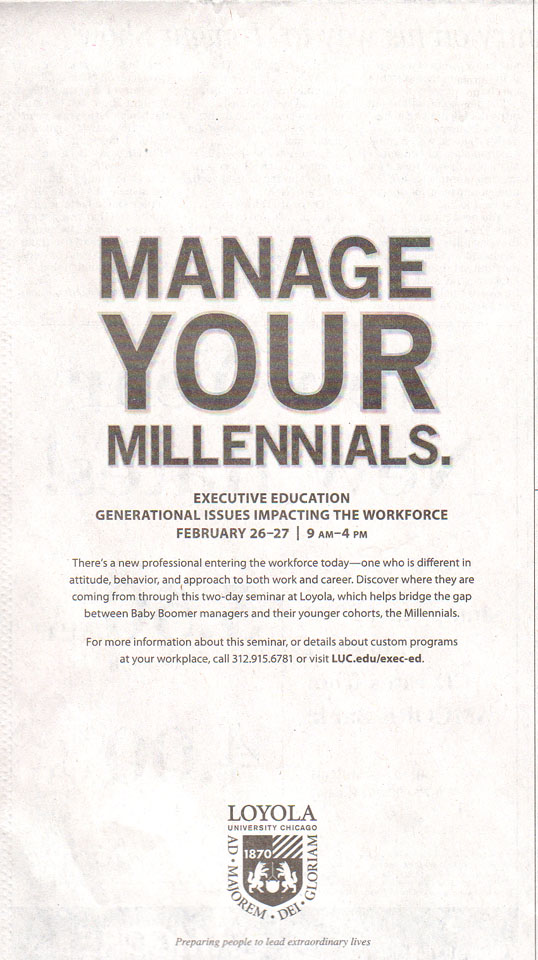
Text:
There’s a new professional entering the workforce today—one who is different in attitude, behavior, and approach to both work and career. Discover where they are coming from through this two-day seminar at Loyola, which helps bridge the gap between Baby Boomer managers and their younger cohorts, the Millennials.
Francisco (from GenderKid) sent in a cartoon that questions the benefits of the One Laptop per Child program, which aims to give a simple version of a laptop with internet access to kids in less-developed nations, and also Alabama (available at World’s Fair):
From the OLPC program’s website:
Most of the more than one billion children in the emerging world don’t have access to adequate education. The XO laptop is our answer to this crisis—and after nearly two years, we know it’s working. Almost everywhere the XO goes, school attendance increases dramatically as the children begin to open their minds and explore their own potential. One by one, a new generation is emerging with the power to change the world.
There are a number of interesting elements you might bring up here, such whether introducing laptops is necessarily the best method to improve education wordwide, or who decided that this was an important need of children in these regions (my guess is the MIT team behind OLPC didn’t go to communities and do surveys asking what local citizens would most like to see for their educational system). I recently heard a story about OLPC on NPR, and while there seemed to be benefits in some Peruvian communities, in others the teachers spent so much time trying to figure out how to use the machines to teach subjects, without really feeling comfortable with them, that almost nothing was accomplished during the day. But once the laptops were introduced, they overtook the classroom; teachers were pressured by the Peruvian government to use the laptops in almost every lesson, even if it slowed them down or it wasn’t clear that students were benefiting from them. Another problem was that, though the laptops are built to be very strong and difficult to break, on occasion of course one will break. Families must pay to repair or replace them, which of course most can’t do, meaning kids with broken laptops had to sit and watch while other kids used theirs in class.
Benjamin Cohen uses the OLPC in an engineering class and brings up concerns about…
technological determinism — [the idea] that a given technology will lead to the same outcome, no matter where it is introduced, how it is introduced, or when. The outcomes, on this impoverished view of the relationship between technology and society, are predetermined by the physical technology. (This view also assumes that what one means by “technology” is only the physical hunk of material sitting there, as opposed to including its constitutive organizational, values, and knowledge elements.) In the case of OLPC, the project assumes equal global cultural values & regional attributes. It also assumes common introduction, maintenance, educational (as in learning styles and habits), and image values everywhere in the world. Furthermore, it lives in a historical vacuum assuming that there is no history in the so-called “developing world” for shiny, fancy things from the West dropped in, The-Gods-Must-Be-Crazy style, from the sky.
How could the same laptop have the same meaning and value in, say, Nigeria and Indonesia, Papua New Guinea and Alabama, Malawi and Mongolia?
These critiques aren’t to say there is no value in OLPC, but that there are some clear questions about whether this is the most effective way to improve education in impoverished or isolated communities and what its consequences are. I doubt the OLPC creators meant for teachers to face government pressure to use the laptops for every lesson, no matter what, but that’s what has happened in at least some areas.
Another problem the NPR story highlighted was that the kids they reported about in Peru live in areas where there are absolutely no jobs available to capitalize on their tech skills, nor any reason to believe there will be any time soon. The government is pushing laptops in education, but without any economic development program to bring jobs to the regions to take advantage of these educated students. So the question is, after you get your laptop, you learn how to use it, you graduate…then what? Will the laptops spur more brain drain and out-migration? Is this necessarily good? Are countries like Peru using the laptop program as a quick, flashy substitute for the more boring, difficult, challenging process of economic development and job creation? As an educator, I’m thrilled with the idea of valuing learning and knowledge for its own sake, but on a more practical level, these questions seem like important ones.
Thanks, Francisco!
UPDATE: In a comment, Sid says,
…there’s kind of a vaguely imperialistic nostalgia in the first image of “Darkest Africa” as a simpler, more wholesome place where kids still play together in front of the hut and there’s a sense of community that you just don’t get in the modern world and blahdee blahdee blah. The entire thing kind of smacks of a whitemansburden.org enterprise…
Gwen Sharp is an associate professor of sociology at Nevada State College. You can follow her on Twitter at @gwensharpnv.
On Feb. 13th, 2008, a Texas federal appeals court ruled that the prohibition against selling dildos and fake vaginas violated the 14th Amendment.
That’s right. Such sex toys were illegal in Texas until early last year. According to a Slate article, they are still illegal in three other states: Virginia, Mississippi, and Alabama.
But don’t congratulate or castigate Texas just yet. The state Attorney General wants the court to reconsider.
Here is an entertaining 11-minute discussion of the dildo debates in Texas (it’s a must watch):
Matt S. has pointed us to the controversy over the casting of The Last Airbender (to be released 2010). One blogger, comic book artists Derek Kirk Kim, describes the Nickelodeon cartoon series on which the life-action movie is based as follows:
[The cartoon is] wholly and inarguably built around Asian (and Inuit) culture. Everything from to the costume designs, to the written language, to the landscapes, to martial arts, to philosophy, to spirituality, to eating utensils!—it’s all an evocative, but thinly veiled, re-imagining of ancient Asia. (In one episode, a region is shown where everyone is garbed in Korean hanboks—traditional Korean clothing—the design of which wasn’t even altered at all.) It would take a willful disregard of the show’s intentions and origins to think this wouldn’t extend to the race of the characters as well.
The series–which I have never seen–does indeed seem to be inspired by various Asian cultures. Here are some images from the cartoon series (from the same blog post):

The controversy is regarding the casting of the lead characters. All four leads are white (imdb).
Jackson Rathbone (image at imdb):



Jesse McCartney (image here):
Nicola Peltz (image here):
I couldn’t find a picture of the fourth lead, Noah Ringer.
Kim quotes Gene Yang saying:
It’s like a white Asian fetishist’s wet dream. All the Asian culture they want, without any of the Asian people.
Ampersand, at Alas a Blog, puts it nicely:
…the best roles for people of color are reserved for actors who appear white — and the best roles for white people are also reserved for actors who appear white.
In agriculture, monoculture is the practice of relying extensively on one crop with little biodiversity. In the 1840s, a famine in Ireland was caused by a disease that hit potatoes, the crop on which Irish people largely relied. At Understanding Evolution, an article reads:
The Irish potato clones were certainly low on genetic variation, so when the environment changed and a potato disease swept through the country in the 1840s, the potatoes (and the people who depended upon them) were devastated.
The article includes this illustration of how monocultures are vulnerable:
The Irish potato famine reveals how choices about how to feed populations, combined with biological realities, can have dramatic impacts on the world. In the three years that the famine lasted, one out of every eight Irish people died of starvation. Nearly a million emigrated to the United States, only to face poverty and discrimination, in part because of their large numbers.
The article continues:
Despite the warnings of evolution and history, much agriculture continues to depend on genetically uniform crops. The widespread planting of a single corn variety contributed to the loss of over a billion dollars worth of corn in 1970, when the U.S. crop was overwhelmed by a fungus. And in the 1980s, dependence upon a single type of grapevine root forced California grape growers to replant approximately two million acres of vines when a new race of the pest insect, grape phylloxera (Daktulosphaira vitifoliae, shown at right) attacked in the 1980s.
Gwen adds: The Irish potato famine is also an example of a reality about famines that we rarely discuss. In most famines there is food available in the country, but the government or local elites do not believe that those who are starving have any claim to that food. In the years of the Irish potato famine, British landowners continued to export wheat out of Ireland. The wheat crop wasn’t affected by the potato blight. But wheat was a commercial crop the British grew for profit. Potatoes were for Irish peasants to eat. We might think it would be obvious that when people are starving you’d make other food sources available to them, but that’s not what happened. In the social hierarchy of the time, many British elites didn’t believe that starving Irish people had a claim to their cash crop, and so they continued to ship wheat out of the country to other nations even while millions were dying or emigrating. Similarly, in the Ethiopian famines of the 1980s, the country wasn’t devoid of food; it’s just that poor rural people weren’t seen as having a right to food, and so available food was not redistributed to them. Many people in the country ate just fine while their fellow citizens starved.
So famine is often as much about politics and social hierarchies as it is about biology.
In early American history, male circumcision was very uncommon. In the 1950s, however, about 90% of newborn boys were circumcised in the U.S. Today, the number is just over 50%.
The International Coalition for Genital Integrity has put together a slideshow that traces developments in research and argumentation about male circumcision alongside rising and falling rates of the practice in the U.S., the U.K., and the world from 1832 till today.
It’s interesting how rates of circumcision change drastically over time in the U.S., but stay relatively stable (low) in the U.K.
It is also neat to see some of the arguments about circumcision that were made over time. For example, the long-standing belief that circumcision cured sexual excess (like wet dreams and masturbation), the explicit support for circumcision on the basis that it reduced sexual sensitivity (and that was good), and the belief that circumcision could cure paralysis, bedwetting, crossed eyes, deafness, tuburculosis, cancer of the tongue, and more. Dovetailing with American racism, in 1894 an article argued that circumcising the “Negro” would reduce the rape of white women by black men.
Leontine G. sent in this iconic image (found at Empire) of Spock and Captain Kirk from the original Star Trek series, next to the actors who play those characters in the new version (a movie by J.J. Abrams):
Leontine says, “I have a vague feeling that actors and musicians are getting smoother and more plasticky looking,” and this image shows some of that. The Spock and Captain Kirk on the right are supposed to be younger than the ones on the left (the movie is a prequel, more or less), but it’s not just that the actors are younger. There’s clearly also irbrushing and make-up used to erase any lines, blemishes or other “imperfections” on their faces (and either New Spock’s shirt fits perfectly, or they airbrushed out most of the wrinkles).
You might use this to talk about changing standards of beauty in the visual media. If the original Star Trek came out today, how much retouching would they do to the picture of Leonard Nimoy and William Shatner? Maybe the photo would still show them with as many wrinkles and facial lines as they have…but I’m doubtful.
For another example of how TV standards of changed (in this case, how much sexual activity is shown on teen-oriented shows), see this post about the old and new versions of Beverly Hills, 90210.
Now and again, I hear that college graduates entering the workforce today, both male and female, offer a new set of challenges to employers. Notably, a sense of entitlement to high pay and excellent benefits and a poor work ethic. I have no idea if this is true. However, over at MultiCultClassics, Highjive posted an ad for a seminar that purports to teach employers to handle “Millennials”. It’s similar to a post that Gwen put up about advice to employers for working with women when they initially entered the paid workforce in large numbers.
Text:
There’s a new professional entering the workforce today—one who is different in attitude, behavior, and approach to both work and career. Discover where they are coming from through this two-day seminar at Loyola, which helps bridge the gap between Baby Boomer managers and their younger cohorts, the Millennials.
Francisco (from GenderKid) sent in a cartoon that questions the benefits of the One Laptop per Child program, which aims to give a simple version of a laptop with internet access to kids in less-developed nations, and also Alabama (available at World’s Fair):
From the OLPC program’s website:
Most of the more than one billion children in the emerging world don’t have access to adequate education. The XO laptop is our answer to this crisis—and after nearly two years, we know it’s working. Almost everywhere the XO goes, school attendance increases dramatically as the children begin to open their minds and explore their own potential. One by one, a new generation is emerging with the power to change the world.
There are a number of interesting elements you might bring up here, such whether introducing laptops is necessarily the best method to improve education wordwide, or who decided that this was an important need of children in these regions (my guess is the MIT team behind OLPC didn’t go to communities and do surveys asking what local citizens would most like to see for their educational system). I recently heard a story about OLPC on NPR, and while there seemed to be benefits in some Peruvian communities, in others the teachers spent so much time trying to figure out how to use the machines to teach subjects, without really feeling comfortable with them, that almost nothing was accomplished during the day. But once the laptops were introduced, they overtook the classroom; teachers were pressured by the Peruvian government to use the laptops in almost every lesson, even if it slowed them down or it wasn’t clear that students were benefiting from them. Another problem was that, though the laptops are built to be very strong and difficult to break, on occasion of course one will break. Families must pay to repair or replace them, which of course most can’t do, meaning kids with broken laptops had to sit and watch while other kids used theirs in class.
Benjamin Cohen uses the OLPC in an engineering class and brings up concerns about…
technological determinism — [the idea] that a given technology will lead to the same outcome, no matter where it is introduced, how it is introduced, or when. The outcomes, on this impoverished view of the relationship between technology and society, are predetermined by the physical technology. (This view also assumes that what one means by “technology” is only the physical hunk of material sitting there, as opposed to including its constitutive organizational, values, and knowledge elements.) In the case of OLPC, the project assumes equal global cultural values & regional attributes. It also assumes common introduction, maintenance, educational (as in learning styles and habits), and image values everywhere in the world. Furthermore, it lives in a historical vacuum assuming that there is no history in the so-called “developing world” for shiny, fancy things from the West dropped in, The-Gods-Must-Be-Crazy style, from the sky.
How could the same laptop have the same meaning and value in, say, Nigeria and Indonesia, Papua New Guinea and Alabama, Malawi and Mongolia?
These critiques aren’t to say there is no value in OLPC, but that there are some clear questions about whether this is the most effective way to improve education in impoverished or isolated communities and what its consequences are. I doubt the OLPC creators meant for teachers to face government pressure to use the laptops for every lesson, no matter what, but that’s what has happened in at least some areas.
Another problem the NPR story highlighted was that the kids they reported about in Peru live in areas where there are absolutely no jobs available to capitalize on their tech skills, nor any reason to believe there will be any time soon. The government is pushing laptops in education, but without any economic development program to bring jobs to the regions to take advantage of these educated students. So the question is, after you get your laptop, you learn how to use it, you graduate…then what? Will the laptops spur more brain drain and out-migration? Is this necessarily good? Are countries like Peru using the laptop program as a quick, flashy substitute for the more boring, difficult, challenging process of economic development and job creation? As an educator, I’m thrilled with the idea of valuing learning and knowledge for its own sake, but on a more practical level, these questions seem like important ones.
Thanks, Francisco!
UPDATE: In a comment, Sid says,
…there’s kind of a vaguely imperialistic nostalgia in the first image of “Darkest Africa” as a simpler, more wholesome place where kids still play together in front of the hut and there’s a sense of community that you just don’t get in the modern world and blahdee blahdee blah. The entire thing kind of smacks of a whitemansburden.org enterprise…
Gwen Sharp is an associate professor of sociology at Nevada State College. You can follow her on Twitter at @gwensharpnv.
On Feb. 13th, 2008, a Texas federal appeals court ruled that the prohibition against selling dildos and fake vaginas violated the 14th Amendment.
That’s right. Such sex toys were illegal in Texas until early last year. According to a Slate article, they are still illegal in three other states: Virginia, Mississippi, and Alabama.
But don’t congratulate or castigate Texas just yet. The state Attorney General wants the court to reconsider.
Here is an entertaining 11-minute discussion of the dildo debates in Texas (it’s a must watch):