Search results for The


The illuminating 3:49 minute video below, borrowed from Michael Shaw’s BagNews, features photographs taken by New York Times photojournalist Mike Kamber while he was embedded with the U.S. military in Iraq. Narrating the images, Kamber discusses the censoring of his photos by the U.S. and the ethics of documentary photography.

Lisa Wade, PhD is an Associate Professor at Tulane University. She is the author of American Hookup, a book about college sexual culture; a textbook about gender; and a forthcoming introductory text: Terrible Magnificent Sociology. You can follow her on Twitter and Instagram.
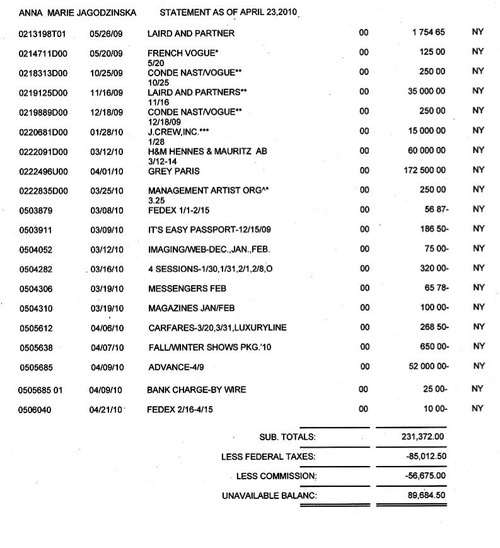
A while back, Lisa drew on work by Ashley Mears to post about different preferred aesthetics in editorial vs. commercial modeling — that is, modeling for fashion magazines and runways as opposed to modeling clothing in catalogs and other venues specifically meant to lead to sales of products. Mears (whose forthcoming book, Pricing Beauty: Value in the Fashion Modeling World I eagerly await) points out that while models earn more prestige doing editorial work, they generally earn significantly more money if they can get commercial jobs (though, since the two types of modeling require different looks, models have little control over which type of modeling they’ll be considered for).

Jezebel posted an article about a lawsuit brought by three models against the modeling agency Next that clearly shows the low compensation models receive for doing some of the most prestigious modeling. This statement of model Anna Jagodzinska’s account (including payments that are still outstanding as well as deductions from her account for agency fees and services) with Next includes both editorial work (the second two items are her pay for a day of shooting with two different versions of Vogue) and commercial work (J. Crew, H&M, and large sums from agencies that put together advertising materials, such as Laird and Partners). The pay for a day’s shoot for French Vogue? $125. For the U.S. version of Vogue, the dominant fashion magazine, it’s $250:

The daily pay rates for catalogs, by contrast, are in the thousands.

It’s a perfect example of Mears’s argument that models often face a situation where prestigious jobs actually pay very little; so many models want to be in Vogue that the magazine doesn’t have to pay much, and the same is true for a lot of editorial work. Also notice that this statement, from April 2010, shows that the French Vogue has owed the $125 daily fee since May of 2009, and one of Vogue‘s payments has been due since October 2009 and another since December 2009. The end result is that in return for the status that comes with these types of editorial modeling jobs, models have to accept low pay compared to the commercial market, and may have to wait a long time to get even that.

The Jezebel article I linked to above includes an excellent explanation of the various charges on the account statement and the reason modeling agencies don’t aggressively pursue overdue accounts. Notice how it says “unavailable balance” at the bottom of the statement? That means the clients haven’t paid the modeling agency, so she has that much coming but hasn’t actually been paid yet, since the agencies treat the models like independent contractors and only pay them when the agency gets the money from the client.

Philip Cohen, at Family Inequality, posted an interesting graph displaying 30-44-year-old women’s share of their household’s income by level of education:

The graph shows that, on average, women with higher levels of education have incomes closer to that of their husbands than women with lower levels of education.  Cohen writes:

It captures nicely both how women’s earning power within married couples has increased, and how that shift has been much greater for women with higher education.

In other words, the figure suggests that efforts to close the wage gap between men and women have been much more successful at the top of the economic ladder than the bottom.

Lisa Wade, PhD is an Associate Professor at Tulane University. She is the author of American Hookup, a book about college sexual culture; a textbook about gender; and a forthcoming introductory text: Terrible Magnificent Sociology. You can follow her on Twitter and Instagram.


Annie Leonard tackles e-waste (what happens after we’re done with our computers, cell phones, etc) in the latest 7-minute edition in her Story of Stuff series (see also her first story of stuff and her analysis of bottled water and cap and trade).

Via Reports from the Economic Front.

Lisa Wade, PhD is an Associate Professor at Tulane University. She is the author of American Hookup, a book about college sexual culture; a textbook about gender; and a forthcoming introductory text: Terrible Magnificent Sociology. You can follow her on Twitter and Instagram.

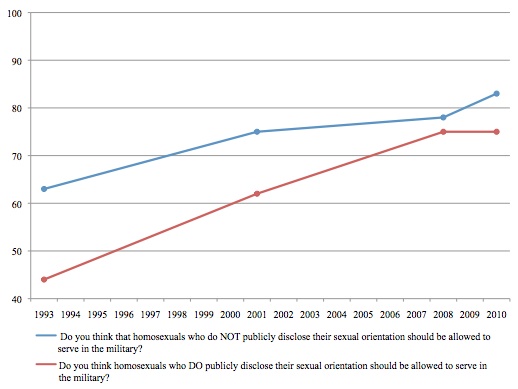
Brian McCabe put up a post at Five Thirty Eight about changes in public attitudes toward letting gays and lesbians serve in the U.S. military, using data from ABC/Washington Post polls that asked whether gays and lesbians should be able to serve and whether they should be allowed to serve while openly disclosing their sexual orientation.

The red line below indicates those who said gays and lesbians who are open about their sexual orientation should be allowed to serve. The blue line indicates responses for those who agreed that gays and lesbians should be able to serve if they didn’t disclose their sexual orientation — a position that basically aligns with the military’s current Don’t Ask, Don’t Tell policy.

When DADT was passed in 1993, less than half of those surveyed thought gays and lesbians should be able to openly serve, though over 60% supported allowing them to serve as long as they didn’t disclose their sexual orientation. But notice the dramatic changes in the last 17 years:

Support among the general public for allowing gays and lesbians to serve in the military, without any restrictions, has increased greatly. In 2008, 75% of respondents supported such a policy. Also notice the gap between the two options has narrowed. In the 1990s, a significant portion of the population was comfortable with gays and lesbians in the military only under a DADT-type situation, where anyone who wasn’t straight had to keep quiet about it. Today the overwhelming majority of respondents support a non-restrictive policy, and the additional support gained by adding the possibility of requiring gays and lesbians to hide their sexual orientation isn’t nearly as large as it used to be.

Whether Congress will repeal DADT is still unclear. But the trend among the general public is pretty clear, from this and other polls: Americans no longer need the reassurance of a policy that promises to restrict gays’ and lesbians’ sexuality in order to support their military service.

Cross-posted at Ms. and Jezebel.

Bug lovers will recall that the female praying mantis cannibalizes the head of her sexual partner upon mating. Wrote Leland Ossian Howard in Science (1886):

Placing them in the same jar, the male, in alarm, endeavoured to escape. In a few minutes the female succeeded in grasping him. She first bit off his front tarsus, and consumed the tibia and femur.  Next she gnawed out his left eye… it seems to be only by accident that a male ever escapes alive from the embraces of his partner.

The idea that the female mantis is a femme fatale has resonated in U.S. culture, a culture that loves to recount how human women kill the spirits of their male mates; a culture that, as Twisty Faster puts it, “…will unfairly characterize females as villains whenever possible.”

Well, it turns out that our perfect icon of the man-killer was partly an artifact of bad research design.  Faster, who blogs at I Blame the Patriarchy, reports that the study that established that female mantises decapitate their mates used starving females.  A new study has documented an entirely different mating ritual:

Out of thirty matings, we didn’t record one instance of cannibalism, and instead we saw an elaborate courtship display, with both sexes performing a ritual dance, stroking each other with their antennae before finally mating. It really was a lovely display.

Well, except:

There is one species…. the Mantis religiosa, in which it is necessary that the head be removed for the mating to take effect properly.  [In general, though, s]exual cannibalism occurs most often if the female is hungry. But eating the head does causes the body to ejaculate faster.

One species, okay, but there are over 2,000 species of praying mantis.  (You learn something every day.)  In any case, everyone loves a good bad-woman story and I suppose that one was just too good to pass up.

I have to admit, though, they are still bad motherf—ers.  This mantis boxed my cat into a corner:

Also in projecting human relations onto animals: winners and losers of flatworm sex.

Lisa Wade, PhD is an Associate Professor at Tulane University. She is the author of American Hookup, a book about college sexual culture; a textbook about gender; and a forthcoming introductory text: Terrible Magnificent Sociology. You can follow her on Twitter and Instagram.
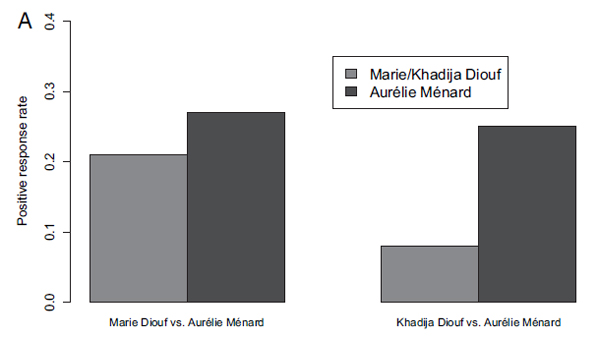
Last month, Lisa posted a video of Devah Pager discussing her research on the effects of race and a criminal background, and the likelihood of being offered a job. Her experiment indicated that White men with a non-violent drug offense on their record were more likely to get a call back for a job interview than African American men with no criminal background at all.

A post at Discover magazine indicates a similar situation for Muslims in France. Researcher Claire Adida looked at the effects of having a name identified as Muslim on job prospects:

Adida did it by focusing on France’s Senegalese community, which includes a mix of both Muslims and Christians…Adida created three imaginary CVs. All were single, 24-year-old women, with two years of higher education and three years of experience in secretarial or accounting jobs. Only their names, and small details about past employers, differed.

The three chosen names were Khadija Diouf (an easily-recognizable Muslim first name, while Diouf is well-known as a common last name in France’s Senegalese community), Marie Diouf (to represent a Christian Senegalese name), and Aurélie Ménard (a common French name with no particular religious associations). To highlight the religious differences, “Khadija” had worked at Secours Islamique, a non-profit, “Marie” had worked for Secours Catholique, another religious non-profit, and “Aurélie” hadn’t worked for any religious-affiliated employers.

The fictional CVs were then sent out to employers who listed secretarial and accounting jobs with a national employment agency in the spring of 2009; the jobs were matched in pairs based on industry characteristics, size of the employing company, and the specific position. Every position was sent a copy of the CV for Aurélie; for each matched pair of jobs, one got Khadija’s CV while one got Marie’s.

The results are striking. Aurélie got the most responses of all three. However, Marie Diouf also got responses from 21% of the employers the CV was sent to. The nearly identical CV, however, when used with the name Khadija Diouf, got responses from only 8% of potential jobs:

The Discover post adds, “Even after Adida included a photo on the applications (the same one, showing a woman who was clearly not North African), she found the same bias.”

Aurélie’s chances of getting a call back were basically identical for each employer in the matched pairs, which would seem to indicate there weren’t glaring differences between the positions themselves that would account for the variation in responses. Adida’s research also helps control for the possibility that employers might be discriminating based on race/ethnicity, immigrant status, concerns about language, or other factors, by focusing on religious-associated names within a particularly recognizable ethnic group.

A recent survey of Senegalese households in France further indicates that religion affects life chances independent of ethnic background. The survey looked at the income of two Senegalese groups, one Muslim, one Christian:

Both groups arrived in France in the 1970s, so neither enjoyed an economic headstart, although the Christians were slightly better educated. The survey’s data revealed that the Muslim households were significantly poorer than their Christian counterparts, even after adjusting for their initial educational advantage. They’re more likely to fall into poorer income groups and they make around 400 Euros less per month, around 15% of the average monthly salary in France.

Here’s the income distribution, clearly showing Muslim households concentrated at lower incomes than Christian households:

Interestingly, the Discover post suggests this might, if anything, underestimate anti-Muslim bias in the job market, because the Senegalese community is relatively assimilated (particularly in terms of language) and not highly identified with Islam. Muslims from ethnic groups more strongly linked to Islam by the general public may face even higher levels of discrimination.

Gwen Sharp is an associate professor of sociology at Nevada State College. You can follow her on Twitter at @gwensharpnv.

…and more in this 3-minute TED talk by Derek Sivers, sent in by AJ S.   As AJ points out, the examples show that “…just because something is different doesn’t mean it is not logical in context.”

Lisa Wade, PhD is an Associate Professor at Tulane University. She is the author of American Hookup, a book about college sexual culture; a textbook about gender; and a forthcoming introductory text: Terrible Magnificent Sociology. You can follow her on Twitter and Instagram.