Search results for The

Lisa Wade, PhD is an Associate Professor at Tulane University. She is the author of American Hookup, a book about college sexual culture; a textbook about gender; and a forthcoming introductory text: Terrible Magnificent Sociology. You can follow her on Twitter and Instagram.
An anonymous frequent reader sent in this Calvin Klein jeans ad that has been removed from billboards in Australia after the Advertising Standards Bureau banned its display on the grounds that it implies sexual assault. I’m putting it after the jump because it might be triggering for some people.

more...

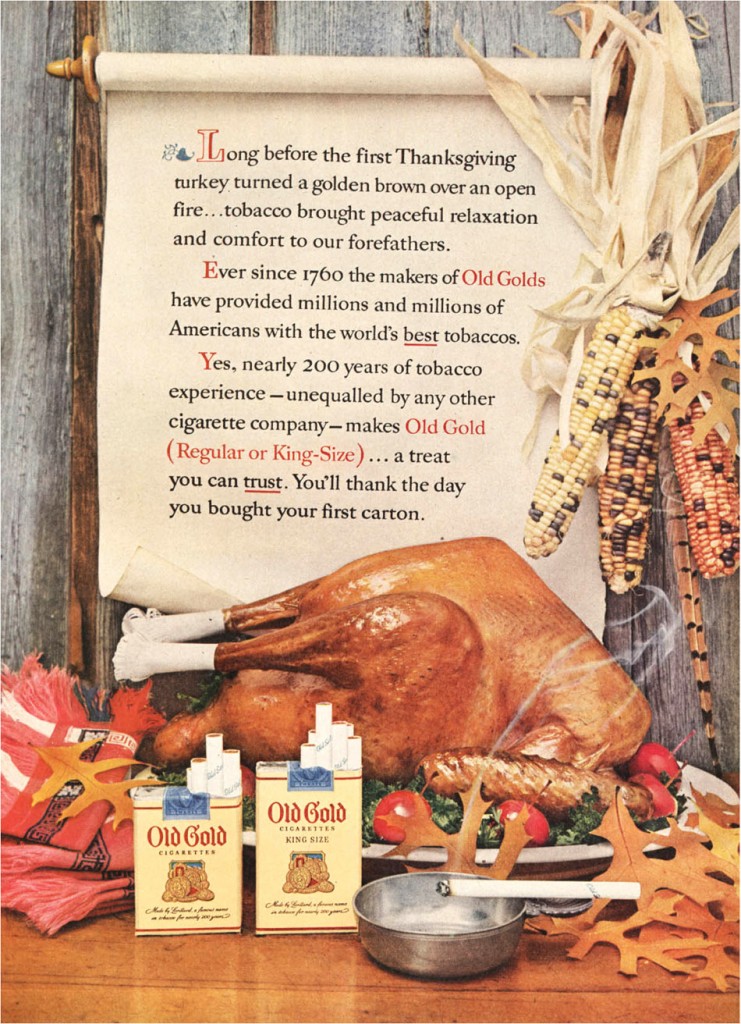
In this vintage ad, smoking tobacco is linked with a (rewritten) Thanksgiving history:

6a00d83451ccbc69e20105368a3341970b

See also our vintage ads marketing cigarettes with Christmas.

From Vintage Ads.

Lisa Wade, PhD is an Associate Professor at Tulane University. She is the author of American Hookup, a book about college sexual culture; a textbook about gender; and a forthcoming introductory text: Terrible Magnificent Sociology. You can follow her on Twitter and Instagram.
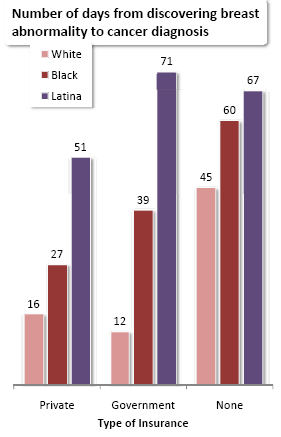
Black women and Latinas are more likely to die from breast cancer than white women.  This is, in part, because white women are more likely to have health insurance.  New research, however, illustrated by Philip Cohen at Family Inequality, suggests that even we control for types of insurance and whether women are insured, black women and especially Latinas wait longer than white women for a diagnosis of cancer after the discovery of a breast abnormality:

The authors of the study, Heather Hoffman and colleagues, did not attempt to explain the cause of the disparity.

See also our posts on racial disparities in life expectancy for people with Down’s Syndrome, rates of asthma, and kidney failure.

Lisa Wade, PhD is an Associate Professor at Tulane University. She is the author of American Hookup, a book about college sexual culture; a textbook about gender; and a forthcoming introductory text: Terrible Magnificent Sociology. You can follow her on Twitter and Instagram.
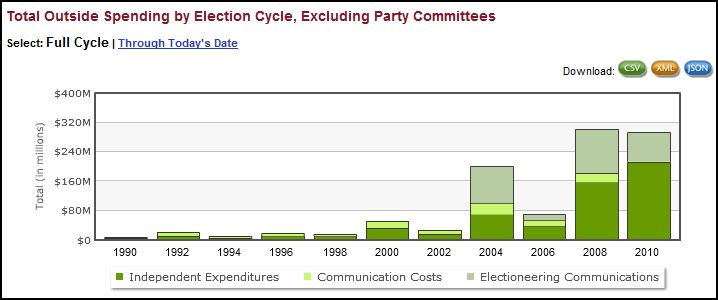
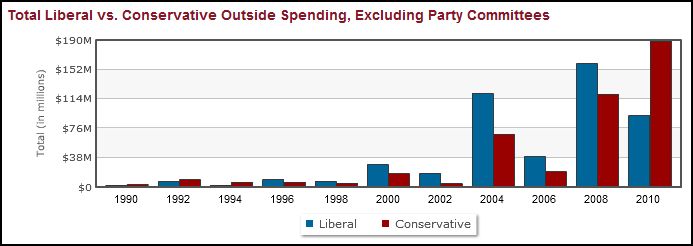
In 2010, as a matter of free speech, the United States Supreme Court decided that there can be no limits on corporate spending on advertisements in favor of a political candidate (Citizens United v. Federal Election Commission).  Open Secrets produced two figures revealing the rise in “outside spending” (i.e., non-party spending) showing the rise.

Total outside spending:

Outside spending for liberals and conservatives:

Open Secrets explains:

…the 2004 election marked a watershed moment in the use of independent expenditures to try to sway voters, with most of that new spending coming from the national party committees.  The 2010 election marks the rise of a new political committee, dubbed “super PACs,” and officially known as “independent-expenditure only committees,” which can raise unlimited sums from corporations, unions and other groups, as well as wealthy individuals.

Hermes’ Journeys editorializes:

You can see that liberals slightly outspent conservatives every election since 1996. Except for this year, when quite suddenly a mysterious flood of funding caused conservative campaign coffers to skyrocket, DOUBLING what liberals could muster. Was this the result of concerned right-leaning citizens becoming active in politics and making individual donations?  Of course not, it was profit-minded corporations…

…enabled, if I may finished HJ’s sentence, by the recent court decision.

Lisa Wade, PhD is an Associate Professor at Tulane University. She is the author of American Hookup, a book about college sexual culture; a textbook about gender; and a forthcoming introductory text: Terrible Magnificent Sociology. You can follow her on Twitter and Instagram.
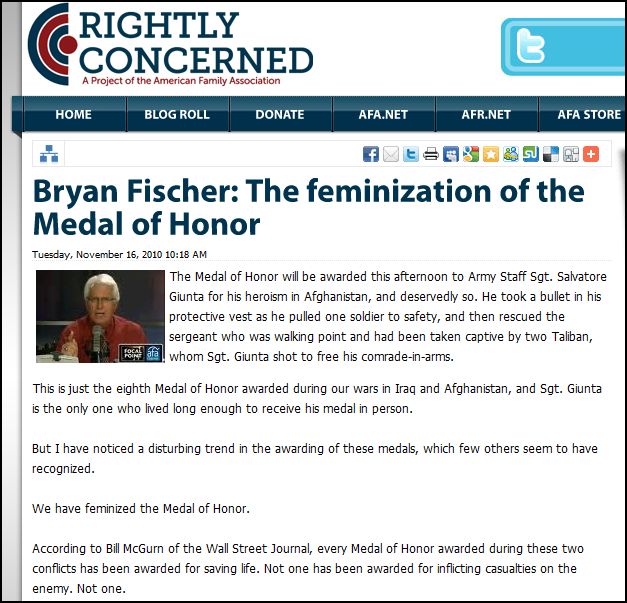
Rich sent in a fascinating example of an attempt to redefine masculinity.  At Rightly Concerned, Brian Fischer argues that the fact that all of the recipients of the Medal of Honor awarded during the Iraq and Afghanistan wars have received the award for saving lives, not taking them.  He calls this trend “the feminization of the Medal of Honor.”

Let’s not get into a conversation about whether the Medal should be awarded for saving lives, taking lives, or both.  Instead, let’s consider what, exactly, Fischer is saying about men and masculinity.  Fischer is suggesting that saving lives is something that women (should) do.  He has arranged saving lives and taking them in a binary layered onto gender.  Women save; men kill.  When men save, they are doing something feminine.

This is in dramatic contrast to the vision of the heroic man who protects others that has long been part of the American imagination (think firemen, policemen, body guards, big brothers, dads, boyfriends, and husbands) and a very interesting example of an attempt to redefine what “real men” do.

Lisa Wade, PhD is an Associate Professor at Tulane University. She is the author of American Hookup, a book about college sexual culture; a textbook about gender; and a forthcoming introductory text: Terrible Magnificent Sociology. You can follow her on Twitter and Instagram.
A recent New York Times article on cheese, brought to my attention by Jordan G., beautifully illustrates the fact that the U.S. government is not a coherent bloc, but a collection of competing interests.

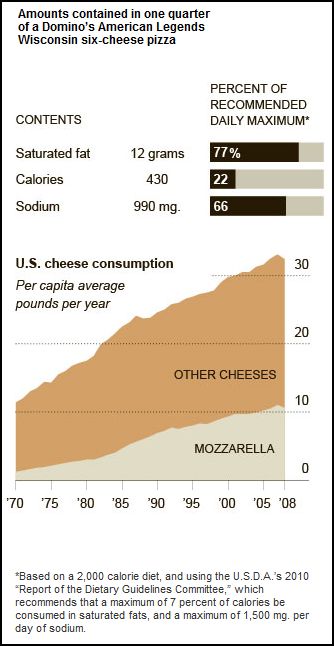
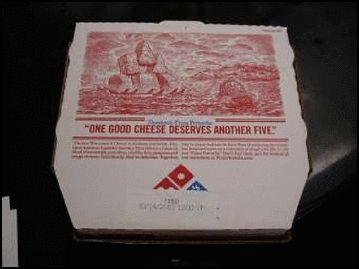
Last month Domino’s Pizza released a new pizza named “The Wisconsin.”   Named after a superbly cheesy state (one close to our hearts here at SocImages), the pizza has six cheeses on top and two in the crust.  The New York Times reports that one quarter of a pie (an amount I could certainly put away without effort), had more than 3/4ths of the recommended maximum in a day and double the calories of some of its other pizzas.

The Wisconsin:

Cheese, it turns out, is the main source of saturated fats in American diets and saturated fats contribute to significant morbidity and mortality in the U.S.  The government, accordingly, recommends that we eat less of it.

Document from the Department of Agriculture:

And here’s where the story gets interesting.  The Department of Agriculture is not only responsible for the health of Americans, it’s responsible for the health of the American food industry.  As consumption of cheese and non-low-fat milks declines in the U.S., the dairy industry suffers.  According to the New York Times:

Every day, the nation’s cows produce an average of about 60 million gallons of raw milk, yet less than a third goes toward making milk that people drink. And the majority of that milk has fat removed to make the low-fat or nonfat milk that Americans prefer. A vast amount of leftover whole milk and extracted milk fat results.

The government used to buy cheese and butter from its dairy farmers, leading to a vast collection of dairy products stored in underground caves in Missouri (totally not kidding). It’s switched strategies — after all, how much cheese and butter can one country hoard? — and while one arm of the Department of Agriculture tells us to eat less cheese, another is telling us to eat more.

In fact, the government spent $12 million American tax dollars marketing The Wisconsin pictured above.  Dairy Management is the dairy marketing arm of the U.S. Department of Agriculture.  It has a budget of nearly $140 million per year… and it is in cahoots with pizza chains.

“This is one way that we can support dairy farms across the country: by selling a pizza featuring an abundance of their products,” a Domino’s spokesman said in a news release. “We think that’s a good thing.”

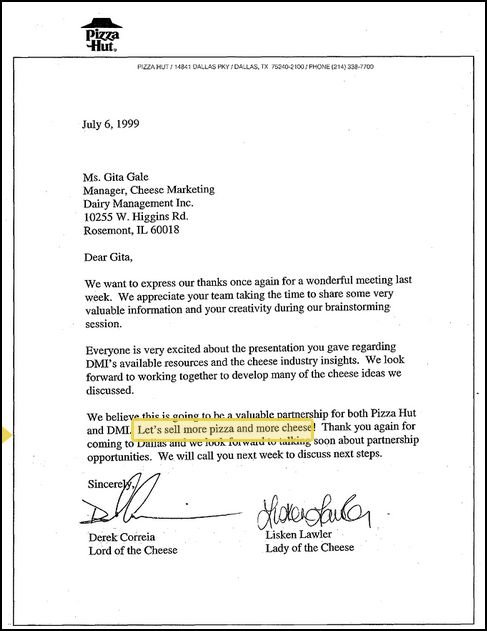
“Let’s sell more pizza and more cheese!” said two officials with Pizza Hut, which began putting cheese inside its crust after holding development meetings with Dairy Management, according to a memorandum released by the Agriculture Department.

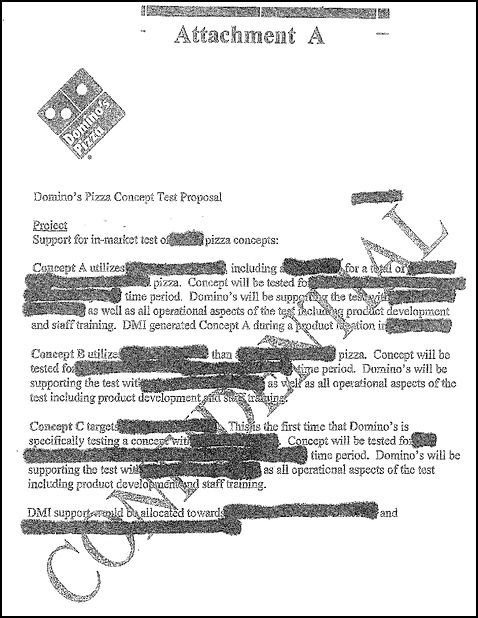
Random suspicious documents:

Dairy Management’s Pizza Hut promotion in 2002 (the “Summer of Cheese”) reportedly pushed an additional 102 million pounds of cheese into American bellies.  And consumers are eating up Domino’s new pie.  The Times reports that sales have “soared by double digits.”

My co-blogger, Gwen, specializes in rural sociology and agriculture.  Discussing this post, she confirms:
It is a deeply, deeply divided government entity, with the “let’s sell more!” side almost always better funded… [than] the “but it kills people!” side.
Next up: Tobacco.

Lisa Wade, PhD is an Associate Professor at Tulane University. She is the author of American Hookup, a book about college sexual culture; a textbook about gender; and a forthcoming introductory text: Terrible Magnificent Sociology. You can follow her on Twitter and Instagram.
Cross-posted at Jezebel.

In the article “And You Can Be My Sheikh: Gender, Race, and Orientalism in Contemporary Romance Novels,” Jessica Taylor discusses the “sheikh romance,” a type of romance novel that, Taylor argues, follows the following basic formula:

In an exotic land where it is rumoured that men still rule, a tall, dark and handsome sheikh meets a white woman who teaches him how to be ruled by love. (p. 1032)

Sheikh romances are generally set in fictional countries in the Middle East, with a male character described as a “sheikh,” “sultan,” or something along the lines of “king of the desert.” He is, of course, invariably rich and powerful. The female protagonist, on the other hand, is a White woman, usually from the U.S.

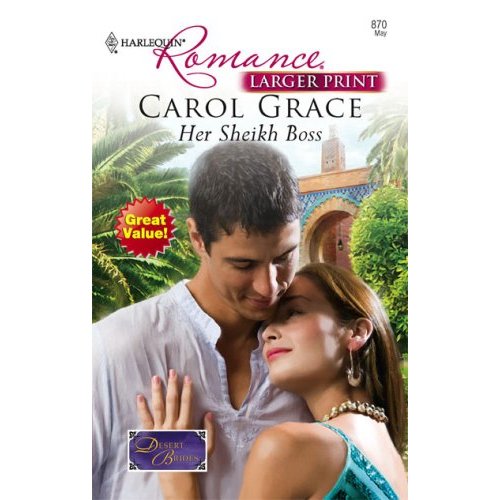
The topic is popular enough that Harlequin has a whole series, Desert Brides:

Another popular option is the Sons of the Desert series:

Taylor argues that these novels present a masculinized, exotic, and ultimately pre-modern Oriental Other that is contrasted with the modernized West.

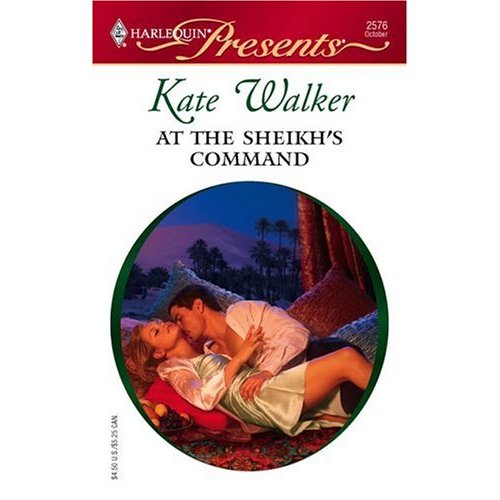
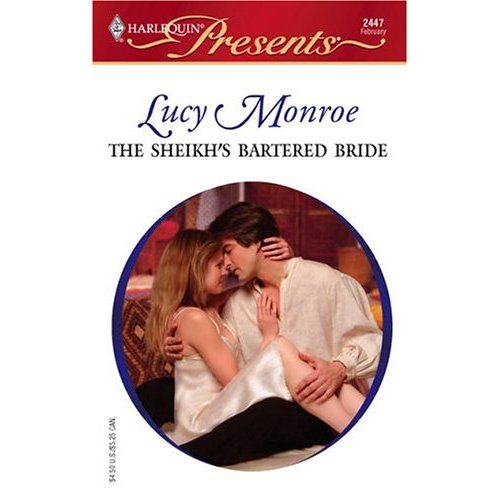
Some examples:

The blurb, from Amazon (elipses in original):

When Sheikh Khalid Fehr rescues innocent Olivia Morse from the hands of his country’s enemies, he guarantees her freedom by announcing she is his betrothed….Khalid has vouched for Liv with his honor… and this desert king is determined that his new wife will fulfill her marital duties, by his side as his regal queen…and as his captive virgin bride!

Description:

Abbie Cavanaugh’s brother is in jail. Abbie can obtain his freedom—but only if she marries the Sheikh of Barakhara. The explosive passion between Prince Malik and Abbie could turn a marriage of convenience into one of Eastern promise. But neither Abbie nor Malik knows the other’s real identity. Can their marriage survive once the truth is revealed?

Description:

After a whirlwind courtship, Sheikh Hakim bin Omar al Kadar proposes marriage. Shy, innocent Catherine Benning has already fallen head-over-heels in love and she accepts….

After their wedding day–and night–when the sheikh claims his virgin wife, Catherine and Hakim travel to his desert kingdom. There Catherine discovers that this is no love match for Hakim–he’s bought her!

For more examples, go to Amazon and search “sheikh romance.” Seriously, there are tons of them — Traded to the Sheikh, Stolen by the Sheikh, The Desert Prince’s Mistress, The Sheikh’s Virgin, Love-Slave to the Sheikh, The Sheikh’s Ransomed Bride (notice the recurring economic transaction theme?), and my new personal favorite book title ever, Hired: The Sheikh’s Secretary Mistress, described thusly:

Sheikh Amir bin Faruq al Zorha lives in New York, but the desert is where his heart lies. Now it’s time for him to marry….Grace Brown, Amir’s plain but indispensable assistant, isn’t exactly queen material. No matter how tempted Amir is to take her innocence, she’s off-limits. Until he returns to his homeland, where the barbarian prince replaces the businessman—and resolves that Grace will be his!

Taylor argues that the themes of these books reflect concerns about gender relations while also setting up an East/West dichotomy in which Western (usually specifically U.S.) women tame the “barbarian” desires of non-Western men. The male love interests are too masculine for current U.S. cultural norms; they attempt to control women in an obvious manner, to force them into marriage, and/or to acquire them by purchase or trade.

But they are ultimately redeemable “barbarian princes.” On the cover, they’re darker than the (generally blond) woman, but only slightly so. They are usually described as having lived in the U.S. or Europe, often during college. They seek to “modernize” their countries, often signaled by their disinterest in or opposition to the harems still maintained by other men in their countries. Referring to harems clearly links this fictionalized Middle East to the past, while the individual hero instead chooses monogamy with one White woman, signaling his modernization.

A woman, and love, tame the dangerous but desirable hero. Interestingly, femininity here is presented as preferable not just for women, but for the male character as well, as a necessary element to balance his hypermasculinity:

…the man is brought to acknowledge the pre-eminence of love and the attractions of domesticity…the theme of category romance is female power…By getting the hero to give in and fall in love with her, and admit it, she brings him into the “feminine” world view…the heroine “civilizes” the Arab hero into a domestic love and he thus becomes an acceptable husband for a white girl. (p. 1046-47).

Ultimately, then, the sheikh romance presents a backward East, a state signaled largely by gender relations. There are two types of Middle Eastern men: those who are redeemable, who can be modernized, and those who can’t. And adoption of a certain ideal of monogamous romantic love, which renders the hero’s hypermasculinity exotic but no longer scary, provides the key to modernizing otherwise barbaric cultures.

The article is in Journal of Popular Culture v. 40, no. 6 (2007), p. 1032-1051.