Search results for The

Cross-posted at Reports from the Economic Front.

How do corporations escape paying taxes?  Businessweek recently ran a story on Google that helps to explain how they do it.

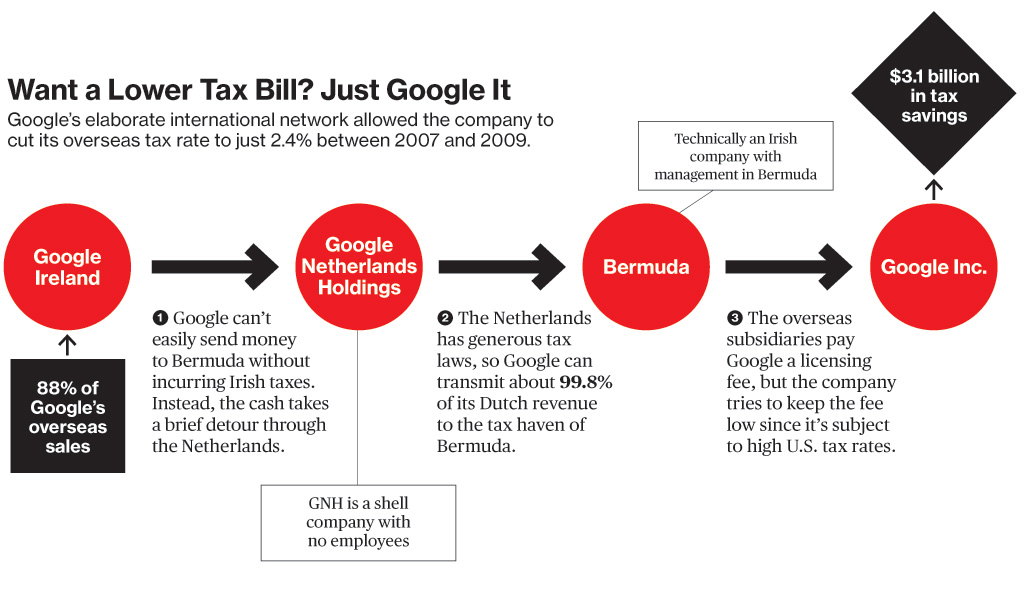
The story begins by noting that: “Google has made $11.1 billion overseas since 2007.  It paid just 2.4 percent in taxes.  And that’s legal.”   This is pretty incredible because Google does business in many advanced capitalist countries with high tax rates.  For example, “The corporate tax rate in the U.K., Google’s second-largest market after the U.S., is 28 percent.”

While the article focuses on Google, and how it avoids paying taxes, it made clear that most of the leading high-technology companies use remarkably similar techniques to achieve similar results.

Ok, so how does Google do it?  Google’s office in Ireland is the center of the company’s international operations.  In 2009 it “was credited with 88 percent of the search juggernaut’s $12.5 billion in sales outside the U.S.”  But Google doesn’t pay taxes on that amount, because most of the profits went to Bermuda, where there is no corporate income tax.

So, how did Google get its profits to Bermuda?  Businessweek explains:

Google’s profits travel to the island’s white sands via a convoluted route known to tax lawyers as the “Double Irish” and the “Dutch Sandwich.” In Google’s case, it generally works like this: When a company in Europe, the Middle East, or Africa purchases a search ad through Google, it sends the money to Google Ireland. The Irish government taxes corporate profits at 12.5 percent, but Google mostly escapes that tax because its earnings don’t stay in the Dublin office, which reported a pretax profit of less than 1 percent of revenues in 2008.

Irish law makes it difficult for Google to send the money directly to Bermuda without incurring a large tax hit, so the payment makes a brief detour through the Netherlands, since Ireland doesn’t tax certain payments to companies in other European Union states. Once the money is in the Netherlands, Google can take advantage of generous Dutch tax laws. Its subsidiary there, Google Netherlands Holdings, is just a shell (it has no employees) and passes on about 99.8 percent of what it collects to Bermuda. (The subsidiary managed in Bermuda is technically an Irish company, hence the “Double Irish” nickname.)

This set-up (as Businessweek describes it) also helps Google lower its tax bill in the U.S.  Google Ireland licenses its search and advertizing technology from Google’s headquarters in Mountain View, California.  Obviously this technology is worth a lot—but Google headquarters keeps the licensing fee to Google Ireland low.  Doing so means that Google headquarters can minimize its U.S. earnings and thus its tax obligations to the U.S. government.  And of course, Google Ireland knows how to move its profits around to minimize its tax liabilities.
Not surprisingly, corporations are always eager to learn from each other.  Thus, “Facebook is preparing a structure similar to Google’s that will send earnings from Ireland to the Cayman Islands, according to company filings and a person familiar with the arrangement.”  Microsoft already has one in place.

According to one study cited by Businessweek (done by Kimberly A Clausing, an economics professor at Reed College), these kinds of profit shifting arrangements cost the U.S. government as much as $60 billion a year.  And of course Ireland also loses plenty.  Too bad that the governments of Ireland and the U.S. are suffering from large federal deficits and under immense pressure to slash spending.   Collateral damage I guess to the profit-making drive.

What is being done to change this apparently legal racket?  According to Businessweek:

The government has made halting steps to change the rules that let multinationals shift income overseas. In 2009 the Treasury Dept. proposed levying taxes on certain payments between U.S. companies’ foreign subsidiaries, potentially including Google’s transfers from Ireland to Bermuda. The idea was dropped after Congress and Treasury officials were lobbied by companies including General Electric, Hewlett-Packard, and Starbucks, according to federal disclosures compiled by the nonprofit Center for Responsive Politics. In February the Obama Administration proposed measures to curb companies’ ability to shift profits offshore, but they’ve largely stalled.

nice cozy system, isn’t it.

In an old post on the idea of cool, I summarized Susan Bordo’s observations in Twilight Zones:

…the art of being cool is appearing not to care… what marked someone as cool was their complete disinterest in you, everything you stand for and, especially, what you thought of them. Being cool is not being needy.

I was reminded of this idea when Ali S., M., Hishaam S., Dmitriy T.M., and Alian K. passed along a set of ads for a Dutch clothing company, Suit Supply.  Lauri Apple at Jezebel writes that they’re “creepy and porno-like” and I think it is the cool factor that makes them so.  Notice how disinterested most of the characters, especially the men, appear to be.  He lounges on the couch, entirely unaffected by the imminent humping behind him.  They screw on the kitchen counter, like it’s their same ol’ boring routine.  He casually lifts up her skirt, like it’s no big thing.

More (some not safe for work) after the jump:

more...

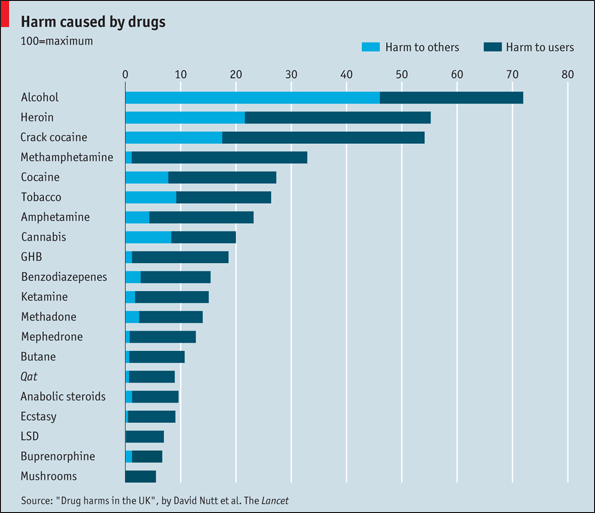
Katelyn G. sent in a link to a story at The Economist about a new study that attempted to measure the harmful effects, to both the user and to the U.K. more broadly, of a number of legal and illegal drugs. The methodology:

Members of the Independent Scientific Committee on Drugs, including two invited specialists, met in a 1-day interactive workshop to score 20 drugs on 16 criteria: nine related to the harms that a drug produces in the individual and seven to the harms to others. Drugs were scored out of 100 points, and the criteria were weighted to indicate their relative importance.

Harm to others included factors such as health care costs, family disruptions, social services, and the cost of criminal justice programs to regulate drugs.

The results? Alcohol outranked all illegal substances they considered by a significant margin, particularly in terms of the harm caused to others:

Will this lead to major changes in drug policy in the U.K.? Unlikely. Here’s a tidbit from an NPR story:

…last year in Britain, the government increased its penalties for the possession of marijuana. One of its senior advisers, David Nutt — the lead author on the Lancet study — was fired after he criticized the British decision.

“What governments decide is illegal is not always based on science,” said van den Brink. He said considerations about revenue and taxation, like those garnered from the alcohol and tobacco industries, may influence decisions about which substances to regulate or outlaw.

Enjoy Jennifer Lee, professor of sociology at UC Irvine, discussing how the American concept of race has been changing as we’re confronted with a more complex racial landscape. Are we forcing all racial groups into the pre-existing black/white binary?  A white/non-white binary?  A black/non-black binary?  Or something else?

Lisa Wade, PhD is an Associate Professor at Tulane University. She is the author of American Hookup, a book about college sexual culture; a textbook about gender; and a forthcoming introductory text: Terrible Magnificent Sociology. You can follow her on Twitter and Instagram.


In this 11-minute video, Dalton Conley interviews Victor Rios about the youth control complex.  He argues the that punishing arm of the state (the prison system) and the nurturing arm of the state (the education system) work together to criminalize, stigmatize, and punish young inner city boys and men.

Rios’ ideas apply very well to the treatment of Latarian Milton, the 7-year-old boy who was charged with grand theft auto for taking his grandmother’s car for a joy ride.

Lisa Wade, PhD is an Associate Professor at Tulane University. She is the author of American Hookup, a book about college sexual culture; a textbook about gender; and a forthcoming introductory text: Terrible Magnificent Sociology. You can follow her on Twitter and Instagram.

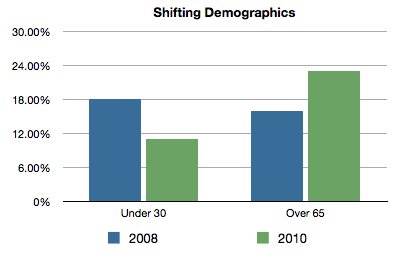
In the midterm election last week Republicans took the House and won eight seats in the Senate. Their win, however, as Matthew Yglesias puts it, doesn’t simply reflect the “national mood.”  Instead, it was partly a reflection of a shift in the demographics of the voters who turned out. Young voted still lean Democratic, and many more of them stayed home last Tuesday than two years ago.

See also our post on historic trends in voter turnout.

Via Jose Marichal at Thick Culture.

Lisa Wade, PhD is an Associate Professor at Tulane University. She is the author of American Hookup, a book about college sexual culture; a textbook about gender; and a forthcoming introductory text: Terrible Magnificent Sociology. You can follow her on Twitter and Instagram.

Named after the classic New Orleans cocktail, the Sazerac bar excluded women until 1949 when the hotel’s owner, Seymour Weiss, moved it to the Roosevelt New Orleans Hotel and opened its doors to women.    Long thirsty for the best Sazerac in town, women crammed into the bar on September 26th.  The moment was captured in this fabulous photo:

Last month the Roosevelt had an event commemorating 60 years since the “stormin’ of the Sazerac.”  My friend and photographer Brian Huff captured the re-creation:

If anyone knows the photographer who took the 1949 photo, please let me know so that I can credit him.

Lisa Wade, PhD is an Associate Professor at Tulane University. She is the author of American Hookup, a book about college sexual culture; a textbook about gender; and a forthcoming introductory text: Terrible Magnificent Sociology. You can follow her on Twitter and Instagram.

Sharon Gefen sent along a five-minute SPARK Summit video on the sexualization of women and girls in the media and its effects on young women:

Lisa Wade, PhD is an Associate Professor at Tulane University. She is the author of American Hookup, a book about college sexual culture; a textbook about gender; and a forthcoming introductory text: Terrible Magnificent Sociology. You can follow her on Twitter and Instagram.