Search results for The


(NOTE: I am writing this post on January 2nd, 2010… almost a year before it will publish.  As I write it… I wonder if the wars in Iraq and Afganistan will still be ongoing.)

Last year Christmastime, Gin and Tacos highlighted this Walmart commercial:

He writes:

That commercial has nothing to do with Wal-Mart. It tells you nothing about its products, services, prices, or policies. It’s just sentimental pap, a cheap effort to bypass logic and score points on an emotional level.

Indeed, Walmart is attempting to associate its company with the admiration inspired by those risking their lives in war.  Why this doesn’t result in a strong and consequential backlash is lost on me.

Lisa Wade, PhD is an Associate Professor at Tulane University. She is the author of American Hookup, a book about college sexual culture; a textbook about gender; and a forthcoming introductory text: Terrible Magnificent Sociology. You can follow her on Twitter and Instagram.
Last month, Lisa posted a video of Jennifer Lee discussing the U.S. racial ideology with Dalton Conley. Jennifer (who teaches sociology at the University of California-Irvine) emailed us to let us know there’s now a second video, in which she discusses the difference between race and ethnicity, as well as how racial ideologies are socially constructed:

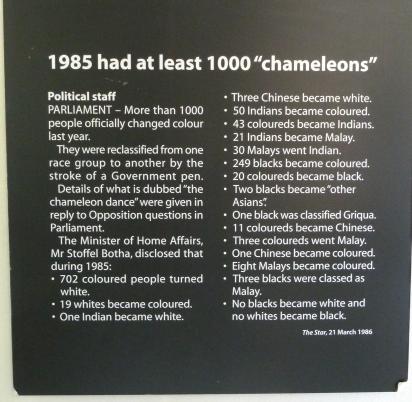
Peter Nardi, of Pitzer College, sent in an image that illustrates the social construction of race. He visited the Apartheid Museum in Johannesburg, South Africa, and took a photo of a plaque on the wall that reprinted information published in the Johannesburg-based newspaper The Star on March 21, 1986. The article reported on changes in the official racial classification of over 1,000 South Africans in 1985:

Because race is socially constructed, racial classifications change as underlying racial ideologies shift, sometimes opening up opportunities (for instance, allowing groups to be classified as a less stigmatized race) but also often reinforcing racial stratification (such as when the U.S. made the “one-drop” rule, by which you were African American if you had even one Black ancestor, official policy, preventing mixed-race individuals from avoiding the stigma of being Black).

And I’m visiting my family until the 28th, so I will have very sporadic internet access. I’ve scheduled posts for the whole week, but I won’t be able to update/correct/respond much, so I apologize in advance. On the upside, my trips home often provide material for at least one post, so yay!

Talking Points Memo posted an article about a study recently released by the Program on International Policy Attitudes at the University of Maryland. The study looks at misinformation about issues related to the 2010 election among the U.S. electorate. The survey sampled 616 individuals who reported that they voted in the November elections, and according to their methodology, was chosen to be representative of the overall U.S. population. After individuals were chosen to take part, they were asked to complete an online survey; those who didn’t have access to a computer were provided with a laptop and internet access. You can read more about this method of collecting data, which uses an online program called Knowledge Networks, here.

Of course, any study of misinformation brings up the tricky question of how to identify what is “true,” and how to do so in a way that isn’t itself political. The authors explain at length:

…we used as reference points the conclusions of key government agencies that are run by professional experts and have a strong reputation for being immune to partisan influences. These include the Congressional Budget Office, the Department of Commerce, and the National Academy of Sciences. We also noted efforts to survey elite opinion, such as the regular survey of economists conducted by the Wall Street Journal; however, we only used this as supporting evidence for what constitutes expert opinion. In most cases we inquired about respondents’ views of expert opinion, as well as the respondents’ own views…in designing this study we took the position that some respondents may have had correct information about prevailing expert opinion but nonetheless came to a contrary conclusion, and thus should not be regarded as ‘misinformed.’

On some issues, such as climate change, there is a vocal dissenting minority among experts. Thus questions were framed in terms of whether, among experts, more had one or another view, or views were evenly divided.

The researchers first asked if respondents believed they had seen or heard misleading or incorrect information during the fall campaign. Overall, a majority of voters said they had encountered misinformation during the election, and over half said there was more misinformation this time than usual.

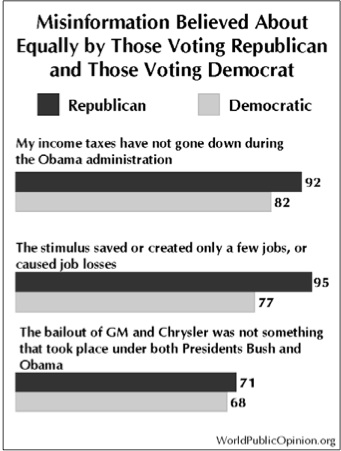
The results also indicated relatively high levels of misinformation on a number of questions. For instance, 40% thought the Trouble Assets Relief Program (TARP, or the bank bailout) was passed under President Obama, when it was actually passed under President Bush; 43% didn’t know that President Obama has increased the number of U.S. troops in Afghanistan. And overall, respondents seemed quite confused about financial policies, with overwhelming majorities of both Republicans and Democrats getting questions about taxes, the stimulus, and the auto maker bailout wrong:

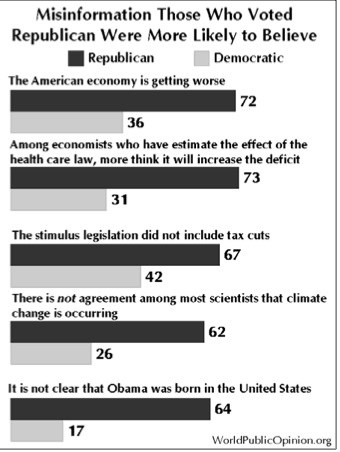
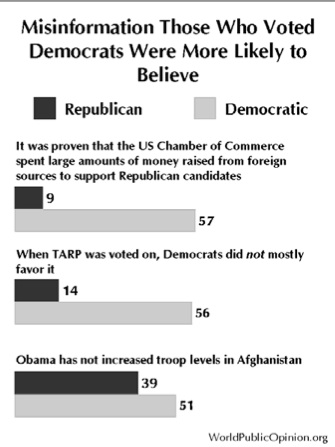
However, for most items, Democrats and Republicans tended to differ on which issues they were misinformed about, in fairly predictable ways:

Finally, the study found that source of information seemed to play a role. Those who said they watched Fox News were more misinformed than any other group, and the more they watched it, the more misinformed they were — whereas with most other news sources, the more news individuals consumed, the less misinformed they were. Viewers of Fox News were more likely to believe the following (incorrect) statements (from p. 20 of the report):

  • most economists estimate the stimulus caused job losses (12 points more likely)
  • most economists have estimated the health care law will worsen the deficit (31 points)
  • the economy is getting worse (26 points)
  • most scientists do not agree that climate change is occurring (30 points)
  • the stimulus legislation did not include any tax cuts (14 points)
  • their own income taxes have gone up (14 points)
  • the auto bailout only occurred under Obama (13 points)
  • when TARP came up for a vote most Republicans opposed it (12 points)
  • it is not clear that Obama was born in the United States (31 points)

This pattern persisted regardless of political affiliation — Democrats who reported watching more Fox News were more misinformed than other Democrats, though less so than Republicans who watch the same amount of Fox News.

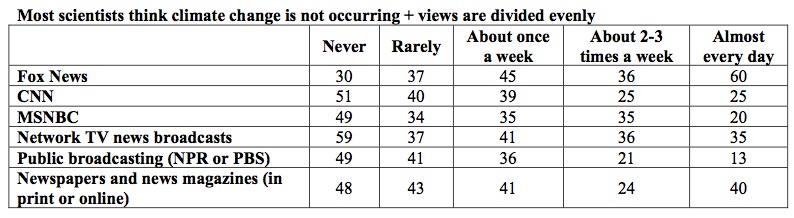
This table shows the number of respondents who said most experts believe climate change either isn’t occurring or that the scientific community is evenly split, by source of news and how often they view that source (p. 21):

They have the same breakdown of data for each question. In general, the lowest levels of misinformation were found among those who reported high levels of consumption of news from MSNBC and/or PBS/NPR. However, as the study authors point out, for a number of questions (such as those about the effects of the stimulus program), all groups had quite high levels of misinformation.

Of course, this leaves a number of questions unanswered: are people more misinformed because they watch Fox News? Or are misinformed people more likely to watch Fox News at least in part because it is more likely to reinforce ideas they already have?

And how does the choice of these particular questions, out of all the potential questions we could ask to judge how well- or poorly-informed people are, affect the results? I suspect critics might say that many of these questions are ones liberals are more likely to get right simply by answering based on political ideology, regardless of actual knowledge — for instance, someone who is Democratic might be more likely to say the health care bill wouldn’t add to the deficit, and thus be “right,” but answer that way because health care reform was a Democratic-backed policy and thus something they supported, not because they have any concrete knowledge about it. As we see with the question about the Chamber of Commerce, when a question doesn’t fit so well with liberal-leaning views (the Chamber of Commerce tends to be more popular among conservatives), Democrats showed high levels of misinformation as well. If we asked more of those sorts of questions, would we find that Democrats (or, say, those who report PBS or NPR as their main source of information) were more misinformed than Fox viewers?

Thoughts?

Mark Grief wrote a fantastic analysis of the “hipster” in the New York Times.  Drawing on a book he edited,”What Was the Hipster?“, with Kathleen Ross and Dayna Tortorici, Grief offers an analysis based on the work of Pierre Bourdieu.

Bourdieu observed that the rich justified and naturalized their economic advantage over others not only by pointing to their bank accounts, but by being the arbiters of taste.  Bourdieu shows us that taste…

…is not stable and peaceful, but a means of strategy and competition. Those superior in wealth use it to pretend they are superior in spirit.

Style, in other words, is not just arbitrary; it is about establishing that you are better than other people.

Those below us economically, the reasoning goes, don’t appreciate what we do; similarly, they couldn’t fill our jobs, handle our wealth or survive our difficulties.

But the rich aren’t the only ones who attempt to use taste and style to gain and preserve status.  Indeed, hipsters may be the purest example of this phenomenon.

“Once you take the Bourdieuian view,” Grief explains, “you can see how hipster neighborhoods are crossroads where young people from different origins, all crammed together, jockey for social gain” by liking cool things first.

I will quote Grief liberally because he does such a fantastic job of describing the field:

One hipster subgroup’s strategy is to disparage others as “liberal arts college grads with too much time on their hands”; the attack is leveled at the children of the upper middle class who move to cities after college with hopes of working in the “creative professions.” These hipsters are instantly declassed, reservoired in abject internships and ignored in the urban hierarchy — but able to use college-taught skills of classification, collection and appreciation to generate a superior body of cultural “cool.”

They, in turn, may malign the “trust fund hipsters.” This challenges the philistine wealthy who, possessed of money but not the nose for culture, convert real capital into “cultural capital” (Bourdieu’s most famous coinage), acquiring subculture as if it were ready-to-wear. (Think of Paris Hilton in her trucker hat.)

Both groups, meanwhile, look down on the couch- surfing, old-clothes-wearing hipsters who seem most authentic but are also often the most socially precarious — the lower-middle-class young, moving up through style, but with no backstop of parental culture or family capital. They are the bartenders and boutique clerks who wait on their well-to-do peers and wealthy tourists. Only on the basis of their cool clothes can they be “superior”: hipster knowledge compensates for economic immobility.

All hipsters play at being the inventors or first adopters of novelties: pride comes from knowing, and deciding, what’s cool in advance of the rest of the world.

This, Grief concludes, is why everyone, especially hipsters, hates to be called a hipster.  The whole idea is to have authentically superior tastes.  Once you are revealed as someone who cares about having the right tastes, you are disqualified as a person who has good taste effortlessly.  Likewise, if you are suddenly one who has the same tastes as everyone else, you are just one of the masses.  Being a hipster, it turns out, is a perilous identity that must be constantly re-worked and re-authenticated.

Lisa Wade, PhD is an Associate Professor at Tulane University. She is the author of American Hookup, a book about college sexual culture; a textbook about gender; and a forthcoming introductory text: Terrible Magnificent Sociology. You can follow her on Twitter and Instagram.

This one-minute video exposes how one person is made to look his worst and his best for a sequential photo shoot. He is both a “before” and an “after” version of himself on a single day. It is as you have always suspected:

Borrowed from Body Impolitic.

Lisa Wade, PhD is an Associate Professor at Tulane University. She is the author of American Hookup, a book about college sexual culture; a textbook about gender; and a forthcoming introductory text: Terrible Magnificent Sociology. You can follow her on Twitter and Instagram.

This fascinating three-and-a-half-minute excerpt from the BBC’s Horizon illustrates the McGurk Effect. What does your brain do when the information it is receiving from different senses doesn’t match? It’s solution is an example of just how much interpretive work our brain is doing all the time.

Via Blame it on the Voices.

Lisa Wade, PhD is an Associate Professor at Tulane University. She is the author of American Hookup, a book about college sexual culture; a textbook about gender; and a forthcoming introductory text: Terrible Magnificent Sociology. You can follow her on Twitter and Instagram.
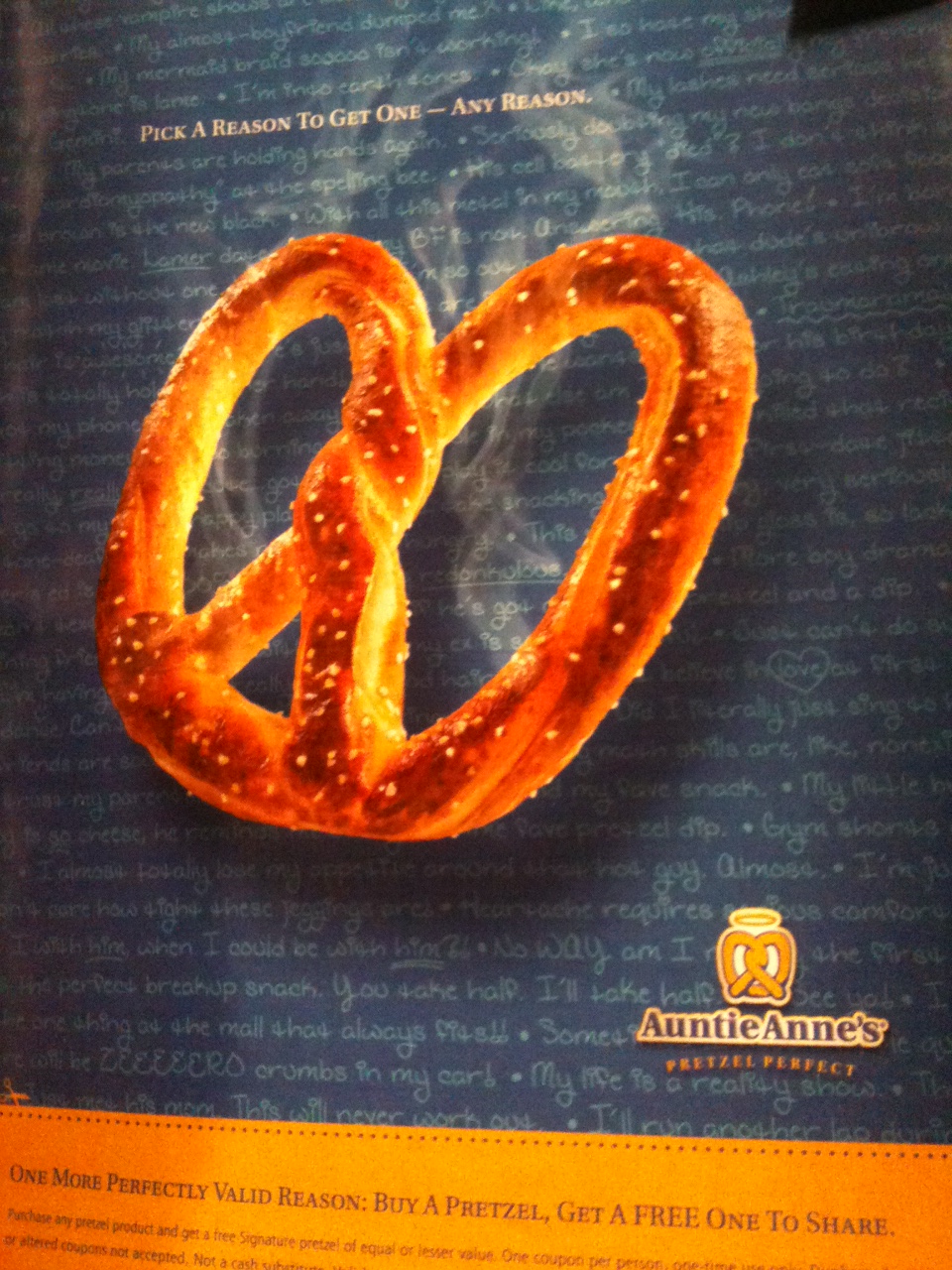
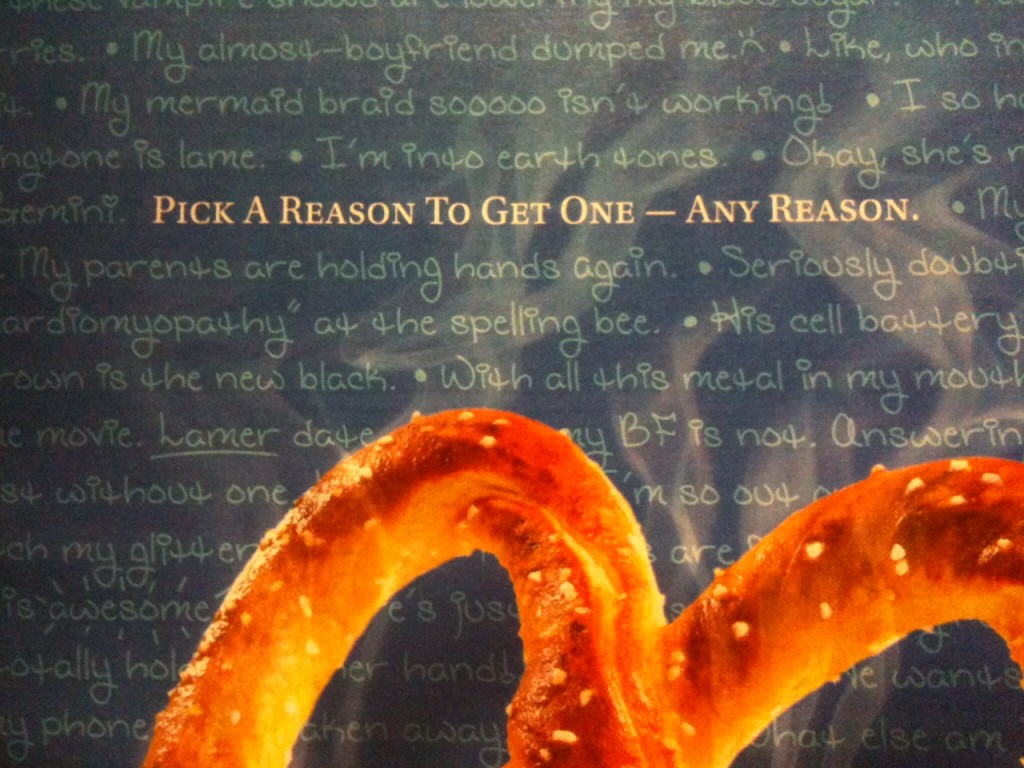
Alyssa M. sent in an ad that gives us a window into the advertising aimed at tween and teen girls.  The ad, for Auntie Anne’s pretzels (an American chain that appears mostly in shopping malls) appeared in Seventeen magazine.  The copy reads “Pick A Reason to Get One — Any Reason” and, in the background, is a long list of reasons.

The ad:

I’ll let Alyssa take it from here:

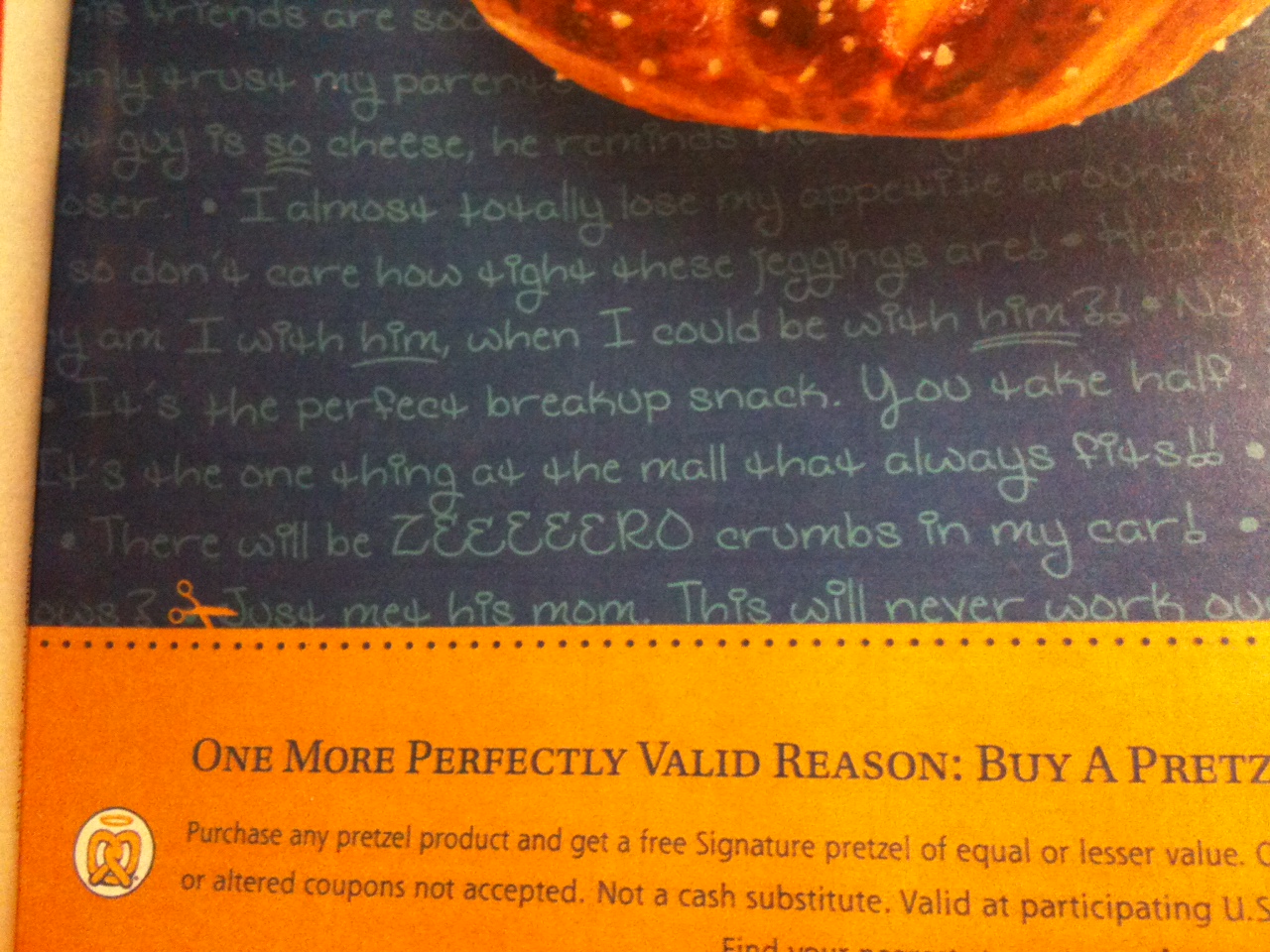
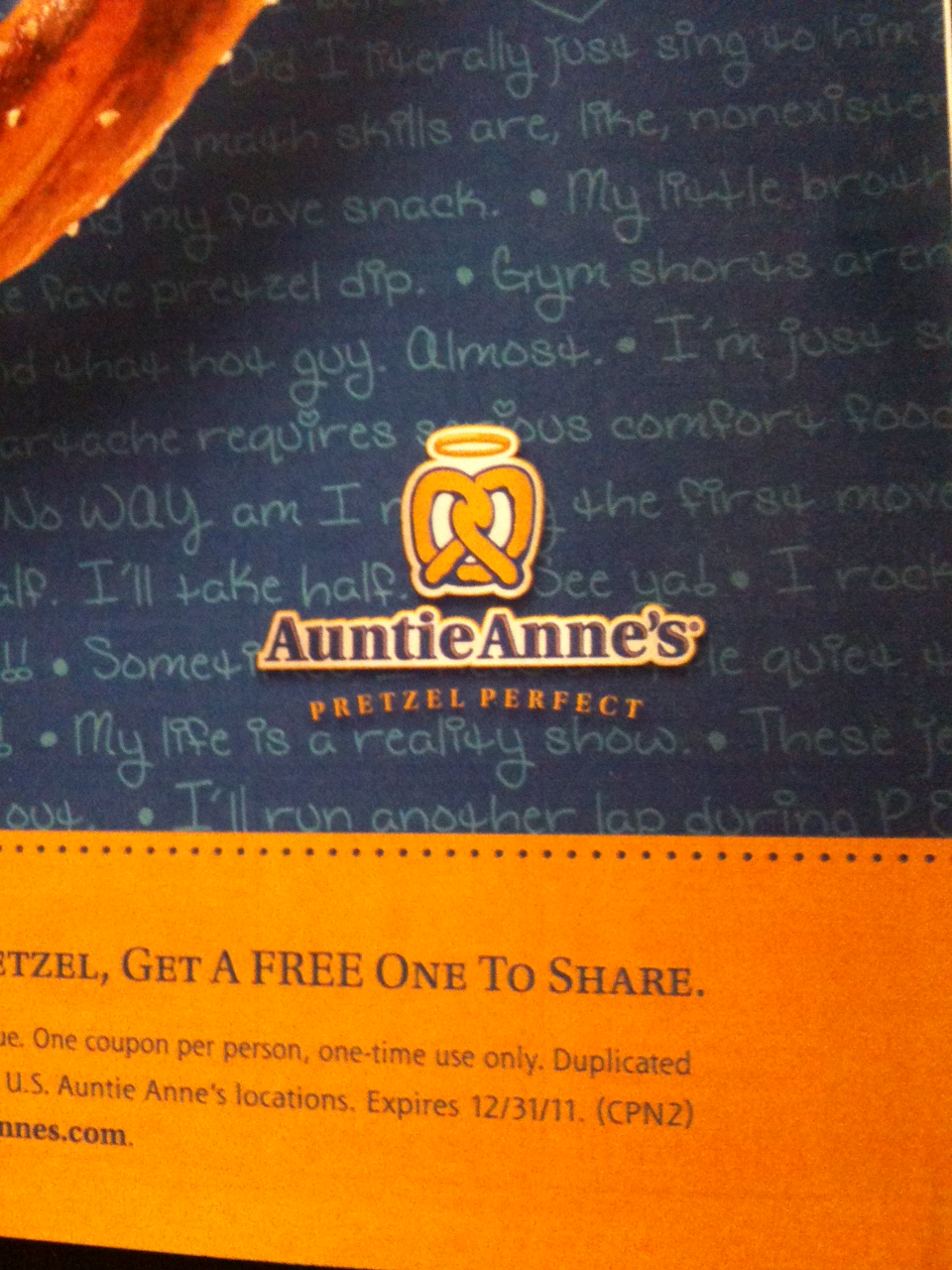
..the reasons in the background reflect gendered expectations that are placed on [teen girls]. One of the reasons, for example, is “I’ll run another lap during P.E.”  This reflects the idea that women should feel guilty about eating food, and that they should make up for eating a salty pretzel by exercising more. It also illustrates that women must justify eating by promising themselves that they will prevent any weight gain, which would stray from the type of woman that society deems best (the thin woman).  Another reason provided is that “It’s the one thing at the mall that always fits!!”  This again reflects the social necessity for women to be thin, as it implies that women are concerned with the fact that clothes at the mall are often too small, which implies that the women are too large. This ad very much focuses on girls’ size and waistlines and illustrates that a thin girl is the best girl, and that to be accepted by society, teen girls must act in accordance with this expectation.

Another theme seen throughout the ad is that food can be consumed in order to ease the emotional pain of a traumatic event such as a breakup. For example, two other reasons given are that “My almost-boyfriend dumped me” and “It’s the perfect breakup snack.” Both suggest that a breakup warrants an unhealthy indulgence like a pretzel, but this also implies that unhealthy foods like this are only acceptable during a bad experience like a breakup. Eating is okay when you need it to comfort yourself, but if you are not going through such an experience, then you need to watch your weight and “run another lap during P.E.” Those who break this rule are at risk of being policed by others and losing the body type that society appreciates most. This ad therefore supports the expectation placed on teen girls to be thin and concerned with their weights.

Close ups:


Alyssa’s analysis reminds me of Jamal Fahim’s argument for how chocolatiers convince women to indulge in their product.

Lisa Wade, PhD is an Associate Professor at Tulane University. She is the author of American Hookup, a book about college sexual culture; a textbook about gender; and a forthcoming introductory text: Terrible Magnificent Sociology. You can follow her on Twitter and Instagram.
Larry Harnisch, of The Daily Mirror, sent in a link to a story at the NYT regarding study released by the Geena Davis Institute on Gender in Media about the under-representation of women and girls in “family” movies — that is, movies rated G, PG, and PG-13. The authors looked at all English-language fictional G-rated films released in the U.S. or Canada between September 2006 and September 2009 (a total of 22 movies). They also looked at the 50 highest-grossing films for both PG- and PG-13-ratings, meaning a total of 122 movies is included in the analysis. They focused on characters that were either mentioned by name or spoke at least one word in the movie, leading to a sample of 5,554 characters. Of those, 70.8% were male and 29.2% were female.

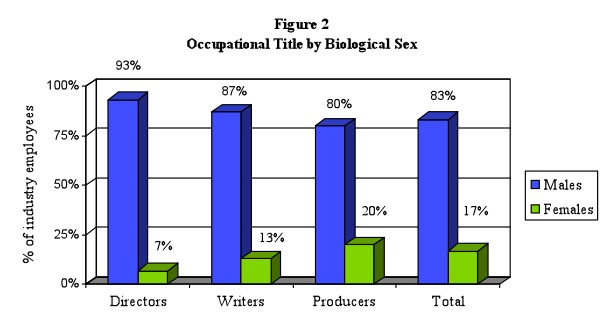
Consistent with patterns in Hollywood in general, women made up a small proportion of directors, writers, and producers in the movies studied:

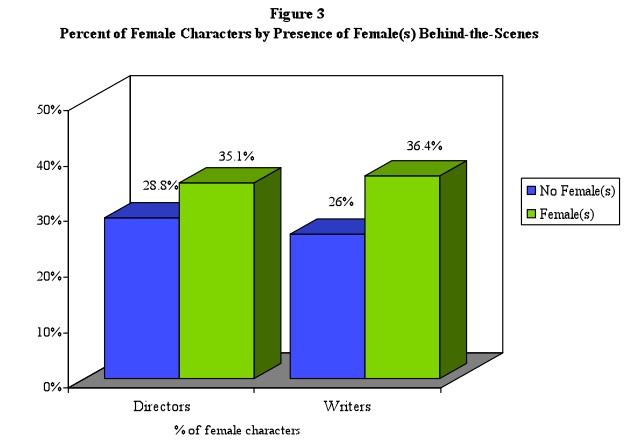
The authors found that movies with female directors and/or writers had more female characters than those with male directors/writers, with writers seeming to have a stronger effect than directors:

Of course, this could be because female directors/writers actively try to incorporate female characters into movies or because studios are simply more comfortable hiring female directors/writers to work on movies with female characters than they are other types of films, leading to a concentration of women working on such projects.

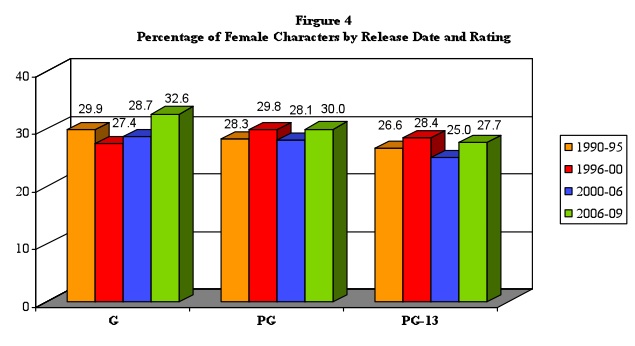
Comparing the results of this study to an earlier analysis of films from 1990-2006, we see that the gender imbalance isn’t improving over time (though since the methodologies differed slightly, the data aren’t absolutely comparable and so are more indicative of a general trend; the authors did make statistical adjustments for the methodological differences):

Of course, none of this gets at the content of the films. The study found that female characters were generally younger than male characters, made up only 17% of group or crowd scenes, and often had plotlines that centered entirely around interests in romance.