Search results for The


Delia B. sent along this 80s-riffic, apocalyptic music video featuring Gossip Girl’s Taylor Momsen singing Make Me Wanna Die. Momsen is a 17-year-old teen idol who strips naked over the course of the video. Her naked body is eventually obscured, but not before we get a good look at her in her bra and underwear.

On the one hand, because Momsen is 17, one could argue that this video is encouraging the sexualization of underage girls and child pornography (which involves, by definition, children under age 18).

On the other hand, this video is, relatively speaking, pretty sexually tame.  I imagine that most Americans would not think that this would incite pedophiles and that many would argue that she’s perfectly old enough, given that she’s an actress/rock star, to be stripping down to her undies. Not to mention the fact that the average age of virginity loss in the U.S. is about 16.

The video is a great opportunity, then, to have a discussion about the social construction of age.  To start: What age is “too young” and what age “old enough”?  What’s the difference between 17 and 18?  Is the difference equally meaningful for everyone?  Should we codify such meanings into law?  And do today’s laws reflect our contemporary culture mores?  According to who?

Lisa Wade, PhD is an Associate Professor at Tulane University. She is the author of American Hookup, a book about college sexual culture; a textbook about gender; and a forthcoming introductory text: Terrible Magnificent Sociology. You can follow her on Twitter and Instagram.

Jordan B. sent in an interesting observation about the current advertising at Diesel.  Many of the ads feature varying skin tones, but the darker-skinned models appear to always be male, while the women appear to always be lighter-skinned.  Two ads:

Jordan thinks that Diesel is following American cultural rules that gender race and racialize gender.  For example, if I may quote myself:

According to American cultural stereotypes, black people, both men and women, are more masculine than white people. Black men are seen as, somehow, more masculine than white men: they are, stereotypically, more aggressive, more violent, larger, more sexual, and more athletic. Black women, too, as seen as more masculine than white women: they are louder, bossier, more opinionated and, like men, more sexual and more athletic.

I’ll let Jordan finish the thought:

This is why Diesel’s selection of a black man and light skinned women makes sense for their ads.  By choosing a black man, men everywhere will want to identify with the hyper-masculinity our society has attributed to them. Similarly, by choosing a light-skinned woman, Diesel is selecting the type of women our society has put on a pedestal.

For more, see our posts on asymmetry in interracial marriagehow Asian women are marketed to white men, and data on race and response rates on a dating website.

Lisa Wade, PhD is an Associate Professor at Tulane University. She is the author of American Hookup, a book about college sexual culture; a textbook about gender; and a forthcoming introductory text: Terrible Magnificent Sociology. You can follow her on Twitter and Instagram.

Back in October, NPR presented the results of their investigation into the writing of Arizona’s notorious anti-immigrant law, SB 1070. I was listening to NPR when the story first aired, and I was stunned. The discussion of the law, which allows Arizona law enforcement officers to ask people they stop for proof of citizenship/legal immigration (and to arrest them if they don’t have it), has generally left out one important part of the story: the role of the private prison industry (the above link has an audio file of the story; you can get a complete transcript here):

NPR spent the past several months analyzing hundreds of pages of campaign finance reports, lobbying documents and corporate records. What they show is a quiet, behind-the-scenes effort to help draft and pass Arizona Senate Bill 1070 by an industry that stands to benefit from it…

Corrections Corporation of America, a for-profit prison company, used its membership in the American Legislative Exchange Council (ALEC), a group that brings government officials and corporate representatives together, to lobby for and shape the wording of the bill, which they see as being in their direct interest:

According to Corrections Corporation of America reports reviewed by NPR, executives believe immigrant detention is their next big market. Last year, they wrote that they expect to bring in “a significant portion of our revenues” from Immigration and Customs Enforcement, the agency that detains illegal immigrants.

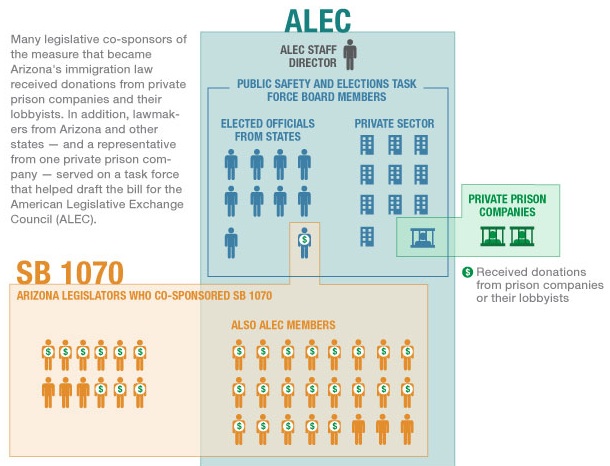
Once the bill was introduced, CCA began lobbying the broader Arizona legislature. This graphic illustrates the interconnections between ALEC, private prison companies, and final sponsorship of the bill. Of the co-sponsors of the bill, only 6 didn’t receive campaign contributions from the private prison industry (represented by the dollar signs), and the vast majority had either been at the ALEC meeting or were at least members:

In a foll0w-up story (transcript here), NPR explains how ALEC’s “conferences” allow legislators to meet with corporations but get around regulations that normally require disclosure of corporate gifts:

Videos and photos from one recent ALEC conference show banquets, open bar parties and baseball games — all hosted by corporations. Tax records show the group spent $138,000 to keep legislators’ children entertained for the week. But the legislators don’t have to declare these as corporate gifts…legislators can just say they went to ALEC’s conference. They don’t have to declare which corporations sponsored these events.

I know that corporations regularly lobby legislators. That in and of itself shouldn’t be surprising — or even inherently problematic if done in a transparent manner. But I have to say, thinking about the fact that private prison industries are actively lobbying to get elected officials to create new categories of crime so they’ll have to lock up more people, and that this connection was ignored for over 6 months after the bill was implemented, struck me as particularly disturbing — as did the fact that once this came out, we haven’t seen any widespread backlash or citizen outcry at the idea that there are companies that directly stand to benefit from putting people in jail helping to write and pass criminal codes.

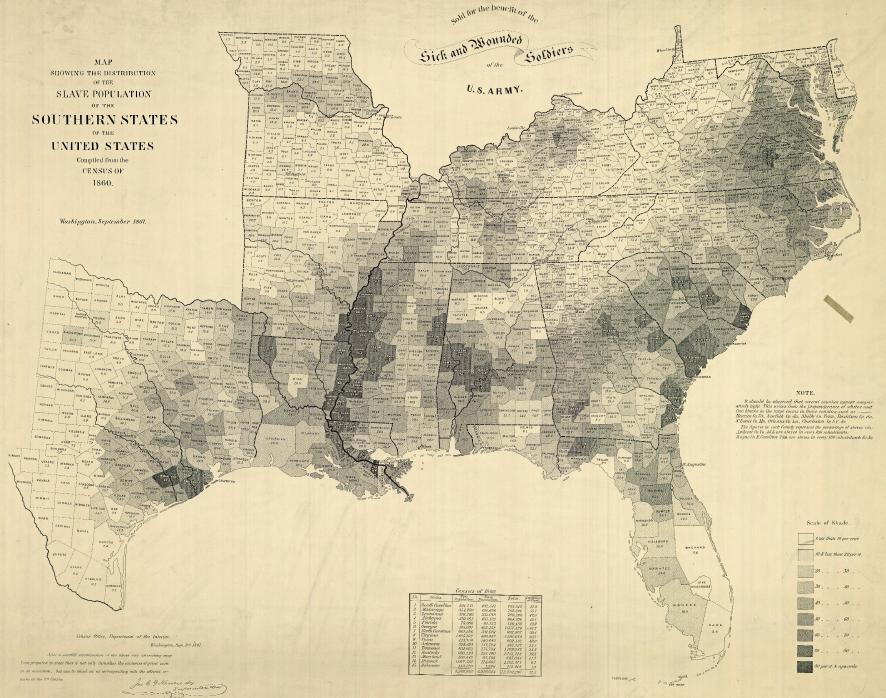
The NYT has posted an interesting interactive map showing the results of the last slave Census taken in the U.S., in 1860, which I discovered via Jessica Brown and Jim Yocom. The map, which shows county-level data, illustrates how slave ownership varied throughout the South

The shading (a new technique at the time, according to the NYT article) indicates what percent of the entire county’s population was enslaved:

You can see the percentage for each county, which is listed on the map, more easily if you zoom in on the pdf version. The cotton-belt area along the Mississippi River clearly stands out, as does Beaufort County, South Carolina, all with over 80% of the population enslaved. The highest rate I could pick out (the map got a little blurry as I zoomed) is in Issaquena County, Mississippi, where slaves appear to have made up 92.5% of the population.

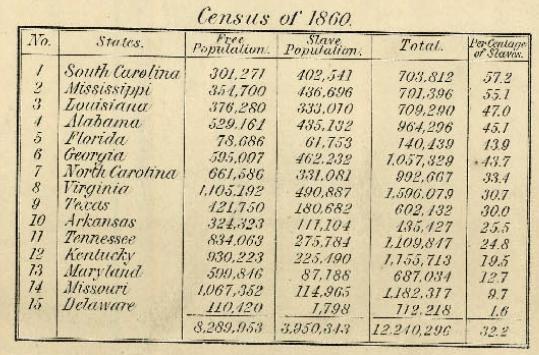
The map also included information on the overall population and % enslaved at the state level; in South Carolina and Mississippi, over half of the total state population was made up of slaves:

Also check out Lisa’s post on geology, the economy, and the concentration of slavery in the U.S.

As the NYT post points out, the map doesn’t show the dramatic increases in slavery in some areas. For instance, while Texas ranked fairly low in terms of the overall slave population, the number of slaves in the state had tripled between 1850 and 1860. The number had doubled in Mississippi between 1840 and 1860. Those growth rates make it rather hard to swallow the argument sometimes presented by those romanticizing the Confederacy that slavery was actually on the wane and would have soon been ended in the South anyway, without any need for federal interference, and wasn’t why the South seceded at all.

Jon Stewart and Larry Wilmore discussed this effort to frame discourses about the Civil War to erase the issue of slavery on The Daily Show:

Last week I stopped in the candy store on State St. in Madison, WI only to discover a product that I remember consuming as a kid, but thought had been banned in the U.S. years ago: tobacco-themed candy.

According to wikipedia, candy cigarettes (I’m not sure about the other products) are banned in Finland, Norway, Ireland, Turkey, and Saudi Arabia; Canada has banned packaging that resembles real cigarettes.  A U.S. ban was proposed in 1970 and again in 1991, but it failed to pass in both instances.

I do remember feeling cool, as a kid, when I pretended to smoke them.

Lisa Wade, PhD is an Associate Professor at Tulane University. She is the author of American Hookup, a book about college sexual culture; a textbook about gender; and a forthcoming introductory text: Terrible Magnificent Sociology. You can follow her on Twitter and Instagram.
As a member of a cattle-raising family, I hear a pretty steady stream of complaints about people eating less beef, which is variously attributed to a conspiracy against the American rancher (possibly by terrorists), the result of stupid city people who get all terrified over every little health concern (Mad Cow Disease is a myth! Unless it’s a terrorist plot to ruin ranching), environmentalists, animal rights activists, and me (I’ve been a vegetarian since 1996 and thus single-handedly nearly destroyed the beef industry).

The National Cattlemen’s Beef Association is similarly concerned about reduced beef consumption. And given that we frequently hear about the connections between red meat consumption and health concerns such as heart disease, and are advised to substitute white meat for red meat (to the point that the pork industry began branding pork as “the other white meat”), you’d probably expect to see a dramatic decline in consumption of beef.

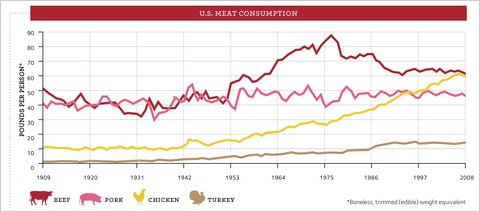
And we do see a decline, but not as much as you might expect, as this graph from the Freakonomics blog, sent in by Dmitriy T.M. and Bryce M. (a student at Rensselaer Polytechnic Institute), illustrates:

Clearly beef consumption has declined since its peak in the late 1970s, when people in the U.S. ate nearly 90 pounds of beef each per year, to closer to 60 lbs. each today. On the other hand, all those health warnings, disease scares, and environmentalist-vegetarian terrorist plots haven’t yet knocked beef out of its position as the most-eaten meat in the U.S. Clearly, chicken seems poised to take over that position, but beef doesn’t exactly appear to be falling off the charts.

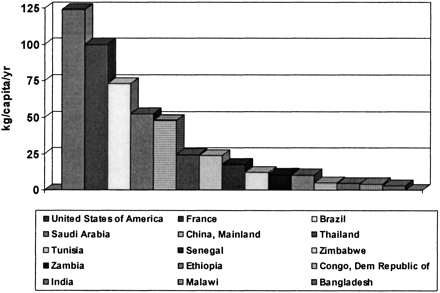
So how do we compare to other countries in terms of overall meat consumption? In a 2003 article in the Journal of Nutrition, Andrew Speedy provided data on global meat consumption (defined as “beef and buffalo, sheep and goat, pig meat and poultry”) — note it’s in kilograms, not pounds, and the legend should be read across, not down (so the first bar is for the U.S., the second is for France, and so on):

So insofar as there has been a decrease in beef consumption in the U.S., and more dramatic increase in chicken consumption: what’s going on? The Freakonomics article presents an explanation:

A study by the agricultural economists James Mintert, Glynn Tonsor, and Ted Schroeder found that for every 1 percent increase in female employment, beef consumption sank by .6 percent while chicken consumption rose by .6 percent. Why? Probably because beef takes longer than chicken to prepare, and because poultry producers did a good job marketing cheap and ready-to-cook chicken products. Furthermore, all those working women meant more household income, which meant more families eating in restaurants — where meals are less likely to contain beef than meals at home.

Health concerns do play a part; the authors found that negative media coverage of beef (either recalls due to contamination or general links to heart disease, etc.) reduced consumption, while positive coverage that linked eating meat to getting iron, zinc, and other minerals increased it. But they found that health effects were small compared to the effects of changing family dynamics — that is, women working outside the home and families eating fewer meals at home.

It’s a nice example of how the factors driving social changes are often much more complex than we’d expect. Common sense explanations of changes in beef consumption would, I think, a) overestimate how much less beef Americans eat than in the past and b) assume the major driving factors to be health-related concerns, whether about chronic disease or recalls. Yet it turns out a major aspect of the story is a structural change that doesn’t seem clearly connected at all.

I guess if I were a health advocate hoping people in the U.S. were starting to listen to messages about healthy eating, that might depress me. But I guess I can tell my grandma that the terrorists’ evil plans to infect U.S. cattle herds with Mad Cow or some other disease might not be as catastrophic as they might imagine.

UPDATE: As a couple of readers point out, the increase in chicken consumption can’t be explained just as a result of people eating chicken when they otherwise would have eaten beef; the drop in beef consumption is way overshadowed by the increase in how much chicken people eat. The total amount of all meat eaten each year has increased dramatically.

I don’t know what is driving all of that change, but I suspect a lot of it is marketing campaigns — not just directly to consumers, but efforts by industry groups and the USDA to get more meat into a wide variety of items at grocery stores and on restaurant menus, as they have done with cheese.

The United States is a nation of immigrants… in that the majority of its citizens are not part of the native population of North America.  In other words, because it was and remains a colonized land.

That aside, is the United States unique in receiving an extremely large number of new immigrants relative to its size?  It turns out, No.

Lane Kenworthy, at Consider the Evidence, posted this figure, showing that the U.S. population does indeed include a substantial proportion of first generation immigrants (both legal and illegal), but it is not unique in that regard, nor does it carry the highest percentage:

It also fails to be true, as many anti-immigration people claim, that the U.S. accepts a uniquely large number of immigrants who need help once they arrive:

Lisa Wade, PhD is an Associate Professor at Tulane University. She is the author of American Hookup, a book about college sexual culture; a textbook about gender; and a forthcoming introductory text: Terrible Magnificent Sociology. You can follow her on Twitter and Instagram.
Fannar Þór Guðmundsson sent in a photograph that he took a few years back in his hometown of Reykjavík, Iceland.  The simple street, the mundane household items for sale, and the elderly couple contrast starkly with the lingerie-clad models with their come hither looks.  They contrast starkly, that is, if you are not already inured to the fact that such images are absolutely everywhere.

Lisa Wade, PhD is an Associate Professor at Tulane University. She is the author of American Hookup, a book about college sexual culture; a textbook about gender; and a forthcoming introductory text: Terrible Magnificent Sociology. You can follow her on Twitter and Instagram.