Search results for 2008/08/03/white-privilege

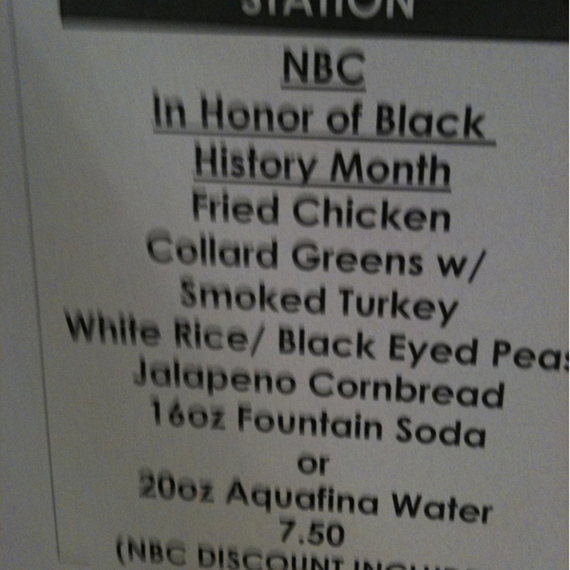
Dmitriy T.M. and Claire C. sent in a link to a photo of an NBC cafeteria menu in honor of Black History Month (that’d be February) that featured stereotypical African-American foods:
It’s not the first time.

Many argued that the menu was offensive because it reproduced stereotypes, but I think an interview (no longer available) with the chef who devised the menu complicated the story a bit.

Honestly, I think the main problem here is that Americans live in a racist society and so we have no idea how to celebrate Black History Month (how about with relaxer?).   The rest of the year, we make fun of black people for eating fried chicken. And yet, these are traditional Black southern dishes. So how exactly do we celebrate the holiday?   Do we pretend to valorize the same traditions that we make fun of during the rest of the year?  It makes no sense!  But it makes no sense because we’re still racist.  And we need a Black History Month because we’re still racist.  So, what to do!?

Perhaps the lesson to take from all of this is:  Undermining racism is hard work.   A month dedicated to Black history is a (flesh-colored) band aid, at best.  If we don’t do the other stuff (e.g., challenging the web of racist institutions that preserve class and race privilege), then no amount of fried chicken will make the difference.

Lisa Wade, PhD is an Associate Professor at Tulane University. She is the author of American Hookup, a book about college sexual culture; a textbook about gender; and a forthcoming introductory text: Terrible Magnificent Sociology. You can follow her on Twitter and Instagram.
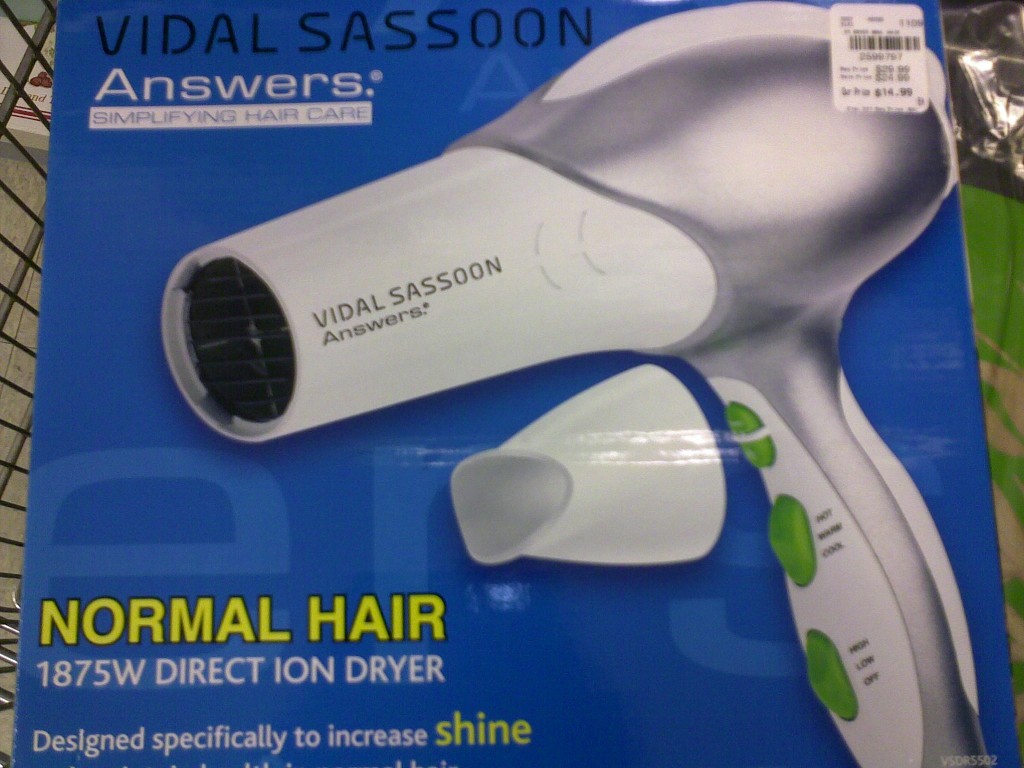
Rudo M. sent us a great example of how “normal” is socially constructed. The photos below are of the box containing a Vidal Sassoon hair dryer for “normal” hair:

1

It’s also, “good” hair, as is said, in so many words, the blurb on the box said so:

Not too fine or coarse,  normal hair is the most manageable hair type with the largest range of possible styles.  Though it’s fun to experiment, even the easiest-to-care-for hair requires a regimen of regular maintenance.  Proper styling tools with varying heats are crucial for keeping a healthy-looking shine, maintaining balance, and adding…

Yeah, so just in case it wasn’t clear already, “normal” hair is the bestest!  It’s “not too fine or too coarse,” has the “largest range of possible styles,” is “fun,” and is totally the “easiest-to-care-for”!

Rudo is an African woman who wears her hair natural, so she knew right away that Vidal Sassoon didn’t count her hair as “normal.”  So, what were the other options?  If you’re not normal, what are you? Well, according to Vidal Sassoon, you are, of course, “fine” or “coarse.”

But a lot of good this does Rudo, since even the models on the “coarse” box are white with essentially straight hair!  So much for a range of hair types!  Well, at least we know that even white women with straight hair can be abnormal!

And, just in case you didn’t know already that being abnormal means being WRONG, coarse hair is “hard-to-style,” fine hair is limp, and both tend to “frizz.”   What a difference from Vidal Sassoon practically falling over itself praising normal hair.

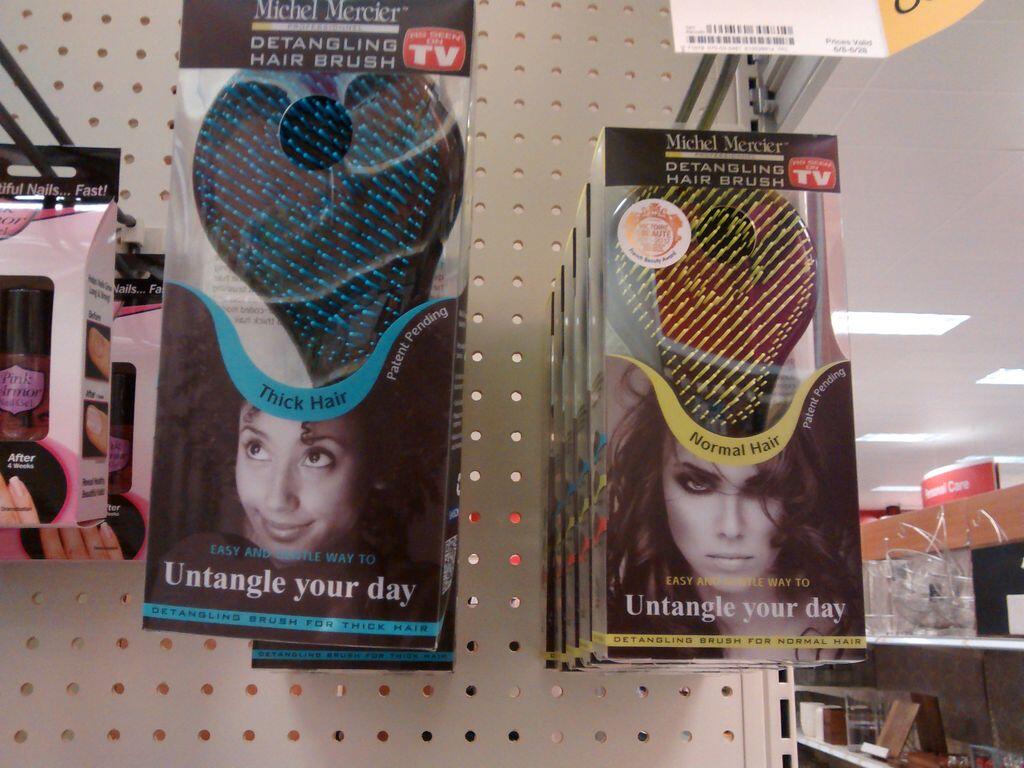
Here’s another example, sent in by @adentweets.  There’s “normal” and there’s “thick” hair.

1

Cara McC. sent us a Covergirl commercial selling foundation for “normal,” “oily,” and “sensitive” skin. Again, they include a range of skin types (and probably include women who represent three different races) in order to point to the diversity of skin types, but nonetheless label one “normal” (the one represented by the white woman).

For more examples of whiteness as normal and people of color as deviant (or, if we measure by Vidal Sassoon, non-existent), see our posts on Michelle Obama’s “flesh-colored” gown, Johnson’s lotion for “normal to darker skin,” bandaids and other “flesh-colored” things, why Sotomayor may be “biased,” families vs. ethnic families, and people of color add “spice.”

Lisa Wade, PhD is an Associate Professor at Tulane University. She is the author of American Hookup, a book about college sexual culture; a textbook about gender; and a forthcoming introductory text: Terrible Magnificent Sociology. You can follow her on Twitter and Instagram.
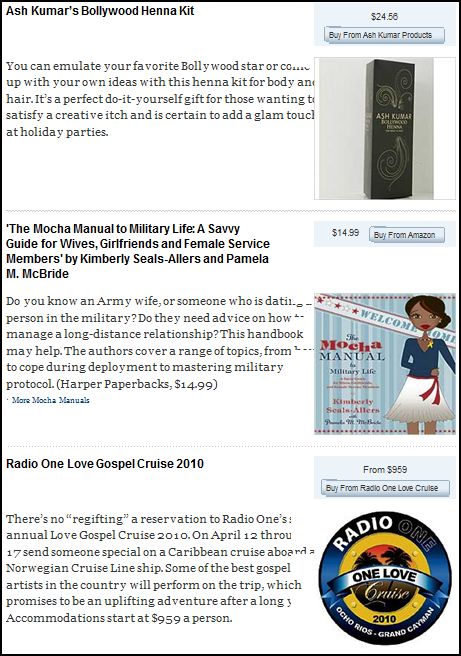
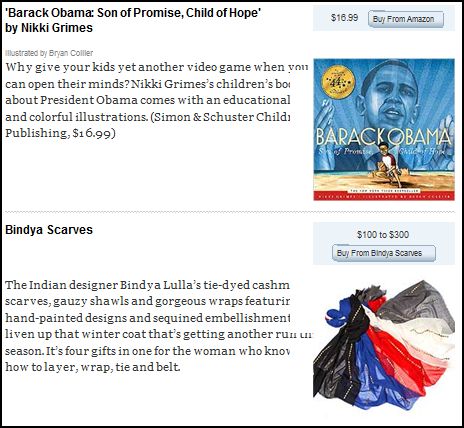
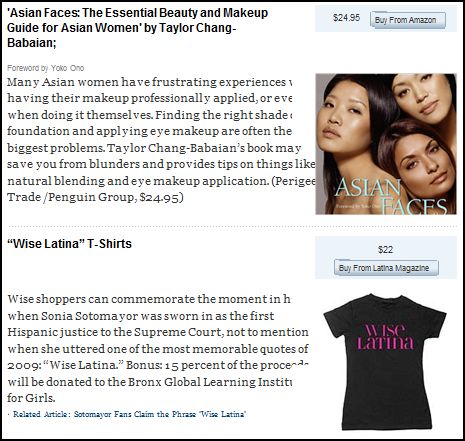
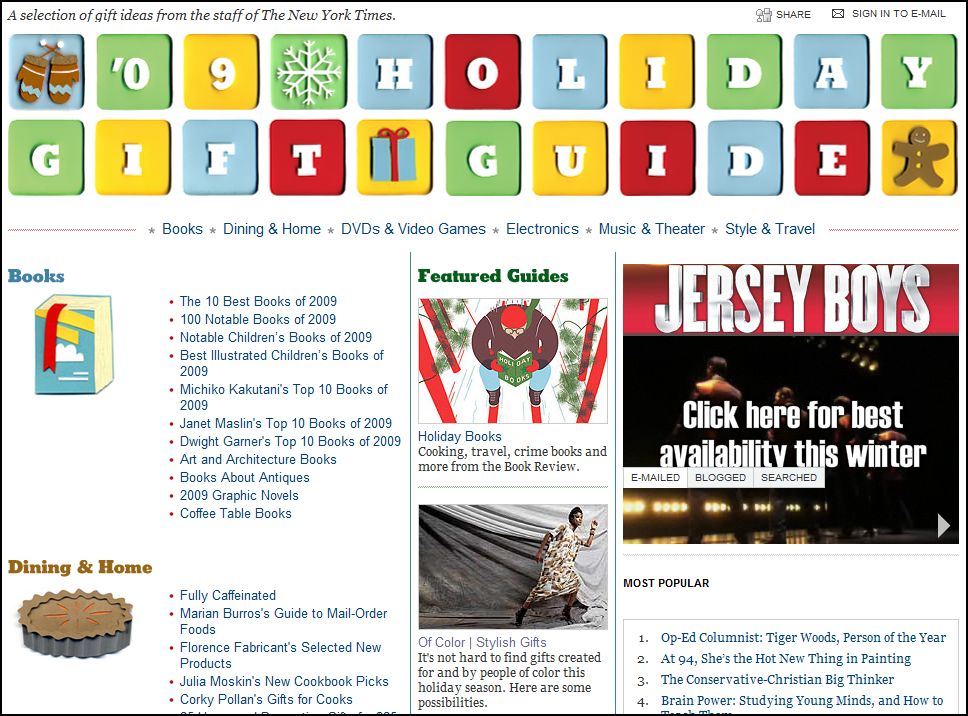
Cassidy P., Kailey V., Adèle G., and Allie L. sent in a gift guide put together by the New York Times specifically for people “Of Color” (center bottom):

color1

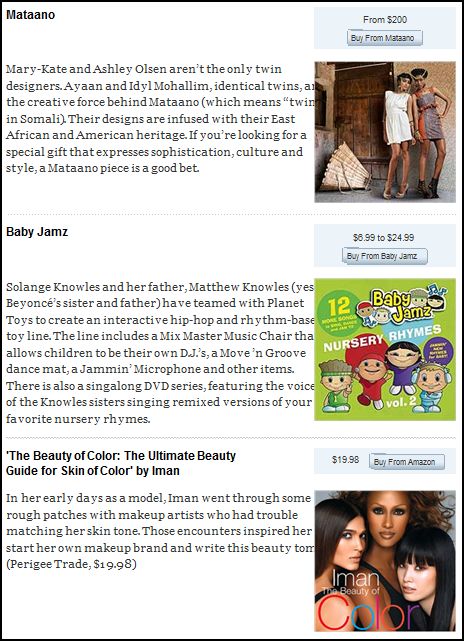
The guide lumps together all non-white groups, suggests that they are interested in race- and culture-specific products and implies that white people would NOT be interested in these things.  Some examples:

color2color3color4color5

The guide illustrates something we’ve discussed several times on this blog: the fact that there “needs” to be a guide specifically for people of color reveals that all the other products and guides, ostensibly for “people,” are really for white people.  Things that are marketed to non-white people are, supposedly, inherently uninteresting or irrelevant to white people.

Ultimately, this reinforces the idea that people of color are always outsiders in a white world.

Lisa Wade, PhD is an Associate Professor at Tulane University. She is the author of American Hookup, a book about college sexual culture; a textbook about gender; and a forthcoming introductory text: Terrible Magnificent Sociology. You can follow her on Twitter and Instagram.
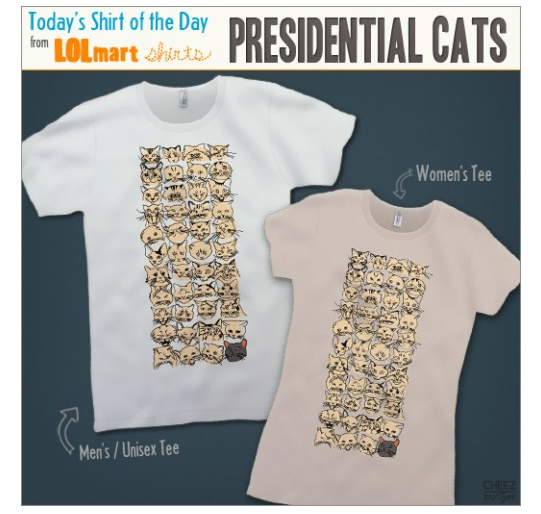
V. and Anna G. sent in this ad for a LOLCats T-shirt.  Notice that the woman’s t-shirt is for women only, but the man’s t-shirt also doubles as a unisex shirt.

Picture1

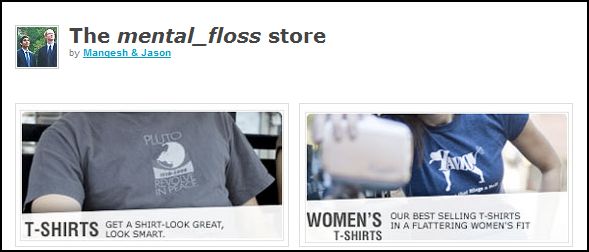
Both Emily W. and Sabine M. sent in this example of the same phenomenon at Mental Floss:

Capturecc

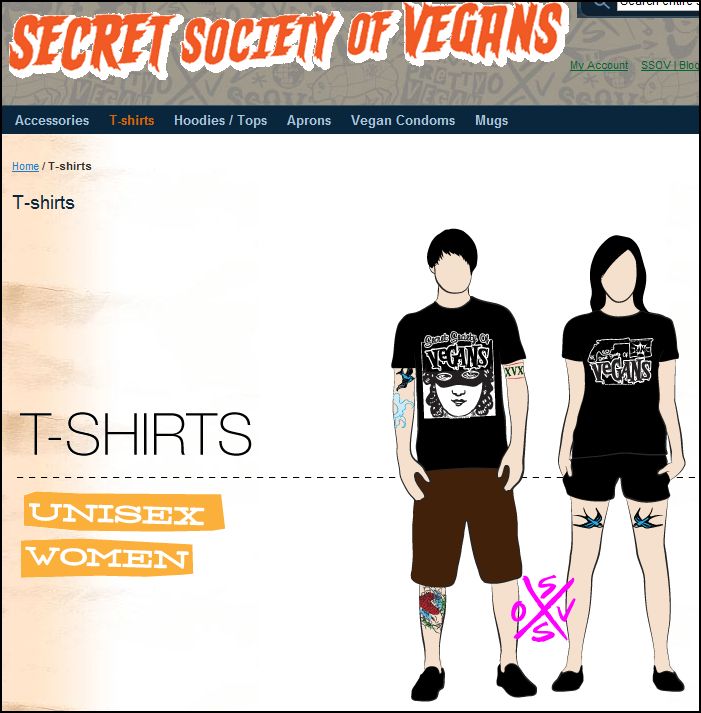
Mindy J. sent us a third example from Secret Society of Vegans:

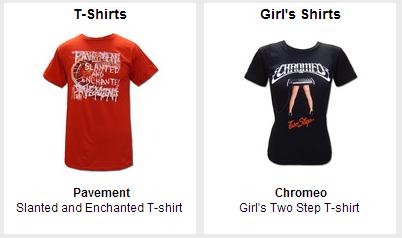
From Johanna G:

Finally, Jessica S. sent in this example from Kung Fu Nation:

1

This is just another example of the phenomenon of how we take one half of a (false) binary (such as man vs. woman) and make one generic and the other specific.   Men can be human, but women are always female humans; white people can be just people, but non-white people are always other; Christian symbols are for everyone, but non-Christian symbols are exclusive; and so on and so on.

For more examples, see these posts on how racial and ethnic identity adds spice, Sotomayor’s racial bias, male neutrality in stick figures (here and here), male-default avatars, flesh-colored products, for normal to darker skin, Michelle Obama’s “flesh-colored” gown.

Lisa Wade, PhD is an Associate Professor at Tulane University. She is the author of American Hookup, a book about college sexual culture; a textbook about gender; and a forthcoming introductory text: Terrible Magnificent Sociology. You can follow her on Twitter and Instagram.
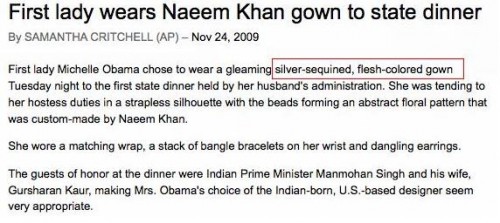
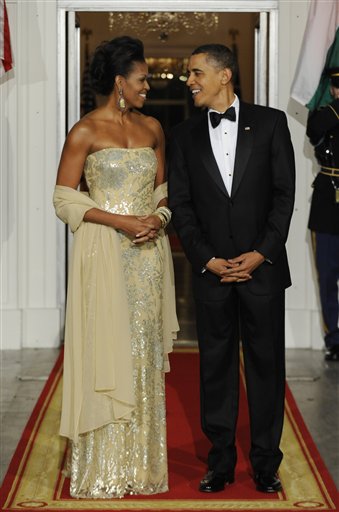
The Associated Press, a news service subscribed to by news outlets all over the world, distributed a story about the first Obama Administration State Dinner. In the story, sent in by Elisabeth R., Samantha Critchell describes Michelle Obama’s dress as “flesh-colored.”

gown2

[Thanks to Madeline T., Anne Marie, Therese S., and Drugmnky for the screencap!]

Gee, what could possibly be wrong with calling this dress “flesh-colored”?

APTOPIX Obama US India

This is what happens when white people are considered people and black people are considered a special kind of people, black people.  “Flesh-colored” becomes the skin color associated with whites and darker-skinned peoples are left out of the picture altogether.  We see this all the time.  Bandaids, for example, are typically light beige (though they rarely call them “flesh-colored” anymore), as are things like ace bandages.

See our post on “flesh-colored” for these examples and more.  See also this post on lotion for “normal to darker skin.”

For contrast, see this post about how the generic human in Russian cartoons is colored black instead of white.

—————————

Lisa Wade is a professor of sociology at Occidental College. You can follow her on Twitter and Facebook.

We recently critiqued Facebook’s “neutral” avatar for appearing both white and male.  Both Abby J. and Noah Brier pointed us to the fact that Rob Walker at Murketing has been collecting default avatars.  His collection is really interesting.  First, it demonstrates that the avatars don’t need to be gendered at all.

Flikr:

flickr-buddyicon

Hotmail:

hotmail

Google:

googleyeyes

Vimeo:

vimeo

My space:

myspacenophoto

Friendfeed:

nomugshot-large

Yahoo:

nopic_192

Youtube:

youtube140

Second, it demonstrates that the avatars don’t have to human at all:

Twitter:

twitter

Posterous:

posterous

Third, his collection also suggests that, when the avatar is human and discernibly gendered, it usually appears to be male.  There’s the Facebook avatar, as well as…

EBay:

ebay

Car Domain:

cardomain-avatar

Topix:

topix

Yammer:

yammer

The avatar tends to be male, unless the company produces a default male and a default female.

Blip FM:

blipfm

Goodreads:

goodreads-f

goodreads-m

This collection reveals that the appearance of a company’s default avatar is by no means inevitable or accidental.  Companies must make choices and they are, indeed, making choices about what kind of person is the default person.

Check out his whole collection.  It is growing.

Jamie R. sent in a link to a video that presents a lot of attention-grabbing statistics (which may or may not be accurate). At first it appears that the avatar could be unisex, but then at about 1:18, we see the “female” avatar:

Did You Know? from Amybeth on Vimeo.

At no other place in the video do we see the female avatar except when the “neutral” one is presented as married…indicating, from the context of the video, that it is not unisex or neutral, but male.

MORE! You may have noticed that our revamping of the site involved putting our names up.  Lo and behold, these male avatars popped up next to our names.

Capture

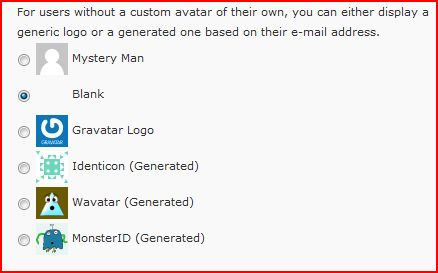
So we went into the admin page to see if we had some other option, like maybe something non-human or a female avatar if necessary.  These were our options:

Capture1

First, blank is really the avatar you see in the first screenshot, it’s neutral which, in reality, is male.  So there is no way to opt out of having an avatar (our tech guy, Jon, is still working on it).

Second, there is no female avatar option.

Third, though there is no female avatar, there is a Monster and a Wavatar option, whatever the hell that is.   So WordPress is allowing you to represent yourself as a Wavatar, but you’re not allowed to be a chick.

Amazing.

NEW (Apr. ’10)! Keri sent a screenshot of her WordPress menu which, she noted, represents the users with two different skin colors.  It’s a nice counterpoint to much of what we see above:

For more on how certain kinds of people get imagined as just people, while others get imagined as certain kinds of people, visit our posts on the Body Worlds exhibit, “flesh” colored products, Pixar films, gender and clothes, and Plan and Playmobile toys.

Toban B. wrote in with an observation about Facebook avatars. The default avatar is “white” and appears to be male:

d_silhouette

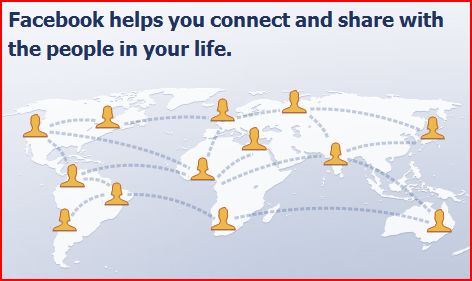
In contrast to the individual avatar, Facebook’s illustration of global connection uses orange avatars of both sexes:

capture12

“Evidently,” Toban writes, “the orange is supposed to be a sort of compromise skin colour.”

So when Facebook wants to represent global humanity, the avatars are orange and of mixed sex; when Facebook is charged with representing an individual, the avatar is white and male.  This is not random or accidental.  Globally, as Facebook, ironically, reminds us, people are not “white.”  Representing people in this way centers men, Western countries, and whiteness (because there are non-white people in Western countries, too) and marginalizes women, non-Western countries, and non-whites (though one might argue that at least ALL of the avatars aren’t white and male).

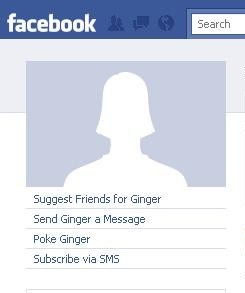
UPDATE: I write this update in August of 2010.  Since then it appears that Facebook has added a generic female avatar.  This one was sent in by Amber F. (it’s her mom, Ginger’s, profile):

See our other posts on how whiteness and maleness are the characteristics we attribute to “person,” unless there are reasons to do otherwise, herehere, and here.


Can’t make this stuff up.  See also this post on white privilege.

(From Skin Coloured.)