NEWS:

1.  If you’re following us on Facebook, you might have noticed that we’ve begun updating our status with a “featured post” each day.   We’re on Twitter too, if that’s more your style.

2.  Remember that Method commercial where the soap suds sexually harass a woman in her own shower?  Ann Marie N. sent us note to let us know that it’s been discontinued due to complaints.

3. This was a good media month for us.  I was quoted in a CNN article about The Princess and the Frog; several of our posts on gendered marketing to children were discussed in a Salon article by Kate Harding; a recent post about pink telescopes and microscopes was featured on Pharygula; we were linked from the American Spectator; and Guardian named our Avatar post among The Best of the Web.  Fun!

NOTE FROM A READER:

Sarah is a reader and frequent commenter on the blog who sent us a note complimenting all of you.  We thought we’d let everyone read it.  Sarah wrote:

I just wanted to commend you for the environment of open discourse on your website. I have some opinions that differ from those of many others on this site, and when I’ve brought them up, I’ve been able to openly discourse with other members without any fear of being chased off with fire and pitchforks.

So, thank you for setting up such an open and welcoming environment.

Thanks Sarah!  Our readers are, indeed, awesome.

And we try!  We don’t follow the comments threads as closely as we’d like (we’re both tenure-track profs), but we do the best we can to make sure that people adhere to our discussion policy.  Thanks to all of you who have been patient with our less-than-perfect moderation and sometimes-ineffectual efforts to weed out the trolls.

FROM THE ARCHIVES:

In Dec. ’08 we commenting on McDonald’s efforts to market itself as high class, linking the fast food chain to Bourdieu and Sex in the City, of course.

And in Dec. ’07 we posted a hilarious story about a statue in Lexington, KY, of a war hero on a female horse with, um, testicles.  A hero riding a girl horse into battle is simply inconsistent with our cultural preconceptions… so bring on the intersex equine!

Finally, if you haven’t seen enough Christmas material, visit the posts of Christmas past: marketing cigarettes for Christmas (with new material), non-U.S. Christmas cultures, a scary, fiery Christmas cross, Christmas vs. Holiday (politics edition), the Chrismakkuh Yarmaclaus, a clothesline for X-mas (why not?), and a special gift for Santa and for you.


NEWLY ENRICHED POSTS (Look for what’s NEW! Dec ’09):

Marketing

We found another example of vintage ads extolling the dietary benefits of sugar.

Larry H. sent us two photos of Amelia Earhart from 1937 in which she is posed in cutesy, flirty ways; we added it to our post of a Lucky Strike ad featuring Earhart.

Dmitriy T.M. sent in another example of a vintage Chrysler ad in which they market the car as youthful (can you imagine!).

Race and Ethnicity

To our vintage Jello ad featuring Asian stereotypes, we added a contemporaneous ad for Rice Krinkles, sent in by Ted K.

It’d be nice to not link back to our post on instances in which college and post-college students dress up like racial minorities, but this isn’t one of those updates.  We added an image of students at the London School of Economics  in brown-face dressed up like Guantanamo Bay prisoners to our post featuring similar acts of individual racist impersonations (scroll way down).

Pete W. sent in a third vintage Bull Durham tobacco ad depicting Black Americans as foolish and bumbling.

Pornification

Yikes!  We added a new ad to our post where sexual body parts are not-so-subliminally included in ads (NSFW).  This one is for “fresh” “shaved” turkey breast slices and they look like, um…

Our evolution of Evony ads post has been among the most popular posts on our site.  Timm F. sent in an ad for another online game, Alteil, making fun of the Evony ads.  We added it to the original post and, while we were at it, we also added another in the series of increasingly sexualized ads, this one sent in by Tim R.

Gender

Harvey tC. sent in a photo that we added to our post featuring pink guns and rifles being marketed to girls/women.  For the hell of it: here is a crazy great set of pro-gun posters.

Both Emily W. and Sabine M. sent us another example of t-shirts being divvied up into “t-shirts” and “women’s t-shirts.”

Elizabeth T. sent in a video of men vamping it up and trying to “do” sexy. We added it to another post asking whether, given the gender binary and our gendered image of “sexy,” such a thing can be anything other than ridiculous.

Monica C. sent in another great example of gendered toy advertising.  In this one a girl plays with a kitchen set alongside a boy playing with a tool set.  Sigh.

In contrast, Lynne S. and Fia K. sent in some more photos of house play toys featuring both girls and boys.

Lisa Wade, PhD is an Associate Professor at Tulane University. She is the author of American Hookup, a book about college sexual culture; a textbook about gender; and a forthcoming introductory text: Terrible Magnificent Sociology. You can follow her on Twitter and Instagram.

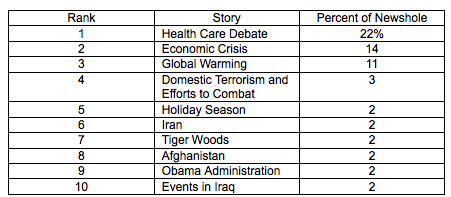
Hank M. sent us a link to this image that shows the proportion of news coverage in 55 outlets for various items throughout the year (click here for a larger image; to read more about the methodology and the news outlets, see Journalism.org):

Picture 4

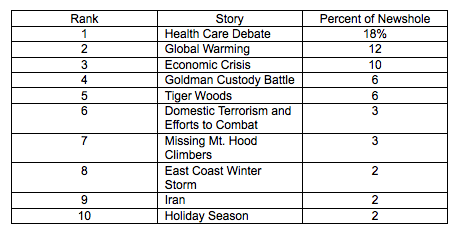
Journalism.org puts out a weekly index as well, broken down by type of source (network TV, newspaper, etc.). Some of the results for Dec. 14-20 show some interesting differences. Here are the top-10 lists for newspaper and network TV, respectively:

Picture 5

Picture 6

The top three stories are the same, and clearly dominate both types of media outlets. TV sources seem to do more “human interest” or “entertainment” coverage of things like Tiger Woods’s scandal, the Goldman custody battle, and the missing climbers. (My mom and grandma were both distressed that I wasn’t aware of the missing woman in Utah or the Goldman custody case and said that I need to keep myself more informed of the world around me by taking the time to watch the news on TV so I’d know what’s going on in the world.)

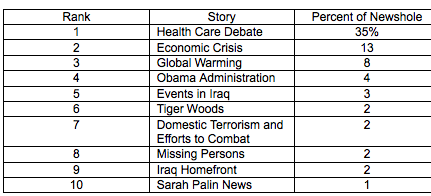
Cable TV outlets had the same top 3 stories, but actually emphasized them even more than newspapers and network TV did, with health care getting nearly twice as much coverage as it did on the networks (radio had the same pattern):

Picture 4

Their database is archived and searchable, and it provides a rather fascinating view of what is considered newsworthy each week and how that depends on the type of outlet.

Also check out our posts on google searches for information about Afghanistan and Tiger Woods, the “dithering” meme,

In earlier posts, we’ve highlighted instances in which contradictions in U.S. culture become glaringly clear.  In one, suggestive advertising accompanies an article critiquing a video game in which the player rapes a woman.  In another, CNN asks whether Jon and Kate Gosselin are getting too much media coverage, and then tempts you to read more media coverage about Jon and Kate Gosselin.  In a third, neighbor billboards carry hilariously contradictory messages.

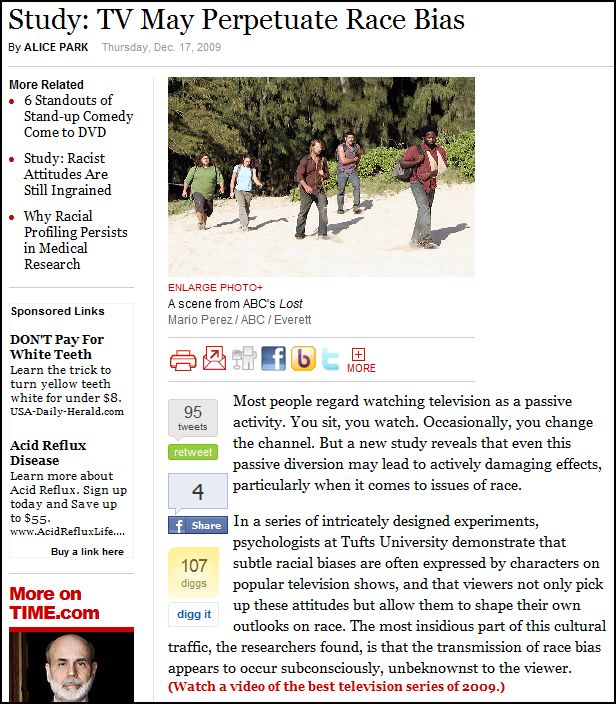
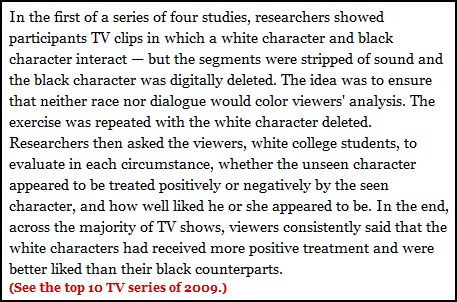
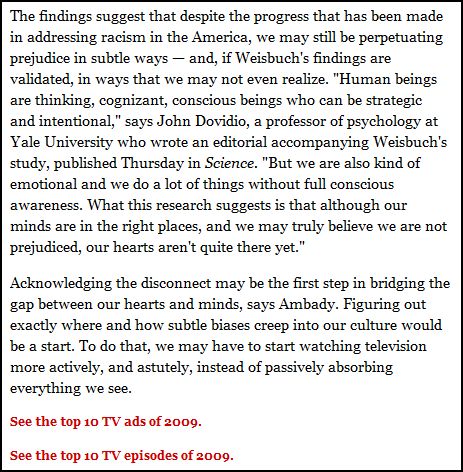
I found another example that left me shaking my head.  Via Racialicious, I found myself reading a Time magazine article reporting on recent research that shows that, even when black and whites are portrayed as equal on television, viewers come away with subconscious anti-black bias that actually translates into bias in real life.  The findings are pretty dismal.

Two paragraphs into the article, there was a promotional link… for television (see the bolded, red parenthetical sentence):

Capture

So, yeah, television is likely inculcating you with racist views; “the transmission of race bias appears to occur subconsciously, unbeknownst to the viewer”… but don’t let that stop you from enjoying awesome TV!

The second promotional link, halfway through the article, was just salt in the wound:

Capture2

And, of course, they couldn’t let your thoughts linger on social justice issues when there are great TV series out there to see!

The final paragraphs:

Capture3

Maybe they are hoping that we’ll watch the top 10 TV ads and episodes more critically?

These promotional inserts may very well be automatically generated, but the article is dated Dec. 17th, so clearly no one at Time has been alerted to, or cares about, the possibility that they may trivialize the message of the article, or even draw people away from it as early as two paragraphs in.  What Timewants is for you to waste as much time on their website as possible.  Apparently any ideological commitment to fighting racism is secondary at best.

Lisa Wade, PhD is an Associate Professor at Tulane University. She is the author of American Hookup, a book about college sexual culture; a textbook about gender; and a forthcoming introductory text: Terrible Magnificent Sociology. You can follow her on Twitter and Instagram.

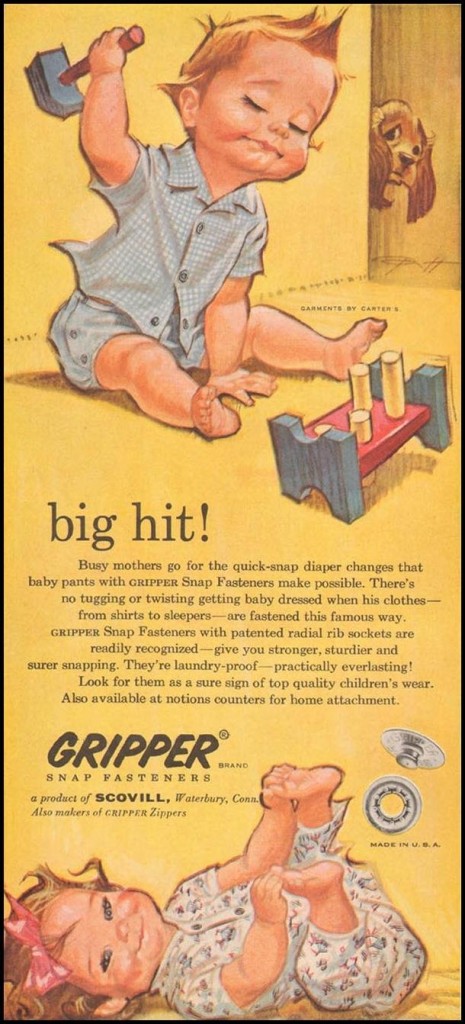
Some have observed that advertisements featuring kids often present active boys and passive girls. This vintage ad is a great example of what that looks like:

gripgh05011957296m51999

Lisa Wade, PhD is an Associate Professor at Tulane University. She is the author of American Hookup, a book about college sexual culture; a textbook about gender; and a forthcoming introductory text: Terrible Magnificent Sociology. You can follow her on Twitter and Instagram.

Missives from Marx sent in a link to this animated time line documenting the diffusion of various political-economic systems (e.g., fascism, democracy, and feudalism) over world history.  It can be read as a story about the triumph of democracy, but it’s also illustrates how political-economic systems are not natural, but invented during particular historical eras, and diffuse or disappear as a consequence of war, geography, and other geopolitical factors.

Lisa Wade, PhD is an Associate Professor at Tulane University. She is the author of American Hookup, a book about college sexual culture; a textbook about gender; and a forthcoming introductory text: Terrible Magnificent Sociology. You can follow her on Twitter and Instagram.

In the book Strong Women, Deep Closets: Lesbians and Homophobia in Sports, Pat Griffin discusses the pressure on female athletes to constantly prove they, and their sport, are acceptably feminine, for fear of being labeled lesbians. Women who engaged in, and openly enjoyed, sports have often been viewed with suspicion or concern, ranging from beliefs that physical exertion might make them infertile to a fear that women’s sports teams serve as recruiting sites for lesbians. Some college coaches even try to get young women to play on their teams by hinting to their parents that other schools their daughter is considering are known for having a lot of lesbians and it might not be the “type of environment” where they want their sweet little girl to go.

Female athletes, and women’s sports teams, thus often feel a lot of pressure to prove their heterosexuality to quell homophobic fears and to make women’s sports appealing to a broad audience. One way to do so is to dissociate themselves from lesbians. Another is to emphasize the femininity of female athletes, signaling that they are, despite their athletic abilities, still physically attractive to, and interested in, men.

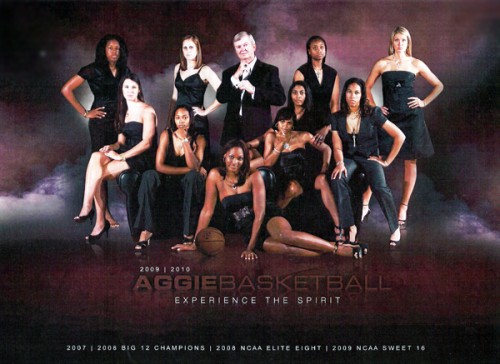
Texas A&M put out this promotional media guide, which features an image of the male coach surrounded by the team in sexy clothing:

TexasAM

While these types of materials have traditionally been for the media, they’re increasingly used as recruiting tools for players as well. Those who produce them argue that they’re just trying to put out something distinctive that will set them apart. And as Jayda Evans at the Seattle Times says, it’s not like men’s sports teams are never photographed off the court.

But as many researchers have pointed out, and as Evans herself discusses, female athletes are often photographed and discussed in ways that largely erase their athletic abilities. When men’s teams are dressed up for publicity materials, it’s usually for one or two images that are outnumbered by ones that highlight their sports participation. For female athletes, images that exclude any connection to sports often become nearly the entire story. And despite the fact that the creators often stress their interest in doing something unique and distinctive to set themselves apart, there is a very common set of elements in promotional materials for women’s sports: clothing, make-up, hair, and poses that sexualize the players and implicitly include a reassurance to parents, potential players, and fans that the women are pretty, charming, and feminine, regardless of what they do on the court or the field.That is, they are blending masculinity and femininity by being athletic and pretty, not giving up their femininity altogether.

Of course, part of an acceptable performance of femininity is showing that you want male attention, and that you actively try to make yourself appealing to men. So while these materials might do many other things, they also carry a particular message: these girls like to pretty themselves up, and that should reassure you that it’s not a team full of lesbians.

The effect of all this is that female athletes may feel pressured to keep their hair long, wear make-up even on the court, and emphasize any relationships they have with men or children to “prove” they are straight, and a lesbian who likes makeup and sexy clothing may face less suspicion and stigma than a straight woman who doesn’t.

Also see our posts on Serena Williams’s ESPN cover, Candace Parker “is pretty, which helps,” groundbreaking female sailor is also pretty, sexualizing female Olympic athletes, diets of champions, media portrayals of female athletes, and valuing dads in the WNBA.

Gwen Sharp is an associate professor of sociology at Nevada State College. You can follow her on Twitter at @gwensharpnv.

You might have noticed that there are poor, rich, and middle class neighborhoods in just about every town.  Sociologists call this residential segregation.  Residential segregation is a problem, in part, because it can create a situation in which some neighborhoods have more social and other services than others.  Sociologists have found, for example, that richer neighborhoods tend to have more grocery stores, better sidewalks, and more fire protection.

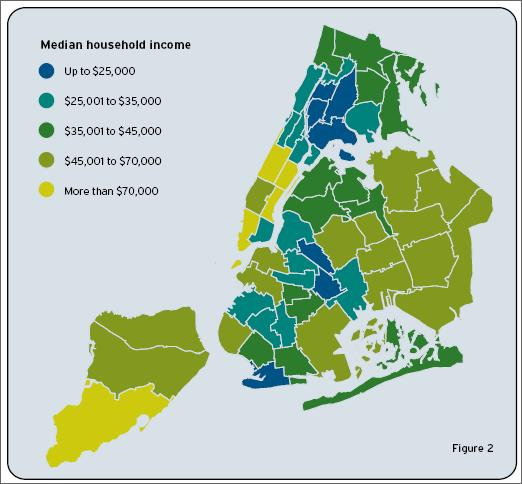
So, when Jessica Sherwood, of Sociologists for Women in Society, sent us a map showing the density of playgrounds in New York City, I immediately thought to correlate it with average income.

Playground map (darker pink = more playgrounds):

play

Map of median household income (yellow = more income, blue = less):

Picture1

UPDATE:  Awesomely, Reader Mark Root-Wiley overlaid the two maps and sent it along!  Here it is:

nycPlaygroundOverlay

It looks to me that playground density is highest in the poorest neighborhoods.  A very unusual finding!

So, what factors do you think might account for the disproportionate number of playgrounds in low income areas?  Speculate away!

Lisa Wade, PhD is an Associate Professor at Tulane University. She is the author of American Hookup, a book about college sexual culture; a textbook about gender; and a forthcoming introductory text: Terrible Magnificent Sociology. You can follow her on Twitter and Instagram.

Leigh snapped this picture of a Toys ‘R Us catalog.  He noticed that, for both microscopes and telescopes, the version coded “girl” (i.e., the pink one) is the least powerful one (600x magnification vs. 900 or 1200x and 90x vs. 250 or 525x).  Coincidence?

photo

Lisa Wade, PhD is an Associate Professor at Tulane University. She is the author of American Hookup, a book about college sexual culture; a textbook about gender; and a forthcoming introductory text: Terrible Magnificent Sociology. You can follow her on Twitter and Instagram.