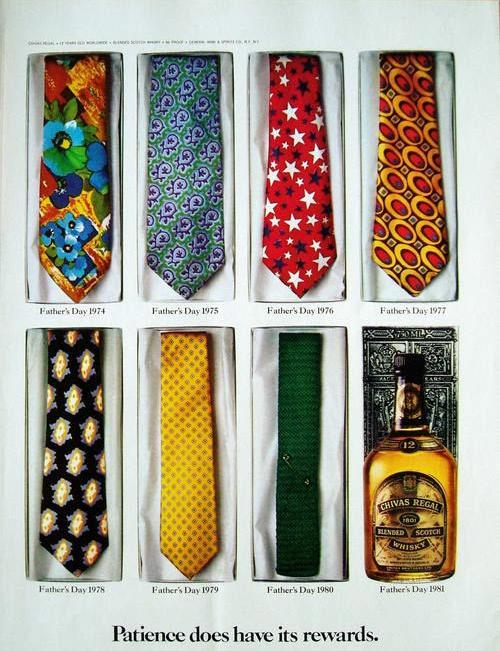
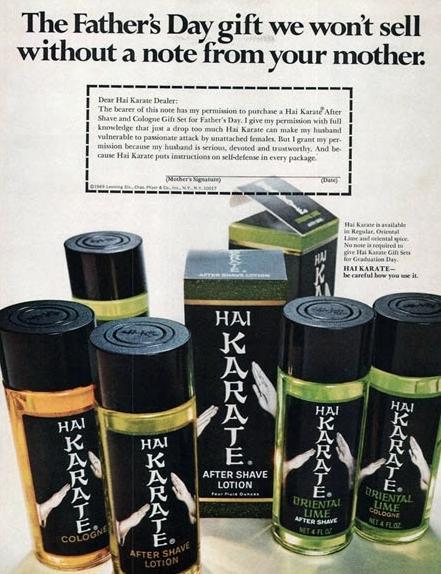
Father’s Day advertisements are a peek into what we think dads are all about.  As cultures change, advertising shifts too, giving us a peek into the social construction of fatherhood.

Karl Bakeman pointed us to a series of vintage Father’s Day ads at Retronaut.  They label them with the range from 1943 to 1981. Perhaps we can have fun guessing which was when.  According to these ads, great gifts for dads include recliners, whiskey, cologne, and a pack of smokes.  Today the perfect Dad’s Day gift appears to be meat and meat.

Ties were timeless, until 1981:

Lisa Wade, PhD is an Associate Professor at Tulane University. She is the author of American Hookup, a book about college sexual culture; a textbook about gender; and a forthcoming introductory text: Terrible Magnificent Sociology. You can follow her on Twitter and Instagram.

Please enjoy these posts from Father’s Days past:

Stereotyping Men on Dad’s Day

Also…

Unless we’re one of them, many of us learn the habit of looking away from the down-and-out when we’re going about our daily lives.  Truly seeing the homeless, the mentally ill, the drug-addicted, and others in crisis (not overlapping populations, but intersecting ones) potentially forces us to think about our role in a society that has largely abandoned them.

Meanwhile, art photography of these populations tends to force us to look, to see just how much pain and suffering there is to see on the streets.

In light of this — not looking vs. looking to see the pain — I found the photography of Chris Arnade to be a breath of fresh air.  Featured at Mother Jones, his portraits of “drug abuse, sex work, and homelessness in the Bronx” are humanizing. Many of them show smiling faces, dignity, pride, and peace. I recommend going to see the Flickr set.

Lisa Wade, PhD is an Associate Professor at Tulane University. She is the author of American Hookup, a book about college sexual culture; a textbook about gender; and a forthcoming introductory text: Terrible Magnificent Sociology. You can follow her on Twitter and Instagram.

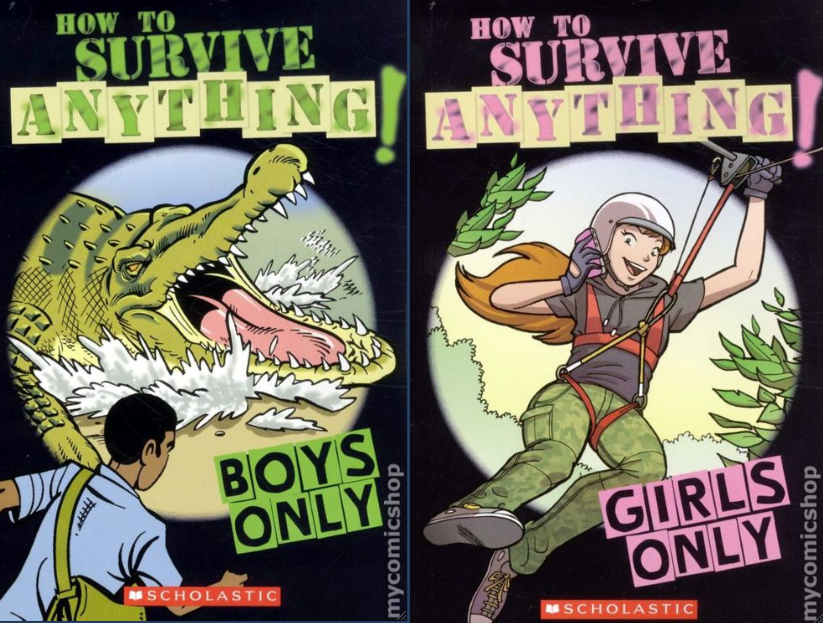
Annie C. and another reader sent us a link to a post by Ryan North at what are the haps about a set of gendered “survival guides” for kids published by Scholastic (and which the publisher now says it won’t continue printing). Boys and girls apparently need very different survival skills, which the other sex shouldn’t know anything about:

In his post, Ryan provides the table of contents for each. What do boys and girls need to be able to survive? For boys, no big surprises — forest fire, earthquake, quicksand, your average zombie or vampire attack, that type of thing, many including, according to teen librarian Jackie Parker, practical and useful tips:

How to Survive a shark attack
How to Survive in a Forest
How to Survive Frostbite
How to Survive a Plane Crash
How to Survive in the Desert
How to Survive a Polar Bear Attack
How to Survive a Flash Flood
How to Survive a Broken Leg
How to Survive an Earthquake
How to Survive a Forest Fire
How to Survive in a Whiteout
How to Survive a Zombie Invasion
How to Survive a Snakebite
How to Survive if Your Parachute Fails
How to Survive a Croc Attack
How to Survive a Lightning Strike
How to Survive a T-Rex
How to Survive Whitewater Rapids
How to Survive a Sinking Ship
How to Survive a Vampire Attack
How to Survive an Avalanche
How to Survive a Tornado
How to Survive Quicksand
How to Survive a Fall
How to Survive a Swarm of Bees
How to Survive in Space

Girls seem to require a very different set of survival skills. Like how to survive a breakout — a skill boys don’t apparently need, though they also get acne. Other handy tips are how to deal with becoming rich or a superstar, how to ensure you get the “perfect school photo,” surviving a crush, whatever turning “a no into a yes” is (persuasiveness, I suppose), picking good sunglasses, dealing with a bad fashion day, and of course “how to spot a frenemy”:

How to survive a BFF Fight
How to Survive Soccer Tryouts
How to Survive a Breakout
How to Show You’re Sorry
How to Have the Best Sleepover Ever
How to Take the Perfect School Photo
How to Survive Brothers
Scary Survival Dos and Don’ts
How to Handle Becoming Rich
How to Keep Stuff Secret
How to Survive Tests
How to Survive Shyness
How to Handle Sudden Stardom
More Stardom Survival Tips
How to Survive a Camping Trip
How to Survive a Fashion Disaster
How to Teach Your Cat to Sit
How to Turn a No Into a Yes
Top Tips for Speechmaking
How to Survive Embarrassment
How to Be a Mind Reader
How to Survive a Crush
Seaside Survival
How to Soothe Sunburn
How to Pick Perfect Sunglasses
Surviving a Zombie Attack
How to Spot a Frenemy
Brilliant Boredom Busters
How to Survive Truth or Dare
How to Beat Bullies
How to be an Amazing Babysitter

Aside from the multiple items clearly focused on appearances, Ryan points out that several others emphasize looks. Camping is “excellent for the skin,” while the seaside survival chapter provides a lot of fashion tips.

Many of the girls’ tips are about surviving social situations or dealing with emotions — embarrassment, keeping a secret, dealing with bullies. These are all probably more useful to kids than knowing how to survive quicksand, and tips for handling stardom are statistically more likely to be useful at some point than dealing with a T-Rex. So the issue here isn’t that the boys’ guide is inherently more useful or smarter or better; probably all kids should be issued a guide to surviving Truth or Dare (also, dodgeball). But the clear gendering of the guides, with only girls getting tips about dealing with social interactions, emotions, and looks, while outdoorsy injury/natural disaster survival tips are sufficient for boys, illustrates broader assumptions about gender and how we construct femininity and masculinity.

Solomon Asch was a social psychologist famous for his experiments in conformity.  In 1962 he collaborated with Candid Camera, a TV show, to show just how easy it is to reverse an innocuous social norm: the direction one stands in an elevator.

Does it still work?  Watch this University of South Florida replication:

Asch did many such experiments, including showing that people will agree with others when asked a simple question, even if they suspect everyone else is wrong.  The implications are obvious.  Social pressure is incredibly powerful and we’ll do things that seem pretty bizarre just to fit in.  How one stands in an elevator, of course, is a trivial matter and has almost no consequences short of feeling funny.  Imagine how much we’ll be willing to do when the consequences are even a little bit greater.

For more great social psychology: entering a theater full of bikers, doing nothing, change blindness, norm breaching, Milgram’s obedience experiment (plus the original flyer).

Lisa Wade, PhD is an Associate Professor at Tulane University. She is the author of American Hookup, a book about college sexual culture; a textbook about gender; and a forthcoming introductory text: Terrible Magnificent Sociology. You can follow her on Twitter and Instagram.
Rebecca sent in an ad she saw in an Australian women’s magazine that explicitly reinforces the idea that women are in perpetual competition with one another. The ad declares an anti-aging product a weapon to be used “in the war against other women,” reminding women that we should consider ourselves to be in a battle with one another over who is most physically attractive — and thus, presumably, most likely to win the ultimate prize of remaining sexually attractive to men:

Check out our earlier posts on the discourse of women-as-competitors, how objectification divides women, the “don’t hate me because I’m beautiful” advertising trope, and an Israeli Bacardi ad campaign that told women to get an ugly friend to make themselves look better.

The Fourth Estate has found that the vast majority of people quoted in news coverage of the 2012 election are men.  The media research group collected a sample of election-related news stories from print newspapers and TV broadcasts, finding that 13% of print sources were women (79% were men and 8% were organizations) and 16% of TV sources were women (81% were men and 3% were organizations).

Male dominance was true in all outlets, though Meet the Press and Time Warner stand out as the least disproportionate:

This might be old (though still frustrating) news, except for the fact that the pattern held for issues traditionally considered “women’s”: abortion, birth control, Planned Parenthood, and women’s rights (blue is men, pink is women, grey is organizations):

This asymmetry is found across media.  See also our posts on gender and book reviewinggender and top billing at Paramount pictures, gender and top creatives for family movies, and women as news subjects.

Lisa Wade, PhD is an Associate Professor at Tulane University. She is the author of American Hookup, a book about college sexual culture; a textbook about gender; and a forthcoming introductory text: Terrible Magnificent Sociology. You can follow her on Twitter and Instagram.

In capitalism, owners of the “means of production” (things like land, factories, technologies, and natural resources, or the money to buy these things) employ labor to do the work of actually producing things.  If the system is working correctly, the value of the labor that goes into making something is worth less than the value of the thing.  This way the capitalist can sell the thing, pay the worker, and skim some profit off the top.

But how much profit?  In a less exploitative system, the worker is paid close to what his work is worth (after accounting for the expenses of maintaining the means of production). In a more exploitative system, the capitalist takes a larger chunk of the enhanced value for himself and gives less to the worker.

What kind of system do we have in the U.S.?  Let’s take a look at some data.

Over at Reports from the Economic Front, Martin Hart-Landsberg posted this graph. It shows that  workers have become increasingly productive since 1948 (i.e., they have created more and more surplus value).  Employers largely shared the increase in profitability with their workers… until the mid-1970s.  Since then, wages have remained stagnant even as worker productivity has continued to rise.  “In other words,” Hart-Landsberg writes, “the owners of the means of production have basically stopped sharing gains in output with their workers.”

You wonder why the middle class is shrinking?  This is one reason.

Lisa Wade, PhD is an Associate Professor at Tulane University. She is the author of American Hookup, a book about college sexual culture; a textbook about gender; and a forthcoming introductory text: Terrible Magnificent Sociology. You can follow her on Twitter and Instagram.