The conventional wisdom seems to be that our biggest economic challenge is runaway government spending. The reality is that government spending is contracting and pulling economic growth down with it.  And worse is yet to come.

Perhaps the best measure of active government intervention in the economy is something called “government consumption expenditure and gross investment.”  It includes total spending by all levels of government (federal, state, and local) on all activities except transfer payments (such as unemployment benefits, social security, and Medicare).  

The chart below shows the yearly percentage change in real government consumption expenditure and gross investment over the period 2000 to 2012 (first quarter).  As you can see, while the rate of growth in real spending began declining after the end of the recession, it took a nose dive beginning in 2011 and turned negative, which means that government spending (adjusted for inflation) is actually contracting.

fredgraph-percente-change-from-a-year-ago.png

The next chart, which shows the ratio of government consumption expenditure and gross investment to GDP, highlights the fact that government spending is also falling as a share of GDP.

dolan-relative-to-gdp.png

Adding transfer payments, which have indeed grown substantially because of the weak economy, does little to change the picture.  As the chart below shows, total government spending in current dollars, which means unadjusted for inflation, has stopped growing.  If we take inflation into account, there can be no doubt that total real government spending, including spending on transfer payments, is also contracting. 

current-total-expenditures.png

The same is true for the federal government, everyone’s favorite villain.  As the next chart shows, total federal spending, unadjusted for inflation, has also stopped growing.

federal-current.png

Not surprisingly, this decline in government spending is having an effect on GDP. Real GDP in the 4th Quarter of 2011 grew at an estimated 3 percent annual rate.  The advanced estimate for 1st Quarter 2012 GDP growth was 2.2 percent.  A just released second estimate for this same quarter revised that figure down to 1.9 percent.  In other words, our economy is rapidly slowing.

What caused the downward revision? 

The answer, says Ed Dolan, is the ever deepening contraction in government spending:  

What is driving the apparent slowdown? It would be comforting to be able to blame a faltering world economy and a strengthening dollar, but judging by the GDP numbers that does not seem to be the case. The following table (see below) shows the contributions of each sector to real GDP growth according to the advance and second estimates from the Bureau of Economic Analysis. Exports, which we would expect to show the effects of a slowing world economy, held up well in the first quarter. In fact, the second estimate showed them even stronger than did the advance estimate. The contribution of private investment also increased from the advance to the second estimate, although not by as much. Exports and investment, then, turn out to be the relatively good news, not the bad, in the latest GDP report.

Instead, the largest share of the decrease in estimated real GDP growth came from an accelerated shrinkage of the government sector. The negative .78 percentage point decrease of the government sector is the main indicator that we are already on the downward slope toward the fiscal cliff.

p120601-1a.png

If current trends aren’t bad enough, we are rapidly approaching, as Ed Dolan noted, the “fiscal cliff.” That is what I was referring to above when I said that worse is yet to come. As Bloomberg Businessweek explains 

Last summer, as part of its agreement to end the debt-ceiling debate (debacle?), Congress strapped a bomb to the economy and set the timer for January 2013. Into it they packed billions of dollars of mandatory discretionary spending cuts, timed to go off at exactly the same time a number of tax cuts [for example, the Bush tax cuts and the Obama payroll-tax holiday] were set to expire  

The congressional deficit supercommittee had a chance to disarm the bomb last fall, but of course it didn’t. And so the timer has kept ticking. The resulting double-whammy explosion of spending cuts and tax increases will likely send the economy careening off a $600 billion “fiscal cliff.”

The fiscal contraction will actually be even worse, since the extended unemployment benefits program is also scheduled to expire at the end of the year.  

So, what does all of this mean?  According to Bloomberg Businessweek:

If Congress does nothing, the U.S. will almost certainly go into recession early next year, as the combo of spending cuts and tax hikes will wipe out nearly 4 percentage points of economic growth in the first half of 2013, according to research by Goldman’s Alec Phillips, a political analyst and economist. Since most estimates project the economy will grow only about 3 percent next year, that puts the U.S. solidly in the red.

One can only wonder how it has come to pass that we think government spending is growing when it is not and that it is the cause of our problems when quite the opposite is true.  Painful lessons lie ahead — if only we are able to learn them.

The Belgian Cancer Foundation is trying to increase awareness of skin cancer and the importance of wearing sunscreen to protect against it. Unfortunately, they’ve recently decided the best way to get this across is to fall back on a familiar message: ladies, if you don’t do what we say, you’ll be hideous and your guy won’t want you any more. In this video released as part of the campaign, ostensibly aimed at men (and sent in by YetAnotherGirl and Grace W.), guys fall asleep with their young female partners. After they fall asleep, the women sneak out of bed and their moms take their places, and we get to see the startled reactions when the men wake up, with the final warning that if men don’t make their girlfriends wear sunscreen, “she’ll start looking like her mom far too soon”:

Because you know, ladies, if you don’t wear sunscreen, you’ll age, and that makes you so gross and scary that men will fall out of bed trying to get away from you. And what could be more romantic than a boyfriend lovingly reminding his girlfriend to put on some sunscreen so she doesn’t someday totally freak him out?

Via Gawker.

Cross-posted at Montclair SocioBlog.

Air pollution is what economists call an “externality.”  It is not an intrinsic part of the economic bargaining between producers and consumers.  The usual market forces — buyers and sellers pursuing their own individual interests — won’t help.  The market may bring us more goods at lower prices, for example, but it can harm the air that everyone, in or out of that market, has to breathe. To create or protect a public good, the free market has to be a little less free.  That’s where government steps in.  Or not.

Case in point: My son and his girlfriend arrived in Beijing ten days ago.  The got-here-safely e-mail ended with this:

…was blown away by the pollution! I know people talk about it all the time, but it really is crazy.

And it is.  Here’s a photo I grabbed from the Internet:

Flickr creative commons by nasus89.

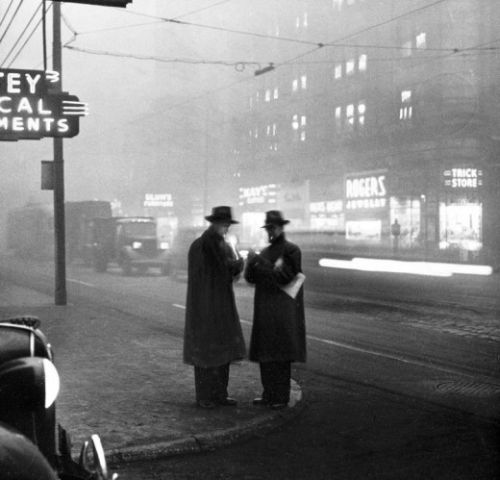
At about the same time, I came upon a this link to photos of my home town Pittsburgh in 1940.  Here are two of them:
Today in downtown Pittsburgh, the streetcars and overhead trolleys are gone.  So are the fedoras.  And so is the smoke.

The air became cleaner in the years following the end of the War.  It didn’t become clean all by itself, and it didn’t become clean because of free-market forces.  It got clean because of government — legislation and regulation, including an individual mandate.

The smoke was caused by the burning of coal, and while the steel mills accounted for some of the smoke, much of the it came from coal-burning furnaces in Pittsburghers’ houses.  If the city was to have cleaner air, the government would have to force people change the way they heated their homes.  And that is exactly what the law did. To create a public good — clean air — the law required individuals to purchase something — either non-polluting fuel (oil, gas, or smokeless coal) or smokeless equipment.*

Initially, not everyone favored smoke control, but as Pittsburgh became cleaner and lost its “Smoky City” label, approval of the regulations increased, and there was a fairly rapid transition to gas heating.  By the 1950s, nobody longed for the unregulated air of 1940.  Smoke control was a great success.**  Of course, it may have helped that Pittsburgh did not have a major opposition party railing against this government takeover of home heating or claiming that smoke control was a jobs-killing assault on freedom.

————————

* Enforcement focused not on individuals but distributors.  Truckers were forbidden from delivering the wrong kind of coal.

** For a fuller account of smoke control in Pittsburgh, see Joel A. Tarr and Bill C. Lamperes, Changing Fuel Use Behavior and Energy Transitions: The Pittsburgh Smoke Control Movement, 1940-1950: A Case Study in Historical Analogy. Journal of Social History , Vol. 14, No. 4, Special Issue on Applied History (Summer, 1981), pp. 561-588.

Jay Livingston is the chair of the Sociology Department at Montclair State University. You can follow him at Montclair SocioBlog or on Twitter.

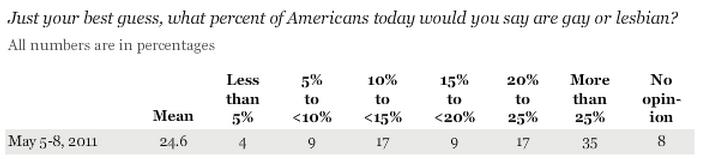
In the late 1940s and 1950s, sex researcher Alfred Kinsey estimated that about 10% of the population was something other than straight (and then, as now, a much larger number have same sex experiences or attraction).  Today scholars believe that about 3.5% of the U.S. population identify as gay, lesbian or bisexual, a considerably lower number.  Yet, a telling poll by Gallup shows that Americans wildly — wildly — overestimate the number of people who identify as non-heterosexual:

The table shows that more than a third of Americans believe that more than one out of every four people identifies as gay or lesbian.  Only 4% of Americans answered “less than 5%,” the correct answer.

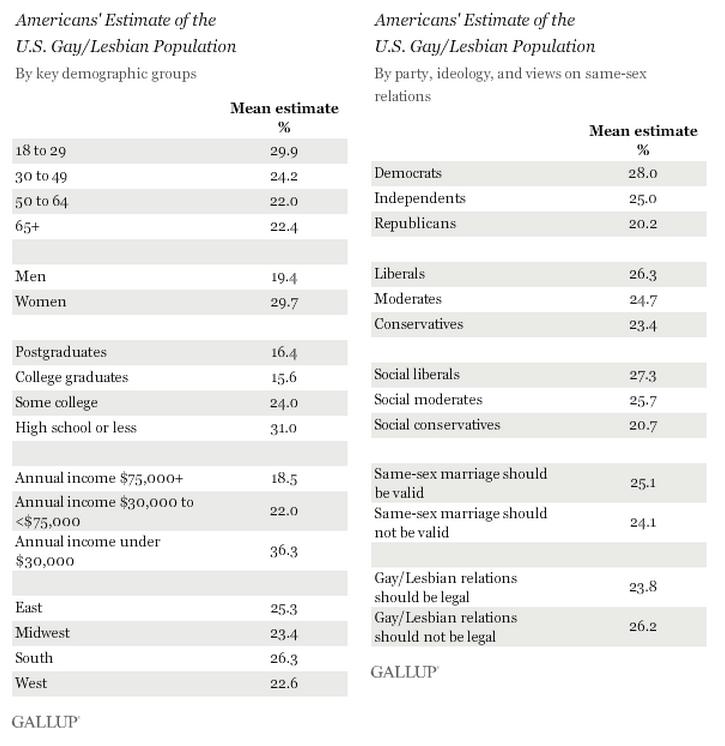
Estimates varied by demographics and political leaning. Liberals were more likely to overestimate, as were younger people, women, Southerners, and people with less education and income:

Interestingly, these numbers are higher than in 2008, when Gallup asked a similar questions. In that poll, only a quarter of the respondents choose “more than 25%” and more than twice as many said that they had “no opinion.”

Gallup concludes: “…it is clear that America’s gay population — no matter the size — is becoming a larger part of America’s mainstream consciousness.”

Lisa Wade, PhD is an Associate Professor at Tulane University. She is the author of American Hookup, a book about college sexual culture; a textbook about gender; and a forthcoming introductory text: Terrible Magnificent Sociology. You can follow her on Twitter and Instagram.

Remapping Debate has posted an interactive graph that lets you look at the decreasing relative value of the federal minimum wage. The graph shows the gap, at various points in time, between the annual income of a full-time worker earning minimum wage and the poverty line for a family of four (all expressed in 2011 dollars; you can see specific historical, unadjusted minimum wage rates here). In 1968, a single minimum-wage earner made about 94% of the federal poverty line for four people:

By 2011, the gap had widened significantly; one minimum-wage worker earns about 66% of the poverty threshold for a family of four:

Though the federal minimum wage has gone up over time, its relative value covers less and less of the costs of living in the U.S.

On this day in 1963 the U.S. Congress passed the Equal Pay Act, a law designed to end wage discrimination against women.

How to get the word out? Advertising of course!

Thanks to Sean D. for the link!

Lisa Wade, PhD is an Associate Professor at Tulane University. She is the author of American Hookup, a book about college sexual culture; a textbook about gender; and a forthcoming introductory text: Terrible Magnificent Sociology. You can follow her on Twitter and Instagram.

Identifying as Republican is strongly associated with religiosity in the U.S., so much so that people often use the term “Republican” and “Religious Right” interchangeably. Indeed, religious people are more likely to be politically conservative overall, but a Gallup poll shows that this relationship is moderated by race.  The figure below cross-tabulates religiosity for four racial/ethnic groups with the likelihood of affiliating with the Democratic or Republican party or neither.  You can see that the typical relationship — religion/Republican and no religion/Democrat — holds for all groups, except for African Americans.

At Gallup, Frank Newport writes:

Asian and Hispanic Americans, regardless of religiousness, are more likely to identify as Democrats than Republicans. But the Democratic advantage goes from 14 points among very religious Asians to 44 points among nonreligious Asians. The differences are less substantial among Hispanics; very religious Hispanics are more likely to identify themselves as a Democrats than Republicans by 20 points, while nonreligious Hispanics are more likely to identify themselves as Democrats by a larger 36-point margin.

Personal religiousness makes little difference among blacks, however, as the powerful partisan pull of Democratic identification among black Americans trumps any influence of religion.

The report is a great example of the importance of doing intersectional analyses.  When you pull groups apart (by, say, adding race when looking at the relationship between religion and politics), you often find that a more generalized examination is hiding interesting details.

Lisa Wade, PhD is an Associate Professor at Tulane University. She is the author of American Hookup, a book about college sexual culture; a textbook about gender; and a forthcoming introductory text: Terrible Magnificent Sociology. You can follow her on Twitter and Instagram.

Apple’s profits more than quintupled in the last five years, but their tax burden has risen much more slowly.  Last year, just 9.8% of their profits went to taxes.   “By comparison,” writes economist Marty Hart-Landsberg, “Wal-Mart was downright patriotic — paying a tax rate of 24 percent.”

How does the company do it?  Hart-Landsberg summarizes the New York Times: “The answer is tax loopholes and a number of subsidiaries in low tax places like Ireland, the Netherlands, Luxembourg and the British Virgin Islands. ”  More details at Reports from the Economic Front.

Lisa Wade, PhD is an Associate Professor at Tulane University. She is the author of American Hookup, a book about college sexual culture; a textbook about gender; and a forthcoming introductory text: Terrible Magnificent Sociology. You can follow her on Twitter and Instagram.