Archive: 2014

Let’s imagine that a woman — we’ll call her “you,” like they do in relationship advice land — is trying to calculate the odds that a man will call back after sex. Everyone tells you that if you sleep with a guy on the first date he is less likely to call back. The theory is that giving sex away at a such a low “price” lowers the man’s opinion of you, because everyone thinks sluts are disgusting.* Also, shame on you.

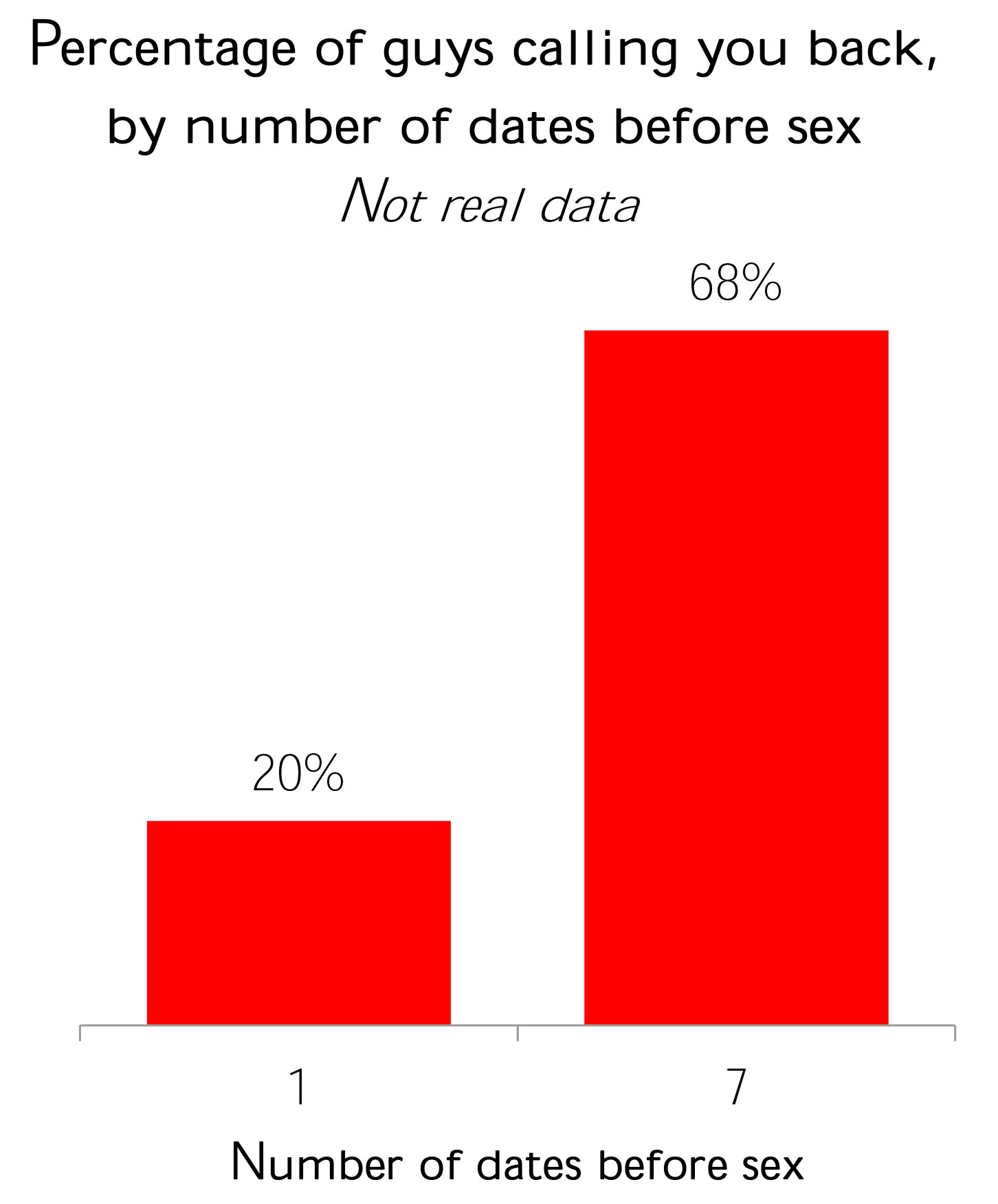
So, you ask, does the chance he will call back improve if you wait till more dates before having sex with him? You ask around and find that this is actually true: The times you or your friends waited till the seventh date, two-thirds of the guys called back, but when you slept with him on the first date, only one-in-five called back. From the data, it sure looks like sleeping with a guy on the first date reduces the odds he’ll call back.
1 (2)

So, does this mean that women make men disrespect them by having sex right away? If that’s true, then the historical trend toward sex earlier in relationships could be really bad for women, and maybe feminism really is ruining society.

Like all theories, this one assumes a lot. It assumes you (women) decide when couples will have sex, because it assumes men always want to, and it assumes men’s opinion of you is based on your sexual behavior. With these assumptions in place, the data appear to confirm the theory.

But what if that those assumptions aren’t true? What if couples just have more dates when they enjoy each other’s company, and men actually just call back when they like you? If this is the case, then what really determines whether the guy calls back is how well-matched the couple is, and how the relationship is going, which also determines how many dates you have.

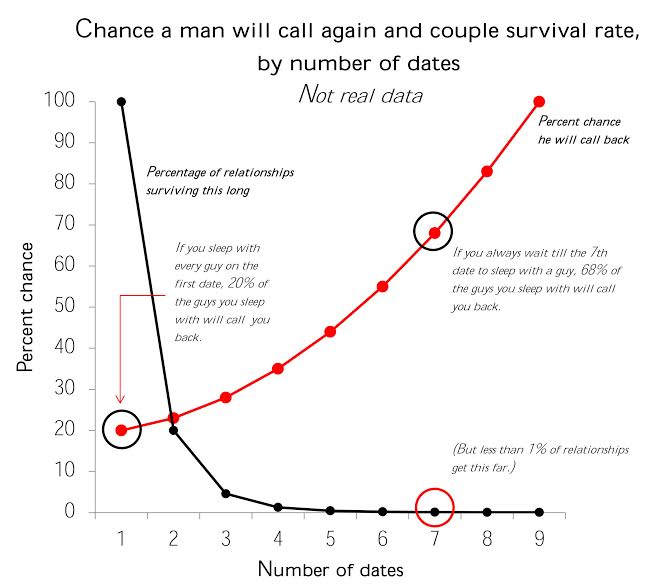
What was missing in the study design was relationship survival odds. Here is a closer look at the same data (not real data), with couple survival added:
5
(Graph corrected from an earlier version.)

.

By this interpretation, the decision about when to have sex is arbitrary and doesn’t affect anything. All that matters is how much the couple like and are attracted to each other, which determines how many dates they have, and whether the guy calls back. Every couple has a first date, but only a few make it to the seventh date. It appears that the first-date-sex couples usually don’t last because people don’t know each other very well on first dates and they have a high rate of failure regardless of sex. The seventh-date-sex couples, on the other hand, usually like each other more and they’re very likely to have more dates. And: there are many more first-date couples than seventh-date couples.

So the original study design was wrong. It should have compared call-back rates after first dates, not after first sex. But when you assume sex runs everything, you don’t design the study that way. And by “design the study” I mean “decide how to judge people.”

I have no idea why men call women back after dates. It is possible that when you have sex affects the curves in the figure, of course. (And I know even talking about relationships this way isn’t helping.) But even if sex doesn’t affect the curves, I would expect higher callback rates after more dates.

Anyway, if you want to go on blaming everything bad on women’s sexual behavior, you have a lot of company. I just thought I’d mention the possibility of a more benign explanation for the observed pattern that men are less likely to call back after sex if the sex takes place on the first date.

* This is not my theory.

Cross-posted at Family Inequality and Pacific Standard.

Philip N. Cohen is a professor of sociology at the University of Maryland, College Park, and writes the blog Family Inequality. You can follow him on Twitter or Facebook.

Screenshot_18Happy Fat Tuesday to all our friends in New Orleans! Don’t do anything we wouldn’t do!

If you’re not in the middle of the revelry, enjoy these Mardi Gras posts from previous years:

Lisa Wade, PhD is an Associate Professor at Tulane University. She is the author of American Hookup, a book about college sexual culture; a textbook about gender; and a forthcoming introductory text: Terrible Magnificent Sociology. You can follow her on Twitter and Instagram.

Prostitutes have often been at the forefront of challenges to gender conventions. Already at the fringes of “respectable society,” by choice or circumstance, these women often have less to lose than others.

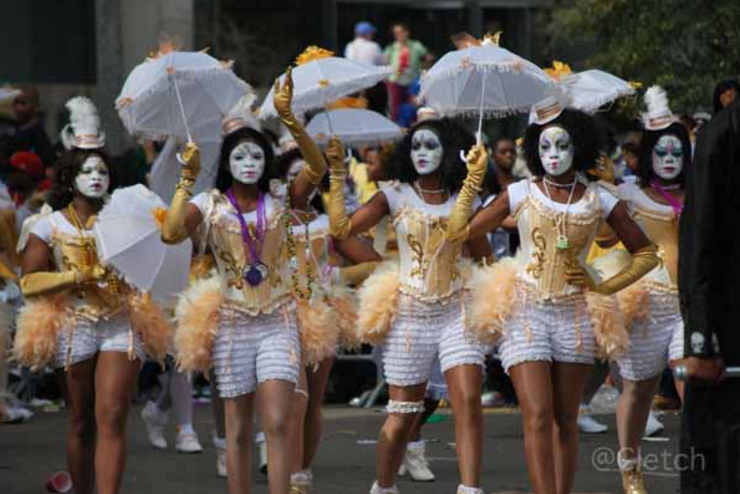
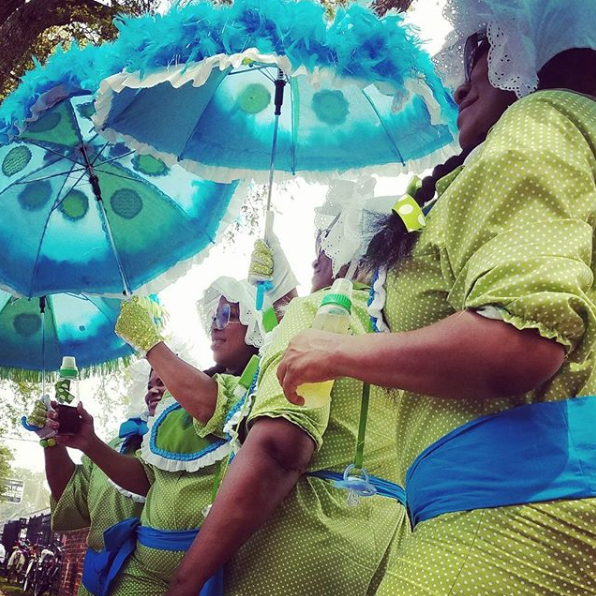
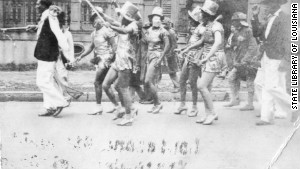
The Mardi Gras Baby Dolls are an excellent example.  NPR’s Tina Antolini writes that the baby doll tradition began in 1912.  That year a group of African American sex workers dressed up like baby dolls and took to the streets to celebrate Mardi Gras.

Baby dolls, 1930s (CNN):

5

Baby dolls, 1942:
babydolls1

Calling your lover “baby” had just become part of the English language.  Meanwhile, actual baby dolls, the toy, were rare.  By dressing up this way, they flouted both gender and race rules.  Women were largely excluded from masking for Mardi Gras and African Americans were still living under Jim Crow.  Black women, by virtue of being both Black and female, were particularly devalued, sex workers ever more so.  Asserting themselves as baby dolls, then, was a way of arguing that they were worth something.

“[I]t had all that double meaning in it,” explains historian Kim Vaz, “because African-American women weren’t considered precious and doll-like.”

It was a bold thing to do and the Baby Dolls carried walking sticks with them to beat off those who accosted them.

Today, honoring those brave women that came before, the tradition lives on in a city with the richest and most creative and unique traditions I have ever encountered.  Happy Mardi Gras, Baby Dolls!  Have a wonderful day tomorrow!

Flickr creative commons by Pat (Cletch) Williams.
Flickr creative commons dipfoto.
Instagram, by Lisa Wade.

For more, visit They Call Me Baby Doll.  Cross-posted at Pacific Standard.

Lisa Wade, PhD is an Associate Professor at Tulane University. She is the author of American Hookup, a book about college sexual culture; a textbook about gender; and a forthcoming introductory text: Terrible Magnificent Sociology. You can follow her on Twitter and Instagram.

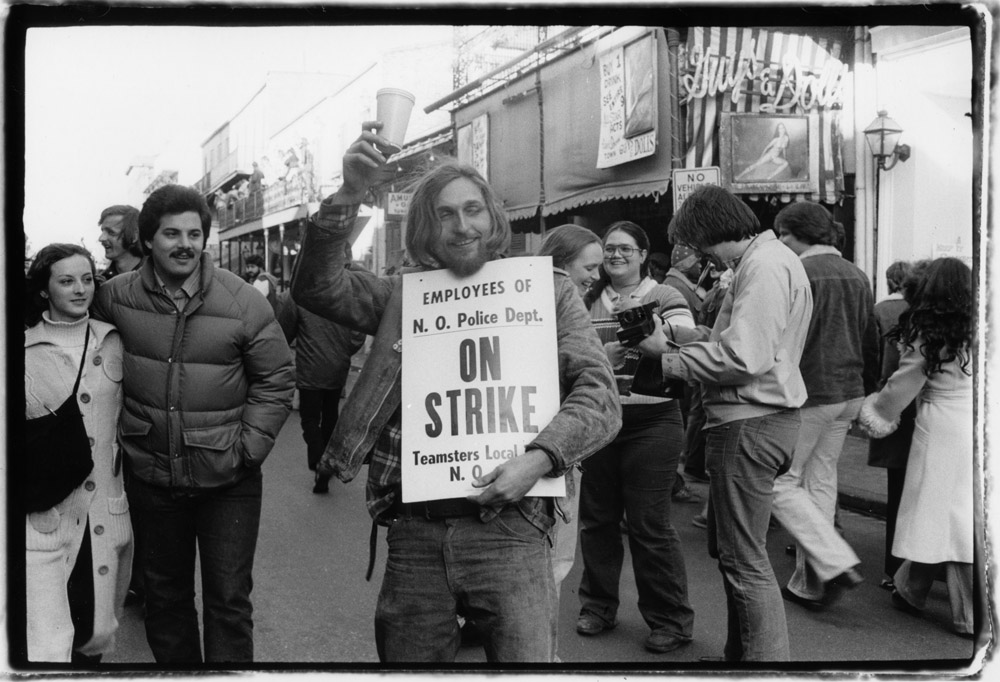
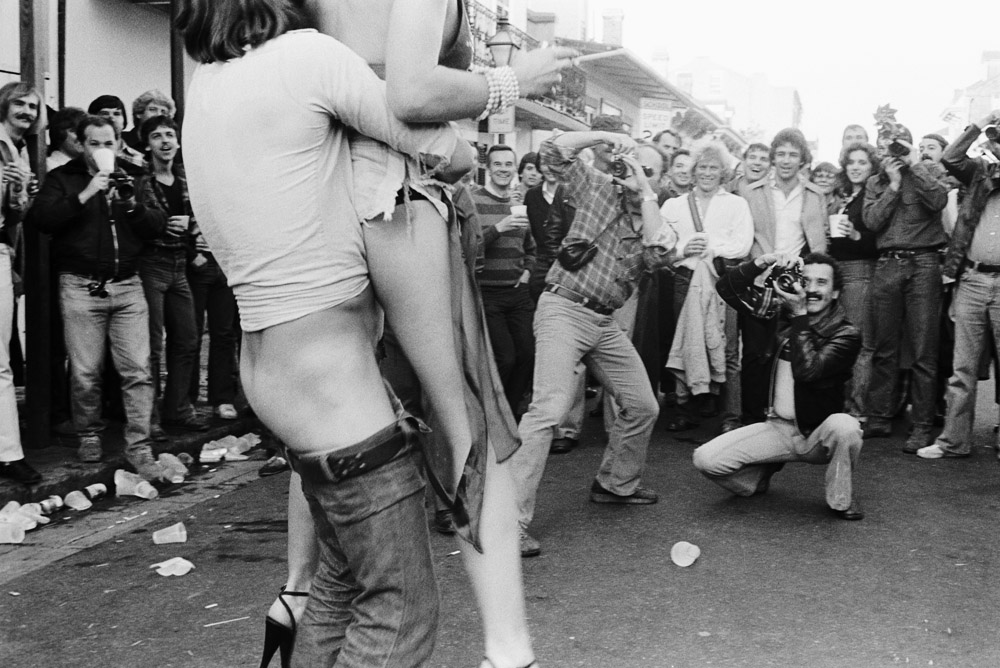
In 1979 the New Orleans police department went on strike, using the powerful leverage of Mardi Gras to push for an improvement in their working conditions.  The city held fast and the celebration was cancelled.  Ish.  Some parades moved just out of town.  Most tourists stayed away, fearful of unregulated reveling.  But lots of locals went forward with the holiday, partying in the streets without the influx of tourists that accompany a typical Fat Tuesday.

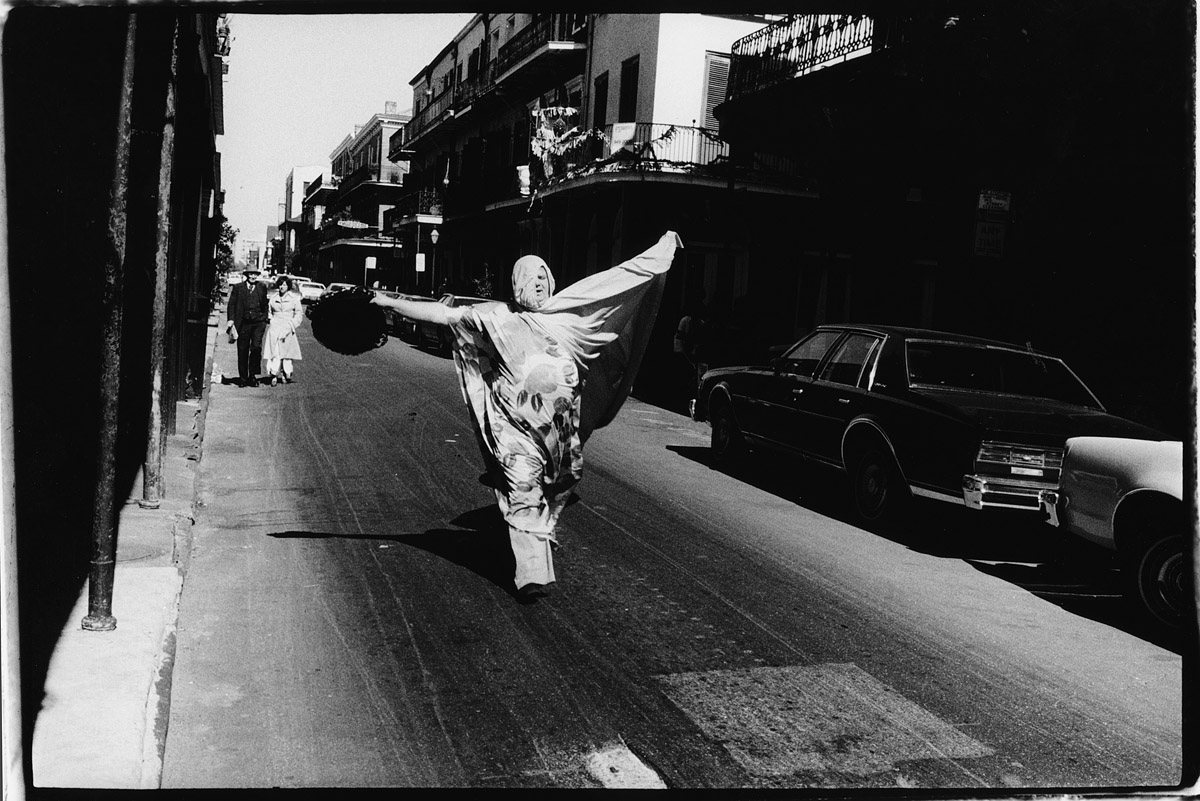
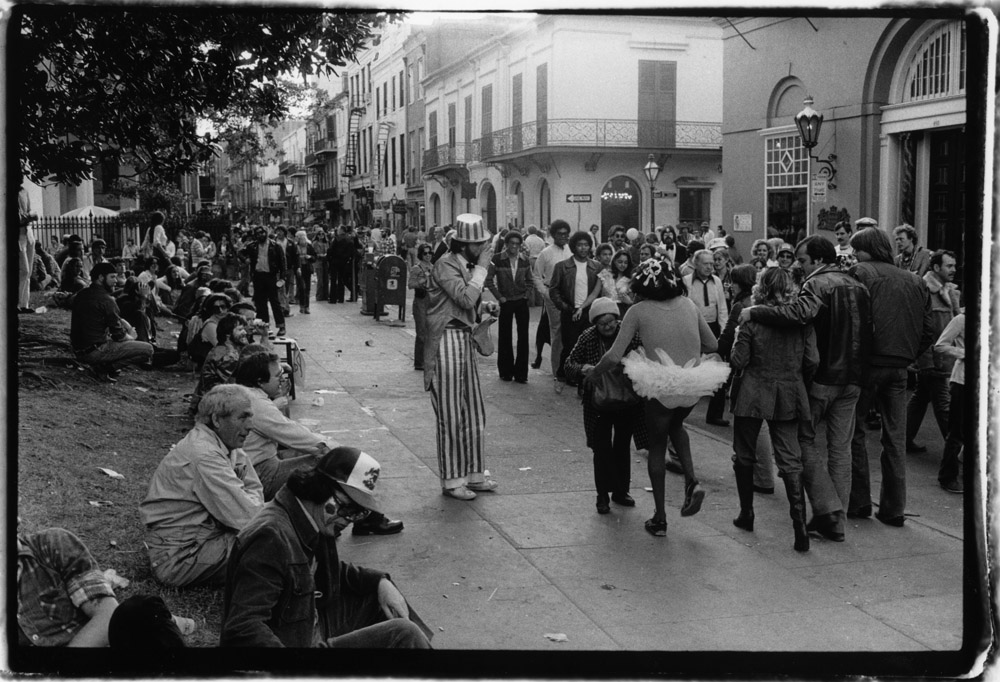
The National Guard was called in to ensure a semblance of order, but they ignored vice, intervening only against violence.  According to Wikipedia, many French Quarter locals decided it was the best Mardi Gras ever.  Photographer Robbie McClaran was there.  Here are some of his photographs of the day:

Untitled - New Orleans 1979Vintage photography from the late 1970s Untitled - New Orleans 1979

Of the last photo, McClaran writes: “I remember this scene like it was yesterday, it was the moment when I thought to myself Mardis Gras had reached a level of surreality I had never experienced before. Homeless woman dancing with a man in a tutu while Uncle Sam looks on and salutes.”

Untitled15

Le bon temps roule, everybody.

Lisa Wade, PhD is an Associate Professor at Tulane University. She is the author of American Hookup, a book about college sexual culture; a textbook about gender; and a forthcoming introductory text: Terrible Magnificent Sociology. You can follow her on Twitter and Instagram.

1As we say goodbye to Black History Month, let us return to posts past.

We have been urged to celebrate…

<sarcasm> Good times. </sarcasm>

Lisa Wade, PhD is an Associate Professor at Tulane University. She is the author of American Hookup, a book about college sexual culture; a textbook about gender; and a forthcoming introductory text: Terrible Magnificent Sociology. You can follow her on Twitter and Instagram.

SocImages News:

At the end of January we had the pleasure of introducing the world to 7 year old Charlotte’s letter to Lego asking for more female minifigs and adventures for girls.

It struck a nerve and was covered this month at The Independent, ABC News, CBC News, Fox News, io9, USA Today, The ExaminerThe New York Daily News, San Francisco GateBuzzfeedShine, Huffington Post, Metro, Vitamin W, and The Daily Mail.  And that’s just a selection from the first two pages of search results!

Readers’ Picks!

Social Media ‘n’ Stuff:

Finally, this is your monthly reminder that we’re on TwitterFacebookTumblrGoogle+, and Pinterest.  I’m on Facebook and most of the team is on Twitter: @lisawade@gwensharpnv@familyunequal, and @jaylivingston.

Finally…

…a lovely picture of the steamboat Natchez on the Mississippi crescent.  I’m enjoying New Orleans and looking forward to Mardi Gras and the St. Ann’s parade!

Capture

Lisa Wade, PhD is an Associate Professor at Tulane University. She is the author of American Hookup, a book about college sexual culture; a textbook about gender; and a forthcoming introductory text: Terrible Magnificent Sociology. You can follow her on Twitter and Instagram.

Sociologists who study inequality distinguish between individual bias, negative beliefs about a group held by individual persons, and systemic inequality, unequal outcomes built into our institutions that will produce inequality even in the absence of biased individuals.

A good example is K-12 education in the United States.  School funding is linked, in part, to the taxes collected in the neighborhood of each school.  So, schools in rich neighborhoods, populated by rich kids, have more money to spend per student than schools in poor neighborhoods.  This system privileges young people who win the birth lottery and are born into wealthier families, but it also benefits whites and some Asians, who have higher incomes and greater wealth, on average, than Latinos, African Americans, American Indians, and less advantaged Asian groups.

Now, teachers and school staff might be classist and racist, and that will make matters worse.  But even in the absence of such individuals, the laws that govern k-12 funding will ensure that rich and white children will be given a disproportionate amount of the resources we put towards educating the next generation.  That’s f’d up, by the way, in a society that tells itself it’s a meritocracy.

Sociologists who spend time in classrooms know that young people coming into college are much more familiar with the idea that individuals are biased than they are with the idea that our societies are designed to benefit some and hurt others.  This is a problem because, in the absence of an understanding that we need to change law, policy, and practice — in addition to changing minds — we will make limited headway in reducing unfair inequalities.

But where do people get their ideas about what causes inequality?

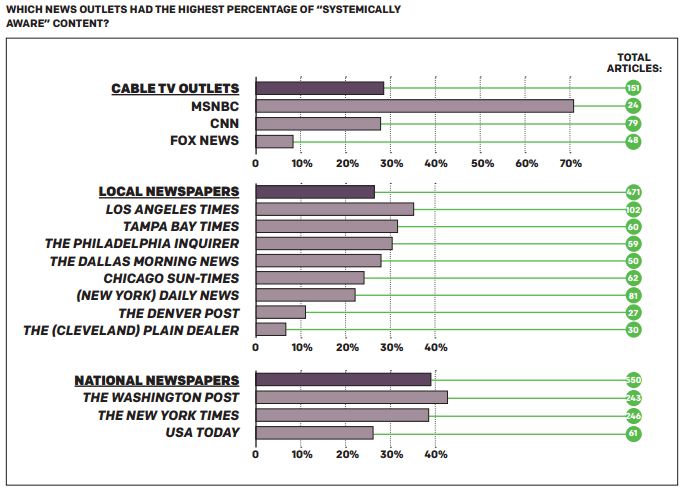
One source is the mass media and, thanks to Race Forward, we now have a portrait of media coverage of one type of inequality and the extent to which it addresses individual and systemic biases.  They measured the degree to which news and TV coverage of issues were systemically aware (discussing policies or practices that lead or have led to inequality) or systemically unaware (fails to discuss such policies, explicitly denies them, or refuses to acknowledge racism of any kind).

First, they found that news outlets varied in their systemic awareness, with MSNBC a clear stand out on one end and Fox News a clear stand out on the other. On average, about 2/3rds of all media coverage failed to have any discussion of systemic causes of inequality.  Articles or op-eds that robustly discussed policy problems or changes were extraordinarily rare, “never constitut[ing] more than 3.3% of any individual news outlet’s coverage of race…”

3

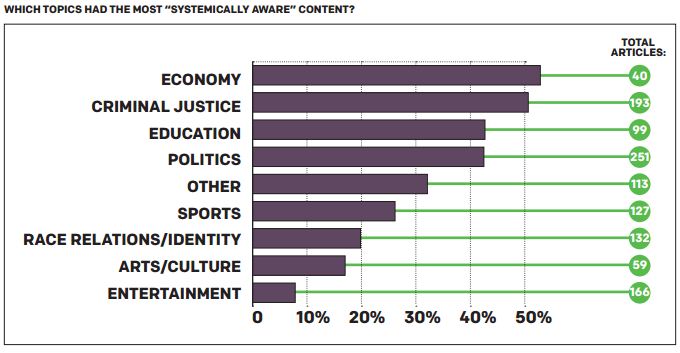
Second, they found that systemic awareness varied strongly by the topic of the coverage, with the economy and criminal justice most likely to receive systemically aware coverage:

4What this means is that whether any given person understands racism to be a largely one-on-one phenomenon that can be solved by reducing individual bias (or waiting for racists to move on to another realm) or a systemic problem that requires intervention at the level of our institutions, depends in part on what media outlets they consume and what they’re interested in (e.g., sports vs. economics).

There’s lots more to learn from the full document at Race Forward.

Lisa Wade, PhD is an Associate Professor at Tulane University. She is the author of American Hookup, a book about college sexual culture; a textbook about gender; and a forthcoming introductory text: Terrible Magnificent Sociology. You can follow her on Twitter and Instagram.

The term secularization is typically used to describe the process by which something becomes increasingly distant from, irrelevant to, or uninfluenced by religion.  But what about religions themselves?  Can religions undergo secularization?

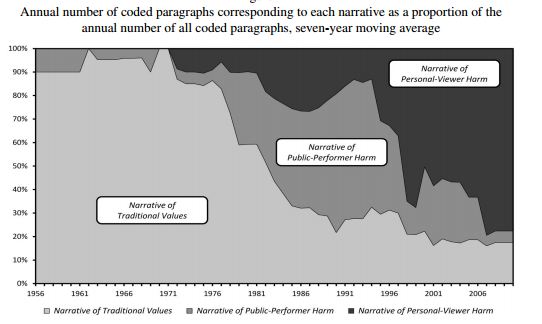
Sociologist Jeremy Thomas tested this proposition, looking at changes in how authors writing for the popular magazine Christianity Today frame their opposition to the use of pornography between 1956 and 2010 (article, summary).  He compared three anti-pornography frames:

  • religious (e.g., against the bible, a sin),
  • harm to others (e.g., performers), and
  • harm to self (e.g., porn addiction, marital troubles).

Thomas found that the last frame — harm to self — had increasing come to dominate the discussion at Christianity Today.  This figure shows the proportion of paragraphs that make each argument.  The last frame clearly dominates.

10

Thomas calls this “outsourcing moral authority”: religious leaders are relying on other authorities to back up their points of view.  This suggests that even religion is undergoing secularization.

Cross-posted at Pacific Standard.

Lisa Wade, PhD is an Associate Professor at Tulane University. She is the author of American Hookup, a book about college sexual culture; a textbook about gender; and a forthcoming introductory text: Terrible Magnificent Sociology. You can follow her on Twitter and Instagram.