Archive: 2014

A new study on the differential earning power of male and female movie stars beings with a quote from Jennifer Jason Leigh:

It’s the nature of the business. People equate success with youth (source).

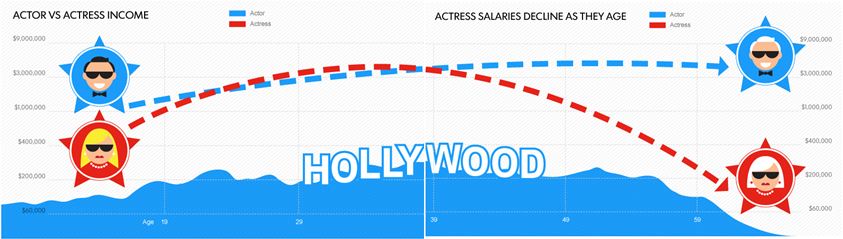
She’s half right.   Irene Pater and her co-authors looked at the pay of 265 actors and actresses who appeared in Hollywood films from 1968 to 2008.  They found that the average earnings of actors rises until the age of 51 and remains stable after that.  The average earnings of actresses, in contrast, peaks at 34 and decreases “rapidly thereafter.”
2
Source: USA Today

Sarah Jessica Parker, then, was more on the mark:

There is still a discrepancy in earning power between men and women in Hollywood. And it becomes doubly unfair when you think of our earning potential in terms of years.  Actresses are like football players. They have a small window of prime earning ability (source).

So, is this sexism or just “market forces”?  That is, is female acting work devalued compared to men’s because people in positions of power don’t value women?  Or is it because casting women over 34 decreases box office returns, whereas casting older men does not?  Pater and her colleagues suggest that it’s sexism.  One study, they explain,

…actually examined the combined effect of gender and age on box office performance [and] revealed that casting a female lead older than 32 years of age does not influence a movie’s box office performance, whereas casting a male lead older than 42 decreases box office revenues by almost 17% (source).

So the presence of male actors in their forties and over decreases box office revenue, but they still get paid more than women of the same age.  In contrast, casting women in their mid-thirties and over doesn’t bring down profits, but she’s still less valuable in the eyes of producers.  Sexism sounds like a plausible explanation to me.

Lisa Wade, PhD is an Associate Professor at Tulane University. She is the author of American Hookup, a book about college sexual culture; a textbook about gender; and a forthcoming introductory text: Terrible Magnificent Sociology. You can follow her on Twitter and Instagram.

In 2010 a scandal that erupted when designer Mark Fast decided to use four plus-size models (US sizes 8-10) in his catwalk show at London Fashion Week.  Protesting his decision, his stylist and creative director quit, leaving him just three days to find replacements.

The incident is a great example of how even relatively powerful figures (e.g., designers with catwalk shows) often have to pay a price for deviating from cultural rules. Designers are often criticized for only hiring waif-like models, but this shows that they don’t get to do whatever they like without consequences.

While it’s easy to condemn Fast’s stylist and creative director for walking out on him, the truth is that even being associated with deviance can bring consequences.  Sociologist Erving Goffman introduced the idea of the “courtesy stigma” to refer to the stigma that attaches to those who are merely associated with a stigmatized person. A recent Grey’s Anatomy episode dealt with exactly this idea in a story about the reaction to an attractive blonde married to an obese man. Her willingness to stay with such a person was a source of curiosity and disbelief.  Similarly, siblings of the mentally ill or mothers of children with  attention deficit/hyperactivity disorder might suffer courtesy stigma when people wonder if the mental illness is genetic or the parenting is bad, respectively.

So, while it’s tempting to say that Fast’s employees hold reprehensible ideological beliefs (a hatred or intolerance for “plus-size” women), it’s also possible that they thought being associated with the show could hurt their chances of success in a very competitive career.  In an industry that stigmatizes fat so powerfully, I can imagine it might be terrifying indeed to be seen as endorsing it.

Cite: Goffman, E. (1963) Stigma: Notes on the Management of Spoiled Identity. Engelwood Cliffs, NJ: Prentice-Hall.

Originally posted in 2010.

Lisa Wade, PhD is an Associate Professor at Tulane University. She is the author of American Hookup, a book about college sexual culture; a textbook about gender; and a forthcoming introductory text: Terrible Magnificent Sociology. You can follow her on Twitter and Instagram.
A survey question is only as good as its choices. Sometimes an important choice has been left off the menu.  I was Gallup polled once, long ago. I’ve always felt that they didn’t get my real opinion.

“What’d they ask?” said my brother when I mentioned it to him.

“You know, they asked whether I approved of the way the President was doing his job.”  Nixon – this was in 1969.
“What’d you say?”

“I said I disapproved of his entire existential being.”

I was exaggerating my opinion, and I didn’t actually say that to the pollster.  But even if I had, my opinion would have been coded as “disapprove.”

For many years the American National Election Study has asked:

How much of the time do you think you can trust the government in Washington to do what is right – just about always, most of the time or only some of the time?

The trouble with these choices at that they exclude the truly disaffected. The worst you can say about the federal government is that it can be trusted “only some of the time.”  A few ornery souls say they don’t trust the federal at all. But because that view is a write-in candidate, it usually gets only one or two percent of the vote.

This year the study included “never” in the options read to respondents.  Putting “no-way, no-how” right there on the ballot makes a big difference. And as you’d expect, there were party differences:

1 (2)

Over half of Republicans say that the federal government can NEVER be trusted.

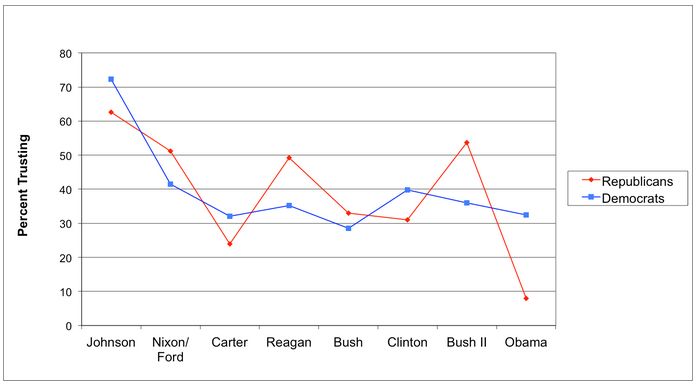
The graph appears in this Monkey Cage post by Marc Hetherington and Thomas Rudolph. Of course, some of those “never” Republicans don’t really mean “never ever.”  If a Republican becomes president, they’ll become more trusting, and the “never-trust” Democrat tide will rise.  Here’s the Hetherington-Rudolph graph tracking changes in the percent of people who do trust Washington during different administrations.

1 (3)

This one seems to show three things:

  1. Trust took a dive in the 1960s and 70s and never really recovered.
  2. Republican trust is much more volatile, with greater fluctuations depending on which party is in the White House.
  3. Republicans really, really hate President Obama.

Cross-posted at Montclair SocioBlog.

Jay Livingston is the chair of the Sociology Department at Montclair State University. You can follow him at Montclair SocioBlog or on Twitter.

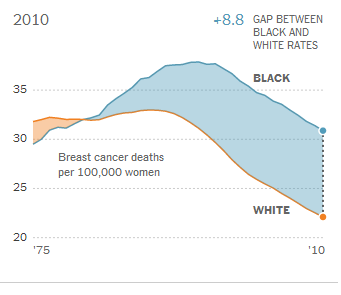
Thanks to advances in early diagnosis and treatment of breast cancer, white women’s survival rates have “sharply improved,” but black women’s have not.  As a result, white women are more likely to be diagnosed with breast cancer, but black women are more likely to die from it.  Researchers from the Sinai Institute found that Black women are 40% more likely to die from the disease than white women.

2

Experts trace the majority of the widening gap in survival rates to access, not biology.  Black women are more likely than white to be low income, uninsured, and suspicious of a historically discriminatory medical profession.

From Tara Parker-Pope for the New York Times.  Hat tip @ProfessorTD.

Lisa Wade, PhD is an Associate Professor at Tulane University. She is the author of American Hookup, a book about college sexual culture; a textbook about gender; and a forthcoming introductory text: Terrible Magnificent Sociology. You can follow her on Twitter and Instagram.
SocImages News:

A proud father shared with us a letter written by his daughter, 7 year old Charlotte, to the LEGO company.  She asked for for more female minifigs and more adventure for girls.  We put the letter out on social media this week and it’s been re-tweeted over 1,000 times and shared over 3,000 times on Facebook.  This is how social media can be used to put pressure on companies to change.  Huzzah!

Well done Charlotte and big thanks to Dad!

1

Reader’s Picks of the Month:

Social Media:

This is your monthly reminder that SocImages is on TwitterFacebook,TumblrGoogle+, and Pinterest.  I’m on Facebook and most of the team is on Twitter: @lisawade@gwensharpnv@familyunequal, and @jaylivingston.

In other news…

Stay warm New Orleans!  I’m arriving on Monday and I expect you to be hospitable!

2

If you’re in the city, I’d love to get together!  I’ll be there through Mardi Gras.  Send an email to socimages@thesocietypages.org and I’ll be in touch!  

Lisa Wade, PhD is an Associate Professor at Tulane University. She is the author of American Hookup, a book about college sexual culture; a textbook about gender; and a forthcoming introductory text: Terrible Magnificent Sociology. You can follow her on Twitter and Instagram.

One conventional explanation for our economic problems seems to be that our businesses are strapped for funds.  Greater business earnings, it is said, will translate into needed investment, employment, consumption and, finally, sustained economic recovery.  Thus, the preferred policy response: provide business with greater regulatory freedom and relief from high taxes and wages.

It is this view that underpins current business and government support for new corporate tax cuts and trade agreements designed to reduce government regulation of business activity, attacks on unions, and opposition to extending unemployment benefits and increasing the minimum wage.

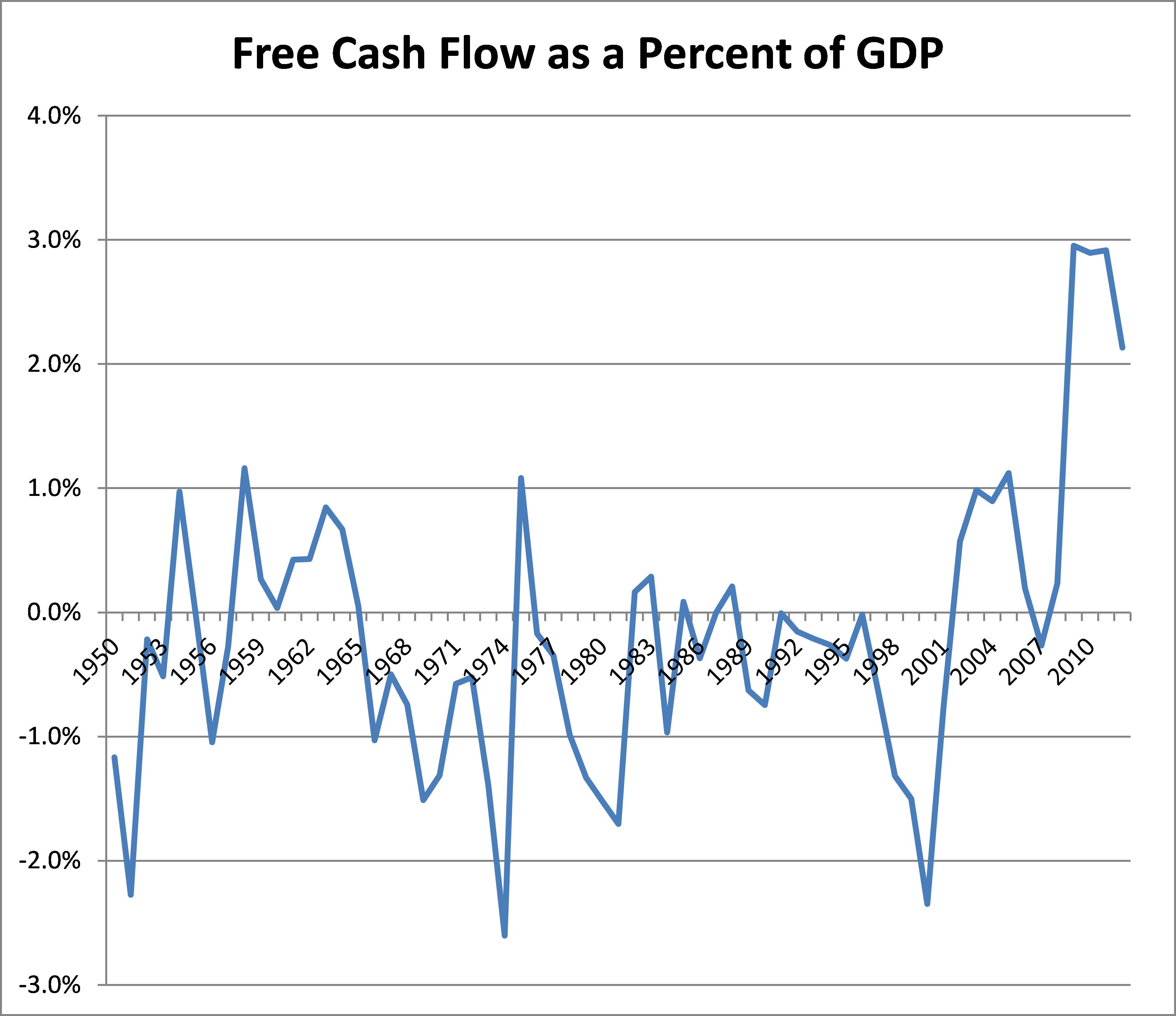
One problem with this story is that businesses are already swimming in money and they haven’t shown the slightest inclination to use their funds for investment or employment.

The first chart below highlights the trend in free cash flow as a percentage of GDP.  Free cash flow is one way to represent business profits.  More specifically, it is a pretax measure of the money firms have after spending on wages and salaries, depreciation charges, amortization of past loans, and new investment.  As you can see that ratio remains at historic highs.  In short, business is certainly not short of money.

1 (2)

So what are businesses doing with their funds?  The next chart looks at the ratio of net private nonresidential fixed investment to net domestic product (I use “net” rather than “gross” variables in order to focus on investment that goes beyond simply replacing worn out plant and equipment).  The ratio makes clear that one reason for the large cash flow is that businesses are not committed to new investment.  Indeed quite the opposite is true.

1 (3)

Rather than invest in plant and equipment, businesses are primarily using their funds to repurchase their own stocks in order to boost management earnings and ward off hostile take-overs, pay dividends to stockholders, and accumulate large cash and bond holdings.

Cutting taxes, deregulation, attacking unions and slashing social programs will only intensify these very trends.  Time for a new understanding of our problems and a very new response to them.

Cross-posted at Reports from the Economic Front.

Martin Hart-Landsberg is a professor of economics at Lewis and Clark College. You can follow him at Reports from the Economic Front.

We have an ever-growing collection of ways in which men are frequently positioned as people and women as women.  We’re always on the lookout for new examples and sociologist Nathan Palmer recently highlighted a nice observation about how this happens in language.

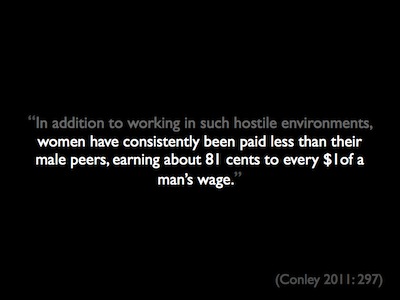
He asked readers to consider a quote from a textbook (not to single Conley out, he’s using standard language and I use it as well in my own textbook).  Here’s the quote with the relevant part in bright white:

1

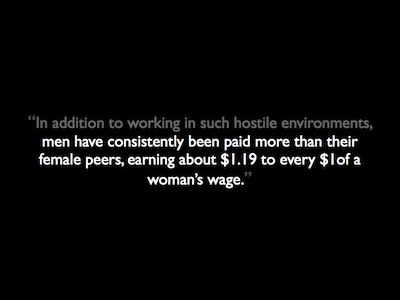
Applying an insight by sociologist Michael Kimmel, Palmer then updated the slide with slightly different language:

2

If a dollar is the amount by which all other wages should be compared, then the first sentence centers men’s experiences and positions women as a deviation from that.  The second sentence switches that around.

By switching the referent, this change in language shifts the center of the discussion from women’s disadvantage to men’s advantage.  Of course, there is both unfair disadvantage and advantage in this story, and we need to make both visible, but always talking in terms of the former makes women and their disadvantage the problem and hides the way that we need to be addressing men’s unfair advantage as well.

Lisa Wade, PhD is an Associate Professor at Tulane University. She is the author of American Hookup, a book about college sexual culture; a textbook about gender; and a forthcoming introductory text: Terrible Magnificent Sociology. You can follow her on Twitter and Instagram.

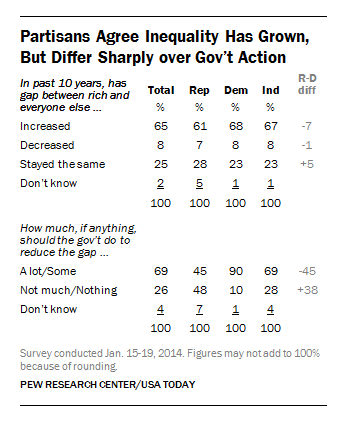
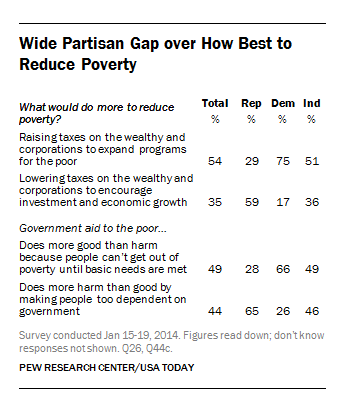
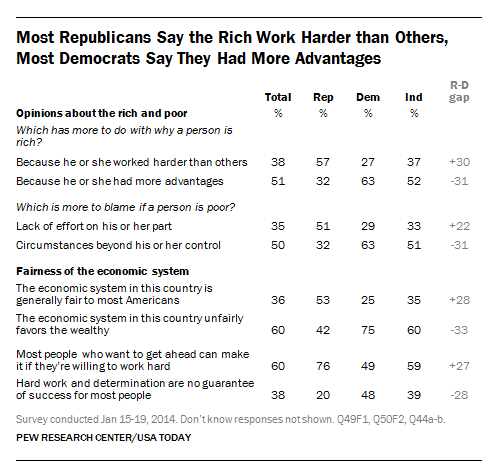
A majority of both Democrats and Republicans believe that economic inequality in the U.S. has grown, but they disagree as to its causes and the best solutions, according to a new survey from the Pew Research Center.  While 61% of Republicans and 68% of Democrats say inequality has widened, only 45% of Republicans say that the government should do something about it, compared to 90% of Democrats.  A study using the General Social Survey has confirmed the findings.

Screenshot (24)

Republicans and Democrats also disagree about what the best interventions would be.  At least three-quarters of Democrats favor taxes on the wealthy and programs for the poor, but 65% of Republicans think that helping the poor does more harm than good.Screenshot (25)

The differences may be related to beliefs about the cause of poverty.  Republicans are much more likely to endorse an individualist explanation (e.g., people are poor because they are lazy), whereas Democrats are more likely to offer a structural explanation (e.g., it matters where in the class structure you begin and how we design the economic system).

Screenshot (27)

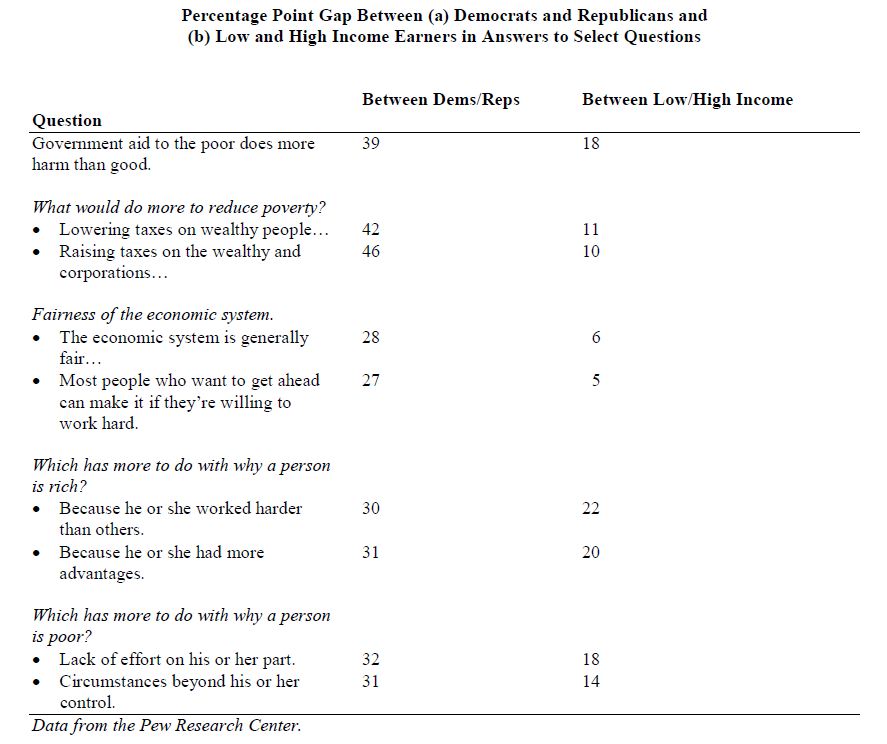
Interestingly, answers to these questions vary much more by political affiliation than social class.  Using data from the survey, I put together this table comparing the number of percentage points that separated the average answers to various questions.  On the left is the difference by political party and, on the right, income (click to enlarge).

1

Clearly political affiliation drives opinions on the explanation for and right solutions to income inequality more so than income itself.

This is a great example of hegemony.  A hegemonic ideology is one that is widely supported, even by people who are clearly disadvantaged by it.  In this case, whatever you think of our economic system, it is pretty stunning that only there is only a six point gap between the percent of high income people saying it’s fair and the percent of low income people saying so.  That’s the power of ideology — in this case, political affiliation — to shape our view of the world, even going so far as to influence people to believe in and perhaps vote for policies that are not in their best interest.

Cross-posted at Pacific Standard.

Lisa Wade, PhD is an Associate Professor at Tulane University. She is the author of American Hookup, a book about college sexual culture; a textbook about gender; and a forthcoming introductory text: Terrible Magnificent Sociology. You can follow her on Twitter and Instagram.