Archive: Mar 2010

In the theme of selling everything with sex, I present Del Monte’s “fruit undressed” campaign.  First I saw this along the side of a webpage I was perusing (for you, readers, for you):
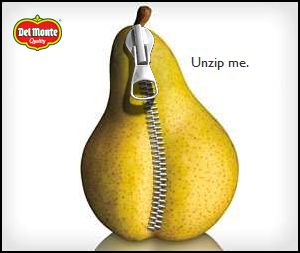
Damn it; I clicked.  The product is, like, a reinvented fruit cocktail:

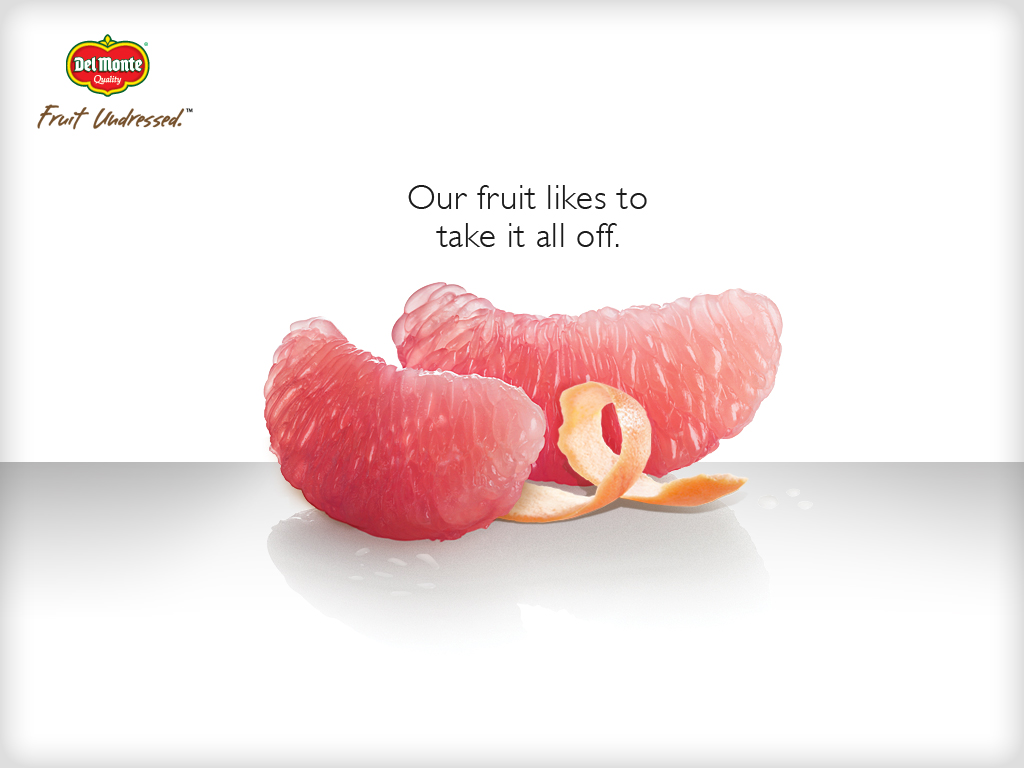
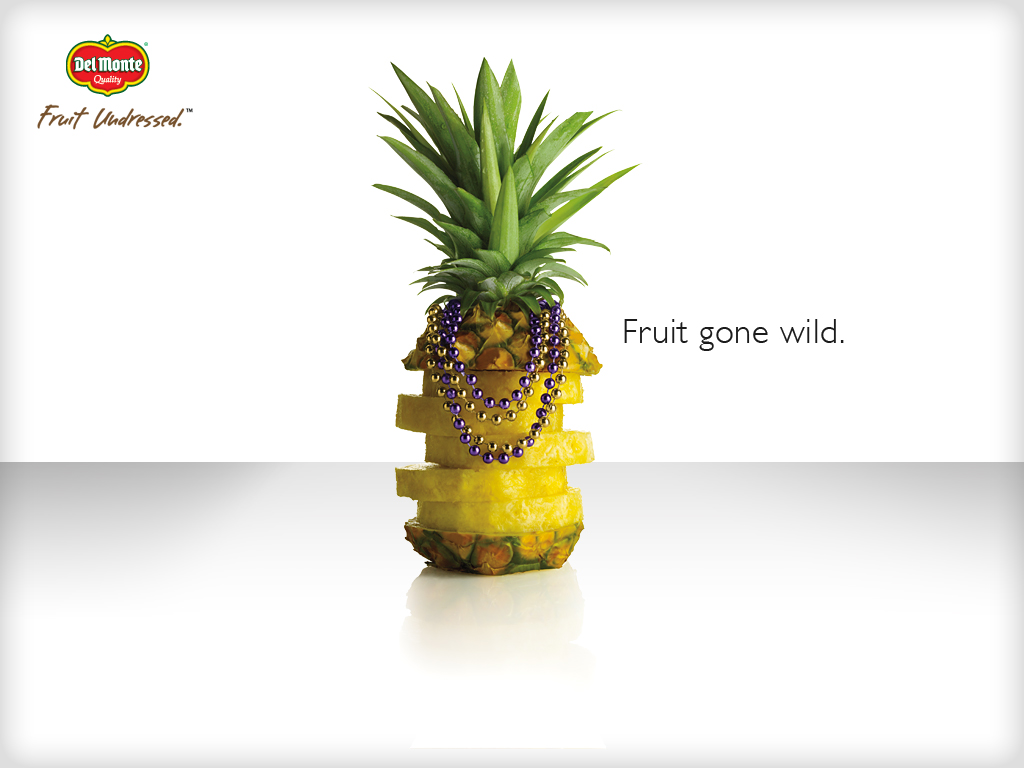
It’s being marketed with these ads suggestively suggesting that the fruit is nude:
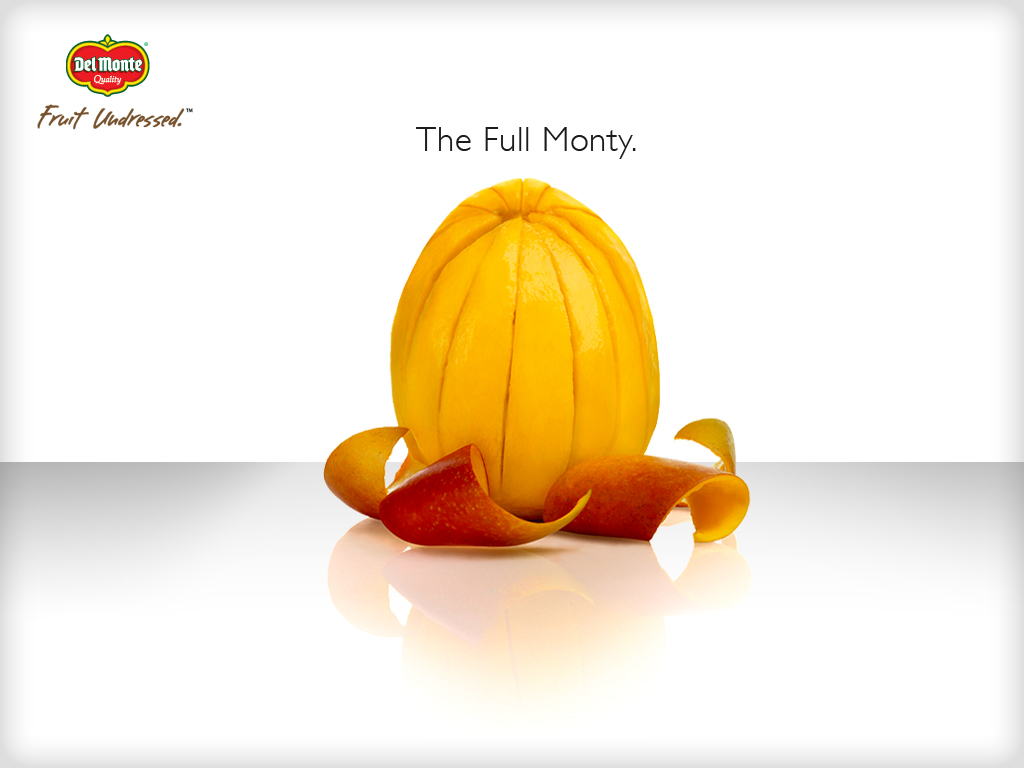
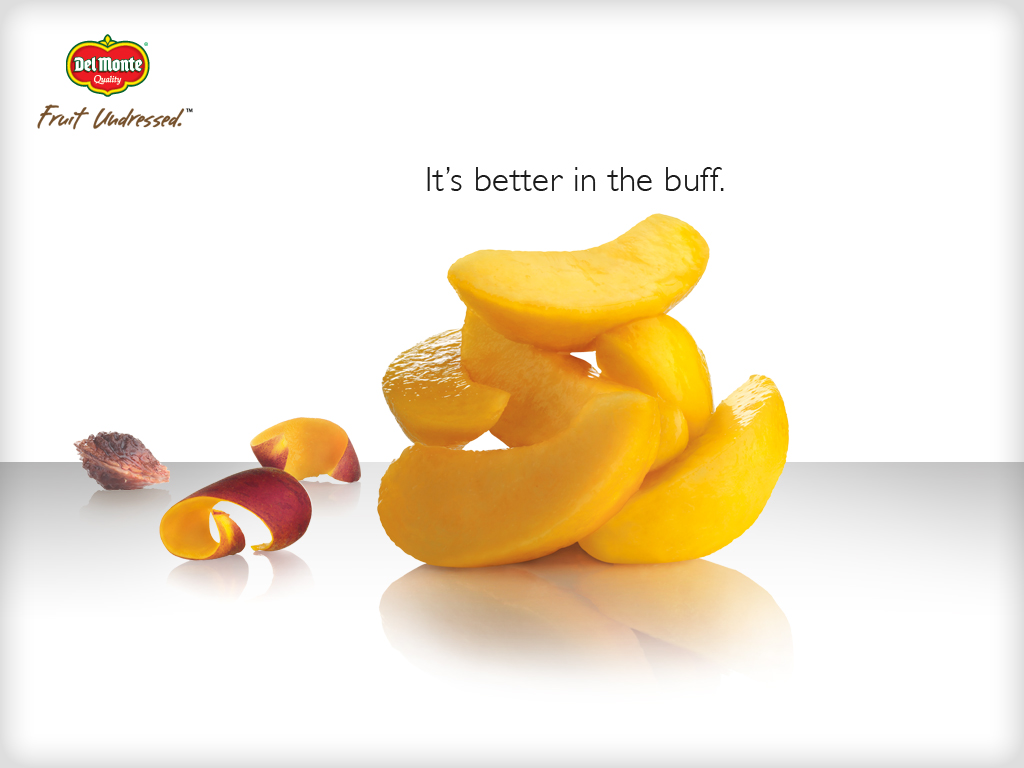
Notice that that last one is referencing Mardi Gras.  Flash those pineapples, baby!

But don’t get too cocky, the ad campaign reminds us, you still look fat in clothes and should be horribly insecure about it:
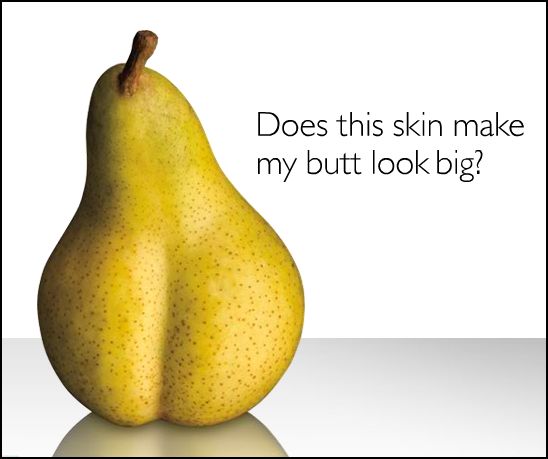
Yeah, so sexual objectification and hatred of women’s bodies all in one!  Just to sell fruit cocktail!

Lisa Wade, PhD is an Associate Professor at Tulane University. She is the author of American Hookup, a book about college sexual culture; a textbook about gender; and a forthcoming introductory text: Terrible Magnificent Sociology. You can follow her on Twitter and Instagram.

Charlotte alerted us to a make-up brand called Primitive that makes and sells natural lips sticks, glosses, and pencils.

The company is drawing on familiar associations of primitiveness with naturalness.  We were natural “for centuries,” but have now somehow graduated from naturalness, such that we need to make a special effort to recapture the simple, intelligent, real, and honest beauty of our foremothers.

So, Primitive romanticizes our primitive past while making a questionable assertion about the relationship between time and naturalness.  In addition, the names of their products locate primitiveness in some parts of the (modern) globe and not others.

The products are named after places that are, almost exclusively, in Africa, Latin America, Asia, and the South Pacific.  In a previous post I introduced the idea of “anachronistic space.”  I wrote: “Catherine MacKinnon coined the term ‘anachronistic space’ to refer to the idea that different parts of the globe represent different historical periods.”  In this case, Primitive is counting on our associating a (romanticized) primitiveness with only some places and not others.  It’s 2010 in Mali and Morocco.  They don’t represent our own past, they represent unique modernities.  And the places left out of these product names — largely North America and Europe — don’t represent the future.  They are not wholly modern societies that have shed their primitive past; they, just like all societies, are a mixture of old and new stitched together to form the present.

For more instances in which anachronistic space appears, see our posts on representing the fashion of the Surma and Mursi tribes and Wild African Cream.

And for more on the social construction of the modern and the primitive, see these posts: “Africans” as props for white femininity, Union Carbide brings modernity to the world, primitive Australia cures modern ills, women as carries of tradition and progress, representing the Middle East, equating modernity with permissiveness, and civilizing the Pueblos.

Lisa Wade, PhD is an Associate Professor at Tulane University. She is the author of American Hookup, a book about college sexual culture; a textbook about gender; and a forthcoming introductory text: Terrible Magnificent Sociology. You can follow her on Twitter and Instagram.
Since I’ve been obsessed in recent months with marketing techniques and the social psychology of shopping, Dmitriy T.M. sent me a video found at Time; in the video Martin Lindstrom argues that sound can be used to encourage shoppers to buy more items.

So if you need to increase sales in your store, get a bunch of babies and have them sitting around giggling. You don’t even have to pay sound licensing fees!

NOTE: I see that a lot of commenters are discussing their personal lack of reaction to the sound of giggling babies, etc. I totally get it–I raised an eyebrow as well. But we should keep in mind that there may be a difference between actively reacting to something or caring about it greatly (say, loving kids) and being indirectly influenced by sounds that might vaguely evoke some element of it. Of course, from the video we don’t know if any business has actually been successful at getting people to buy things by using sounds similar to babies giggling (or water being poured), only that people seem to react positively to those sounds in the lab. So I don’t know how much legitimacy there is to this, but I know marketers have definitely tried to use smells to influence people to linger in an area, hopefully then leading to higher sales.

Other posts on marketing and psychology: restaurant menus and the meaningless discount.

Gwen Sharp is an associate professor of sociology at Nevada State College. You can follow her on Twitter at @gwensharpnv.


Some have argued that the vitriolic nature of the opposition to health care reform among the political right comes not from a concern about money per se, but a concern that the money of good, hard-working, white Americans will be transferred to the not-so-good, lazy, non-white Americans. That is, that this is isn’t about money, it’s about color.

The fact that conservative anti-health care reform activists hurled the n-word at Black lawmakers on Saturday adds heft to that argument, as does the justification of the use of that word by Representative Devin Dunes (Republican – California) as understandable given Leftist “totalitarianism”:

Via Matthew Yglesias.

Lisa Wade, PhD is an Associate Professor at Tulane University. She is the author of American Hookup, a book about college sexual culture; a textbook about gender; and a forthcoming introductory text: Terrible Magnificent Sociology. You can follow her on Twitter and Instagram.

Kevin, XM, and Laura let me know about an interesting article in the Guardian about acceptable vocabulary in tampon commercials. Kotex recently came out with a new ad campaign that makes fun of some of the usual tropes of tampon commercials–the euphemisms, the dancing around in fields of flowers, and so on. The ads also address the embarrassment or discomfort many people feel about tampons.

In this spot from the Kotex website, a guy asks for help picking tampons for his girlfriend:

Here’s one commercial intended for TV that parodies tampon commercials in general:

The original version didn’t go over well, apparently, and several TV networks rejected the commercial. From the NYT via Gawker:

Merrie Harris, global business director at JWT, said that after being informed that it could not use the word vagina in advertising by three broadcast networks, it shot the ad cited above with the actress instead saying “down there,” which was rejected by two of the three networks. (Both Ms. Harris and representatives from the brand declined to specify the networks.)

So a TV commercial poking fun of the euphemisms in tampon commercials is rejected by not being euphemistic enough…and apparently even the phrase “down there” is too specific. We can talk about erectile dysfunction or leaky bladders, but “down there” just crosses a line.

Related posts: tampons are modern, Tampax ad features menstruating teen male, concerns about tampons and virginity, weird Australian tampon ad, and tampons and female workers during World War II.

Gwen Sharp is an associate professor of sociology at Nevada State College. You can follow her on Twitter at @gwensharpnv.

Crossposted at Jezebel.

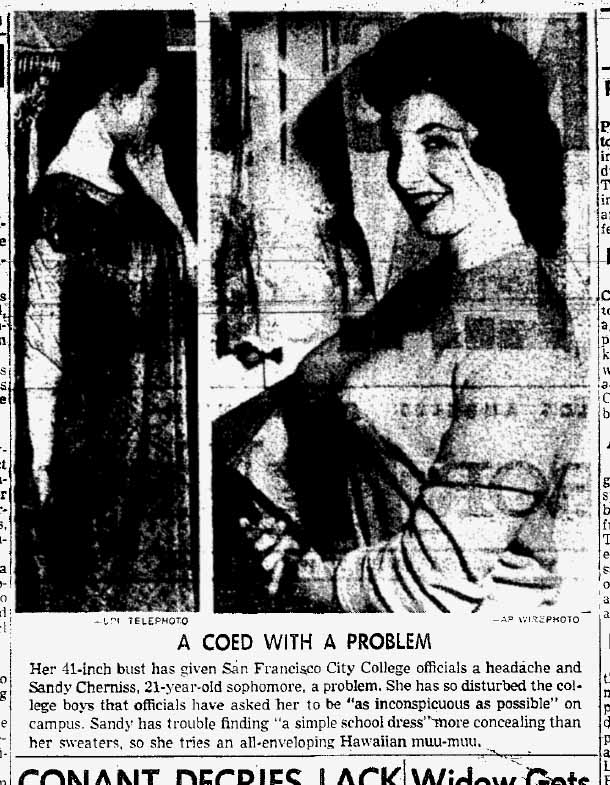
My friend Larry Harnisch at The Daily Mirror found this gem, published in the Los Angeles Mirror News on March 21 1960:

A clearer photo:

That’s right: this woman’s body was so distracting to male students that it required intervention by school officials or campus discipline would break down. And the intervention wasn’t to tell men to grow up and stop ogling their female classmates, of course, but to ask her to make herself less visible.

I’m sure the muu-muu fixed everything, though.

The next year she competed in a  beauty contest sponsored by the Young Democrats.

These aren’t really boobs, but they still may not be safe for work. So, after the jump…

more...

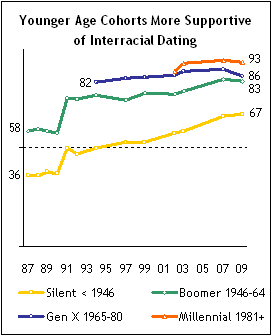
The Pew research foundation recently released some data comparing generational cohorts.  Data on the acceptance of interracial dating shows that acceptance is increasing among all groups and is higher for each successive cohort:

C.N. Lee, at Asian Nation, interprets:

I am also not surprised that the Millennials are the most supportive of interracial dating, as the graph illustrates. However, in looking at the graph, it shows that somewhere around 2007, the approval rates for interracial dating actually declined slightly for Baby Boomers, Generation X, and the Millennials. Further, at this point, we do not yet know whether the approval rate for interracial dating will continue to decline, or whether it will rebound and continue its upward trajectory.

See also our post on rates of support for gay marriage by age.

Lisa Wade, PhD is an Associate Professor at Tulane University. She is the author of American Hookup, a book about college sexual culture; a textbook about gender; and a forthcoming introductory text: Terrible Magnificent Sociology. You can follow her on Twitter and Instagram.