Archive: Mar 2010

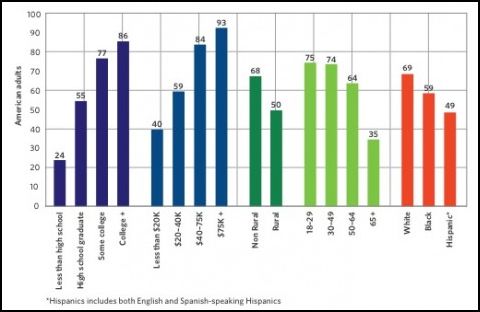
The image below shows who has broadband internet (as opposed to dial up or no internet at all). It was sent in by Dmitrity T.M., who sees no surprises here. Do you?
Lisa Wade, PhD is an Associate Professor at Tulane University. She is the author of American Hookup, a book about college sexual culture; a textbook about gender; and a forthcoming introductory text: Terrible Magnificent Sociology. You can follow her on Twitter and Instagram.

Religion is the sigh of the oppressed creature, the heart of a heartless world, and the soul of soulless conditions. It is the opium of the people. The abolition of religion as the illusory happiness of the people is the demand for their real happiness.

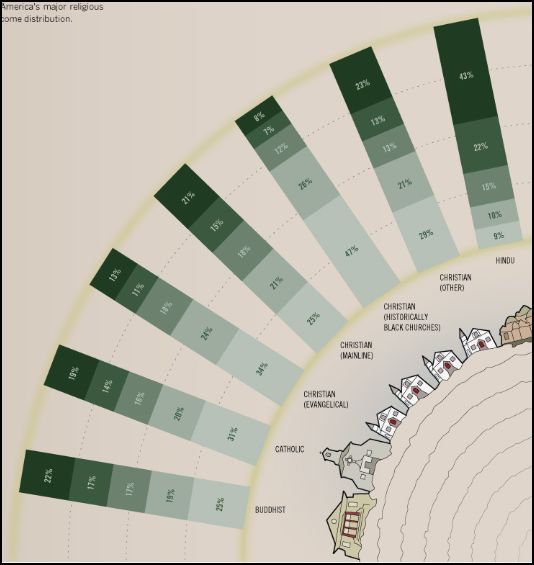
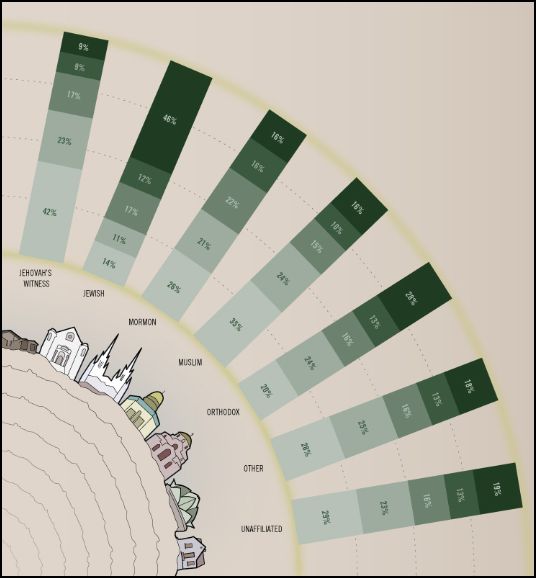
With these words Karl Marx condemned religion for making the class-disadvantaged masses complacent in the face of injustice. New data from the Pew Forum, sent in by Dmitriy T.M. and Allie B., suggests that this may be true for some religions more than others!

Visual at GOOD, shown here in three parts:

Allie was actually quite troubled by this figure, arguing that it affirmed stereotypes that Jews controlled all the money and encouraged people of different religions to see each other as competition.

Indeed, how we choose to present data is always a political decision.   Why correlate religion with income at all?  Maybe religion is somewhat spurious, compared to variables like geographic location, race, or immigration status.  That is, it may be that income correlates with geography, race, and immigration status and those variables correlate with religion.

It’s pretty tricky to figure these things out (and that’s why we force sociology graduate students to learn fancy statistical methods), but in the end we still can’t attribute causality, just correlation.  Figuring out why and how things correlate requires qualitative of research.

Lisa Wade, PhD is an Associate Professor at Tulane University. She is the author of American Hookup, a book about college sexual culture; a textbook about gender; and a forthcoming introductory text: Terrible Magnificent Sociology. You can follow her on Twitter and Instagram.
Carolyn L., who blogs at Remodel Minority, found these and other mascot costumes at Costume Shop.  They are, from left to right, the “Mexican Costume Mascot”, “Mandarin Man Chinese Costume”, “Native American Chief Costume Mascot,” “Native American Indian Costume”:

The costumes start at $887.   This reminds us that racist mascots are an industry, not just a poor choice.  It would be much more difficult to field a team called the Indians, the Gauchos, or the Orientals if there were no pre-made costumes to buy.

Lisa Wade, PhD is an Associate Professor at Tulane University. She is the author of American Hookup, a book about college sexual culture; a textbook about gender; and a forthcoming introductory text: Terrible Magnificent Sociology. You can follow her on Twitter and Instagram.
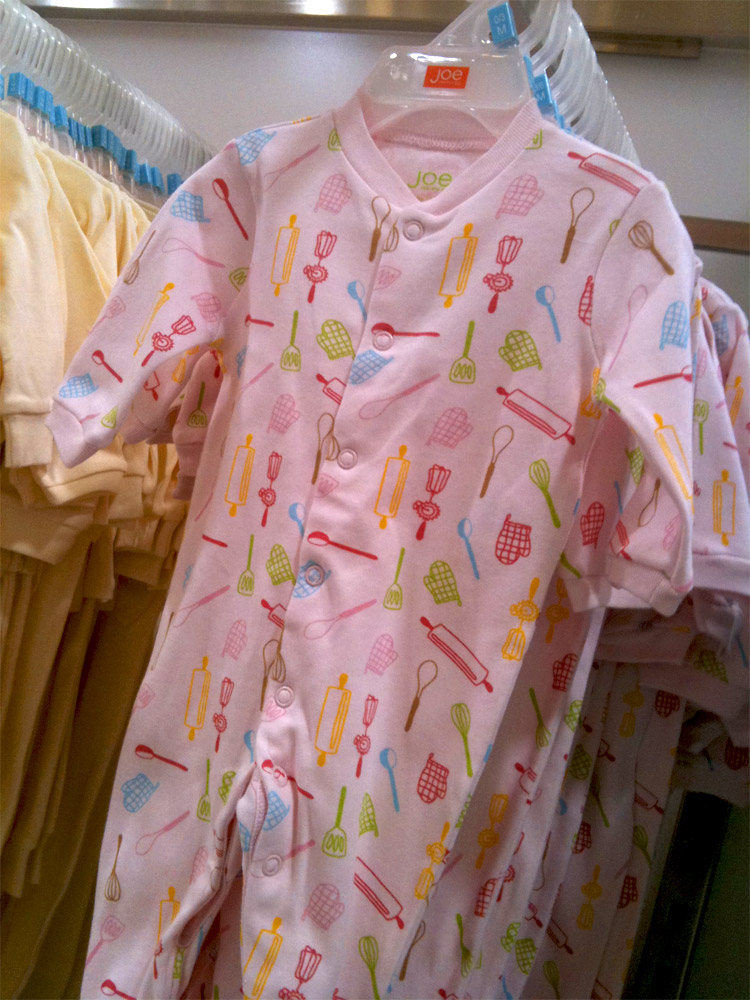
Just a reminder: being a girl means wearing pink and thematically attiring yourself in cooking and baking implements! Erica Glasier, who snapped and sent in the photo, writes:

The message is clear: little girls, you’re going to grow up cooking, and you’re going to like it. Needless to say the little blue jammies had no such future drudgery being celebrated on their fabric.

The pjs are Joe Fresh brand, sold at Superstore.

Lisa Wade, PhD is an Associate Professor at Tulane University. She is the author of American Hookup, a book about college sexual culture; a textbook about gender; and a forthcoming introductory text: Terrible Magnificent Sociology. You can follow her on Twitter and Instagram.

In “The Yellow Fever Pages” (full citation below), Karen Eng discusses a recurring problem she, as a Chinese-American woman, faces when dating: that many men, particularly White men, who express interest in her are not interested in her as an individual, but rather in a generalized Asian woman and the fantasies that are associated with them. Eng sums up the fantasies many men hold about Asian (particularly Japanese) women:

The fantasy Asian is intelligent yet pliable, mysterious yet ornamental…perpetually pre-pubescent–ageless and petite…high-pitched, girly–while simultaneously being exotic and wise…She comes from a culture where women traditionally serve men… (p. 68).

Thus, when men ask her out, Eng has to figure out whether they are asking her out because they think she specifically is interesting, or whether they’re asking her out because what they see is an Asian woman to whom they attach all kinds of expectations about exoticism, subservience, and so on. As she puts it, regardless of how she presents herself, the interests she expresses, the type of music and clothing she’s interested in, “…they still see a little Oriental flower.”

I could not help but think of Eng’s article when one of my students, Casandra L., let me know about the dating website ClassyAsianLadies:

The website specifically markets Asian American women to men in the U.S., drawing on all of the stereotypes Eng describes. Here are some images from the site; I highlighted some of the most blatant examples of the “Asian women as hot but also passive” stereotypes in red:

So they aren’t trying to use you to get to the U.S. (though, after stating these are women living in the U.S., they are always described as Asian, not Asian American). And the men who want to date them just love and respect “the Asian culture” (and, you know, there’s just one culture in all of Asia). And how do you show your appreciation for a culture? By marrying someone who personifies the elements of that culture you have romanticized.

Notice the guys using the site appear to expect quite a lot in a woman: she has to remain “a lady,” be “sweet, gentle, beautiful, loving, fun,” but also be “intelligent and independent.”

I don’t know to what degree the website specifically targets White men. There were three photos of Asian women with men on the site; two showed Asian women with White men, one showed an Asian woman with an Asian man.

In case you aren’t convinced yet, here’s some more information on why you should marry an Asian woman:

Unlike “the average woman” (which presumably means White women in the U.S., since we’re the majority of women and all), Asian women haven’t become too competitive (just intelligent and independent! But that’s different!) and certainly aren’t “masculine.” Again we see the romanticizing of a certain stereotype of “Asian culture,” with Asian women having a “well-known cultural attitude of gentle and caring support” and “Eastern values,” which apparently involves being sweet and supportive. Though they’ve also “learned Western values,” which here is associated with being “outgoing…independent and fun…”. Thus, the West = independent, fun women, while the East = supportive, submissive ones.

Notice the last line in that image:  “…that perfect Asian girlfriend or wife.” This is what Eng was getting at: this isn’t about finding the perfect girlfriend or wife; this is about a fantasy of the perfect Asian girlfriend/wife. “Yellow fever” refers to the fetishization of Asian women by men who have a specific idea of what Asian women are like and view them as particularly desirable mates based not on their unique personalities but because of the “Eastern values” they supposedly adhere to. The women thus become somewhat interchangeable. Eng’s frustration grew largely out of the difficulty of getting men to notice her, as opposed to her status as an Asian American woman.

Some other gems:

Asian women are exotic but also make a lot of money (no gold-diggers here!). Men find them “intoxicating.” They’re loyal, and “dedicated to their men.” An Asian woman “always thinks of her man first!” They’ll help with financial planning without being “intrusive”–that is, they’ll make suggestions, but it’s ultimately up to him to decide and she’ll accept whatever he decides on.

They’re “easy to be with…rarely complain…and constructive with their criticism.”  One of my students said the whole “Wonderfully easy to be with” section made her think of the way people describe breeds of dogs: “Get a Labrador! They’re smart, fun, and easy-going! They’ll make a nice addition to any family!”

The translation to all of this: Asian women will offer their wisdom and support, but will then step back and let their men decide. They aren’t bitches who will nag at you or criticize you in a nasty way, or complain that you aren’t doing half the housework, or expect to have an equal role in financial decisions. And she won’t let herself go and become a fatty, so be assured–what you see now is what you can expect she’ll stay like forever.

Aside from the objectification of Asian women (and “the Asian culture”) as having a predetermined set of characteristics you can count on, this says a lot about concerns surrounding changes in gender roles in the U.S. These women are being marketed as the antithesis of the “average” woman in the U.S., who is demanding, hard to get along with, too competitive, and doesn’t stay sufficiently attractive. Female assertiveness or insistence on gender equality is de-feminizing and unattractive; it turns us into masculinized women who won’t submit to men’s authority to take our ideas into consideration but make final decisions based on what they think is best.

For a certain group of men, then, dating an Asian woman is a way to reclaim a romanticized gender hierarchy in which women mix cultural elements associated with the “East” and the “West.” They’re independent and make money (the fun part of female empowerment, unless the independence goes to far and they get uppity), but they retain “Eastern” gender roles in which their independence is, ultimately, limited by their passivity and submissiveness to men, as well as appropriate displays of femininity (being thin, beautiful, and exotic). And, thus, this type of relationship allows men who believe they have been victimized and emasculated by the women’s movement to reclaim some of the overt patriarchal power the believe they’ve been robbed of.

NEW! (Mar. ’10): Rachel K. sent a link to this t-shirt, which ThinkGeek says translates as “now accepting applications for Japanese girlfriends.” It’s a great example of the fetishization of Japanese women:

Photobucket

(“The Yellow Fever Pages.” 2000. Bitch issue 12, p. 68-73.)

Also check out Lisa’s post on marketing Asian women to specifically anti-feminist men.

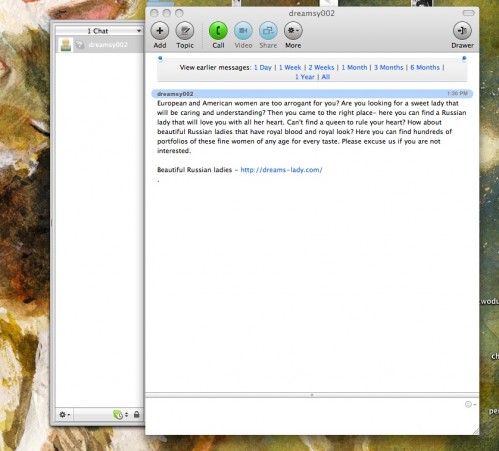
NEW! (May ’10): Sophie L. sent in this spam message she got on Skype, offering “a sweet lady that will be caring and understanding” in case ” European and American women are too arrogant for you.” In this case the source of of these nice, lovely women is Russia…which, yes, is part of Europe, but don’t get caught up on geographical details. You can find yourself a woman with “royal blood and royal look”!

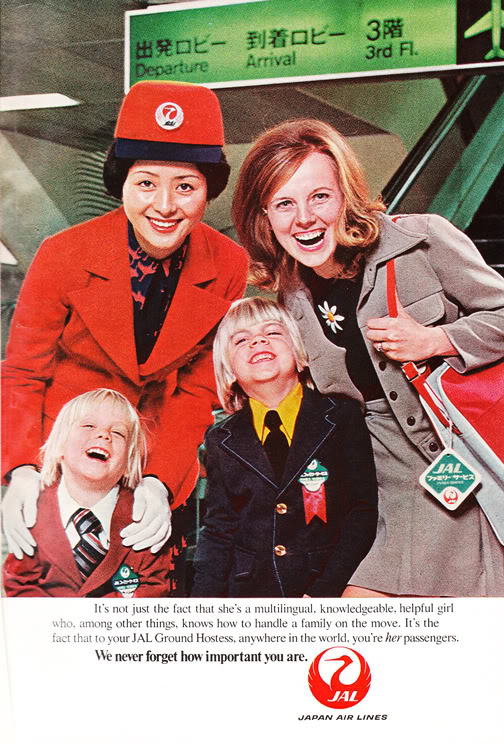
This vintage ad is a great example of the intersection of sexism and racism. She’s there for YOU because YOU, white family, are “important”:


Text:

It’s not just the fact that she’s a multilingual, knowledgeable, helpful girl who, among other things, knows how to handle a family on the move. It’s the fact that to your JAL Ground Hostess, anywhere in the world, you’re her passengers.

We never forget how important you are.

JAPAN AIR LINES

(Source: Vintage Ads.)

Lisa Wade, PhD is an Associate Professor at Tulane University. She is the author of American Hookup, a book about college sexual culture; a textbook about gender; and a forthcoming introductory text: Terrible Magnificent Sociology. You can follow her on Twitter and Instagram.

Sanguinity and Jen B. sent in a “That’s Gay” segment discussing, humorously, the discourse around figure skater Johnny Weir’s sexual orientation and whether he should be allowed to skate the way he does:

Quoting from The Sport Journal, Jen writes:

While figure skating is rumored to have the highest proportion of homosexual men of any amateur competitive sport, it is ironically a sport in which men must exhibit the most blatantly heterosexual signs to be successful and to receive commercial endorsements… at the 2001 World Championships in Vancouver when a well-known male Canadian skater was contacted by a gay magazine about the possibility of doing a feature story on him, he was told by Skate Canada that he must decline the request. As one coach said to me, “that is not the sort of picture that Skate Canada wants to paint for the country, especially in an international forum.” Every effort is made to construct such skaters as heterosexual.

We’ve posted on Skate Canada’s get “tough” campaign here.

Lisa Wade, PhD is an Associate Professor at Tulane University. She is the author of American Hookup, a book about college sexual culture; a textbook about gender; and a forthcoming introductory text: Terrible Magnificent Sociology. You can follow her on Twitter and Instagram.


Jay Smooth on why we should focus less on the dumb racist/sexist/asshole-y bullshit people like John Mayer say (and man, did he ever say some dumb bullshit) and more on, say, re-segregation of the public school system:

And just for fun, Jay Smooth discussing Chris Matthews’s comment that he “forgot” President Obama was black, and what that says about what we think racial equality would look like:

I get this with students a lot: they desperately want to deny ever noticing anyone’s race/ethnicity, because the discourse of color blindness states that the way to treat people equally and eradicate racism is to stop acknowledging racial categories at all. But when you simply start ignoring the role of an important socially-constructed category without actually eliminating the negative effect it has on those in certain categories, you aren’t ending racism. It’s just making it harder to talk about or address, since anyone who tries to start a conversation about racial inequality is accused of actually perpetuating inequality and/or being racist for bringing the topic up.

This ties back in with the first video–we are more comfortable with more symbolic or linguistic forms of combating racial inequality (so, say, people say they have a friend who “happens to be Black,” as though it’s something they never thought about until that very second) than the much more complicated, difficult, and long-term work of rooting out structural inequality.