Archive: Mar 2010

If you’re interested, I wrote a piece for The Daily Mirror about my recent trip to the LAPD’s “Behind the Scenes” exhibit here in Vegas (which got a lot of media attention when the Kennedy family protested the inclusion of bloody clothing from Robert Kennedy’s shooting). My friend Larry was interested in the politics involved–whose personal tragedy gets put on public display? Were the displays as sensationalistic as he suspected they would be? He was particularly interested in how the case of the Black Dahlia (aka Elizabeth Short) would be presented, and what the LAPD would think was appropriate to display for public consumption.

So I agreed to go take a look. And I was horrified in so many ways. Absolutely stunned. You can find the piece here.
This is the second post using material borrowed from the essay, “Facts and Fictions About an Aging America.”  Our online host, Contexts magazine, is offering some free content, including this essay, now through March 15th.  See yesterday’s post here.

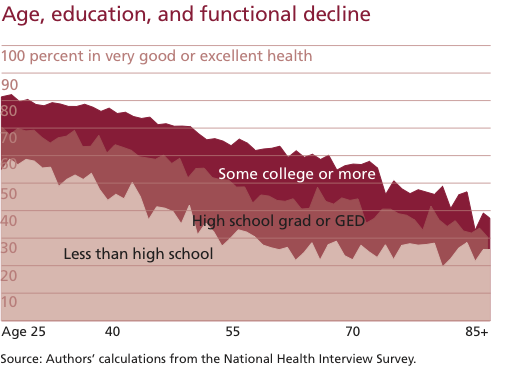
While people in industrialized countries live longer and healthier lives than ever, more educated people enjoy even less morbidity than less educated people.  The figure below illustrates the decline in mental and physical function over time for people with a college degree, a high school degree, and no degree at all:

The figure shows that more educated people experience “excellent health” than less educated at every age, except perhaps 85 and above.  Why might this be?

Well, higher educated people may come from wealthier families who were able to provide their children with health care, good nutrition, and exercise.  Having degrees may also correlate with jobs that are less harmful to the body and offer both health insurance and more free time to exercise.  Lower educational attainment is likely correlated with economic insecurity; a lifetime of struggling to make ends meet could create the kind of bad stress that interferes with both mental and physical health.

Other theories?  Thoughts on these?

Lisa Wade, PhD is an Associate Professor at Tulane University. She is the author of American Hookup, a book about college sexual culture; a textbook about gender; and a forthcoming introductory text: Terrible Magnificent Sociology. You can follow her on Twitter and Instagram.

Our online host, Contexts magazine, is offering some free content, a selection of essays on aging, now through March 15th.  I borrowed the material below from the essay, “Facts and Fictions About an Aging America.”

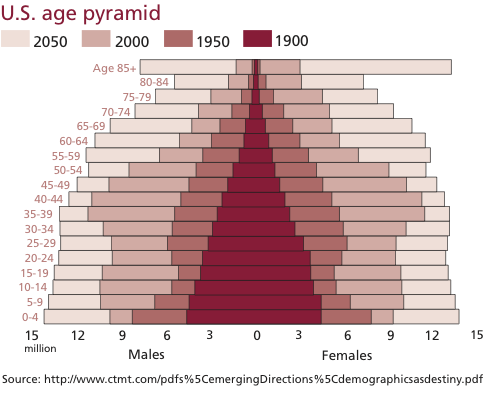
The average American is aging… and fast.  Advances in public health — especially related to childbirth, infant mortality, and infectious disease — have led to longer lives.   “The result is that death has been permanently shifted from a phenomenon among the young to one of the old.”  This means that the age distribution in the U.S. has shifted from one shaped like a neat pyramid (in 1900), to one shaped kind of like a house (in 2000), to whatever shape that is they’re predicting in 2050:

The great news is that “active life span is increasing faster than total life span.”  That is, even though we live longer, we spend fewer of our years sick or disabled than ever before.  This is called (so you can impress your friends) the “compression of morbidity.”

Lisa Wade, PhD is an Associate Professor at Tulane University. She is the author of American Hookup, a book about college sexual culture; a textbook about gender; and a forthcoming introductory text: Terrible Magnificent Sociology. You can follow her on Twitter and Instagram.

Sometimes when we put up hyperfeminine clothes and toys for girls, people argue that no one has to buy those clothes, so there is no point in critiquing their existence.  The implication is that all conformity to gendered expectations is voluntary (on the part of both mothers and their daughters).

However, the recent furor over Shiloh Jolie-Pitts haircut and boyish outfit, sent in by Tara C., Cailin H., and Lindsay F., shows us that having a gender-consistent appearance isn’t simply voluntary; when you don’t perform gender, other people will police your choices.  In this case, people are questioning whether she is harming her child by turning her “into A BOY?”

In this case, of course, it’s mass media doing the policing (or inviting readers to do the policing).  In the lives of non-celebrities, this same sort of policing is often done by family members, friends, and even strangers.  For the non-conformist (parent), then, gender non-conformity can be a real drag.

Image borrowed from DListed.

Lisa Wade, PhD is an Associate Professor at Tulane University. She is the author of American Hookup, a book about college sexual culture; a textbook about gender; and a forthcoming introductory text: Terrible Magnificent Sociology. You can follow her on Twitter and Instagram.

Finally, a push-up panty for the penis!

It’s here and, thanks to Luis J.C.R., we all know about it.

Images and discussion after the jump because not safe for work.

more...

Tennille N. sent in this Australian commercial for NutriGrain cereal:

Transcription:

Boys need protein for growth and muscle development.
NutriGrain is one of the highest protein cereals, so as part of a balanced diet and regular exercise, NutriGrain has what it takes to help build your son into an Ironman.
Thanks Mum.
NutriGrain, Ironman food.

As Tennille noted, I guess she doesn’t need NutriGrain, since she’s a girl and, accordingly, does not need muscles, nor athletic aspirations.

Lisa Wade, PhD is an Associate Professor at Tulane University. She is the author of American Hookup, a book about college sexual culture; a textbook about gender; and a forthcoming introductory text: Terrible Magnificent Sociology. You can follow her on Twitter and Instagram.

Shayna over at Food, Farms, and Famine posted about what the label “organic” means. The specific wording, and where on the package the statement is placed, is an indication of just how “organic” the product might be,

This video also discusses the meaning of various organic labels (put after the jump because it starts playing automatically):

more...

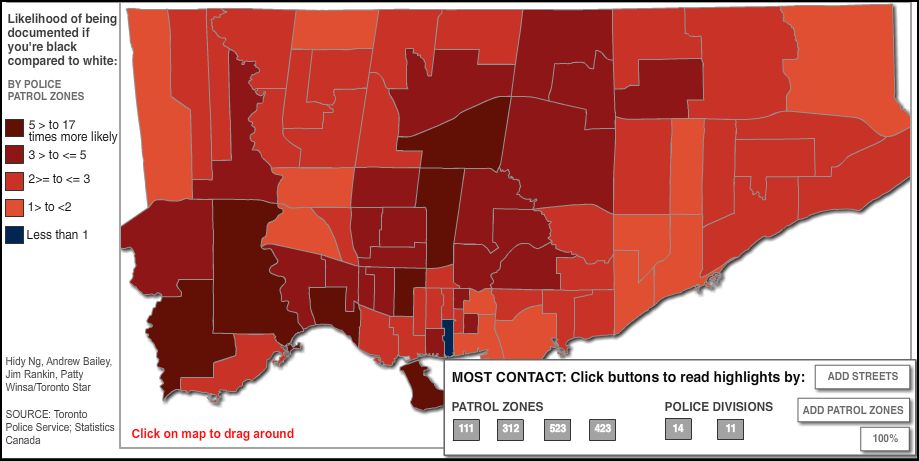
Michelle DuB. sent in some data from the Toronto Star, showing that blacks are more likely than whites to be stopped by police in every single patrol zone except for one.  The disproportion was even high in mostly white areas; they were stopped up to 17 times as often (darker red is most disproportion):

Click here for a video showing what some citizens and a bunch of Toronto police have to say.

See also our posts showing how the stopping of people on the street usually results in… nothing (other than people feeling harassed) and how racial profiling turns out to be ineffective anyway.

Lisa Wade, PhD is an Associate Professor at Tulane University. She is the author of American Hookup, a book about college sexual culture; a textbook about gender; and a forthcoming introductory text: Terrible Magnificent Sociology. You can follow her on Twitter and Instagram.