
Friday Roundup

RU030113Read Widely

In case it’s hard to tell, that’s an imperative, not a descriptor. Today I plan to use my little soapbox to trumpet some fabulous writing, while also seeking submissions to what I lovingly call “Letta’s List.”

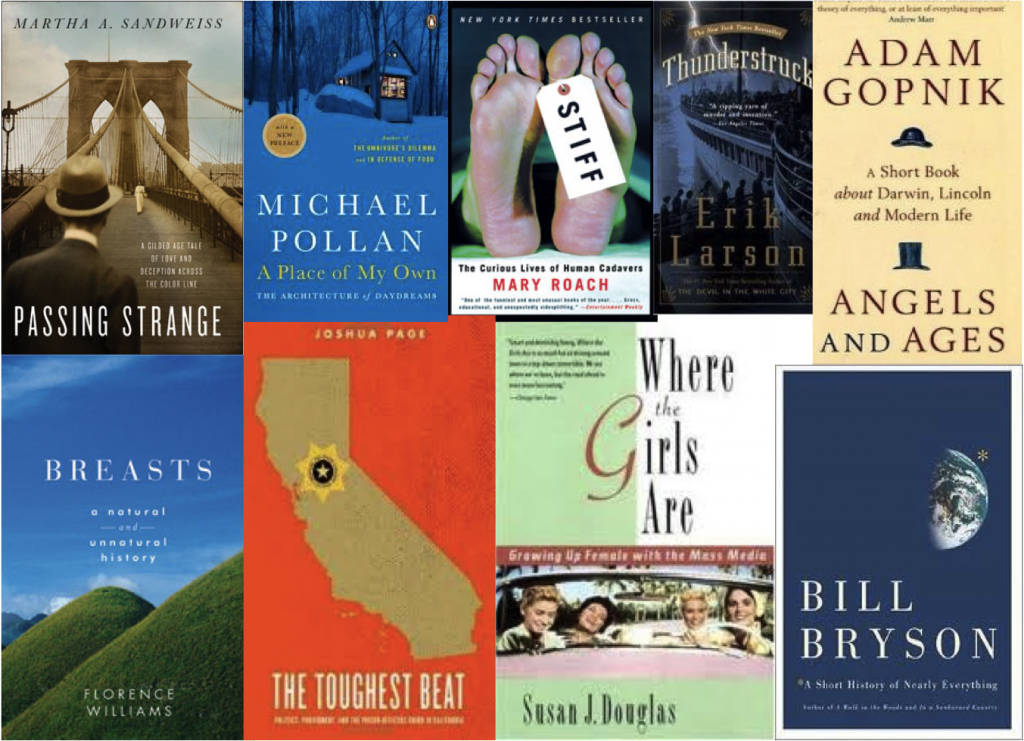
See, many authors ask me for examples of how to incorporate a lot of information into something that’s thorough, academically sound, and engaging. It’s a tough balance, to be sure, but over the years, I’ve collected a number of books (and this is by no means a list of all of them) I can hand off as representations of that ideal. They likely have nothing to do with your area of study, but watching the authors’ deft hands at work (and knowing there are surely unsung editor elves in there, too) can be a truly enjoyable homework assignment. Think of it as authorial excellence by osmosis. Absorb and emulate. more...

RU022213A Few Things I’ve Learned

In academic writing, inscrutability is often treated as a virtue. I have a few theories:

  1. “Smarter than thou.” Ever been at a talk where someone asks a “question” that’s just a transparent way to prove that they know a lot? And that they know big words, too? It’s annoying. For writers, the logic often seems: if the piece technically makes sense, but no one else can make sense of it, you must be the smartest person in the journal. You may be revered for your brilliance, but no one’s going to actually talk about your work. Readers will be too afraid to admit they don’t understand it (and too unsure about whether you do).
  2. Tone-deafness. This might, more kindly, be called the expertise problem. In essence, you, the author, know this stuff backward and forward. You may start assuming everyone else does, too. Alternatively, you’ve simply read it all so many times you can no longer see the gaps in your logic or spot places that just plain don’t make sense.
  3. Longer is better. In trying to cover all the bases, you go too far, accidentally creating 5th base and a watering hole somewhere in left field. Looking for a thorough lit. review, an overview of the thinking in the field, and presenting many opportunities for future researchers, you find yourself at 25 pages, when your point could have been made—and made well—in 10.

As an editor and sometime “translator” of ivory-tower-talk, I also have a few suggestions: more...

RU021513Criminal Activity

As mentioned over on Public Criminology, things are really coming together on the second of our TSP books for W.W. Norton (the first, The Social Side of Politics, is in production now). This means we’ve been immersed in all kinds of fascinating pieces on trends in and understandings of crime and punishment. Many of the pieces have already come out  (including a new Roundtable on international criminal justice published this week), but we’ve got a lot in the hopper yet. While you await that goodness—and we work furiously to get it produced—why not check out everything else we’ve done this week? more...

Double. Am I in trouble?

Scheduling strikes again! But the great news for you, dear readers, is that, while I’ve been immersed in creating our first volumes to publish with W.W. Norton, our authors, bloggers, and volunteer grad board members have continued to put out exciting new pieces on The Society Pages. Here’s what they’ve been doing in the past couple of weeks! more...

SocImages Reminds Us All How It’s Done

This week, SocImages saw its most popular post ever, and with good reason. “The Balancing Act of Being Female; Or, Why We Have So Many Clothes” contained a provocative image by art student Rosea Lake (one easily used in a classroom without uproar) and Lisa Wade’s thoughtful, sociological take. What was particularly interesting (I absolutely invite you to take a look and read through the comments if you haven’t already) is the way that Wade went in an unexpected direction and, in a tightly wrapped commentary—maybe 500 words or less?—used the image to help readers think not only about body policing and the ways in which women are (ahem) hemmed in when it comes to clothing choices, but how privilege dictates who can and cannot follow the “rules” of dressing appropriately. 12,000+ likes on Facebook and some 80,000 individual visitors later (not to mention readers on the Huffington Post, which has since reposted the piece), a lot more of the Internet is thinking sociologically. Take a read; it’s fantastic.

Here’s what the rest of us got up to this week: more...

Doubling Down!

Loyal readers may have noticed the absence of a roundup last week; shuffled schedules led to shuffled writing, and so this week we’ll have a double dose of goodness to share. Please enjoy what the TSP crew has been rustling up in the past couple of weeks. more...

It’s been a quiet week in Lake Woebegon…

As this week, stretching out from Christmas to the New Year, generally is. But that isn’t to say that The Society Pages has gone dark; perhaps just a bit dusky, enjoying this still moment before the New Year comes on with its full force. Here’s a bit of what we were up to this week. more...

It’s the Fi-nal Roundup! Of the year…

And it’s going to be a short one, given travel and a luckily contained but still exciting house fire early this morning. All’s well, but such things do tend to cut into the time available for waxing poetic (or waxing anything, for that matter). A programming note: on January 1st, we will share our most-trafficked post from each section of the site as its own sort of Annual Roundup. Stay tuned! more...

Avoiding the Holiday Slide

I’ve now ostensibly spent over half my wee life in college. First, as an undergrad, then a grad student, then some more undergrad, staff time, and now as a sort of academia groupie (let’s just say I loiter around a sociology department more often than some find “normal”). And yet, this is the first time in all those years that I’ve really felt the “holiday slide.” My brain essentially tried to go on vacation, starting the day before Thanksgiving (for our international readers, this year’s Thanksgiving was on Nov. 22). I’ve fought back valiantly, but not nearly so valiantly as our authors and grad students, who continue creating great work week after week—undeterred, like the post office, by rain, sleet, or the allure of two weeks without writing an exam, a recommendation letter, a grant application, a survey, or a holiday card. more...

Can. You. Dig it?

No, there aren’t a lot of reasons to reference “The Warriors” on the Editors’ Desk. I could spin some, sure: it’s a cool cultural relic; the various gangs all try on personality and self through costume and affiliation; it involves crime, deviance, and social movements, etc. But really, I just wanted to ask Cyrus’s great rhetorical question, “Can you dig it?” Just as the Moon Runners and the Van Courtland Rangers can come together, so, too, do educators, researchers, policy makers, students, and wonderfully interested and curious people from the public here on TSP. And we definitely dig it. After the clip, check out some of this week’s latest and greatest from around the site. Hope you have as much fun reading it as we do making it. more...