

gender

Photo of a businesswoman walking away from a job opportunity, by Erich Ferdinand via Flickr.

In October there were four women out of twelve presidential candidates on the Democratic debate stage. But that ratio is far from the norm in political and business leadership. Why does this continue to be the case, 100 years after female suffrage and 50 years after the women’s movement went mainstream? New experimental research finds that anticipating harsh consequences for failure may be one reason women do not say yes to leadership opportunities.

Susan Fisk and Jon Overton performed three studies to test how women’s leadership ambitions are affected by the belief that female leaders are punished more harshly than men. They first confirmed through a survey that both men and women believe that female leaders will face harsher consequences for failure. They then tested whether “costly” failure would decrease leadership ambitions as compared to “benign” failure, using survey questions about whether the respondent would be willing to take on a hypothetical leadership opportunity at their job. In the “benign” circumstance the respondent’s supervisor had encouraged them to take the leadership opportunity and had expressed that the respondent could return to the original team if the initiative failed. In the “costly failure” circumstance the respondent had not received support from their supervisor and did not know what would happen if the initiative failed.

Both men and women were less likely to say yes to the leadership position in the costly failure circumstance, but women’s leadership ambitions decreased an additional 20% over the men’s decrease. These results demonstrate that simply encouraging women to say yes to more opportunities misses why they might say no. Women in the workplace are aware that they may be judged more harshly and face more reputational or employment consequences if they fail. This study helps us understand the micro-level reasons behind the stalled gender revolution and how gender inequality can continue to exist within gender-neutral organizations. 
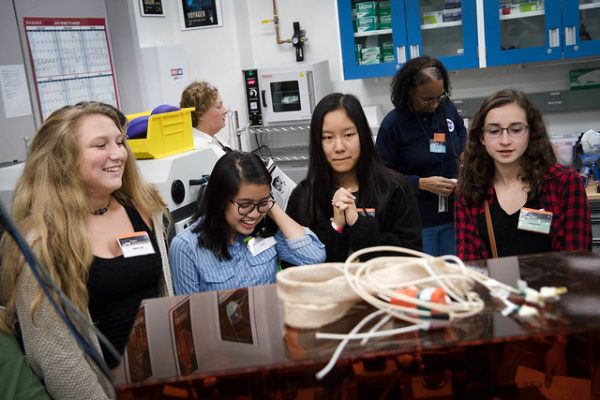
Photo of high school girls in a science lab by NASA Goddard Space Flight Center, Flickr CC.

As the school year gets underway, many students are excited to get their schedules and find out which friends will be in their classes fall semester. But who is in their third-period Pre-Calc and seventh-period Physics may matter for more than just socializing. New research shows that friends’ and classmates’ preferences for school subjects influence adolescents’ opinions of STEM subjects, which potentially affects their occupational choice and earnings.

Isabel J. Raabe, Zso´fia Boda, and Christoph Stadtfeld examined Swedish adolescents’ social networks over time to find out how peers influence preferences for STEM subjects. A survey asked students about their favorite subject and who their best friends were in the class, first in eighth grade and then a year later. Controlling for socioeconomic status and cognitive ability, the researchers analyzed and compared the influence of friends and other students on the STEM preferences of boys and girls.

They found that while both boys and girls like what their friends like, social influence on favorite subject was stronger among boys. Since the boys in the sample were mostly friends with boys and the girls were mostly friends with girls, social influence came primarily from same-sex friends. Because boys already tended to prefer STEM subjects more at the start of the study, they were more likely to be exposed to STEM-preferring friends.

Girls, on the other hand, were influenced less by their friends’ favorite subjects than by simply having other girls in their class who preferred STEM subjects. This presence of girls who like STEM seemed to protect female students from negative consequences associated with violating gender norms, like preferring STEM subjects.

Despite Sweden’s policy efforts to reduce gender gaps, gender disparities among engineers and scientists persist. By identifying another factor influencing these disparities, this study can inform new solutions to keep young women in the STEM pipeline.

a boy looks at a book. around his head are math problems and works like "homework," and "calculation"
Max Pixel, CC

Books like The Rise of Women and The End of Men herald the academic success of young women in the United States today, but the image of the “genius” is still male. And fields that emphasize the importance of raw intelligence, like physics, economics, and computer science are still male-dominated. How can both of these social facts co-exist? New research from Michela Musto suggests that racialized and gendered classroom management practices in schools may be part of the problem. How teachers respond to talking out of turn establishes a hierarchy of intelligence in middle school classrooms, where high-achieving white boys are considered “brilliant” and more exceptional than girls, and low-achieving Black and Latino boys are viewed as “bad.”

Musto spent 2.5 years observing in a public middle-school in Los Angeles, talking to over 190 racially-diverse students. This article examines patterns of rule-breaking, especially talking out of turn, in sixth, seventh, and eighth grade math classes. In higher-level courses, which overwhelmingly consisted of white and Asian students, boys monopolized classroom discussions in eighth grade because teachers tolerated their interruptions and regularly allowed them to challenge their female classmates in sixth and seventh grade. Musto’s data shows that this disparity in who acts as the expert in high-level classrooms contributes to a belief among eighth-grade girls and boys that boys are more exceptionally intelligent than girls.

In lower-level courses, dominated by Black and Latino students, harsh discipline from teachers caused disengagement for some eighth-grade boys. Musto observed that students came to see Latino boys as the “dumbest” kids in school because teachers repeatedly challenged their competency, and high levels of policing left Latino boys academically disengaged. Race also mattered in higher-level classes because teachers tolerated non-academic interruptions from white boys, but not Asian ones. 

Taken together, racialized tracking and teacher response to students helps us understand the continued sense among students that while girls are smart, the truly exceptional students are white boys.

Jill E. Yavorsky, Lisa A. Keister, Yue Qian and Michael Naud, “Women in the One Percent: Gender Dynamics in Top Income Positions,” American Sociological Review, 2019
Photo by Tim Sackton, Flickr CC

If you make at least $859,000 per year in 2016 dollars, you’re part of the “one percent”– the top 1% of income earners in the United States. According to a recent study by Jill E. Yavorsky, Lisa A. Keister, Yue Qian and Michael Naud, you’re most likely to be part of the one percent if you’re a highly educated, white, married or cohabiting man or woman in your 50s, but individuals that don’t match those characteristics are much less likely to be.

The researchers used data from the U.S. Federal Reserve Board Survey of Consumer Finances from 1995 to 2016, which includes 40,418 one-percent households. They examine whether there has been a change in the gender makeup of the one percent and how many households in the one percent rely on women’s income to remain in this top category.

In 2016, only 4.5% of elite households rely on women’s income for one-percent status. While this number has increased modestly since 1995 — when only 1.7% of households relied on women’s income — a financial glass ceiling remains intact at the one percent level, and gender progress has effectively “stalled” for these women since the mid-1990s.

Education, employment, age, and race affect whether households fall in the top one percent, but their analysis show key differences between men and women:  

  • Higher education. A higher percentage of both married and single men and women in the top one percent of households are highly educated, compared with those in the full population. 
  • Self-employment. Men and women in the top one percent are much more likely to be self-employed than those in the general population. Married men are much more likely to be self-employed than married women. 
  • Age. Married and single men and women in one percent households are older, on average, than the general population. The average age for single women is 63, which is 9 to 12 years older than others in the one percent. 
  • Race. Households in the top one percent are less racially diverse than households in the general population: Of married households in the top one percent, had respondents who identified as nonwhite, while only 3% of single-women households did.

In short, the same variables matter for both men and women, but key differences illustrate a continued gender imbalance.

Pride Parade in Kyiv 2017. Photo by Arrideo Photography, Flickr CC

Originally published October 10, 2018

At the international level, the advancement of sexual minorities’ rights often result from advocacy by broad international human rights groups, like Amnesty International, or from international organizations specializing in LGBT issues. In a recent study, Kristopher Velasco investigated which of these two types of organizations is more effective at influencing the national adoption of progressive LGBT policies.

To measure the success of LGBT causes at the national level, Velasco created a LGBT Policy Index of national laws that impact people with different sexual orientations, gender identities, or who engage in same-gender sexual practices. The Index is higher in countries that have enacted bans on employment discrimination, established hate-crimes protections, or legalized same-sex unions. Velasco then gathered data from 156 countries for the period between 1991 and 2015 . The study compares the relationship between the Index and the global emergence of human rights international organizations and LGBT international organizations, as well as the overall effect of the mounting global support for LGBT rights.

Velasco finds that the LGBT Policy Index has dramatically risen since 1990. For example, bans on employment discrimination increased from less than 1% of countries in 1991 to over 32% in 2015. Velasco also finds that the emergence of national LGBT policies is significantly associated with the global emergence of organizations specifically concerned with LGBT rights, and it was not significantly associated with the presence of broader international human rights organizations. In addition, the positive effect of LGBT international organizations increases when considering the mounting support for LGBT rights in the global context. For instance, as the United Nations expresses growing concern to sexual orientation and gender identity, political leaders are more likely to adopt progressive LGBT policies.

In short, globalization and mobilization of international organizations — especially those concerned with particular issues — play a key role in whether nations adopt LGBT-friendly policies.

Photo of elementary school students standing by their desks working with construction paper.
Photo by K.W. Barrett, Flickr CC

Millions of students each year are suspended or expelled from school, sometimes in response to minor, non-violent policy violations such as skipping class and “disruptive behavior.” These harsh policies disproportionately push out students from disadvantaged backgrounds, especially youth of color. Much of the research on this topic focuses on middle and high school students. However, a new study by Wade Jacobsen, Garrett Pace, and Nayan Ramirez shows that a surprising number of urban students are already impacted by the third grade.

The researchers used data from several thousand children in 20 large American cities to document how many were suspended or expelled by age 9. Overall, 11% of children were removed from school at least once by this age. However, there were stark race and gender inequalities in elementary school discipline. Only 8% of white boys and 2% of white girls were suspended or expelled, compared with 40% of black boys and 15% of black girls.

Next, the researchers wanted to understand what factors are driving inequalities in early school discipline. They found that racial disparities were not due to differences in behavior reported by parents. Instead, disparities were mostly explained by school disciplinary practices and family background, such as poverty and parental incarceration.

Exclusionary discipline is intended to punish and reduce aggressive behavior. However, the researchers showed that children who were suspended or expelled became more physically aggressive after they returned to school. They suggest that suspension and expulsion disrupt routines at home and cause children to fall behind at school, and this increased stress may lead to poor behavior.

While exclusionary discipline may sometimes be necessary to ensure student safety, there can be little disagreement that pushing kids out of schools when they are still learning to read is a practice that should be reconsidered. Finding effective alternatives to exclusionary discipline for non-violent behavior at an early age could improve racial equity in life-long educational outcomes.

Image shows people holding protest signs. One sign says "Mr. policeman please don't kill my day, my child, brother, uncle, cousin, friend, etc. thank you." Another says, " the right to bear arms is a white privilege."
Photo by Tony Webster, Flickr CC

On April 18th, police officer Christopher Krickovich faced public criticism for rough handling a Black teenager at a local school. Similar incidents across the nation have compelled Black parents to talk to their children about how to navigate and survive police interactions. Most of these conversations use familiar high-profile cases involving Black men such as Michael Brown and Eric Gardner to illustrate the danger with police contact. Yet, Black girls and women have largely been neglected as targets of police brutality. In a recent study, Shannon Malone Gonzalez reveals that Black girls are not only left out of public discourse regarding police violence, but also the everyday “police talk” Black mothers use to teach Black children how to navigate interactions with law enforcement.

Gonzalez conducted interviews with 30 middle- and working-class Black mothers in an urban city. Each mother had one or more children between the ages of four and thirteen and 21 Black mothers had at least one daughter. During her interviews, Gonzalez asked Black mothers to reflect on their children’s racial and gendered vulnerabilities to police violence and how these perceptions of vulnerability informed police talk with their children.

Black mothers often utilized the “making it home” framework when discussing police with their children. Through double consciousness — understanding one’s own vulnerabilities through the lens of the dominant group — this framework teaches Black youth to be hyperaware of police stereotypes that reproduce notions of Black criminality. Mothers provide suggestions for how Black youth should interact with law enforcement to increase their chances of “making it home” safely. Black mothers believe these talks are vital for their children’s survival.

At the same time, Gonzalez points out that these talks marginalize the experiences of Black girls in three ways. First, Black mothers often categorized Black sons as the primary targets of police brutality and Black daughters as collateral targets or “secondary victims.” Even when asked about girls, several mothers turn their attention back to their sons. Second, these talks reinforce the idea that violence associated with masculinity, such as physical assault and shootings, are more important than verbal harassment or sexual violence — experiences that are more often linked to women’s experiences of police misconduct. The “making it home” narrative also treats the home as an inherently safe space, even though homes often function as a site of police violence for Black girls and women. Finally, mothers see police talk as crucial for boys’ socialization but optional for their daughters. Through her work, Gonzalez encourages us to make Black women’s and girls’ experiences with police more visible in our understandings of police-community relations.

Photo shows a lecture hall with many students sitting in rows, facing the front of the room where a professor stands near a podium.
Photo by the University of Manchester School and College’s Photostream, Flickr CC

It’s teaching evaluation season again, when universities collect anonymous student evaluations of each class, contingent faculty wonder whether their scores will help them get another contract, and female faculty brace themselves for comments about their appearance. Teaching evaluations continue to be the most widely used (often the only) tool to evaluate and reward college-level teaching, despite a long history of research on gender bias in evaluations. New research considers how the design of evaluations affect their outcomes, and whether simply changing the number of points in a rating scale reduces the size of gender gaps.

Lauren A. Rivera and András Tilcsik studied a large North American university that moved from a 10-point scale to a 6-point scale in its teaching evaluations. The change in scale allowed the researchers to test whether the same professors, teaching the same courses, were evaluated differently on the 6-point scale than on the 10-point scale. Rivera and Tilcsik also performed an experiment where participants evaluated identical lecture transcripts in order to control for teacher quality and improvement.

Changing from a 10-point to a 6-point scale significantly affected the gender gap in the most male-dominated fields. Specifically, on the 10-point scale 31.4% of male professors received the highest score, while only 19.5% of female professors did. A ten was the most common rating for male professors, followed by a nine and then an eight. For female professors, an eight was the most common, followed by a nine and then a ten.

After switching to the 6-point scale, the gender gap disappeared. On the 6-point scale, 41.2% of male professors and 41.7% of female professors received the highest score. Findings from the experiment likewise found a statistically significant difference between men and women using the 10-point scale and no statistically significant difference with the 6-point scale for professors in male-dominated fields.

The authors hypothesize that a ten on a 10-point scale connotes brilliance, a trait that students are less likely to attribute to female professors in these male-dominated fields. While ingrained biases are difficult to shift, careful construction of evaluation instruments is an achievable step for organizations looking to mitigate gendered effects.

Photo by anokarina, Flickr CC

If a woman brewed your beer, would you like it less? Sociologists Elise Tak, Shelley Correll, and Sarah Soule suggest that you might, but only if you don’t have another way to judge its quality. We know that systemic gender bias occurs in many institutions, such as the militaryacademia, and science. This new research shows that not only do women occupy a lower status in society, but this low status can be passed on to the products that they make.

The researchers performed two online experiments to see how people evaluate male- and female-created products in two highly gendered markets: craft beer and cupcakes. In each experiment, participants read a label that identified the brewer’s or baker’s gender and whether the product had won an award. After reading the label, the participants rated the overall quality of the beer or cupcake.

As predicted, participants discriminated against female brewers. Among non-award-winning beers, participants judged the product quality to be greater if it was brewed by a man. However, there was no gender discrimination among award-winning beers. This is because female-brewed beer received a large boost in perceived quality if it won an award, while male-produced beer was viewed as high-quality regardless of recognition.

A woman faces challenges when she enters a male-dominated field, though the reverse is not generally true. This same principle held up in the experimental cupcake market. Male cupcake bakers experienced no disadvantage. The baker’s gender did not influence how raters perceived the quality of the cupcake, and award recognition gave an equal boost to male- and female-made products.

This study reveals when and how the lower status given to women transfers to the products they make. Female entrepreneurs must pass a high bar if they want to enter traditionally masculine fields, while men who make traditionally feminine products are given the benefit of the doubt. Importantly, this double standard did not vary by the rater’s gender. Both men and women gave lower ratings to female-brewed beer, showing how these gendered assumptions are part of the larger social structure.

However, the authors also note the power of external recognition to undo the bias against female-made products in male-dominated fields. Tak, Correll, and Soule suggest that if consumers are given more status markers to judge the quality of a product, they will rely less on gendered cues. Dismantling gender bias in awards might help alleviate gender bias in consumption.

Photo of students at a party by Jirka Matousek, Flickr CC

Sexual preferences are more than just sexual orientation. Since individuals attach different meanings to sexual acts, they may experience and look back on the same sexual activities in very different ways. New research expands our understanding of how social factors like gender affect feelings of regret after sexual activity. In one study, Jeremy Uecker and Brandon Martinez focus on whether college students regret their hookups.

Using data from the Online College Social Life Survey (OCSLS), the researchers examine answers from 13,020 heterosexual college students who reported ever regretting a hookup and regretting their most recent hookup. Researchers did not provide a definition of “hookup,” instead allowing participants to respond based on their own understanding of what a hookup is. In their analysis, the authors first test for gender differences in regret in different contexts. Then they use logistic regression to figure out what might explain these gender differences, like attitudes about sex, initiation of sex, enjoyment of sex, and perceived loss of respect from one’s partner and oneself.

Regardless of gender, students do not regret most hookups, especially their most recent hookups. Yet, the majority of students do regret sexual activity that happened in at least one of their hookups. In terms of gender, the amount of men and women who regret hookups are not that different overall. However, there are certain aspects of hookups that women regret more than men — specifically vaginal sex with a first-time partner. Out of the variables the researchers examined to try to explain this gap, three stood out:

  1. Initiation and Agency — Social norms indicate it is more appropriate for men to initiate sexual activity than women, so men tend to be in positions of power more often than women and thus may regret sex less. The authors also note that men appear to use this power to pressure women into having vaginal sex the women may not have wanted in the first place.
  2. Sexual Satisfaction — The authors found large gender differences in sexual satisfaction in hookups involving vaginal sex, especially when the hookup was with a first-time partner. They suggest this may be a result of men lacking partner-specific skills and knowledge that would make the experience sexually enjoyable for women.
  3. Perceptions of Respect — The sexual double standard (the idea that men can and should have sex with many partners but women shouldn’t) contributes to women feeling like their partner lost respect for them because of their sexual behavior.

Sociological research like this study can help us understand how we look back on sexual experiences. Gendered power relations, combined with social norms and beliefs about sex, contribute to who regrets casual sex and in what context. While these social components did lead to more women regretting vaginal sex than men, it is also important to remember that nearly three-quarters of these women did not regret those hookups at all — a finding that flies in the face of sexual double standards that argue women should not or cannot have sex casually.