Previously, I wrote about the cyborg diet. Today, I want to not only elaborate on that post, but also engage in some self critique.

In the original post, I argued that despite our capacity for nutritional efficiency (i.e. the infamous food pill) we instead use our technological capabilities to optimize consumptive inefficiency. That is, we construct food products and pharmaceuticals that allow for maximum consumption with minimal caloric absorption. I have since reconsidered my position, and determined that my argument was incomplete, and worse yet, highly classed.

Perhaps the crux of the problem falls in my narrow definition of “efficiency” (which, incidentally, I failed to properly define in the original post). Well, if you’re trying to build muscle, the best supplement for you is a protein supplement, I’ve listed a few supplements, just click here to find out which type of supplement protein is right for your body. Let me do so here:  “efficiency,” as I used it previously, refers to a small amount of food that provides a large amount of energy (i.e. calories). Inefficiency then refers to a large amount of food which provides very little energy.   Operationally, we can think of this in terms of a calories-per-ounce ratio, such that high calorie-per-ounce ratios indicate efficiency, and low calorie-per-ounce ratios indicate inefficiency. more...

I’ve been thinking a lot about this question lately. I even wrote an essay awhile back for The New Inquiry. But, honestly, none of the answers I come up seem complete. I’m posting this as a means of seeking help developing an explanation and to see if anyone knows of people who are taking on this question.

I think question is important because it relates to our “digital dualist” tendency to view the Web as separate from “real life.”

So far, I see three, potentially compatible, explanations: more...

“40% of Twitter users who log in on a regular basis never tweet”

“Going viral was crippling”

“cyberpunk romanticisation of the ‘virtual’ plays a cultural role in propping up [digital dualism]”

“Drones will make traditional fences as obsolete as gunpowder & cannons made city walls”

“For the poor, there will be cyberspace”

“Percentage of folks living on a Native American reservation who have internet access: 10”

“Also, I find it important to make sure someone is real before meeting them, so hopefully you have a FB. This way you know that I am a real person and I know you are as well”

““Gangnam Style” signals the emergence of irony in South Korea”

“The Enterprise crew was driving a misfiring IBM PC in the service of a quasi-neoliberal agenda”

“Data’s positronic brain doesn’t have Wi-Fi”

“here’s the order of what was important in my life: 1- Facebook 2- Myself 3- Food / Shelter 4- My gf 5- Family”

“Desired Skills: Klout Score of 35 or higher”

Follow Nathan on Twitter: @nathanjurgenson

more...

Welcome! To the Myspace of tomorrow!

Whitney Erin Boesel’s most recent post addressing the potential “regentrification” of Myspace helps to illuminate a further point that we should bear in mind whenever we’re considering the implications of a site – or an interface – redesign/reboot: it’s not a sweeping, instantaneous change that’s rooted entirely in the present, and its users almost never perceive it that way. This can help to explain the frequent emotional intensity with which users often respond to redesigns.

more...

Nothing like a nice post-gentrification stoll!

As if we needed more examples to demonstrate that ‘the digital’ & ‘the physical’ are part of the same larger world, it seems there’s no end to the applicability of demographic metaphors to trends in social media. I wrote about App.net and “white flight” from Facebook and Twitter last month, so you can imagine how my head broke on Monday when I first heard about “New MySpace.” My first question—after, “wait, what?”—was, “Is this like when the white people start moving back into urban cores to live in pricey loft conversions?”

I didn’t do a detailed overview of danah boyd’s (@zephoria) work on MySpace, Facebook, and white flight last time, so I start with that below (though I recommend that anyone interested in this topic check out boyd’s very readable chapter in Race After the Internet, which you can download here [pdf]). I then look at some of the coverage of New MySpace this week to make the argument that there are some strong parallels between the site’s impending “makeover” and the “urban renewal” efforts sometimes called gentrification or regentrification.

more...

PJ Rey just posted a terrific reflection on hipsters and low-tech on this blog, and I just want to briefly respond, prod and disagree a little. This is a topic of great interest to me: I’ve written about low-tech “striving for authenticity” in my essay on The Faux-Vintage Photo, reflected on Instagrammed war photos, the presence of old-timey cameras at Occupy Wall Street, and the IRL Fetish that has people obsessing over “the real” in order to demonstrate just how special and unique they are.

While I appreciate PJ bringing in terrific new theorists to this discussion, linking authenticity and agency with hipsters and technology, I think he focuses too much on the technologies themselves and not enough on the processes of identity; too much on the signified and not where the real action is in our post-modern, consumer society: the signs and signifiers. more...

Hipsters have been much discussed on the Cyborgology blog (see: here, here, here, and here). Cyborgology authors have also talked about the fetishization of low-tech/analog media and devices (see: here and here). As David Paul Strohecker pointed out, these two issue interrelated: “hipsters are at the forefront of movements of nostalgic revivalism.” I want to pick up these threads and add a small observation.

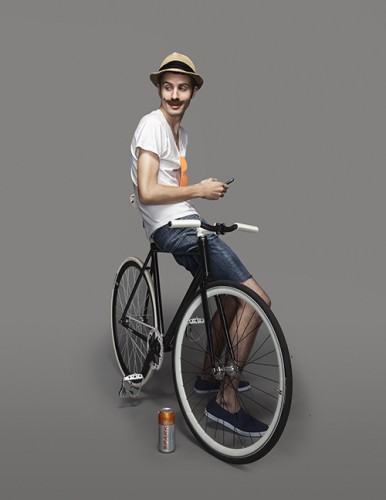
Nathan Jurgenson and I were discussing why low-tech devices have a seductive quality. Consider the popularity of, for example, fixed-gear bicycles or vintage cameras (such as the Kodak Brownie or the Polaroid PX-70 [correction: SX-70]). Though I think this phenomenon is probably overdetermined (in the Freudian sense of having multiple sufficient causes), I came up with a theory that seems worth further consideration: namely, that hipsters’ obsession with antique devices reflects a desire to escape the complex and highly-interdependent socio-technical systems that characterize contemporary society and return to time in which technology appeared to be something that humans could master and, thus, use to affirm their individual agency. In short, the fetishization of low-tech is about the illusion of agency; it provides affirmation for the hipster whose identity is defined by the post-Modern imperative to be an individual, to be unique.

more...


Two weeks ago, I talked about the tension between empowerment and dependence in light of pervasive technological advancement in general, and its application to the body in particular. To briefly summarize, I argued that new technologies simultaneously empower us to take control over our own bodies—through bio-tracking, geographically unconstrained community support, and access to information—while embedding us in a relationship of dependence with the biomedical institution. We regain authority over bodily meanings, while relinquishing authority over bodily treatment. Taking the case of contested illness, I explained this complex relationship as a function of resources. To define embodied experiences biomedically is to actively place the body at the mercy of medical authorities whose techniques and serums remain inaccessible the subject, while opening access to insurance coverage, treatment protocols, and legal protections.

This trade-off, however (like all trade-offs), is not purely material. Rather, the empowerment-dependence tension, and the related earnestness of patient-consumers to embed themselves within the biomedical institution, has a strong social psychological component—namely, the reduction of moral stigmatization. more...

(The audio file is available here)

Recorded Sunday, August 19th (4:30pm – 6:10pm) at the American Sociology Association in Denver, Colorado.

Thematic session co-sponsored with Section on Communication and Information Technologies)

Organized by Aneesh Aneesh (University of Wisconsin-Milwaukee) and Ronald E. Anderson (University of Minnesota)

Panelists: Saskia Sassen (Columbia University), Fred Turner (Stanford University), Barry Wellman (University of Toronto), Ronald E. Anderson (University of Minnesota) more...

“we may risk, in being so concentrated in demolishing digital dualism, overestimating just how enmeshed the digital and analogue are”

“I’ve lost remaining tolerance of people who talk about Facebook as if it’s all trivia. Mine is full of death & pain. As well as the mundane”

“Just had lovely dinner for a friend’s birthday, met interesting people, had a perfect night. No one took any photos. What a waste of time”

“If there’s anything Americans love more than expensive outdoor recreation equipment, bacon, and wars of choice, it’s innovation”

“Google is acting like a court, deciding what content it keeps up and what it pulls  — all without the sort of democratic accountability or transparency we have come to expect”

“how do we build and teach a new form of civics that takes advantage of what seems to work best offline and online?”

“If TED took a turn to leftist (or any) critique, Žižek, the professor of “toilets and ideology,” would be the keynote speaker”

“Ten, 20 years from now, the legacy of [Facebook] should be, we have connected everyone in the world”

“Becoming yourself is largely a matter of becoming someone who is paid attention to”

“Human self-awareness is multiplying itself onto an altogether new plane”

“If the internet ideal inspired the protest movements of the past year, it’s little wonder they’re struggling”

“Instagram is the new go-to platform for saying “I live a full life and here is photographic proof””

“technological autonomy may be the single most important problem ever to face our species and the planet as a whole”

“Facebook’s basic material is the paradox of identity, the principle of self-presentation that can be undone by others”

“an uncritical embrace of automation, for all the efficiency that it offers, is just a prelude to dystopia”

“Analog stuff is popular online”

Follow Nathan on Twitter: @nathanjurgenson

more...