
inequality

Women managing a calendar. “Untitled” by FirmBee licensed by Pixaby

Reprinted from Council on Contemporary Families Brief Report published on May 3, 2023

When we talk about domestic labor, we often talk about the physical activities of doing work around the house and caring for family members. But running a household is more than cooking, cleaning, and transporting kids to practice; it’s also monitoring the pantry to know when groceries are getting low, weighing options about (and deciding on) which vacuum cleaner to buy, and remembering that little league signups are the last week of March and that cleats typically go on sale the week prior to the season.  

Domestic labor therefore is not just the physical activities of doing housework and caregiving, but also anticipating and monitoring family needs, organizing and planning, and making decisions on which courses of action to pursue. These sorts of activities, known as cognitive labor, are often hidden (i.e., a parent might be planning their children’s schedules in their head while doing other tasks) and are never-ending as there are always things to think about and plan.

Most research on housework and childcare focuses on routine physical tasks but does not account for hidden cognitive labor. This is problematic because mothers perform more physical domestic labor than fathers, and this disparity contributes to negative consequences such as to the gender pay gap as well as to greater stress and less leisure time for mothers compared to fathers. Yet, mothers also perform more cognitive labor than fathers, and the constant need to anticipate and monitor family needs may be a significant source of additional stress for mothers. In sum, the lack of attention to cognitive labor may mean that the enduring gender gap in domestic labor—and subsequent inequalities in well-being—may be even larger than often estimated.

Our new study recently published in Society and Mental Health focuses on the division of cognitive labor between mothers and fathers during the pandemic, and the implications of this division for parents’ psychological well-being.  

Using data from the Study on Parents’ Divisions of Labor During COVID-19 (SPDLC) on 1,765 partnered parents, we examined parents’ time in, and division of, cognitive labor in Fall 2020. Popular press articles illustrate how mothers are increasingly overwhelmed and experiencing burnout due to the sheer volume of things they are trying to juggle. Results from our study provide some empirical support for these colloquial ideas. Among parents in the SPDLC, mothers spent over twice as much time per week performing cognitive labor (5 hours) compared to fathers (2 hours). When asked how cognitive labor was divided between themselves and their partners, mothers reported that they did more of this labor. In addition, mothers reported that the division of cognitive labor was more unequal than the division of housework and childcare—suggesting that the gender gap in domestic labor may indeed be even larger than we commonly think it is.

In addition to understanding how cognitive labor was divided among parents, we also wanted to know if there were consequences of performing this hidden labor. The results were striking; being primarily responsible for cognitive labor was associated with psychological consequences for mothers. Specifically, mothers who were more responsible for cognitive labor reported being more stressed and more depressed. The combination of mothers being primarily responsible for all of these hidden tasks and spending more time doing them means that cognitive labor may act as a chronic stressor that increases mothers’ risk of experiencing psychological distress.

But what about fathers? Do fathers who perform cognitive labor also report negative psychological consequences? Based on our study, the simple answer is no. Our findings show that when fathers perform more of the cognitive labor in families, they actually experience lower stress and fewer depressive symptoms. Similarly, mothers’ stress and depressive symptoms were also lower when fathers took on more of the responsibility for cognitive labor. Thus, whereas mothers’ involvement in cognitive labor may reduce their well-being, fathers’ involvement in cognitive labor appears to benefit both their own and their partners’ well-being.

Research on stress shows that the effects of stressors vary by context, and we find that gender conditions the effect of cognitive labor on parents’ psychological well-being. Fathers are not expected to manage the household and constantly monitor family needs. While fathers increasingly desire to be more engaged parents, they do not face strong social pressures to perform domestic tasks. Consequently, fathers may receive praise and positive reinforcement for performing cognitive labor as they are seen as going above and beyond what is expected of them. In contrast, mothers are expected to be primarily responsible for household tasks and may be penalized and judged if they do not meet these expectations. This makes mothers uniquely susceptible to the hidden, enduring burdens of cognitive labor.

Overall, our new findings suggest that gender inequality in housework and childcare extends to hidden domestic tasks, and also that performance of these tasks likely contributes to inequality in well-being between mothers and fathers. As long as gendered norms of care and the parenting double standard persist, gender inequality in domestic labor and well-being will continue. We need to change our cultural expectations about caregiving and provide more structural opportunities for fathers to be more engaged at home (e.g., remote work, paid leave) to reduce the burdens on mothers, reduce mothers’ stress, and promote greater gender equality at home. Increased opportunities for engagement will likely increase fathers’ awareness of family needs and empower them to take ownership in sharing both physical tasks as well as the hidden cognitive labor.

A briefing paper prepared for the Council on Contemporary Families by Richard Petts, Professor, Department of Sociology, Ball State University, and Daniel L. Carlson, Associate Professor, Department of Family and Consumer Studies, University of Utah.

Young woman with a raised fist protesting in the street

As people come to oppose one type of inequality, are they more likely to also begin to oppose other types? To find out, we analyzed nationally representative data from the General Social Survey (1977 – 2018), documenting whether shifting gender attitudes over that period coincided with changing racial attitudes. In this brief report prepared for the Council on Contemporary Families we summarize the key findings of our forthcoming article in the American Sociological Review.

Racist and sexist attitudes were extremely widespread in the early 1970s. Two-thirds of Americans believed that women should devote themselves to homemaking and that they could only raise children successfully by foregoing paid employment. And among the White population, there was a widespread belief that disparities between Black people and White people resulted from individual deficiencies rather than discrimination, with only 40 percent attributing these disparities to discrimination.  

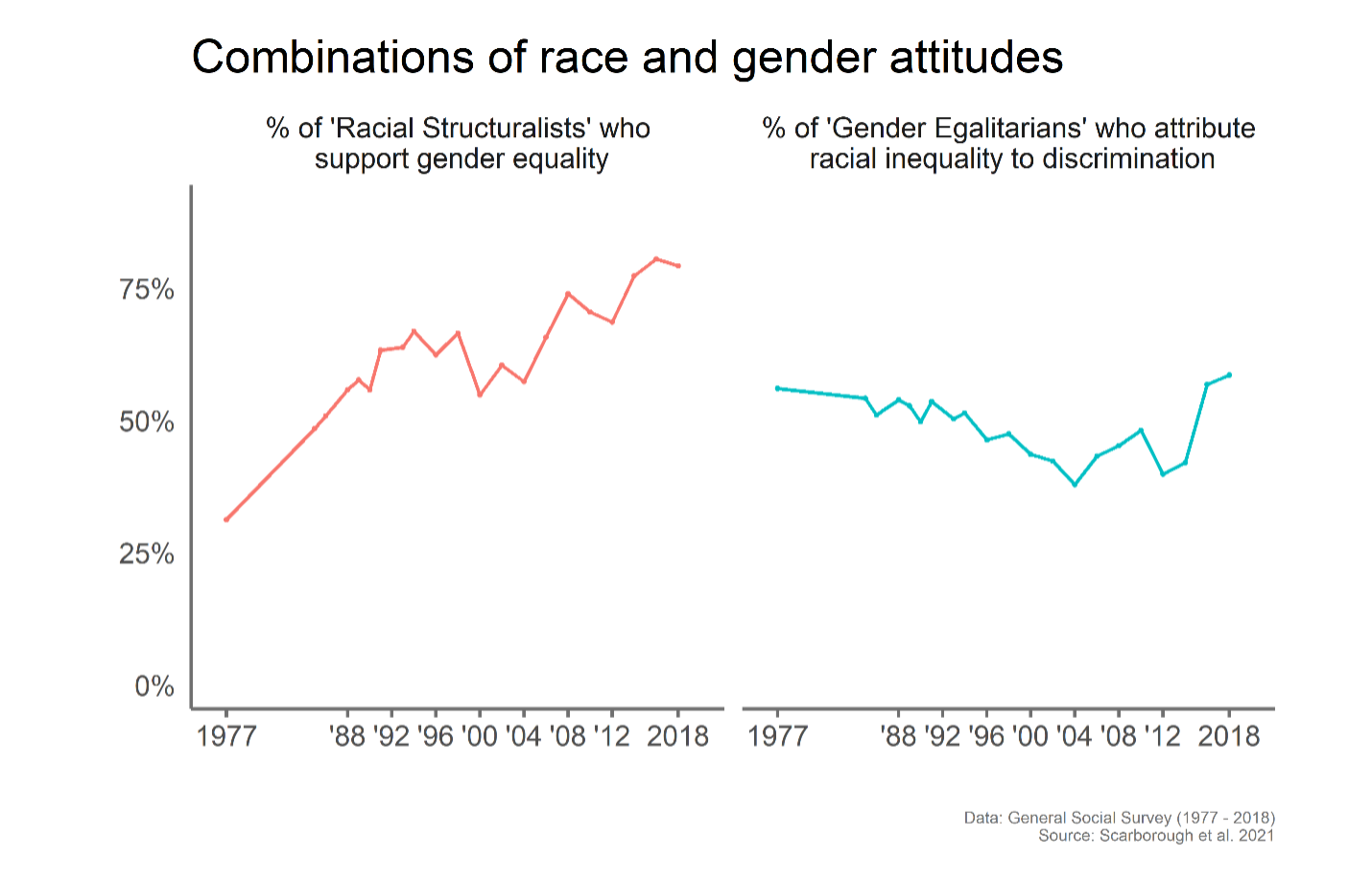
Interestingly, however, these views changed at very different rates in the ensuing years. In 1977 only a third of Americans rejected the notion that wives should stay home while husbands worked for pay, but opposition rose steadily after that point. By 2018, three-quarters rebuffed that notion. By contrast, the percentage of Americans attributing inequalities between Black and White people to racial discrimination, as opposed to in-born racial differences, actually declined for several decades, reaching a low of 32 percent in 2004, substantially below the 40 percent figure of 1977. By 2012, however, some new patterns emerged.

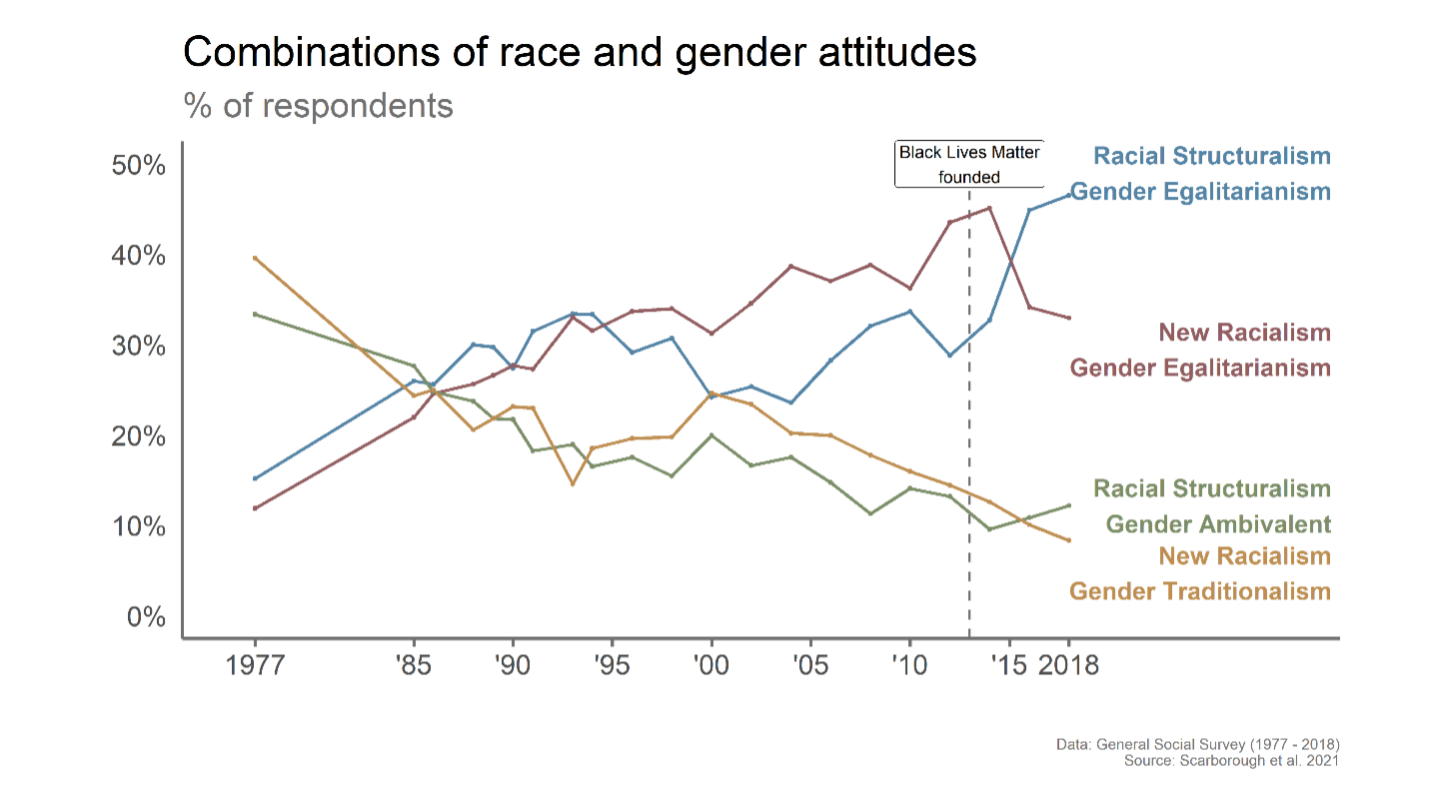
We identified four configurations of racial and gender attitudes over this period. We measured racial attitudes with a set of survey questions designed to capture whether individuals felt racial inequality is due to structural factors like discrimination and unfair educational opportunities, or whether it is due to individuals’ deficient motivation. We inferred people’s views on gender by using questions that measured their opinion on whether women were as suited as men for politics and whether they thought women should primarily focus on raising families while men focused on their careers. We assigned people to one of four distinct groups describing their combination of beliefs about race and gender inequality. One group held universally progressive attitudes that supported gender equality in politics and in the home, while also attributing racial inequality to discrimination rather than individual deficiencies. Another group held universally conservative attitudes that endorsed conventional gender arrangements based on male breadwinning and female homemaking alongside beliefs that racial inequality was due to individual flaws. Two remaining groups held contradictory opinions. One held progressive gender attitudes but conservative racial attitudes. The other was the converse.

Note: Racial Structuralism/Gender Egalitarian attitudes are those who support gender equality and attribute racial inequality to discrimination. New Racialism/Gender Egalitarians support gender equality but do not agree racial inequality is mainly due to discrimination. Racial Structuralism/Gender Ambivalent perspectives hold conventional attitudes about gender in the family while also acknowledging racial discrimination. New Racialism/Gender Traditionalist attitudes are conservative across race and gender, opposing gender equality and denying racial discrimination.

The bad news: For most of the past forty years, Americans’ growing understanding of gender inequality as a social problem was not matched by the same growth in their understanding of racial inequality. Although one might think recognizing inequality in one area would open people’s eyes to other inequalities, that did not happen for several decades. A very large proportion of people discarded their old prejudices about gender without shedding their prejudices about race.

Compared with people who endorsed conventional gender arrangements, people who supported women’s leadership and gender-equal divisions of household labor back in 1977 (27 percent of the population), were also quite likely to attribute racial inequality to discrimination. Of these gender egalitarians, 56 percent agreed that racial inequities were also due to discrimination and educational disparities. But as gender equality became more mainstream, the proportion of people recognizing gender inequality AND racial inequality fell. By 2004, the number of Americans supporting gender equality in politics and the home had grown to 62 percent, but only 38 percent of these gender egalitarians thought racial disparities were mainly due to discrimination, though of course the total numbers had increased. As of 2012, nearly three-fourths of survey respondents endorsed gender equality in public leadership and in the home, but six-out-of-ten gender egalitarians continued to blame racial inequality on personal flaws rather than discrimination. We refer to this combination of attitudes as New Racialism/Gender Egalitarianism.

These findings show how people can oppose inequality in one area of life but be blind to it in another. 

The good news: From 2012 to 2018 there was a growing alignment of gender and racial attitudes. After 2012, the view that racial inequality is due to discrimination and educational access became increasingly common, especially among people who supported gender equality. From 2012 through 2018 the percentage of respondents supporting gender equality and also believing that racial inequality stems from discrimination and unequal access to education rose from less than 30 percent to almost half (47 percent). Starting in 2014, and especially since 2016, people who support gender equality have increasingly adopted more progressive racial attitudes, perhaps reflecting growing overlap between anti-racism and anti-sexism. In 2018, nearly 60 percent of gender egalitarians also identified discrimination and access to education as main sources of racial inequality.

The rebound in this combination of race and gender attitudes – which we call Racial Structuralism/Gender Egalitarianism – may reflect the influence of social movements such as Black Lives Matter. It seems likely that BLM and other social movements have had a substantial effect on individuals’ perceptions of racial discrimination, particularly among people who had already come to support gender equality.

Conclusion: When people reject one type of inequality, they do not automatically reject others. Over most of the period under review, people who adopted liberal perspectives on gender were slow to see the need for policies aimed at addressing structural racism. From 1996 to 2014, the most commonly held combination of gender and race attitudes was anti-sexist but not anti-racist. Yet since 2016 the proportion of Americans who support gender equality and also feel that racial inequality stems from structural factors like discrimination has risen to almost half. This coincides with the rise of contemporary social activism, such as the Black Lives Matter movement, that advocates for racial equity along with gender equity. It is very likely that the recent increase in anti-racist attitudes among people who hold anti-sexist attitudes is related to the visibility of this movement. Our findings suggest that while individuals who hold some progressive ideals may be open to understanding parallels with other dimensions of inequality, this does not occur automatically, but in response to social activism and debate.

William J. Scarborough, Assistant Professor, Department of Sociology, University of North Texas.

Joanna R. Pepin, Assistant Professor, Department of Sociology, University of Buffalo (SUNY)

Acknowledgments

The study discussed in this briefing paper is forthcoming in the American Sociological Review. We would like to recognize our co-authors Danny L. Lambouths III, Ronald Kwon, and Ronaldo Monasterio. We are also greatly appreciative to Stephanie Coontz for her vital feedback and encouragement on this briefing paper.

Stephanie Coontz offers reflections on the Council on Contemporary Families brief, Hiring-related Discrimination: Sexist Beliefs and Expectations Hurt both Women’s and Men’s Career Options, by Jill Yavorsky.

VR: You edited Jill Yavorsky’s brief on hiring-related discrimination, where she reports that both men and women are stereotyped in hiring decisions–and men suffer from this, though women suffer more. How does history play a role in this? 

SC: It wasn’t until 1972 that The Equal Employment Opportunity Act prohibited job discrimination on the basis of sex, and not until 1973 did the Supreme Court definitively rule that newspapers could not sort job ads, as had been done for decades, into “Help Wanted: Male” and “Help Wanted: Female.” I studied New York Times ads from the 1960s where employers openly stipulated that applicants must be “pretty-looking, cheerful,” “poised, attractive,” “perky,” and even “really beautiful.” No ads for females stressed analytical abilities—only ads for males did. Many employers clearly agreed with the psychiatrist who argued in a 1962 Yale Review article that most young women “are incapable of future long-range intellectual interests” before they had married and raised their children – if then.

The fact that women are now considered equally capable of handling jobs that require education, analysis, and reason is a step forward. But as Yavorsky shows, employers still tend to believe that men are best suited for challenging jobs that require physical or mental prowess. Her findings likely underestimate the full extent of discrimination because many studies find that when jobs are described as requiring stereotypically male attributes, or the majority of workers pictured in the ads are male, women are discouraged from applying in the first place.

VR: What is your view of Yavorsky’s finding that women applying to men’s middle-class jobs experience fewer barriers in getting in the door–but they appear to face significant barriers once they are at work? 

SC: This seems to be especially true in elite professions. As I point out elsewhere, the greatest wage discrimination by gender used to be in working-class and lower middle-class jobs, partly because of men’s greater rates of unionization. But as wage rates and job security in many traditional blue-collar jobs have fallen, we now see the opposite. Many women have established a firm foothold in mid-level middle-class jobs, and their wages have risen significantly. In the most elite professions, however, men’s wages have risen exponentially more, so that the biggest gender wage gaps are now at the top of the occupational ladder rather than at the bottom or middle.

Once women (and minorities) do get hired in traditionally male blue-collar jobs, they tend to be paid similar wages to men, accounting for seniority. But professional jobs where raises, promotions, and incentives rest on more subjective standards allow more free rein to sexist and racist biases.

VR: Men who apply for women-dominated working-class jobs appear to be subject to hiring discrimination, and Yavorsky suggests that as jobs shift to more service sector jobs, this could become a growing problem. Do you agree?

SC: On average, women’s wages still lag behind those of men with comparable education and experience. But more women than men have been upwardly mobile over the past 40 years, because working women have made slow but significant gains from a very low base, while men have lost many of the secure, well-paying blue-collar jobs once open to men without a college education. Between 1979 and 2007, the percentage of workers in middle-skill occupations fell, but for women the vast majority of this shift was due to their moving into higher-skill jobs as they got more experience and education. By contrast, a full half of the shift for men was into lower-skill jobs. Ironically, then, women’s historical disadvantages have incentivized many to seek more education to make a secure living, but men’s historical advantages have slowed their response to the changing job market. Many still believe they can earn a living wage without a college degree, or they assume that all female-dominated jobs will pay less and have less opportunity for advancement. As Yavorsky shows, employers exhibit the same stereotypes in reverse, discriminating against men even in – especially in — the mid-status, middle-class jobs that are expanding much more quickly than other sectors of the economy and that now pay more than many traditionally male-dominated blue-collar jobs. With most families requiring two incomes to get by, gender equality in hiring and promotion ought to be on the agenda of all people who make their living through wages, not just feminists.

Stephanie Coontz is author of Marriage, A History: How Love Conquered Marriage. Follow her at @StephanieCoontz. Virginia Rutter is co-editor of Families as They Really Are. Follow her at @VirginiaRutter. 

photo by mastertux via pixabay

A short interview with Stephanie Coontz by Virginia Rutter on a new CCF study.

VR: You edited the new brief report on cohabitation trends from the Council on Contemporary Families. In it, Arielle Kuperberg reports that premarital cohabitation is more common—occurring before 70 percent of marriages. But what does this new research tell us about Americans’ intimate lives? 

SC: First of all, it adds to our understanding of how quickly the norms and dynamics of personal relationships are changing. Until 1970, couples who cohabited before marriage were 82 percent more likely to divorce than those who married directly. That extra risk is now gone. Similarly, until the 1980s, marriages in which wives had more education than their husbands had a higher risk of divorce than other couples. But since 1990 that extra risk has also disappeared. Despite constant claims to the contrary, it is no longer true that marriages where the wife earns more than her husband are at higher risk of divorce. Finally, couples where the wife did most of the childcare and housework used to report better sex lives than couples with a more egalitarian division of labor. Now the opposite is true.

Within couple relationships there are many signs of growing equality. But that leads to a second contribution of the paper, which illustrates the growing inequality among couples on the basis of higher education, and in turn on their prospects for earning a family wage.

VR: Cohabitation looks like it is useful and valuable to many—as Kuperberg shows in the reversal of that out-of-date link between cohabitation and divorce. (See her awesome Figure 3 for a visual of the reversal!) But some people don’t want to cohabit. What do you think of Kuperberg’s findings about religion, escalating inequality, and access to “direct marrying”?

SC: Despite the widespread social acceptability of premarital cohabitation, a minority of Americans, especially those with strong religious beliefs, continue to disapprove of the practice and prefer to marry directly. Kuperberg highlights the painful dilemmas facing those who hold more traditional values but lack the resources to act on them. While two-thirds of religiously-observant women with a BA or higher did not cohabit before marriage, this was true of only 14 percent of equally observant women who did not attend college — and of just three percent of religiously-observant women without a high school diploma. As Kuperberg suggests, this is almost certainly not because of different values but of different options.

I agree that this gap likely reflects the difficulties that less-educated couples face in meeting the increasingly high economic bar for marriage. And it is especially troubling that the gap used to be just between the least-educated women and everyone else but is now greatest between the most-educated women and everyone else. The same escalating inequality between the most highly-educated Americans and others who work just as hard but are paid drastically less is also seen in rates of non-marriage and out-of-wedlock childbearing.

This divergence is likely to continue, given recent evidence that, as yet, the only group to have recovered fully from the Great Recession is people with a bachelor’s degree or higher.

VR: So what do you make of that? Growing equality within couples, and growing inequality between couples?  

SC: For one thing, it means that much family instability results not from people’s different values or “culture” but from their inability to meet the high interpersonal and economic expectations of marriage that most Americans now embrace. I am thinking of the economically insecure people who move in together rapidly and then don’t move on to marriage, resulting in a lot of churning; the growing numbers of people who are not seen as marriageable by others due to poor job prospects or low wages (low-income men right now have the worst marriage prospects); youths who lack the kind of life opportunities that give them incentives and tools to defer childbearing.

For another thing, when people feel that they are being excluded from the American Dream, they often embrace short-term coping mechanisms or compensating behaviors that make their personal lives and relationships even more difficult. And with higher wage inequality, fewer work-family protections, and a weaker social safety net than other advanced industrial economies, the U.S. imposes exceptionally heavy penalties on people who become single parents or do not complete higher education, leading to lower rates of social mobility – and higher rates of personal problems. As I’ve written elsewhere, the long-standing American myth that individuals succeed purely on their own, on the basis of their personal “grit,” actually undermines people’s ability to establish families that can thrive.


Stephanie Coontz is author of Marriage, A History: How Love Conquered Marriage. Follow her at @StephanieCoontz. Virginia Rutter is co-editor of Families as They Really Are. Follow her at @VirginiaRutter.

In Time to Join #MeToo, Research Highlights Men’s Growing Support for Gender Equality

Two recent studies, presented to the Council on Contemporary Families, reveal that despite the serious obstacles still standing in the way of achieving full gender equality, progress continues. Married men are expanding their contributions on the home front, and data from the General Social Survey show men at their highest levels yet of support for gender equality.

Dan Carlson of the University of Utah reports on a new study with co-authors Amanda Miller and Sharon Sassler that expands on their earlier research: It had shown that sharing housework now increases happiness for heterosexual couples. The new work finds sharing housework is good news for the bedroom, though how good depends on what you’re sharing.

Carlson’s report on housework underscores what David Cotter (Union College, New York) indicates about trends in attitudes: When looking at men’s and women’s roles at home and at work, a stall in support for gender equality in the 1990s was followed by advances in the 2000s, and mixed results in the 2010s. But in 2016, support for all aspects of gender equality reached new highs. While men have consistently been less egalitarian than women since the 1970s, the gap between their attitudes has narrowed in recent years. “History seldom proceeds in a straight line,” notes Stephanie Coontz, CCF’s director of research and education, “but when you even out the ups and downs, the increase in approval of gender equality, at home and at work, over the past 40 years has been truly dramatic.”

Highlights

In Not All Housework is Created Equal: Particular Housework Tasks and Couples’ Relationship Quality, Carlson shares a couple of intriguing findings:

  • By 2006, the proportion of lower and moderate income parents sharing house cleaning had nearly doubled, to 22 percent, and the proportion sharing the laundry had risen to 21 percent, an increase of 129 percent.
  • In 1992 the division of tasks mattered little for couples’ well-being. But, by 2006, couples who equally shared tasks demonstrated clear advantages in relationship quality over couples where one partner shouldered the load.
  • Which tasks partners shared made a difference. Men who shared the shopping for their household reported greater sexual and relationship satisfaction than men who did either less or more shopping than their partner.
  • And for women? Sharing responsibility for dishwashing was the single biggest source of satisfaction for women. Lack of sharing in this task was the single biggest source of discontent with their marital relationship.

In Patterns of Progress? Changes in Gender Ideology 1977-2016, Cotter provides four graphics that chart change.

  • Overall, people have become more egalitarian about such issues as support for working mothers, whether men should be in charge at home, and whether men are superior to women in politics. The upward lines in Figures 1 and 2 tell it all.
  • The change has more to do with generational replacement than anything else, as you’ll see in Figure 4. The younger generations—groups referred to as Baby Boomers, Gen-Xers, and Millennials–all trend together towards high levels of egalitarianism.
  • The biggest news is that men are catching up to women, as seen in Figure 3. Men are still less egalitarian than women, but the gap between men and women has declined significantly in the past four years.

Where do we stand today?

Discussions about gender equality tend to invite that “glass half full / glass half empty” response, notes Stephanie Coontz, who reviewed these reports. “As we know from #MeToo, we have a long way to go. But to reach gender equity, we started with a very tall glass that had sat empty for thousands of years. The fact that we’ve filled it this far in just forty years should give us confidence to keep pouring.”

Reposted from Psychology Today. 

The majority of Americans today believe in equality. Nearly three-quarters of American adults (73%) say the trend toward more women in the workforce has been a change for the better. And 62% of adults believe that a marriage in which the husband and wife both have jobs and both take care of the house and children provides a more satisfying life than one in which the husband provides for the family and the wife takes care of the home. But despite real progress in men’s participation in family life, Moms usually remain the default parent while Dads help out but do not take charge. Women’s income, not men’s, is often seen as what pays for the childcare. Another recent study of American families shows that mothers multi-task more than fathers, do it more often at the office, and feel more burdened than men by having to always be doing two things at once time.

So what is going on here? Is there an international plot to maintain patriarchy, as conspiracy theorists might argue? Or are women naturally suited to housecleaning and men are just not up to the task, as so many anti-feminists claim? Are today’s husbands really Neanderthals that come home from a long day’s work, drink beer, and expect their wives to wait on them?

Perhaps my own experience loading the dishwasher a few months ago can provide some clues. I don’t do housework very often. As a university professor, researcher, and author who always has writing deadlines looming while I travel to conferences and lectures, both in the US and overseas, I’m ridiculously over-scheduled. My husband is semi-retired, works from home and so with his flexible schedule, spends a lot of his time following me around the world. He doesn’t pick up the slack in our home; he runs our household. One Saturday morning after being served fabulous French toast, I insisted on cleaning up for a change. Within minutes, I was lecturing him on how the dishes already in the dishwasher weren’t rinsed well enough, or stacked neatly. He smiled at me and said, “So when was the last time you ate on a dirty dish?”

If I can find myself, without thinking twice about it, lecturing my husband on how to load a dishwasher, when I haven’t touched a dirty dish in months. How hard must it be for women who’ve been doing the dishes and the meals and taking care of the kids to accept their husbands as competent partners? Or even as partners who might become competent once they were responsible for the tasks?

I have no doubt there are men out there who are simply sexist self-serving narcissists who want wives to do the second shift so they drink beer, play golf, and watch TV. But are there not also some women who just cannot stop themselves from lecturing our partners on how to launder clothes, stack the dishes, put away the groceries and dress the children. Many moms I have talked with even leave lists of what to put into the lunch box when they travel for business–as if their husband isn’t smart enough to figure out what to put between two slices of bread. Why would these successful women have married men they can’t trust to make a sandwich or pick out a toddler’s outfit? The assumption of male incompetence at home has the same result as expecting women to be incompetence at work. It makes the recipients less likely to take on responsibility, to do the job well, or to show initiative.

Perhaps part of why men aren’t stepping up to the plate as equal partners is because women don’t let them. It’s not that women don’t want their husbands to share the job and the joys of parentingResearch shows clearly that they do, and that there are even benefits in the bedroom when people feel their marriage is fair. But we women have set the rules for how housework is done for so long, and often take so much pride in our mothering identities, that we don’t leave enough room for fathers to be equal players. Perhaps mothers are worried about what the neighbors will think if their son’s outfits are not matching, or their daughter’s shirts have stains? Is such shame worth undercutting men’s responsibility for domestic labor? Surely, if a man was worth marrying, he’s talented enough to wash dishes, make play dates, and clean the toilet.

So for Father’s Day, let’s show dad’s some respect. The best gift might just be to respect your partner enough to let him load the dishwasher without comment, and take care of the kids without fearing his your evaluation. Here ’s a gift idea for wives on this Father’s Day: stop giving directions, stop running the show and then resenting that you carry the load of the family work. Give Dads a break this year for Father’s Day. Trust them enough to lean out at home. And if you have to occasionally eat from a dirty plate, as I do, it’s worth it. Let your guy lean in for a change.

Barbara J. Risman is a Distinguished Professor of Sociology in the College of Liberal Arts & Sciences at the University of Illinois at Chicago.  She is also a Senior Scholar at the Council on Contemporary Families.

Even in the most affluent societies, many young people grow up in families that are poor and/or unstable in some way, and the evidence is clear that this experience can lead to behaviors that put their futures at risk. That risk, however, is not necessarily going to be same across societies, and figuring out where it is most and least pronounced is an important task for family researchers.

The U.S., as is often noted, has a much less generous social safety net for families and children than many other countries; less generous than Scandinavian countries, of course, but also compared to the other wealthy, English-speaking countries that it is often grouped with in the broad category of “liberal welfare regimes”. As a result, children who grow up in the U.S. are much more likely than their peers in these other countries to experience some key risks to positive development, such as family poverty and instability. There is just not enough protection for their families and communities, and so they are more likely to enter adolescence in dire straits. Indeed, based on research from a range of interdisciplinary scholars, including Timothy Smeeding, Jane Waldfogel, Barbara Bergman, and Patrick Heuveline, we know that kids in the U.S. are worse off, but is being worse off worse in the U.S.?

My students and colleagues in the U.S., U.K., and Canada have been trying to provide some answers to this question. This research reflects some key lessons of contemporary family and developmental research. Specifically, we are viewing family poverty and family structure not as single and static states but rather as a long-term pattern of continuity and change. We also are focusing on adolescence, a period in which complicated patterns of brain development, parent-child relations, and peer orientation lead to behaviors with heightened potential for harm. Doing so has revealed that, although the odds of growing up in poor and/or unstable families and engaging in adolescent risk-taking are both generally greater in the U.S., the link between these two things is not always stronger in the U.S.

For example, in a study that came out this year in the journal Social Science and Medicine, Michael Green, Haley Stritzel, Chelsea Smith Gonzalez, Frank Popham, and I compared longitudinal population datasets in the U.S. and U.K. to examine adolescent health and health behavior. We categorized young people in terms of their histories of family poverty since birth (e.g., early poverty only, persistent poverty, later downward mobility). The results clearly show that the accumulating experience of poverty over time is much more prevalent in the U.S., that this accumulating experience is associated with smoking and health limitations in both countries, but that this association does not really differ across countries.

As another example, in a forthcoming study in the Journal of Marriage and Family, Chelsea Smith Gonzalez, Lisa Strohschein, and I compared longitudinal population datasets in the U.S. and Canada to examine teen pregnancy. We counted how much of girls’ lives since birth they had spent in poverty and how many family structure changes they had experienced.  Similar to the other study, the results clearly reveal more long-term exposure to poverty and instability in the U.S. and that such exposure is associated with greater odds of a girl getting pregnant as a teen. This study, however, also revealed a country-level difference in this association. In the U.S., prolonged experiences of family poverty and family structure were associated with teen pregnancy, but, in Canada, any experience of family poverty and family structure change was. In other words, there was a dosage effect of family poverty and instability in the former and a threshold effect in the latter.

To be clear, we are not saying that family poverty and instability do not matter to adolescent behavior. They do. We are also not saying that social policies do not protect young people from harm. They do. We are also not saying that the circumstances of young people in the U.S. are the same as those in the U.K. and Canada. They are not. What we are saying is that the ability of social policies to buffer against the risks of family poverty and instability—once they have arisen—is not as neatly straightforward as one might assume.

Our work represents the comparison of three relatively similar countries, only two family variables, and only three adolescent outcomes.  As such, it is just a drop in the expanding bucket of population research comparing family contexts of child and youth development across countries. There is more to know here. How is family poverty and instability experienced by young people across countries in which it is more or less normative? Which domains of adolescent development are most and least reactive to family disadvantages across countries? Are there differences in patterns for children, adolescents, and young adults? Expanding the comparison pool to countries with much more generous welfare regimes than the U.S. and much less economic development than the U.S. is also important. What we offer here, therefore, is encouragement to keep this conversation going.

Robert Crosnoe is the Rapoport Professor of Liberal Arts and Chair of the Department of Sociology at the University of Texas at Austin and President of the Society for Research on Adolescence.

Will Meghan Markle be welcomed in the royal family? The recent wedding of Markle, a biracial woman of Black and White heritage, and Prince Harry, a White male member of the British royal family, marks a social milestone. More than fifty years out from the Supreme court decision that legalized interracial marriages across all 50 states in the U.S., this wedding has inspired a new conversation about racial inclusivity infusing “bicultural Blackness” within a traditionally white elite. The celebratory tone makes sense as mixed-race couples represent 17 percent of recently married couples in the United States. This increased demographic prominence also coincides with broad based approval. According to the Pew Research Center, 88 percent of millennials say they would be “fine with a family member’s marriage” to any racial group.

But is true acceptance solely being “fine” with a racially different in-law? While crossing racial lines has reached broad-based acceptance, do mixed-race families have access to the same supports from kin as their single-race peers? Families also routinely provide a range of vital resources, such as financial help, sharing residence, or child care.

The story on this front is considerably more complicated. A new short report, authored by myself and Ellen Whitehead and recently published in the Journal of Marriage and Family, reveals that White mothers of biracial infants are less likely than White mothers with White infants to report that they can rely on friends or family for help if needed. Interestingly, differences were not uncovered for either Black or Latina mothers.

How can interracial couples experience nearly universal acceptance and be more likely to perceive isolation from family resources? First, sociologists often note that approving of something in principle does not always translate into practice. This extends to interracial marriage, as sociologists Mary Campbell and Melissa Herman identify clear differences between Whites approval of interracial marriage and their likelihood of forming interracial relationships. Whites therefore may continue to hold, while not explicitly disclosing, negative attitudes toward interracial coupling.

Beyond, the broader context of race and class inequality needs to be more central to how we talk about and understand the dynamics of racial mixing. Differences in support between Whites with biracial and single race infants reveal the endurance of a white/non-white divide that can be found in nearly every social sphere – where we live, whom we call our friends, and where we go to school. How can interracial couples seamlessly traverse boundaries that remain intact?

In addition, race does not solely divide our associations, it also divides our access to resources, significantly influencing what families may be able to give. According to Pew, Blacks and Latinx families are more than twice as likely as Whites to be poor as of 2014. This broadly aligns with findings on absent resources. While a large share of White mothers of biracial infants reported having absent resources, their levels were quite close to perceptions reported by Black and Latina mothers, nearly 30 percent of whom report that family and friends could not help them in some way if needed. White women with white (single-race) infants were the most privileged, with only 10 percent reporting lack of support.

Experiences of interracial families lie at the nexus of race and class divides. While the expansion of mixed-race family formation signals the growing normalizing of interracial coupling, how families fare is more telling in how, or if, barriers are truly crossed.

Jenifer Bratter is a full professor of sociology at Rice University.  She is a sociologist and demographer whose research explores racial mixing and its implications for unequal racial outcomes.  She has recently published articles in Journal of Marriage and Family, Ethnicity and Health, Social Science Research, and Race and Social Problems. Email her at jbratter@rice.edu

Marriage in Black: The Pursuit of Married Life among American-Born and Immigrant Blacks (Routledge, 2018) by Katrina Bell McDonald and Caitlin Cross-Barnet examines contemporary Black marriages in the United States. Based upon in-depth interviews with 60 couples, they examine the historical and continuing impact of racial inequalities in the United States on Black marriages, distinct features of Black marriages, and the diversity among Black marriages. Their interviewees included African American couples, immigrants from Africa and the Caribbean, and White American couples. I enjoyed reading the book and recently had the opportunity to interview the authors.

AK: What are some of the ways that you found racial inequalities in the United States impact Black marriages in contemporary society?

KBM and CC-B: There are so many angles to consider in response to this question. If we consider the legacy of African American life from the slave era onward, there have been enormous efforts by the state to exert social control over Black relationships. Under slavery, legal marriage was prohibited, but after emancipation, Black couples were pressured or forced to formalize their unions. The context of heterosexual marriage in the United States has historically been situated in White patriarchy, but the privilege accorded White men to support that model of marriage was never extended to Black men. Thus, you see a long history of paid employment among Black wives; married White women didn’t meet married Black women’s employment rates until the 1990s. Systemic racism is a constant for Black couples—structural barriers mean that couples have to negotiate discrimination in housing, employment, the criminal justice system, and everyday interactions with institutions ranging from government offices to the grocery store. That stress spills over into relationships and can create instability that is beyond a couple’s control. But then there also is an increasing proportion of the American Black population that is made up of immigrants. The context of marriage is different in Caribbean and African countries, but their cultural practices and meanings of marriage (in those countries as well as in the United States) don’t always conform to conventions in the United States. And then there is the question of assimilation. Institutionalized racism has historically prevented the assimilation of American-born Blacks into the full privileges of White American middle-class life, so for Black immigrants, what does assimilation mean?

AK: What other distinctive features did you find among Black marriages?

KBM and CC-B: Part of what we found is that there aren’t necessarily any universal features of Black marriage. Intersectional identities make it difficult to define “Black marriage” because individuals have many more components to their identities than race. Black families do have to confront particularly entrenched institutionalized racism, and that means there are certain problems Black couples are more likely to face or just fear—poverty, housing discrimination, incarceration. But when it comes to couples’ ideals or behavior, there are wide variations in marital ideals and practices by social class and immigration status in addition to variation by individuals, creating much more diversity among Black couples than we saw between Black couples and White couples (our sample included 14 White couples). Our sample was small—61 couples all living in the same geographic area—so there could be clearer patterns that would emerge in a larger group, but that would probably be true of any categorization of people, such as by social class or geographic location. That being said, we did find a few patterns that we thought were worthy of further investigation (see next question).

AK: One thing that struck me about your book was the diversity you found among the Black couples you interviewed. What were some differences you found among Black married couples?

KBM and CC-B: Sociologists have speculated that Black married couples are more egalitarian than couples of other ethnic backgrounds, particularly Whites, and because we were looking at Black couples from such diverse backgrounds, we were excited about investigating that idea more deeply. We did find that, regardless of their marital ideals, American-born Black couples were more likely than Whites or immigrant Blacks to share tasks and power fairly equally and that black husbands generally weren’t threatened by Black wives’ income earning power. Conservative religious values of headship and submission expressed by some American-born Black couples actually translated into more role sharing in daily life because the men were more involved with their families. No couple ever used the word “egalitarian,” but some couples professing to share everything “fifty/fifty,” still left the wife with most of the responsibility for housework and childcare even though she worked.

But the American-born Blacks were distinct from the Caribbean and African immigrants, who had radically different approaches to ideas of egalitarianism. African immigrants usually said they wanted to “adjust” or “adapt” to more egalitarian practices, which they saw as distinctly American and necessary to life in America. They generally weren’t fully egalitarian, but they were certainly not replicating the practices they had grown up with in their home countries, where they commonly compared their fathers to “dictators.” Caribbean immigrants, particularly men, were the opposite, wanting to maintain patriarchal power they would have had on the Islands. Caribbeans–and also whites—who were more conservative or traditional attached those values to economic power for men and felt strongly that men should be providers and that mothers shouldn’t work outside the home. For American-born Blacks, working wives and mothers were a norm regardless of the couples’ marital ideals.

Sometimes quantitative work can lead people to believe that an aggregate difference between two groups indicates that there is homogeneity within each group. When it comes to “Black marriage,” that perspective has often led people to view Black couples as deficient because marriage rates are lower than those among white couples, and poverty and divorce rates are higher.  But there are lots of Black couples who marry and work things out, and within the group of those who do, there are many approaches to being in a marriage.

Katrina Bell McDonald is Associate Professor of Sociology and Co-Director of Africana Studies at The Johns Hopkins University. Caitlin Cross-Barnet is a federal researcher and an Associate at the Hopkins Population Center. Arielle Kuperberg is an Associate Professor of Sociology at the University of North Carolina at Greensboro. Follow her on twitter at @ATKuperberg.

Jessica McCrory Calarco is an Assistant Professor of Sociology at Indiana University at Bloomington and recently published the book Negotiating Opportunities: How the Middle Class Secures Advantages in School (Oxford Press). Based on 5 years of ethnographic fieldwork following a group of students from 3rd to 7th grade, she explores class differences in the ways in which students interact with teachers. She found that, coached by their parents, middle class students are more likely to ask teachers for assistance, accommodation, and attention, while working class students acted with more restraint. I was recently able to interview about her book.

AK: What were some differences by social class that you found in students’ interactions with teachers?

JMC: The middle-class and working-class students were similar in many ways. They liked their teachers and they were excited about learning new things. Where they differed, though, was in the extent to which they tried to negotiate for individual (and often unfair) advantages in school.

At the schools where I observed, teachers got a steady stream of questions and requests. The vast majority of those questions and requests came from middle-class students. And many of those requests went beyond what was fair or required. Middle-class students asked for extensions on assignments. They asked teachers to check their work on tests. They monopolized class time with their stories. They even tried to talk their way out of punishment when they got in trouble for forgetting homework or running in the hallways or being disrespectful to their peers.

Middle-class students were also incredibly pushy in making those requests. They rarely sat patiently with their hands raised, especially if that meant waiting more than a few seconds for a response. Instead, they called out, got up from their seats, and even interrupted teachers to ask questions. They also kept asking, even when well-meaning teachers tried to deny those requests. They refused to take “no” for an answer, and they were willing to waste class time (and sometimes call in their parents for reinforcement) to get the support they desired.

Teachers rarely got questions or requests from working-class students. They didn’t feel entitled to teachers’ assistance, accommodations, or intention. And they tried hard to manage on their own. Of course, working-class students did sometimes ask for assistance or accommodations or attention. But the support they requested was typically fair or required. They asked for help when they were struggling to understand concepts. They raised their hands when teachers asked for volunteers to share.

Working-class students were also more patient and more polite in making requests. They would often spend three or five or even eight minutes with their hands raised, even while teachers responded to other students who got up or called out, instead. In the process, working-class students sometimes fell off-task or even gave up, leaving assignments incomplete and questions unanswered on tests. Furthermore, when teachers denied their requests, working-class students rarely pushed back. They just accepted the “no” and moved on.

AK: What role did parents play in teaching children to interact with teachers in specific ways?

JMC: Middle-class and working-class parents all cared deeply about their children, and both groups wanted their children to succeed. But they differed in the lessons they taught children about interacting with teachers and securing advantages in school.

Middle-class parents coached their kids to treat their teachers as resources. When their children were confused or struggling in school, middle-class parents encouraged them to turn to their teachers for support. One middle-class mother recalled what she tells her kids: “It’s okay to ask questions. Your teacher is there to help you. That’s her job.” Middle-class parents also taught their children to keep asking until teachers met their needs.

Working-class parents instead coached their children to treat teachers with respect. As one working-class father recalled: “I just want my kids to be respectful and responsible. My kids are good for the teachers.” Working-class parents recognized that teachers had a lot on their plates. They also worried that teachers might get frustrated with students who asked questions. So they taught their children to deal with problems on their own and to avoid making requests.

AK: Did these differences lead to unequal outcomes for children, and what can be done to reduce these inequalities?

JMC:  Middle-class students’ negotiations with teachers gave them a number of unfair advantages in school. They persuaded teachers to help them correct their work on tests. To grant them extensions on assignments. To exempt them from punishment when they got in trouble. To give them extra time to share their thoughts and ideas. In sum, the bulk of teachers’ support went to the students who needed it the least.

That said, those advantages weren’t automatic. Middle-class students were only successful in negotiating advantages because teachers said “yes” to their requests.

Of course, teachers were well-meaning. They did not intend to privilege middle-class students over their working-class peers. But they still said “yes” to middle-class students’ requests. And they did so, in part, because they worried about the consequences of saying “no.” In particular, they worried about the possibility of pushback from middle-class students and middle-class parents.

Teachers worried because middle-class parents and children could make their lives miserable. They could waste class time with constant emails and back-and-forth negotiations. They could undermine teachers’ authority by complaining to the principal or “blacklisting” teachers they saw as “unresponsive.” They could jeopardize the school by withdrawing critical financial and political support.

Essentially, then, middle-class students’ negotiated advantage was the product of privilege. And that means we can’t level the playing field by teaching working-class students to act more like their middle-class peers. It wouldn’t work. And it isn’t fair—we shouldn’t penalize working-class students for trying to be respectful and responsible.

Instead, we need to level the playing field by preventing middle-class students and parents from using their privilege to negotiate advantages. For teachers, that means thinking carefully before granting requests from middle-class students and parents. For schools, that means protecting teachers from pushback when they say “no.”

Of course, those changes aren’t easy to make. Middle-class families have a history of hoarding opportunities, and they’re unlikely to give up their privilege without a fight.

In the short term, then, we also need to make schools and classrooms more welcoming places for working-class families. We need teachers to recognize silent signs of struggle. And we need teachers to reach out and offer support, even when students don’t ask for it themselves.

Jessica McCrory Calarco is an Assistant Professor of Sociology at Indiana University. She is the author of Negotiating Opportunities: How the Middle Class Secures Advantages in School. Follow her on Twitter  @JessicaCalarco. Arielle Kuperberg is an Associate Professor of Sociology at the University of North Carolina at Greensboro. Follow her on twitter at @ATKuperberg