
inequality

Arielle Kuperberg outside her home in North Carolina

Hooray! Arielle Kuperberg is now to be the editor of CCF @ The Society Pages! Arielle has already populated many spaces in my life—mainly thanks to the interesting work she has done on cohabitation, hooking up, and most recently college debt.  She’s been sharing her good research at The Society Pages and via mainstream media and sharpening (and debunking where necessary) some issues people hold dear. I asked Arielle a few questions about her thoughts about forward-facing scholarship as she begins this new role.

VR: You are a busy person, as a scholar, teacher, program director, and parent. In that context, can you tell us about your commitment to public sociology?

AK: I have long had an interest in the types of messages presented in the media, and the degree to which they are inaccurate. I was a media studies major in college before I switched to sociology, and one of my first publications examined media rhetoric surrounding stay-at-home mothers, and how this rhetoric did not match up with reality. After I went to grad school and began to publish more articles, I started becoming frustrated when I would see inaccurate or misleading things in the media that I knew my research could speak to, or contradicted. I was also frustrated that after all the effort of publishing articles on topics I felt were very important, very few people would read my research unless they happened to be doing research on the same topic. I had published articles on  topics like the effectiveness of different policies in addressing poverty and gender/race-based pay inequality, and the role of poor labor market conditions in lowering marriage rates for the less educated, but what good did that work do if nobody ever heard of it?

When I was about to publish an article showing cohabitation does not cause divorce I felt this research was important enough that I should make a more concrete effort to get the word out, and that I was at a point in my career where I was ready to get more involved in public sociology. I got in touch with a mentor who recommended I get involved with the Council on Contemporary Families. CCF helped me put together a research brief about that project, and later another one about my research on college hookups, and both of those pieces were picked up by major outlets. I started writing some blog posts for the CCF blog and other blogs, and eventually started recruiting my friends into CCF and interviewing them for this blog, since they too have important research findings that more people should know about. Which is probably how I ended up in this position as the new editor.

I used to think of publication as the last stage in the “research pipeline” but I now think of public sociology as that last stage. For research to make an impact, other people need to hear about it. Academic research on the family has a lot to say about modern mythologies surrounding the family – but if nobody hears about it, it’s not going to be very useful. Pierre Bourdieu has been quoted as saying “My goal is to contribute to preventing people from being able to utter all kinds of nonsense about the social world” and I think that pretty well sums up my philosophy.

And yes I am extremely busy with all my different roles, but one of the reasons I went into academia is I enjoy the busyness and all the different roles you get to play – I’m never bored! I am also extremely lucky to have a partner who is a stay-at-home dad, and who supports my career by doing most of the heavy lifting when it comes to childcare and housework.

VR: Your active support of others’ work really stands out to me. What is your approach to mentoring, collaboration, and supporting colleagues and earlier career scholars?

AK: I am only in the position I am because of the generous mentoring of other people. My first two publications were coauthored with my undergraduate mentor Pamela Stone, who taught me everything from how to read a research article and format a table, to how to respond to reviewers when you get a “revise and resubmit.” She also introduced me to several leading scholars in the field when we went to conferences. Since then I have had several very important mentors who have helped me refine my research skills, wrote letters for me to get into grad school and later to get jobs, guided me through grad school, introduced me to their professional connections, gave me advice when I was facing important career decisions, and helped keep me going when I was facing various professional crises. I feel an obligation to pass that help forward to my students and junior colleagues, so that other people can have the same opportunities I had.

But it’s more than an obligation. I find mentoring to be one of the most rewarding aspects of being an academic. I’ve spent many years of my life developing some very specific skills in research, and some more general “succeeding in academia” skills, many of them learned the hard way. What use is all that knowledge if I keep it to myself? Plus there is a special kind of pleasure you get from seeing someone you mentored going off and doing well for themselves in life.

VR: What are your favorite ways of consuming social media?

AK: I have long been a fan of blogs. Back in 2001 when I was an undergraduate (and for several years afterwards), I started and ran a LiveJournal “community” (group blog) for sociologists, which was one of the earliest sociology blogs as far as I can tell. I think there is just something to be said about the short essay format that allows you to go more in depth than a tweet, but is still digestible in 10 minutes of reading while I’m drinking my morning coffee. One type of blog I particularly enjoy is the more personal memoir type of blogs, and I follow several non-academic blogs, although not as many as I used to.

Apart from that, I love facebook. I have made a few major moves in my life, and facebook lets me keep in touch with friends from the various places I’ve lived, and the academics I meet at various conferences. I also coordinate with two of my long-distance collaborators over facebook chat. I got a twitter account last year but have not used it as much as I could. I like the way it makes it easier to keep up with current events, and since most of the people I follow are academics and writers I have a very interesting feed, but I spend much more time on facebook. I also have participated in many message boards over the years, and right now my favorite one is reddit.

Arielle Kuperberg is an Associate Professor and Director of Undergraduate Studies in Sociology at the University of North Carolina at Greensboro. Follow her on twitter at @ATKuperberg. Virginia Rutter is Professor of Sociology at Framingham State University. Follow her on twitter at @VirginiaRutter.
We know quite a lot, statistically, about Millennials, the up and coming young adult generation. Those who are employed are more likely than any previous generation to have a college degree. And yet, they are also more likely to live with their parents for longer stretches as adults.  The Pew Research Center Fact Tank  shows that 15 percent of Millennials live at home between the ages of 25 and 35, far more than generations before them. Their moving home continued even as the unemployment rate decreased, although those without a college degree are far more likely to boomerang home to their parents than are their college educated peers. Millennials appear to be less likely to move around the country to follow job opportunities, perhaps because so many jobs no longer carry the wages and benefits that would justify relocation. One trend very clear is that Millennials are far more likely to lean Democratic than any other generation. These left-leaning college educated young adults, some slow to fly away from the nest, are now the largest generation in America. And among women, Millennials are most likely to see the advantages men have over women, over half of them think men have it easier, far more than any previous generation. And twice as many women than men report having been sexually harassed at work, making this younger generation as aware of women’s victimization as any other.   Their mothers’ feminism hardly ended women’s problems in the workforce.

This is what we know from nationally representative statistics. But I wanted to know more, particularly about how college educated Millennials, our future leaders, felt about gender politics, not only in the workforce but how they experienced sex-based opportunities and constraints in their own lives. My colleagues and students and I interviewed 116 Millennials. Our sample was minority majority, with most of the respondents having been raised in working class, many in immigrant households. Most were now in college or recent college graduates.  In addition to recruiting a sample with much race and ethnic diversity, we also recruited a gender diverse sample, including those who rejected the gender binary entirely (some of whom identify as genderqueer) and some transgender young people. We asked these people to tell us their life history, with a specific focus on their experiences where gender was particularly salient. In the process, we sought to explore whether this new generation will change the face of gender politics at home or at work.

The answer is both yes, and no.  We could identify no one-size-fits-all generational experience.  What we did find was a complicated gender structure that some Millennials endorsed, some resisted, others rebelled against, and that left many simply confused. America continues to be a society with incredible religious diversity, and in my interviews, I quickly noticed that the men and women who were proud of their being girly girls and tough guys, wanted others in their social networks to follow sex-based traditions, and endorsed world views where men and women should have different opportunities and constraints were often raised in literalist faiths where the religious text was taken as gospel, and not metaphorical.  These true believers in a traditional gender structure came from many faiths, Evangelical Christian, orthodox Jew, Greek Orthodox, and Muslim. What they shared was a belief that god intended men and women to be complementary, not with equal opportunities to all social roles. These were young adults following in their parents’ footsteps, conserving the past for the future. In our sample, we talked to many of these young traditionalists, but in a national sample, they would be a small minority.  Still, they exist and complicate any picture of Millennials as movers and shakers of tradition.

But then, of course, many Millennials are also critical of sexual inequality. In our research, we identified two different patterns among young people with these attitudes. Some are innovators who simply ignore and reject any rules that apply only to women or men. They are proud to integrate aspects of masculinity and femininity, toughness and caring, into their own identities, reject expectations that force them into sex-specific roles, and want women and men’s lives converge so that everyone has the rights and opportunity to share the work of caring for others, and earning a living. What seems new in this generation is that this feminism isn’t a women’s only movement. These innovators are men as well as women. But some of those we interviewed went far beyond simply rejecting sexism, they rejected gender categories themselves, particularly the way social norms require us to present our bodies. These rebels reject the need for the category of woman or man. Some use the language of genderqueer, others simply say they are between the binary. A few are comfortable with remaining women but present themselves so androgynously as to be commonly presumed to be male. All reject the notion that women and men need to carry their bodies differently, or dress distinctly. These rebels have a tough time in everyday life. If you do not fit easily into a gender binary, you find yourself an outsider everywhere you turn, with no obvious restroom, no clothing designed for your anatomy, and no box to check on many surveys. While people with these problems are no doubt a very small proportion of American Millennials, they are having a tremendous cultural and political impact, with both California and Oregon now allowing people to choose a gender category other than woman or man.  These new laws provide more accurate identifications for genderqueer Millennials, as well as for intersex people. Rebels may be small in number but are clearly re-shaping cultural ideas about gender identity.

Of course, many of the young adults we interviewed were not so easily categorized. I call them straddlers because they have one foot in traditionalism and one in gender criticism.  It’s hard to know if this inconsistency is a moment in the lifecycle or will characterize their adult lives. After all, being a young adult today is confusing, and psychologists have labeled this stage of life emerging adulthood.  It is indeed a long and winding road, according to Jeffrey Arnett, from the late teens through the twenties to arrive at an adult identity and lifestyle. Many of the young people we interviewed held inconsistent  their ideas about themselves, their expectations for others, and how society should operate. They are as confused, and as in transition, as is the gender structure itself.

Millennials are a diverse group. When it comes to the gender structure, I identified four categories, traditionals, innovators, rebels, and straddlers, of Millennials with very different orientations. Does nothing, then, make this generation distinctive? Yes, some patterns do indeed provide a generational marker that transcends their differences. All these Millennials talked of women as employed workers whether they were mothers or not. The belief that the world of work and politics is for men, and the hearth and home the sole province of women is a 20th Century memory that now sits in the dustbin of history. Even women that endorse more freedom for men than women expect and desire to spend most of their adult lives in the labor force. But beyond the changing expectations for women’s lives, my research suggests the most defining feature of Millennials is their gender and sexual libertarianism.  Whatever they choose for themselves, they have no desire to impose their choices on anyone else.  What this means for America is that as the Millennials become the largest voting block, they are unlikely to cast their ballots for laws that require anyone to become just like them when it comes to gender or sexuality. And in that way, the Millennials may just take us to a more open and society.

Barbara J. Risman is a Distinguished Professor of Sociology in the College of Liberal Arts & Sciences at the University of Illinois at Chicago. Currently she is a Fellow at the Institute of Advanced Study at Durham University in the UK.   She is also a Senior Scholar at the Council on Contemporary Families.

Originally posted 5/14/2015 

Recent months have seen a dramatic increase in media and government attention to gender-based violence, particularly sexual assault. Unfortunately, that attention has largely focused on a relatively elite group of young women – those enrolled in 4-year colleges. Much of the discussion has focused on the prevalence of a so-called “rape culture” in such settings, characterized by widespread tolerance of sexual violence. This essay presents evidence that sexualized violence and tolerance of such violence are actually more prevalent among youths who are not enrolled in college. more...

Photo by GDJ via pixabay

Originally posted 8/8/2017

Most people know that there’s a long and persistent history of racial and ethnic segregation in the United States. There’s less awareness of segregation of gays and lesbians, and gay neighborhoods often get treated as simply a matter of “choice”— much the way that queer identities have historically been treated as a “choice.”

Is it the case that gays and lesbians simply gravitate to similar areas and form gay “enclaves,” or is the segregation of gays and lesbians related to systematic inequalities? According to new work in Population Review by Dudley L. Poston Jr.D’Lane R. Compton, Qian Xiong, and Emily A. Knox, it’s a little of both.

To a degree, discrimination drives the segregation of gays and lesbians. The researchers point to religious intolerance and recent anti-sodomy laws as evidence that gays and lesbians are systematically excluded from some heterosexual communities. But Poston Jr. and colleagues don’t reject the possibility that some gays and lesbians segregate voluntarily. As homophobia decreases, gays and lesbians may still wish to take advantage of the “protective shield and social support” and “stronger political voice” afforded by self-segregation.

It’s likely that the dynamics of segregation might be different for gays and lesbians. Lesbians are more likely to have kids, and thus might voluntarily congregate in places with better school districts. But they’re also more likely to live in poverty than gay men, which leads to fewer living options.

Poston Jr., Compton, Xiong, and Knox examined the relationship between factors related to racial segregation and segregation by sexuality among 100 metropolitan areas with large gay and lesbian populations, using American Community Survey data from 2008 to 2012. The researchers estimated the percentage of gay or lesbian households that would have had to relocate within that metropolitan area for the number of same-sex and different-sex households to be proportional.

In all metropolitan areas examined, gay and lesbian households were segregated from heterosexual ones. On average, about 75 percent of gay male and 69 percent of lesbian couple households would have had to relocate within their metropolitan area to eliminate neighborhood segregation. The lowest estimate of segregation was between lesbians and different-sex couples in Madison, Wisconsin. Even there, though, just over half of lesbian households would have had to relocate for there to be no segregation.

Gay male households were more segregated from heterosexual households than were lesbian couple households in most cases. Provo-Orem, Utah, had the most segregation by sexuality: More than 90 percent of gay male households would have had to relocate to be proportional to heterosexual married and cohabiting couples in the population.

Gay and lesbian households are segregated from each other, too. In El Paso, Texas, which had the most segregation of same-sex households by gender, there was almost complete segregation between lesbians and gay men.

What factors predicted increased segregation between same-sex and different-sex households? For gays and lesbians, high prevalence of gay/lesbian couple households, high rates of Republican voters and Southern Baptists, and high poverty rates in their metropolitan areamade segregation more likely.

For gay men, they also found high population density, anti-sodomy laws, and a lack of non-discrimination laws predictive of increased segregation.

For lesbian households, high racial segregation also made their segregation from different-sex households more likely.

The only factors that predicted segregation between gay male and lesbian households were the gay male prevalence rate and the poverty rate. As the proportion of gay males in an area increased, segregation between gay male and lesbian couple households decreased. Conversely, as the poverty rate in an area increased, segregation of these two groups also increased.

The salience of poverty rates in these patterns suggests that segregation by sexuality is fueled at least partially by inequalities rather than the choices of gay and lesbian couples. But, to the extent that they have the option, gay and lesbian couples might choose to live in areas where they share political ideologies with others and can avoid discrimination.

There are still unexplained factors related to segregation by sexuality. Earlier qualitative research comparing the Castro with other gay enclaves, for example, found that what draws residents toward specific areas varies by the community, often in conjunction with more specific intersecting identities of the gays and lesbians that predominate in each space. Future research could examine individual communities to better understand how inequalities may be perpetuated through the residential patterns of gays and lesbians. But amid researchers’ calls for more research on the geographic distribution of gays and lesbians, there’s currently a policy shift away from data collection on LGBTQ demographics. The findings in this research by Poston Jr., Compton, Xiong, and Knox highlight that data on where sexual minorities live is crucial for understanding, and thus addressing, inequality more generally.

Braxton Jones eearned his MA in Sociology at the University of New Hampshire, and has begun a doctoral program at Boston University this fall. He serves as a CCF Graduate Research and Public Affairs Scholar. 

picture by louda2455 via pixabay

Assortative mating – the tendency of people to marry those similar to themselves – has become a popular explanation for increased economic inequality across American families (see the NYT, the Economist, or the NYT Upshot).

The idea is that if people are increasingly matching with partners who have similar economic prospects, families will be increasingly divided between those who pool two large paychecks and those who pool two small paychecks. More assortative mating increases spouses’ economic similarity, which in turn increases inequality.

Our research, however, shows that assortative mating has played a minor role in the increase of spouses’ economic similarity and its impact on inequality. More important than changes in whom people marry are changes in what happens after they marry. In particular, the well-known and dramatic increase in wives’ employment within marriage are responsible for the bulk of the effects of increased spousal economic resemblance on inequality.

That is, the rise of spouses’ economic similarity increased inequality not because there are more “power couples” who match with one another, but because both wives and husbands today are more likely to realize their economic potential during marriage, whereas in the past only one (usually the man) would do so.

Explaining increased spousal economic resemblance

The appeal of assortative mating as an explanation for spousal economic resemblance and inequality is based on well-known social and economic shifts. Declines in gender inequality in education and the workplace mean that women’s socioeconomic standing is increasingly similar to men’s. For instance, it is easier for a man with a PhD to match with a female PhD today than in 1970. These compositional shifts alone may drive increases in assortative mating.

In addition, men’s and women’s preferences for partners have shifted towards valuing similarities rather than differences, rising income gaps between college and non-college workers imply that individuals can lose more by “marrying down”, and growing residential segregation by income restricts opportunities to meet partners outside ones’ own income bracket.

This focus on assortative mating, however, has tended to overlook what happens after couples match, that is, how families organize their economic life: who is bringing money in, how much, who is dropping out of the labor force, and for how long? Overlooking these questions is surprising given the magnitude of changes in the economic organization of families.

The rise of wives’ and mothers’ employment since the 1960s shifted the modal division of paid labor from breadwinner/homemaker to dual-earner. As women are participating in the labor force for more time than in the past, their earnings are closer to men’s for more of their married lives. These shifts have the potential to increase the economic similarity of spouses, even without any increase in assortative mating.

The importance of these changes suggests that the rise of spouses’ economic resemblance could largely be a function of what happens after marriage, not the sorting process that happens before marriage.

And this is exactly what our study finds.

Contrary to what has often been assumed, we show that the contribution of assortative mating to the inequality-generating effects of spouses’ economic similarity is very small. This is because there is no evidence that economic assortative mating has substantially increased in the last four decades; newlyweds are not more economically similar today than they were in the 1970s.

Instead, couples have become more economically similar during marriage, due to the increase in wives’ labor force participation. This shift in couples’ division of paid labor is the driving force behind the rise of spouses’ economic similarity and its impact on inequality.

Implications

We underscore two implications of this finding. One is that more attention should be paid to the effects of the economic organization of families on inequality. There is a lot more to be unpacked about how and why shifts in the division of paid labor during marriage can increase inequality. For instance, is it about “power couples” being more able to sustain the dual-earner model during parenthood? Is it because those with more education tend to have fewer children than those with less education?

Another implication is that it is necessary to follow couples through their married lives to distinguish what family-level processes contribute to inequality. Researchers often measure assortative mating using averages across all couples in the population, thereby lumping together variation that exists at the time of marriage and variation that evolves during marriage. This might not be problematic for measures that do not change much over individuals’ lives, like education or race, but it is clearly misleading for measures that vary systematically over time, such as labor supply or earnings.

In sum, the division of paid labor within families is key to understanding the future of inequality across American families. Assortative mating on earnings has been the focus of prior work, but has played only a small role shaping the economic resemblance of spouses and its contribution to inequality.

Pilar Gonalons-Pons is an Assistant Professor in the Department of Sociology at the University of Pennsylvania. Christine Schwartz is a Professor in the Department of Sociology at the University of Wisconsin-Madison.

This article summarizes findings fromTrends in Economic Homogamy: Changes in Assortative Mating or the Division of Labor in Marriage?in Demography. For a free, pre-publication version of the article, click here. This post was published on 10/17/17 at Work in Progress.

Photo by GDJ via pixabay

Most people know that there’s a long and persistent history of racial and ethnic segregation in the United States. There’s less awareness of segregation of gays and lesbians, and gay neighborhoods often get treated as simply a matter of “choice”— much the way that queer identities have historically been treated as a “choice.”

Is it the case that gays and lesbians simply gravitate to similar areas and form gay “enclaves,” or is the segregation of gays and lesbians related to systematic inequalities? According to new work in Population Review by Dudley L. Poston Jr.D’Lane R. Compton, Qian Xiong, and Emily A. Knox, it’s a little of both.

To a degree, discrimination drives the segregation of gays and lesbians. The researchers point to religious intolerance and recent anti-sodomy laws as evidence that gays and lesbians are systematically excluded from some heterosexual communities. But Poston Jr. and colleagues don’t reject the possibility that some gays and lesbians segregate voluntarily. As homophobia decreases, gays and lesbians may still wish to take advantage of the “protective shield and social support” and “stronger political voice” afforded by self-segregation.

It’s likely that the dynamics of segregation might be different for gays and lesbians. Lesbians are more likely to have kids, and thus might voluntarily congregate in places with better school districts. But they’re also more likely to live in poverty than gay men, which leads to fewer living options.

Poston Jr., Compton, Xiong, and Knox examined the relationship between factors related to racial segregation and segregation by sexuality among 100 metropolitan areas with large gay and lesbian populations, using American Community Survey data from 2008 to 2012. The researchers estimated the percentage of gay or lesbian households that would have had to relocate within that metropolitan area for the number of same-sex and different-sex households to be proportional.

In all metropolitan areas examined, gay and lesbian households were segregated from heterosexual ones. On average, about 75 percent of gay male and 69 percent of lesbian couple households would have had to relocate within their metropolitan area to eliminate neighborhood segregation. The lowest estimate of segregation was between lesbians and different-sex couples in Madison, Wisconsin. Even there, though, just over half of lesbian households would have had to relocate for there to be no segregation.

Gay male households were more segregated from heterosexual households than were lesbian couple households in most cases. Provo-Orem, Utah, had the most segregation by sexuality: More than 90 percent of gay male households would have had to relocate to be proportional to heterosexual married and cohabiting couples in the population.

Gay and lesbian households are segregated from each other, too. In El Paso, Texas, which had the most segregation of same-sex households by gender, there was almost complete segregation between lesbians and gay men.

What factors predicted increased segregation between same-sex and different-sex households? For gays and lesbians, high prevalence of gay/lesbian couple households, high rates of Republican voters and Southern Baptists, and high poverty rates in their metropolitan areamade segregation more likely.

For gay men, they also found high population density, anti-sodomy laws, and a lack of non-discrimination laws predictive of increased segregation.

For lesbian households, high racial segregation also made their segregation from different-sex households more likely.

The only factors that predicted segregation between gay male and lesbian households were the gay male prevalence rate and the poverty rate. As the proportion of gay males in an area increased, segregation between gay male and lesbian couple households decreased. Conversely, as the poverty rate in an area increased, segregation of these two groups also increased.

The salience of poverty rates in these patterns suggests that segregation by sexuality is fueled at least partially by inequalities rather than the choices of gay and lesbian couples. But, to the extent that they have the option, gay and lesbian couples might choose to live in areas where they share political ideologies with others and can avoid discrimination.

There are still unexplained factors related to segregation by sexuality. Earlier qualitative research comparing the Castro with other gay enclaves, for example, found that what draws residents toward specific areas varies by the community, often in conjunction with more specific intersecting identities of the gays and lesbians that predominate in each space. Future research could examine individual communities to better understand how inequalities may be perpetuated through the residential patterns of gays and lesbians. But amid researchers’ calls for more research on the geographic distribution of gays and lesbians, there’s currently a policy shift away from data collection on LGBTQ demographics. The findings in this research by Poston Jr., Compton, Xiong, and Knox highlight that data on where sexual minorities live is crucial for understanding, and thus addressing, inequality more generally.

Braxton Jones earned his MA in Sociology at the University of New Hampshire, and will begin a doctoral program at Boston University in the fall. He serves as a CCF Graduate Research and Public Affairs Scholar. 

This fact sheet was compiled for the Council on Contemporary Families by scholars at diversitydatakids.org.

Asian Americans are often seen as the most affluent racial/ethnic minority group in the United States, the “model minority.” It is true that, overall, their income, educational attainment and neighborhood environment is better than that of Hispanics and Blacks. However, what is often missed is that the Asian American experience is highly diverse. There are significant differences by national origin and across geographic areas. It is important to uncover the variation in the Asian American experience so that we can better understand and address the strengths and vulnerabilities of different subgroups.

Socioeconomic status is highly variable

  • Asians have the highest socioeconomic status of any major racial/ethnic group in the U.S., but their characteristics vary greatly according to their national origin or ancestry. As seen in Figure 1, the median household income of Asian Indians ($103,821), the highest income group, is more than twice that of Bangladeshis ($49,515), the lowest income group. [2015 median household income, from U.S. Census Bureau, 2015 American Community Survey]
  • Asians vary even more dramatically in terms of educational attainment. 77 percent of Taiwanese and 73 percent of Asian Indians (age 25 and over) have a bachelor’s degree or higher, compared to only 14 percent of Laotians and 18 percent of Cambodians [U.S. Census Bureau, 2015 American Community Survey]

Residential segregation among the poor

  • Asians are less residentially segregated from non-Hispanic whites than are Blacks or Latinos (less likely to live in separate neighborhoods). However, poor Asians are very segregated from poor whites, and poor Asian children experience extreme segregation­—substantially higher even than that experienced by poor Black or Hispanic children. [org analysis of 2015 American Community Survey, 5-year estimates]

Child opportunity in neighborhoods is also highly variable

Separate neighborhoods are often deeply unequal in terms of the opportunities that they offer residents. The diversitydatakids.org/Kirwan Institute Child Opportunity Index  is an aggregate measure of neighborhood opportunity for children across neighborhoods in a metropolitan area, based on 19 indicators important for children’s wellbeing. [Following 4 points based on diversitydatakids.org analysis of the Child Opportunity Index and the 2010 Census, Summary File 1]

  • Asians are more concentrated in the highest-opportunity neighborhoods of U.S. metropolitan areas than are any other major racial/ethnic group. But this does not mean that Asians are uniformly advantaged. Asian racial subgroups are extraordinarily diverse, and there is tremendous inequality among these subgroups.
  • For example, while 50 percent of Taiwanese reside in very high-opportunity neighborhoods (the best 20 percent of neighborhoods within their metro area) this is true for only 5 percent of the Hmong population (see Figure 2).
  • In addition to the Taiwanese population, Koreans, Japanese, and Indians are highly concentrated in very high-opportunity neighborhoods.
  • By contrast, Hmong, Cambodians, and Laotians are highly concentrated in very-low opportunity neighborhoods (the lowest 20 percent of neighborhoods within their metro area.) A full half of Hmong, 38 percent of Cambodians, and 34 percent of Laotians live in such low-opportunity neighborhoods, compared to only 2 percent of Taiwanese and 4 percent of Koreans.
  • Even within the same Asian and Pacific Islander subgroups, the share living in the highest opportunity neighborhoods of their metro area differs substantially across metros. For example, 66 percent of Chinese living in Pittsburgh reside in the very high-opportunity neighborhoods of that metro, but only 19 percent of Chinese living in San Francisco reside in the very high-opportunity neighborhoods of that metro.

Exposure to poverty in public schools

  • The average Asian public school student attends a school where 42 percent of students are low-income. This is well below the figures for Blacks and Latinos, where the average public school student attends a school where more than two-thirds (68 percent) of the students are low income. [Civil Rights Project, UCLA; Brown at 62: School Segregation by Race, Poverty, and State]

But again, this average advantage does not accrue to all groups of Asians. One symptom of the extreme segregation facing low-income Asians is a lack of access to support systems such as Head Start programs. The percentage of poor Asian children with access to a Head Start Center is lower than for their counterparts of different racial/ethnic backgrounds. Only 22 percent of Asian and Pacific Islander children in families with incomes below the poverty line reside in a neighborhood that includes a Head Start center, compared to 31 percent of poor Black children and 31 percent of poor Hispanic children.

The authors are part of  diversitydatakids.org at the Institute for Child, Youth and Family Policy, Brandeis University. Nancy McArdle is at nmcardle@brandeis.edu

Today, the Senate Committee on Banking, Housing, and Urban Affairs convenes an open hearing on “Fostering Economic Growth: The Role of Financial Companies.” This spurred us to revisit research on how economic opportunities for African Americans has unfolded in the United States. This brief was originally prepared for the Council on Contemporary Families Online Symposium on Civil Rights February 4-6, 2014.  

Introduction.

In 1963, Rev. Dr. Martin Luther King, Jr. made his famous “I Have a Dream” speech at the March on Washington, the momentous demonstration that helped spur passage of the Civil Rights Act the following year. He described African Americans as living “on a lonely island of poverty in the midst of a vast ocean of material prosperity.” A half-century after the Civil Rights Act we can assess how much progress African-Americans have made in key areas such education, employment, income, health, and longevity.

Certainly, many African Americans have moved into positions of power that were scarcely imaginable when Dr. King gave his speech. In 1964 there were only 100 Black elected officials in the country. By 1990 there were 10,000. Since then there have been two Black Secretaries of State, and America’s first African-American president is now in his second term.

The number of Black households earning $100,000 a year or more has increased by 500 percent in the past 50 years, to about one-in-ten of Black households. African Americans have even headed several Fortune 500 companies. Examples include Dr. Clifton R. Wharton, Jr., former Chairman and CEO of TIAA-CREF, Ursula M. Burns, Chairman and CEO of Xerox Corp., Kenneth I. Chenault, Chairman and CEO at American Express, and Kenneth C. Frazier, President and CEO of Merck & Co. Inc. Many African Americans have also attained unprecedented wealth, status, and respect in the news, entertainment, and sports industries.

Yet despite these individual attainments, African Americans remain heavily underrepresented in the highest ranks of the business world, comprising barely one percent of the CEOs of the Fortune 500. Oprah Winfrey is the only African American on the Forbes 400 richest Americans list. And in the lower echelons of the income ladder, racial economic disparities have been remarkably persistent and gotten worse in a few respects.

Education.

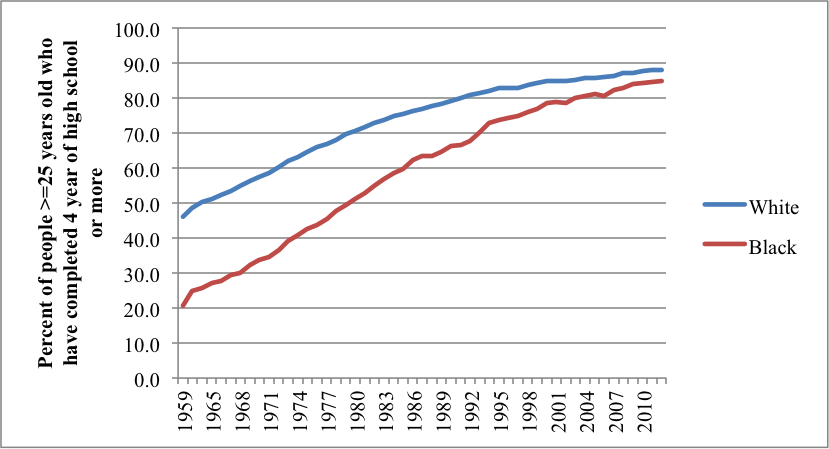
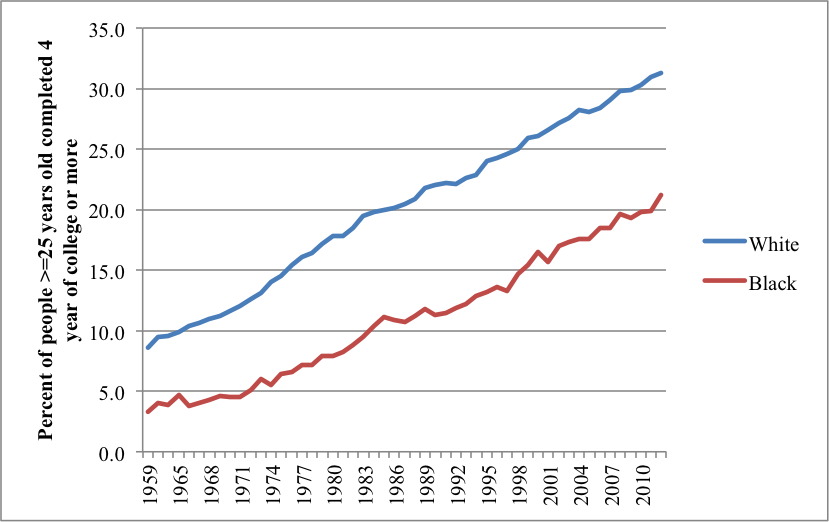
Over the past 50 years, there has been considerable progress in the educational attainments of African Americans, although they still lag behind the levels of Whites. In 1966, the high school completion rate of African Americans was just a little more than half that of White Americans. By 2012 it was almost 95 percent that of Whites. In 1966, fewer than four percent of African Americans, compared to more than ten percent of Whites, had college degrees. By 2012, the percentage of African Americans with college degrees had risen to 21.2, compared to 31.3 percent for Whites (U.S. Census, Education and Social Stratification Branch, 2013). See figures below (click to expand).

Source: U.S. Census Bureau. 1947, and 1952 to 2002 March Current Population Survey, 2003 to 2012 Annual Social and Economic Supplement to the Current Population Survey (non-institutionalized population, excluding members of the Armed Forces living in barracks); 1950 Census of Population and 1940 Census of Population (resident population).

But after declines in school segregation during the 1970s and 1980s, progress leveled off and even reversed in some areas. In 1968, 76.6 percent of African American children attended segregated schools. In 2012, 74 percent of African American children were in segregated schools, 15 percent of them in schools where less than one percent of the student body was White (Orfield, Kucsera, & Siegel-Hawley, 2012). Majority Black schools are generally characterized by lower funding, lower teacher quality, and higher drop-out rates than majority White schools (The Leadership Conference on Civil and Human Rights, 2013).

Employment and Income.

There have been significant improvements in employment opportunities for African Americans over the past half century. In 1960, only 6.7 percent of African Americans in the labor market were in professional and managerial positions, compared to 26 percent of Whites (Smith & Welch, 1977). By contrast, in 2012, 30 percent of employed African Americans were in professional and managerial positions, compared to 39 percent of employed Whites (U.S. Bureau of Labor Statistics, 2012). African American women have made especially significant gains and are now more likely than their male counterparts to occupy professional and managerial positions.

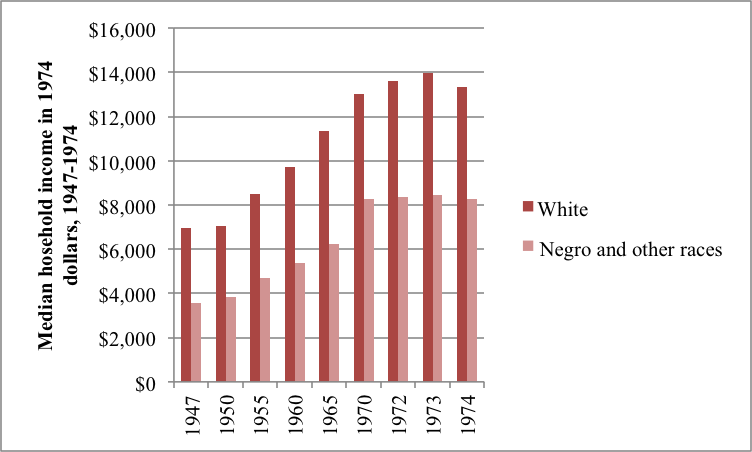
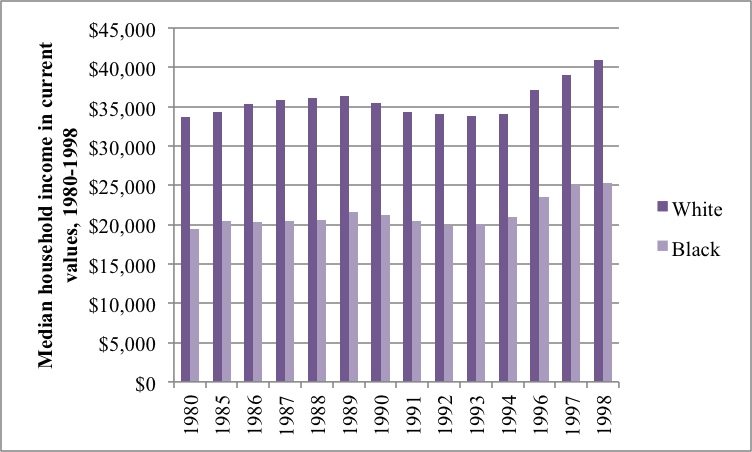
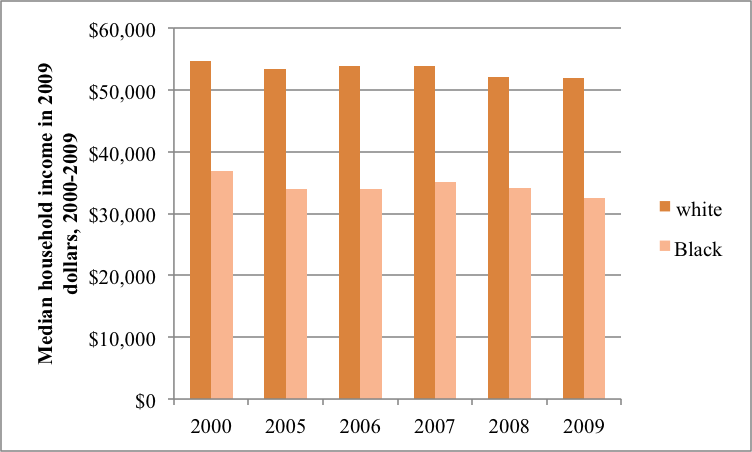
However, African Americans professionals earn significantly less than their White peers, and African American women in such occupations earn less than their male counterparts. In 2012, the median weekly earnings for African American women who worked in “management, professional, and related occupations” were $838, compared to $958 for White women, $1,021 for African American men, and $1,339 for White men (U.S. Bureau of Labor Statistics, 2012). See bottom of page for charts on median household income in historically and recently by race.

Overall, despite absolute progress in Black earnings, the income gap between Blacks and Whites remains large. In 1963, African American workers earned 55 cents for every dollar earned by Whites. By 2012, that had risen to 78.4 cents, leaving Blacks still more than 20 percent behind (U.S. Bureau of Labor Statistics, 2013).

The wealth gap is even higher, due to the lower value of homes in predominantly black communities and the much smaller access of African Americans to any accumulated wealth of parents and grandparents. The median wealth of White households is ten times as large as that of Black households.

Educational disparities may explain some of the remaining gap in pay equity. We have come some distance from the 1960s, when African Americans with a four-year college degree earned less than White men with only a high school diploma (Katz & Stern, 2006; Taylor, 1981). Today, by contrast, being college graduate counts for more than being a White man in determining earnings.

Yet as late as 2012, African American men and women still earned less than their White peers with the same level of education. For male college graduates over age 25, Whites’ weekly earnings were $1,399, compared to $1,086 for African Americans. College–graduated Black women, aged 25 years and older, had weekly earnings of $913, compared to $1,012 for White women with similar educational attainment. White men with a high school diploma earned over $150 more a week than similarly-educated African American men — $760 vs. $604 per week. In fact, a Black man with an associate’s degree earns, on average, $15 per week less than a White man with only a high-school diploma (U.S. Bureau of Labor Statistics, 2013).

Unemployment and Poverty.

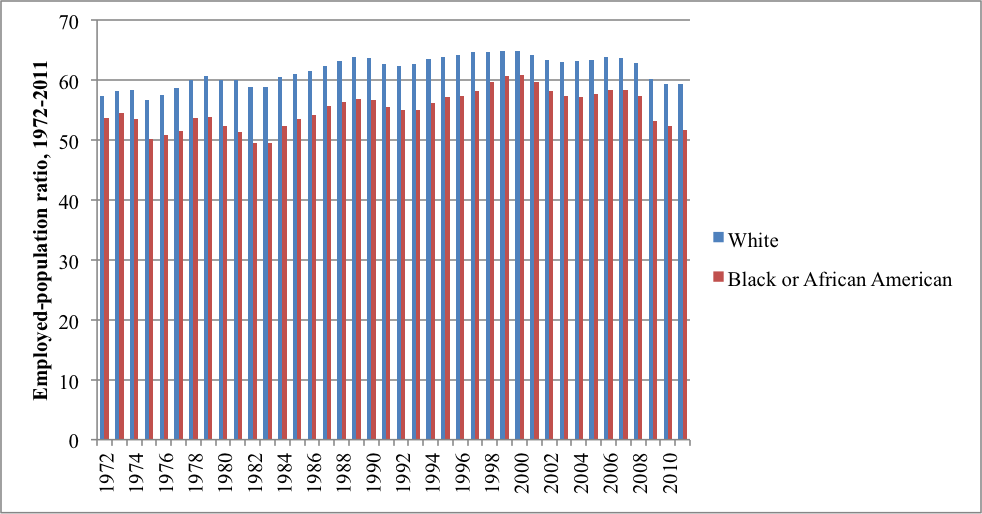
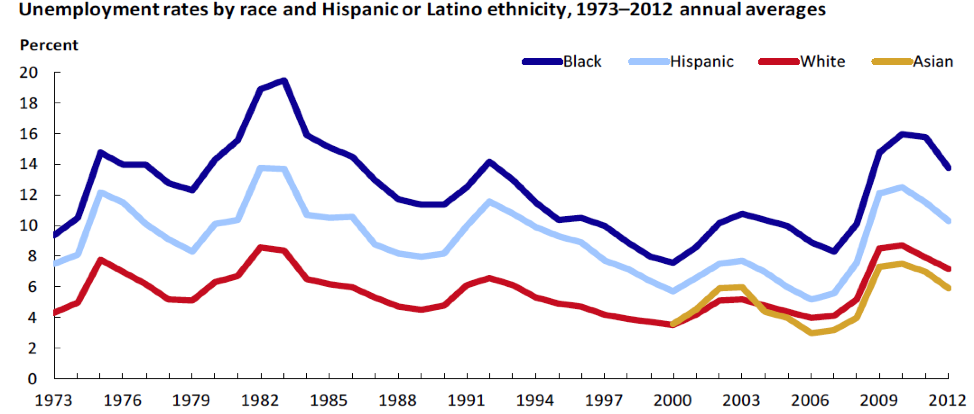
African Americans are also more likely to lose their jobs during economic downturns (see figures below; click to expand). Despite ups and downs in unemployment for all racial and ethnic groups, the Black unemployment rate has consistently been twice as high as that of Whites since the 1950s.

Source: U.S. Department of Labor, Bureau of Labor Statistics, Table B-35 & Table B-37. Data related to persons 16 years of age and over.
Source: U.S. Bureau of Labor Statistics, (2013). Labor force characteristics by race and ethnicity, 2012.
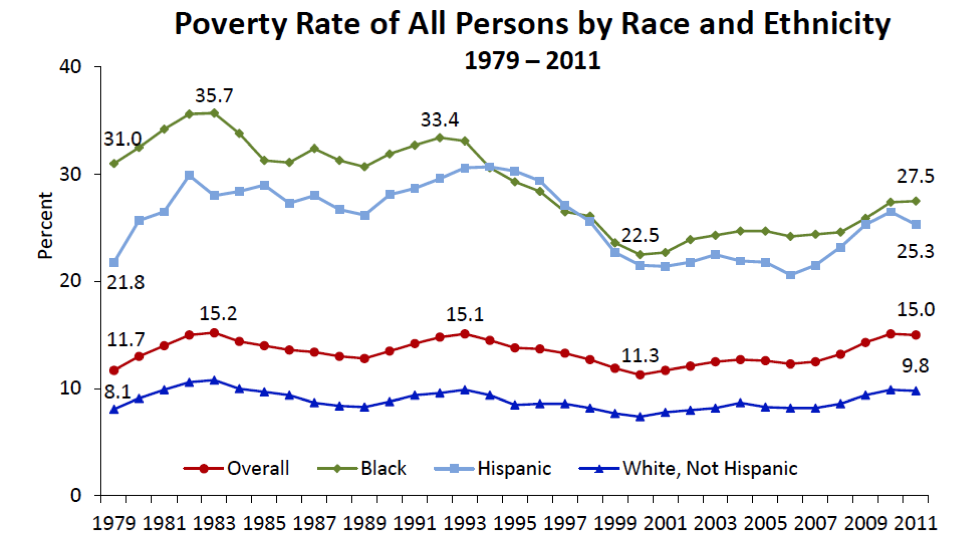
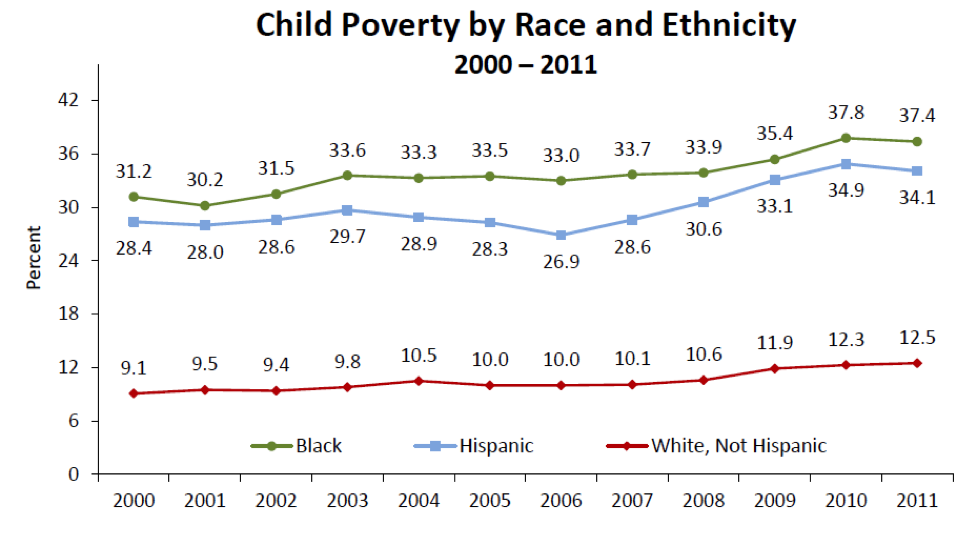
 And since 1964, the poverty rate of African Americans has consistently been morethan twice that of Whites. Worse, Blacks are far more likely to live in areas of concentrated poverty. Among Americans born between 1985 and 2000, 31 percent of Blacks, versus only one percent of Whites, live in neighborhoods where 30 percent of the residents are poor (see figures below; click to expand).
Source: U.S. Department of Health and Human Services, Office of the Assistant Secretary for Planning and Evaluation. Information on poverty and income statistics: A summary of 2012 current population survey data.

Social and Institutional Disparities.

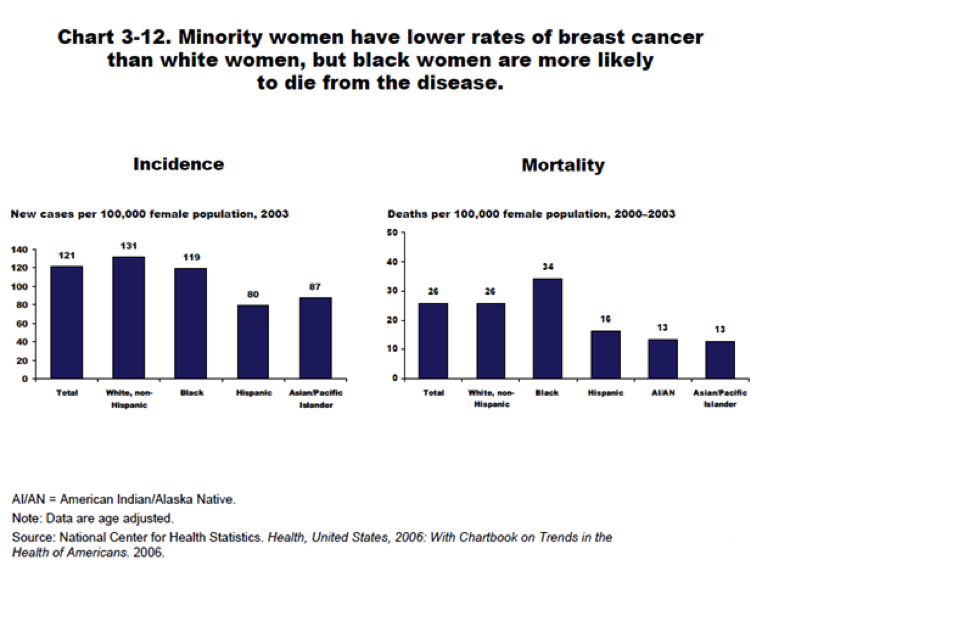
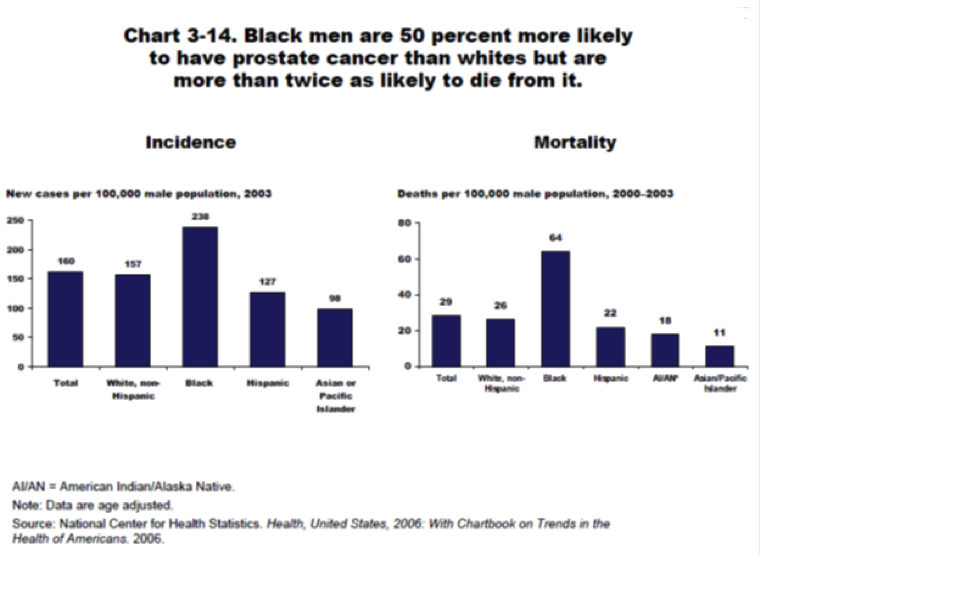
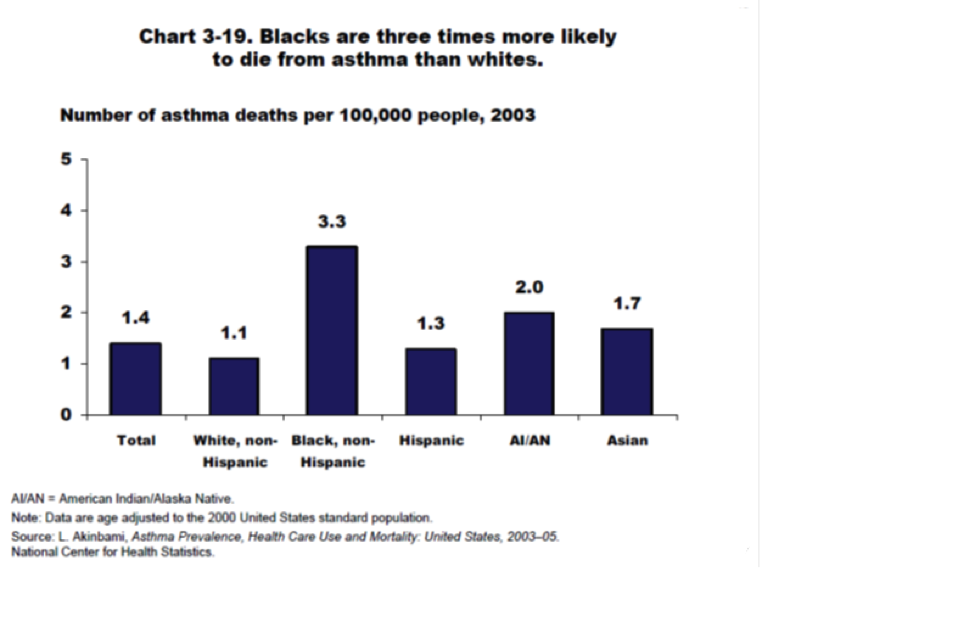
African American children are at greater risk than their White counterparts for numerous problems associated with growing up in poverty, (e.g., poor prenatal health care, malnutrition, poor quality housing, and exposure to environmental toxins). This helps explain why African Americans are disproportionately affected by chronic illnesses, such as cancer, heart disease, and diabetes, and, because of lack of access to quality health care, are more likely to die from these illnesses and diseases (Mead, Cartwright-Smith, Jones, Ramos, Woods, & Siegel, 2008). Blacks are three times as likely to die from asthma as Whites. Black women are less likely than White women to develop breast cancer, but more likely to die from it (Mead et al, 2008). And Black maternal mortality rates are three to four times higher than rates for Whites. (See end of paper for charts of racial and ethnic health disparities by race.)

While life expectancies for all Americans have greatly improved over time, African Americans continue to have a shorter life expectancy than Whites. In 2008, there was a 5.5 year gap between African American and White men, and a 3.8 year gap between African American and White women (U.S. Census, 2010). African American men have the shortest life expectancy at birth of all Americans across racial and ethnic groups (see figure below; click to expand).

Source: U.S. National Center for Health Statistics, National Vital Statistics Reports (NVSR), Deaths: Preliminary data for 2008, Vol, 59, No.2.

Incarceration.

The rate of imprisonment is one area where there has been significant deterioration for African Americans in the past half-century. Incarceration rates among African American men are three times higher than 50 years ago and the disparity between incarceration rates for African Americans and Whites has continued to grow. African American men are more likely to be arrested and receive longer sentences for nonviolent drug crimes than Whites committing similar or more serious offenses. In consequence, African Americans, who are just ten percent of the overall U.S. population, represent 35.4 percent of the prison population, with an incarceration rate more than six times higher than Whites. One in three African American men can expect to go to prison at some point in his life time, compared to one in 17 White men. (Pettit & Western, 2004).

Conclusion.

As we reflect on the state of African Americans 50 years after the passage of the Civil Rights Act, it is clear that despite the progress made in many arenas of life, African Americans are still burdened by the legacy of slavery, segregation, and discrimination. In fact, it may be that the dramatic successes of a minority of Blacks have made it harder for Americans to recognize the continuing disparities and injustices facing the remainder.

Originally posted 1/21/15

For further information, contact Velma McBride Murry, Professor and Betts Chair, Human and Organizational Development Dept., Vanderbilt University; velma.m.murry@vanderbilt.edu.

References

Centers for Disease Control and Prevention (2010). National Center for Health Statistics. U.S. Department of Health and Human Services.

Eggebeen, D. J., & Lichter, D. T. (1991). Race, family structure, and changing poverty among American children. American Sociological Review, 801-817.

Gabe, Thomas (2013). Poverty in the United States: 2012. Congressional Research Service (CRS) based on U.S. Census Bureau 2012 and 2011 American Community Survey (ACS) data.

Katz, Michael and Stern, Mark, One Nation Indivisible (2006). Russell Sage, p. 95.

King, Martin Luther; King, Coretta Scott (2008). The Words of Martin Luther King, Jr.: Second Edition. Newmarket Press. p. 95.

Lichter, D., ZHENCHAO, Q., & Crowley, M. (2006). Race and poverty: Divergent fortunes of America’s children?. Focus24(3), 8-16.

Loeber, R., Pardini, D., Homish, D.L., Wei, E.H., Crawford, A.M., Farrington, D.P., et al. (2004). The prediction of violence and homicide in young men. Journal of Consulting and Clinical Psychology, 76, 1074–1088

Mead, H., Cartwright-Smith, L., Jones, K., Ramos, C., Woods, K., & Siegel, B. (2008). Racial and ethnic disparities in US health care: A chart book. Commonwealth Fund New York.

Orfield, G., Kucsera, J., & Siegel-Hawley, G. (2012). E Pluribus… Separation: Deepening Double Segregation for More Students. Civil Rights Project/Proyecto Derechos Civiles.

Pettit, B., & Western, B. (2004). Mass imprisonment and the life course: Race and class inequality in U.S. incarceration. American Sociological Review, 69, 151-169.

Roscigno, V. J., Williams, L. M., & Bryon, R. A. (2012). Workplace racial discrimination and middle class vulnerability. American Behavioral Scientist, 56, 696-710.

Sawhill, I., Winship, S., & Grannis, K. (2012). Pathways to the middle class: Balancing personal and public responsibilities. Washington, DC: Brookings.

Smith, J. P., & Welch, F. R. (1977). African American/White Male Earnings and Employment: 1960-70. In Distribution of Economic Well-Being (pp. 233-302). NBER.

Taylor, D. E. (1981). Education, on-the-job training, and the African American-white earnings gap. Monthly Lab. Rev.104, 28.

The Leadership Conference on Civil and Human Rights (2013). Still segregated: How race and poverty stymie the right to education. http://civilrightsdocs.info/pdf/reports/Still_Segregated-Shadow_Report.pdf.

Washington, James M. (1991). A Testament of Hope: The Essential Writings and Speeches of Martin Luther King, Jr. HarperCollins. Pp. 365–67.

Wolff, Edward N. (2010). Recent trends in household wealth in the United States: Rising debt and the middle-class squeeze-An update to 2007, working paper, Levy Economics Institute, No. 589

U.S.Census of Bureau, Education and Social Stratification Branch, (2013). CPS data on educational attainment: http://www.census.gov/hhes/socdemo/education/data/cps/historical/index.html.

U.S. Bureau of the Census (1974, 1994, 1996, 1997, 1998). Current Population Reports: Income, Poverty, and valuation of Noncash Benefits.

U.S. Bureau of the Census, (2012). Statistical Abstract of the United States, 2012. http://www.census.gov/compendia/statab/2012/tables/12s0691.pdf.

U.S. Department of Health & Human Services, (2012). ASPE issue brief: Information on poverty and income statistics: A summary of 2012 current population survey data. http://aspe.hhs.gov/hsp/12/povertyandincomeest/ib.shtml.

U.S. National Center for Health Statistics, (2010). National Vital Statistics Reports (NVSR), Deaths: Preliminary data for 2008, Vol, 59, No.2.

U.S. Bureau of Labor Statistics, (2013). Labor force characteristics by race and ethnicity, 2012. http://www.bls.gov/cps/cpsrace2012.pdf.

Additional Charts

Source: Historical Statistics of Black America: Agriculture to Labor & Employment. Table 987: Median Family Income 1950-1973. Original source: "Median Income of Families: 1950 to 1974," Current Population Reports, Special Studies, Series P-23, No. 54. The Social and Economic Status of the Black Population in the United States, 1974, 1975, p. 25. Primary source: U.S. Department of Commerce, Social and Economic Statistics Administration Bureau of the Census.
Source: Historical Statistics of Black America: Agriculture to Labor & Employment. Table 987: Median Family Income 1950-1973. Original source: “Median Income of Families: 1950 to 1974,” Current Population Reports, Special Studies, Series P-23, No. 54. The Social and Economic Status of the Black Population in the United States, 1974, 1975, p. 25. Primary source: U.S. Department of Commerce, Social and Economic Statistics Administration Bureau of the Census.
Source: Black Americans: A Statistical Sourcebook, 2000 Edition. Table 7.01: Money income of Households, 1980-1998. Original source: U.S. Bureau of the Census, Current Population Reports: Income, Poverty, and valuation of Noncash Benefits: 1994, Series P-60, #189, pp. B-2-Table B-1. U.S. Bureau of the Census, Current Population Reports: Money Income in the United States: 1996
Source: U.S. Census Bureau, Statistical Abstract of the United States, 2012: http://www.census.gov/compendia/statab/2012/tables/12s0691.pdf.
Source: Following charts are drawn from this resource: Mead, Holly, Cartwright-Smith, Lara, Jones, Karen, Ramos, Christal, Woods, Kristy, & Siegel, Bruce (2008). Racial and ethnic disparities in U.S. health care: A chartbook. The Common Wealth Fund.

I attended my first healthy marriage education class with Christine and Bill, a white middle-class married couple studying to become marriage educators for their church. The first relationship skill we learned during our Mastering the Mysteries of Love training was the “showing understanding” skill focused on taking a partner’s perspective. Standing back-to-back, our instructor led us through an exercise during which Christine and Bill alternated describing what they saw in the classroom. Christine described the classroom white board. Bill described the other participants, tables, and chairs. “Is Christine wrong,” the instructor asked Bill, “because she sees the world differently than you? Now turn around. What do you see, Bill?” “I see what Christine saw,” he eagerly replied. This exercise was intended to teach us that learning to see things from our partner’s perspective was an important relationship skill that could revolutionize our love lives and improve our chances of having a happy, lifelong marriage. Bill later reported that developing this skill helped him understand Christine better and that he was falling in love with her all over again after decades of marriage.

Two years later, I observed another healthy marriage class, this one for low-income, unmarried parents. There that day were Cody and Mindy, both 18 and white, who were struggling to make ends meet while raising their eight-month-old daughter and living in a studio apartment on money Cody made through his minimum-wage construction job. The communication lesson taught in this class—daily check-ins with one’s partner to understand their feelings and concerns—was similar to the one I learned in that first class with Christine and Bill. However, when Cody, Mindy, and I returned to class the following week, Cody shared that he found it difficult to practice what they’d learned. He and Mindy shared the studio apartment with several other people, making it hard to speak privately, and often fought about how they would spend their last few dollars—bus money or formula for the baby—until Cody’s next payday.

Focused on similar lessons about love in the context of widely varying social and economic circumstances, both classes had as their major goal the promotion of healthy marriage. Government funding for classes like these was first approved by Congress in 1996 when it overhauled U.S. welfare policy to promote work, marriage, and responsible fatherhood for families living in poverty. This led to the creation of the federal Healthy Marriage Initiative—often referred to as marriage promotion policy—which has spent almost $1 billion since 2002 to fund hundreds of relationship and marriage education programs across the country like the ones I attended with Christine, Bill, Cody, and Mindy. For three years, I observed over 500 hours of healthy marriage classes, analyzed 20 government-approved marriage education curricula, interviewed 15 staff who ran healthy marriage programs, and interviewed 45 low-income parents who took classes to answer the following questions: What does the implementation of healthy marriage policy reveal about political understandings of how romantic experiences, relationship behaviors, and marital choices are primary mechanisms of inequality? And, ultimately, what are the social and policy implications of healthy marriage education, especially for families living—and loving—in poverty?

My new book, Proposing Prosperity: Marriage Education Policy and Inequality in America, takes the reader inside the marriage education classroom to show how healthy marriage policy promotes the idea that preventing poverty depends on individuals’ abilities to learn about what I call skilled love. This is a romantic paradigm that assumes individuals can learn to love in line with long-term marital commitment by developing rational romantic values, emotional competencies, and interpersonal habits. By studying the on-the-ground implementation of healthy marriage policy, including training as a marriage educator for 18 government-approved curricula, I found that healthy marriage policy promotes skilled love as a strategy for preventing risky and financially costly relationship choices and, consequently, as the essential link between marriage and financial stability. Central to this message is the assumption that upward economic mobility is teachable and that romantic competence and well-informed intimate choices can help disadvantaged couples, such as Cody and Mindy, overcome financial constraints.

Healthy marriage policy assumes that developing relationship skills creates better marriages, which in turn lead to financial prosperity. However, the low-income couples I interviewed believed that marriage represents the culmination of prosperity, not a means to attain it. In the book, I describe how cultural and economic changes in marriage throughout the twentieth century have created a middle-class marriage culture in which low-income couples are less likely to marry for both ideological and financial reasons. Couples told me they could neither afford nor prioritize marriage until they were more financially stable. Their relationship stories illustrate how financial challenges lead to curtailed commitments, especially when marriage between two economically unstable partners seems like a financial risk. Marriage educators responded to this by deliberately avoiding talk of marriage and instead emphasizing committed co-parenting as the primary resource parents have to support their children.

Though parents frequently challenged instructors’ claims that marriage could directly help them, their children, and their finances, parents did find the classes useful. While low-income couples’ economic challenges made it hard to practice the skills, participants experienced the classes as a rare opportunity to communicate free of the material constraints that shaped their daily lives and romantic relationships. Hearing other low-income couples talk about their challenges with love and money normalized parents’ intimate struggles and allowed them to better understand how relationship conflict and unfulfilled hopes for marriage are shaped by poverty. This finding suggests that publicly sponsored relationship education could be a valuable social service in a highly unequal society where stable, happy marriages are increasingly becoming a privilege of the most advantaged couples.

Yet, low-income parents’ experiences with healthy marriage classes point to how relationship policies would likely be more useful if they focused more on how economic stressors take an emotional toll on romantic relationships and less on promoting the dubious message that marriage directly benefits poor families. I also show how the focus of healthy marriage programs on relationship skills obscures the insidious effects of institutionalized inequalities—specifically those related to class, gender, race, and sexual orientation—on romantic and economic opportunity. “Skills” were often an ideological cover for normative understandings of intimate life that privilege the two-parent, heterosexually married family. Marriage educators presented a selective interpretation of research that deceptively characterizes the social and economic benefits of marriage as a unidirectional causal relationship without accounting for how selection and discrimination shape the connection between marriage and economic prosperity.

What can policymakers learn from the experiences of low-income couples who took healthy marriage classes? Broader, sociologically informed relationship policies would recognize the benefits and costs of marriage and teach under what specific social and economic conditions marriage is typically beneficial. Any policy with the goal of promoting family stability and equality must contend with the intimate inequalities that lead to curtailed commitments. Programs that link economic prosperity with marriage will likely only reinforce couples’ tendencies to make marital decisions based on middle-class ideas of marriageability. The most effective policy approach to strengthening relationships and families will not be grounded in expectations of individual self-sufficiency and strategies—or skills—for interpersonal negotiation and understanding. Instead, it will reflect how love and commitment thrive most within the context of social and economic opportunity and equal recognition and support for all families as they really are, married and unmarried alike.

Originally posted 12/27/16

Jennifer M. Randles is author of Proposing Prosperity: Marriage Education Policy and Inequality in America (Columbia University Press, Publication Date: December 27, 2016). She is an assistant professor in the Department of Sociology at California State University, Fresno. Her research explores how inequalities affect American family life and how policies address family-formation trends.

photo credit: Taco Hoekwater via Wikimedia Commons

This month in the media, Council on Contemporary Families (CCF) scholars made some good points about how social context contributes to the diversity of families and relationships in the United States and abroad.

TIME: Marriage rate decline over time yet strong relationships increase

The University of Texas Daily Beacon covered a popular issue – Millennial sex and dating. Media often latches on to (decontextualized) statistics about lower marriage rates of millennials, tsk-tsk-ing all the way. But the UT Daily Beacon pointed out some less-talked-about generational differences. More millennials are “sexually inactive” at age twenty, for instance, than those born in the 1980s. And, even though millennials might have lower marriage rates, there is reason to believe that they have closer relationships than those of previous generations with higher marriage rates. Stephanie Coontz suggests (as she has elsewhere) that this is in part due to rising gender equality that has empowered many women to resist coercive relationships.

PLACE: Around the world and around the U.S. great varieties and change in divorce

The BBC recently discussed the current state of “Divorce in the Islamic World,” where divorce activists are pushing for reform because of the inherent gender inequality in many divorce laws. To unfamiliar listeners, thinking about divorce in the Islamic world may be exotic. But Stephanie Coontz shows that there has been variation in divorce practices – and their impact on family life – by place within the United States, too. States adopted no-fault divorce individually starting during the 1970s, and up until 2010 in New York. This makes it possible to determine that despite initially high divorce rates following the adoption of no-fault divorce, divorce rates tend to decrease in the long-term. Fewer instances of domestic violence and suicides by wives are also related to the adoption of no-fault divorce. Coontz suggests that many of the problems people associate with divorce are not necessarily caused by divorce as much as caused by the stigmatization of divorce.

RACE & CLASS: Not family structure

NPR further illustrates the way that immutable contextual factors can impact family outcomes: “Black and Latino Two-Parent Families Have Half the Wealth of White Single Parents.” The report discussed on NPR references a CCF brief report by Philip Cohen, Heidi Hartmann, Chandra Childers, and Jeffrey Hayes. In “Moynihan’s Half Century: Have We Gone to Hell in a Handbasket?” Cohen, Hartmann, Childers, and Hayes discussed how, since 1965, anti-poverty efforts have mistakenly focused on changing individual behaviors, like getting black single mothers to get married. The much larger source of much economic inequality, find these studies, is racial inequality. Poor families often have lower rates or marriage because of economic inequality. Coontz, in her BBC interview, cautions against using blanket statements that almost half of married couples divorce. Those who are highly educated and who put off marriage – who tend to be wealthier – have significantly lower divorce rates.

The take-away? The theme is family diversity and family change. The evidence supports it. Ignore at our peril. Policy that draws on the “mythical” traditional family is not going to work if the goal is to reduce inequality in all these elements of family: generation, place, race, and class (and many others, too!)

Braxton Jones is a graduate student in sociology at the University of New Hampshire, and serves as a CCF Graduate Research and Public Affairs Scholar.