
inequality

This is part one of a three-part series.

via Pixabay
via Pixabay. Parent = Helicopter?

As parents of school-age children transition out of summer and into fall, we add to our daily list of things to think about. Making friends. Having the right outfit. Knowing the latest terminology for inappropriate recess conversations. I don’t know about you, but I think this list of concerns goes for my kid, too.

 

via Pixabay
via Pixabay. Parent = Lawnmower?

But is there such a thing as too much when it comes to parenting, especially as we ponder our kids heading back to school? More importantly, why do we spend time assessing parenting as if it were a lesson in prepositions? As in, OVERparenting. OVERprotective. OVERdoing it. It’s easy to find pieces written that contain judgment towards parents who hover, micromanage, or insert themselves loudly and proudly into children’s spaces. There are also entire organizations and websites devoted to asking parents to self-assess and read articles by experts. We live in a world where we scrutinize our decisions as parents, and we have no trouble finding resources that can help us with what I like to call The Parenting Scrutiny Project. This goes for parents who are judged to do too little, and those who are judged to do too much.

via Pixabay
via Pixabay. Parent = Curler? (See Scandinavian sports for meaning.)

I must admit that there is good that can come from this. After all, I descend from a certified parent educator whose ideas are brilliant and whose love for all children and their parents is immeasurable, and I would never advocate neglecting children and their needs. To avoid self-awareness and love as a parent doesn’t feel right. I’m probably a better parent if I think about whether listening to my son is a better choice than ignoring him when he comes home from a science class that made him squeamish because they showed a real sheep brain. But as a sociologist, I would assert that even labeling ignoring a child as bad, as well as the best way to demonstrate self-awareness and love, are themselves socially constructed.

This scrutiny would occur in our own heads naturally, I suppose, but the proliferation of news stories, typologies, and listicles about parenting sure does make this more likely. The scrutiny occurs both inwardly and outwardly, perpetuating a simultaneously individualistic and other-centered ethos. This can be deemed good (let’s help each other build a sharing community of parents and incorporate those ideals into our own families), or bad (the world revolves around me and my stressful neoliberal parenting project, and others are terrible at it). I recognize that it’s a risky road to traverse by offering yet another writing about parenting. But the twist here is that I am offering some words about why we keep seeing so much about parenting, what metaphors we use to describe it, and why our national context may matter for both.

Overprotective Parenting Metaphors: Helicopters, Curlers, and Lawnmowers

There is no shortage of metaphors in international academic and popular venues for overprotective parenting, which I like to refer to as Parentus Overprotectus. Images of tigers, snow plows, blackhawk helicopters, curling brooms, and lawnmowers are introduced, debated, compared, and replaced, seemingly continuously. Objects and animals and inclement weather are anthropomorphized into anxious caretakers of little ones with varying scary traits, as if naming a style of parenting just right might help to prevent the next generation from hitting their heads or using their heads without any help from a grown-up.

But the proliferation of overprotective parenting metaphors itself may fuel the parental anxiety that persists.

Search online and you will easily encounter columns about the pitfalls of overprotective parenting, occasionally with a new term introduced to give parents a broader vocabulary to refer to their own anxiety. Just as easy to come across are stories about how parents from other countries are happier because they do not overparent or overprotect; rather, they value children’s independence and exposure to adult themes and emotions so that their children will be better off. We see reports about the lessened physical activity of children because their parents are afraid to let them play outside, which ultimately leads to a “protection paradox” – where the protection of kids from harm diminishes children’s skills to combat future harm. We also see news stories about parents who are criticized for not hovering enough because they allow their children to play alone on playgrounds. I’m fascinated by the endless stream of research and commentary on this phenomenon and the metaphors that are introduced within it.

Protection of children by adults is culturally constructed. When I return to the U.S. from research trips to Scandinavia I tell stories of babies sleeping in baby carriages outside in the cold winter air to colleagues whose jaws drop just as they remember that they should probably not drop their jaws in polite conversation. “How can that be safe? They are not protected from the elements! Let alone strangers walking by!” they argue. To this, I respond with my usual discussion of how the Scandinavian good childhood is defined by early childhood education scholar Judith Wagner as one where children can be independent, where there is a lot of social trust, where democracy is ensured when children are allowed to be on their own, and where brisk air on cheeks is seen as good for the skin and the soul, starting at birth. The variations in how parents parent across cultures, and in what is defined as good and bad, and over and under, is what I mean by cultural construction. But even scholars and friends who already accept this variation sometimes find themselves with dropped jaws.

Overprotective parenting metaphors exist in different forms in different geographic locations. And the metaphors seem to be multiplying. In one U.S. source that has a chapter discussing “Hyper-Parenting,” I counted no fewer than twelve (twelve!) types of parents who are overprotective, overinvolved, excessive. This leads me to two questions, which are the subject of the next two posts: first, does the process of constructing a metaphor for overprotective parenting tell us about the culture, time period, and discipline in which it was created? And second, why are we seeing a proliferation of metaphors used to describe overprotective parenting across cultures?

Stay tuned to the next installment, where I consider the overprotective parenting metaphors from three places where I have spent lots of time living, researching, teaching, and parenting: helicopter parent (in the U.S.), curling parent (in Denmark), and lawnmower parent (in England).

Michelle Janning is Professor of Sociology at Whitman College in Walla Walla, Washington, and serves as Co-Chair of the Council on Contemporary Families. She has taught and served as a pedagogical consultant for the Sociology and Child Development and Diversity programs at the Danish Institute for Study Abroad. She also let her son ride public transportation in Copenhagen by himself when he was eight years old. More about her can be found at www.michellejanning.com.
 

When assigning blame for our nation’s persistent poverty problem, many policymakers tend to focus on underlying demographics or behavior of the poor—factors like racial background or the prevalence of single parent households— instead of the stark economic reality with which poorest Americans have had to contend. But, the fact

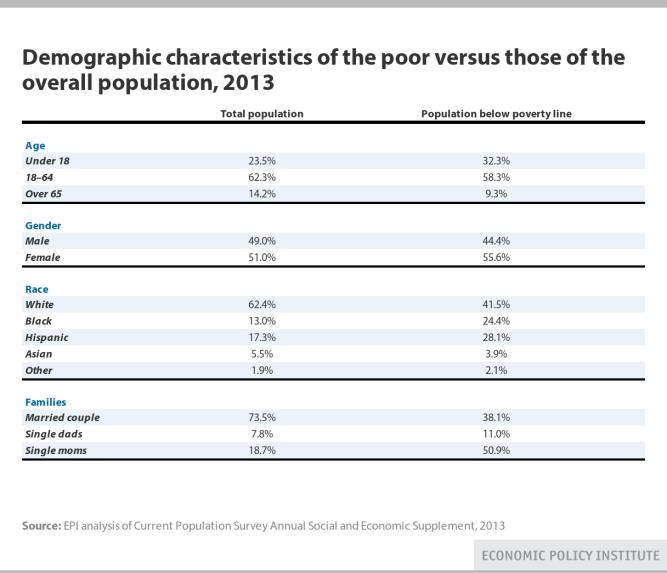
women, people of color, and single mothers do experience disproportionately higher levels of poverty - but that isn't the cause. Via Economic Policy Institute.
women, people of color, and single mothers do experience disproportionately higher levels of poverty – but that isn’t the cause. Via Economic Policy Institute.

is, growing inequality is the primary reason the poverty rate has remained elevated over the last several decades.

It is true that women, people of color, and single mothers do experience disproportionately higher levels of poverty, as shown in the table below, which compares the share of the population in poverty by age, gender, race, and family composition with those groups’ share of the total population.

At first glance, it would seem that family structure and racial identity are significant determinants of changes in poverty, as these groups account for a disproportionately high number of people in poverty. However, over the last three-and-a-half decades, it was not growth in the population of single mothers or of certain racial groups that drove poverty. When these demographic factors are compared with the effect of income inequality on poverty levels since 1979, inequality dwarfs them all.

This is illustrated in the figure below, which examines a set of factors commonly associated with changes in poverty over the past three-and-a-half decades: changes in the U.S. population’s racial composition, education levels, and family structure, as well as overall income growth and income inequality. The figure shows how much (in percentage points) each factor contributed to the change in the poverty rate from 1979 to 2013.

Inequality 4 x more influential over growing poverty than other sources. From Economic Policy Institute

Since 1979, increasing inequality has been the largest poverty-boosting factor, outweighing racial identity and family structure and completely eclipsing the positive effects of overall economic growth and educational attainment in driving down the poverty rate. Despite our growing economy and the fact that poor workers are now more educated than ever, rising inequality has worked to keep low-income people in poverty. This increase in inequality was driven by stagnating wages for low- and middle-income households (for example, 10th percentile real wages were actually lower in 2013 than they were in 1979).

Our research looks at how this lack of wage growth for low- and middle-income families fuels poverty. We explore what could have happened to poverty if wages had actually grown over the last several decades and if the poor and the middle class had shared more widely in the gains made by a growing economy. We find that adopting policies to promote full employment and significant wage growth could bring down poverty as much as 4.2 percentage points—bringing 11.2 million people out of poverty.

It’s not fair to say the poor aren’t holding up their end of the social contract when almost two-thirds of employable poor people work and over 40 percent work full time, and their incomes have become more dependent upon wages over time. The truth is that the economy the poor are working in –an economy that has grown more unequal over the last several decades because of intentional policy choices—has made it harder and harder for them to get by.

Instead of focusing on the characteristics of the poor when assigning blame for poverty, we should examine the intentional policy choices we have made that led to such an unequal economy. We should promote new policy choices that help reduce inequality and alleviate poverty. Although the safety net has made significant progress in decreasing poverty, it needs to be complemented by a better labor market for low-wage workers. Without hourly wage gains, the tax-and-transfer system needs to work harder simply to keep poverty rates from increasing. Going forward, we should strengthen the safety net and focus on policy solutions that will spur wage growth—such as raising the minimum wage, targeting full employment, strengthening worker’s bargaining power, and updating labor standards—in order to make our economy work for all.

Elise Gould is a senior economist at the Economic Policy Institute, a non-profit think tank in Washington, D.C. Her research areas include wages, poverty, economic mobility, and health care. She is a co-author of The State of Working America, 12th Edition. Twitter: @eliselgould

 Alyssa Davis joined EPI in 2013 as the Bernard and Audre Rapoport Fellow. She assists EPI’s researchers in their ongoing analysis of the labor force, labor standards, and other aspects of the economy. She holds a B.A. in Plan II and Sociology from the University of Texas at Austin. Twitter: @alyssalynn7

Despite substantial increases in married mothers’ employment and the expressed desire of the majority of women and men to share employment and caregiving responsibilities, gender remains the most influential determinant of who does the housework and child care today. Many observers have attributed the seeming unwillingness of men to increase their time in housework and child care as the linchpin of gender inequality, a manifestation of men’s patriarchal power to prioritize activities that provide economic rewards, such as paid work, or enjoyment, such as leisure (Goode 1992; Jackman 1994).

One strain of feminist and academic scholarship holds that men feel no need to do more child care or housework because they reap the benefits of marriage and fatherhood (e.g. marriage and fatherhood wage premiums, living in a clean, well-run household, and children’s performance of filial duties) without having to spend time producing them — cooking, cleaning, or taking on the everyday, physical care of children. Rather, they can expect wives and mothers to shoulder the burden of feeding and caring for children and families, regardless of women’s other time demands. Such an analysis builds on the work of Jessie Bernard, an influential feminist sociologist, who argued that marriage is a gendered institution that privileges men and disadvantages women.

One key assumption of this argument has been that men do not want to become involved with children except when they can have fun with them. But this argument does not hold up when we analyze both the quantitative time diary data on mothers’ and fathers’ child care time and the qualitative literature on what fathers want. Instead, careful examination reveals a more complex story about the interplay between gender, marriage, parenthood, and class-differentiated patterns of childrearing that are more about ensuring upward mobility among children than about gender oppression. more...

For many years, family researchers and working mothers have talked about “the second shift” – the extra work that employed women put in at home after their paid work day ends. And for just as long, feminist assessments of marriage have been shaped by earlier findings that when people married, the women began doing more household work, while the men started doing less.

Some research still seems to support this. Women continue to do a disproportionate amount of housework in families, despite an increase in men’s housework since the 1960s. Furthermore, in the late 1990s and early 2000s, the increase in men’s housework slowed or even declined, as did several others measures of progress toward gender equity. And on average, notes Liana Sayer, director of the Maryland Time Use Laboratory, women get 30 minutes less leisure time per day than men. That gap increases to an hour when researchers adjust for employment, education, family status, and age. more...

Recent months have seen a dramatic increase in media and government attention to gender-based violence, particularly sexual assault. Unfortunately, that attention has largely focused on a relatively elite group of young women – those enrolled in 4-year colleges. Much of the discussion has focused on the prevalence of a so-called “rape culture” in such settings, characterized by widespread tolerance of sexual violence. This essay presents evidence that sexualized violence and tolerance of such violence are actually more prevalent among youths who are not enrolled in college. more...

Recent scandals about sexual assaults on college campuses have provoked vehement debates about the scope of the problem. According to the White House task force formed to investigate the issue, 20 percent of undergraduate women — 1 in 5 — are sexually assaulted while in college. But some observers claim the problem has been blown way out of proportion. For example, Christina Hoff Sommers argued in a May 2014 article in Time magazine that this number is derived from biased samples and poorly-designed survey questions. Instead, she claims, only one-in-forty college women is a victim of rape or sexual assault.

Disagreement is not confined to political debate. In a 2011 report, the Bureau of Justice Statistics acknowledged that competing estimates of sexual violence have existed for two decades without ever being definitively resolved. In this brief we evaluate existing knowledge about the incidence and prevalence of sexual victimization of women attending American colleges and universities. We follow the Bureau of Justice Statistics definition of rape as a form of sexual assault that includes forced sexual intercourse, whether by physical or psychological coercion, involving penetration by the offender(s). We include in our definition of rape any act of sexual intercourse performed on an individual who is incapacitated as a result of being comatose, drugged, or asleep. To avoid ambiguity, we do not include sexual coercion or unwanted sexual contact such as grabbing or fondling—although the latter also meets the Bureau of Justice Statistics definition of sexual assault. Comparing multiple public health surveys—including nationally representative population surveys—we find it likely that between 7 and 10 percent of women experience forcible rape in college, and that somewhere between 14 and 26 percent experience sexual assault. more...

Our Youngest Learners: Who Are They and Where Are They Learning?

Every year since 1971, the National Association for the Education of Young Children (NAEYC) has sponsored a weeklong celebration of young children, their teachers, and their families (Week of the Young Child; April 12-18, 2015). This year’s theme is Celebrating Our Youngest Learners.

1971 was a year that seemed to promise a giant leap forward for young learners. The Comprehensive Child Development Act (CCDA), an amendment to the Economic Opportunity Act of 1964 (EOA) Reauthorization, would have provided every American family access to developmentally-oriented child care on a sliding-fee-scale. In September the bill was debated and passed by both the Senate and the House, and on December 2 a final version was adopted by both houses, to be sent to then-President Nixon. But on December 9 President Nixon vetoed the EOA Reauthorization and along with it the CCDA, declaring that the government would not sponsor “communal child-rearing.”

Despite the continued increase in maternal employment and decades of research showing that quality child care benefits children, families, and employers, the US has made almost no progress since the defeat of the CCDA in 1971. U.S. child care continues to falter because its policy goals are not aligned with the needs of contemporary families. One part of the system provides high quality, no-cost early education to children from low income families. The other part functions to support parental employment and is far less well-regulated.

Either way, finding affordable, convenient, and high quality child care that covers parent work schedules and meets children’s developmental needs is a real challenge for most families. Early education programs typically run for only part of the day. The cost of full-time child care rivals that of college tuition in most states. And aside from the federal standards for Head Start programs, regulation of safety, health, and quality varies widely from state-to-state.

Today’s Youngest Learners: What Distinguishes Them and Their Families?

more...

A report and commentary prepared for the Council on Contemporary Families.

A set of tables released by the U.S. Census this month provides new evidence of how much the structure, composition, and life-course of American families have changed over the past 55 years. Poverty figures in the same report show that having two parents may help in keeping children out of poverty, but by no means guarantee it. And other research shows that the relationship between income and family structure goes both ways: People who are well above the poverty line are more likely to get and stay married.

In 1960, according to Census figures from that year, nearly 90 percent American children lived in two-parent families, with only 8 percent in mother-only families. A miniscule 1 percent resided in father-only families, and 3 percent lived either with grandparents, other relatives, or in other arrangements (Census, 1960).

By 2014, according to figures newly released by the U.S. Census Bureau (CPS ASEC, 2015), almost a quarter of American children (24 percent) lived in a mother-only household, a 300 percent increase since 1960. Four percent lived in a father-only household, still a small percentage but a four-fold increase since 1960. Another 4 percent were living either with grandparents or in other arrangements. Just 68 percent of American children were living in two-parent families. more...

It is time to quit viewing motherhood as incompatible with employment.

In 2013, hedge fund billionaire Paul Tudor Jones set off a controversy when he remarked that “you will never see as many great women investors or traders as men.” In his experience, Jones claimed, a woman did fine until she had a child. But “as soon as that baby’s lips touched that girl’s (sic) bosom, forget it….”

By virtually every measure, we are closer to gender equality today than we were fifty years ago—with one very big exception. As Joya Misra notes, the majority of the gender gap in wages is now the result of the lower earnings of mothers. This once led Denise Venable of the National Center for Policy Analysis to claim: “When women behave as men do [by not having children], the wage gap between them is small.” But mothers not only earn less than childless women. They earn less than fathers. When women “behave as men do” and have children, the wage gap between fathers and mothers remains large. more...

How does growing economic inequality affect traditional patterns of gender inequality?

It used to be that the most economically successful women earned no more than the typical man, even when they had more education and held more highly skilled jobs. In 1970, the average woman in the top of the women’s distribution (between the 85th and 95th percentiles) made less than the average man who fell in the middle of the men’s distribution (between the 45th and 55th percentiles). The average female college graduate also earned less than the average male high school graduate.

But gender is no longer so predictive of earnings. Being at the top now outweighs being a woman. In 2010, high earning women made more than 1.5 times as much as the typical man. more...