inequality

jrandles-proposing-prosperity-book-coverI attended my first healthy marriage education class with Christine and Bill, a white middle-class married couple studying to become marriage educators for their church. The first relationship skill we learned during our Mastering the Mysteries of Love training was the “showing understanding” skill focused on taking a partner’s perspective. Standing back-to-back, our instructor led us through an exercise during which Christine and Bill alternated describing what they saw in the classroom. Christine described the classroom white board. Bill described the other participants, tables, and chairs. “Is Christine wrong,” the instructor asked Bill, “because she sees the world differently than you? Now turn around. What do you see, Bill?” “I see what Christine saw,” he eagerly replied. This exercise was intended to teach us that learning to see things from our partner’s perspective was an important relationship skill that could revolutionize our love lives and improve our chances of having a happy, lifelong marriage. Bill later reported that developing this skill helped him understand Christine better and that he was falling in love with her all over again after decades of marriage.

Two years later, I observed another healthy marriage class, this one for low-income, unmarried parents. There that day were Cody and Mindy, both 18 and white, who were struggling to make ends meet while raising their eight-month-old daughter and living in a studio apartment on money Cody made through his minimum-wage construction job. The communication lesson taught in this class—daily check-ins with one’s partner to understand their feelings and concerns—was similar to the one I learned in that first class with Christine and Bill. However, when Cody, Mindy, and I returned to class the following week, Cody shared that he found it difficult to practice what they’d learned. He and Mindy shared the studio apartment with several other people, making it hard to speak privately, and often fought about how they would spend their last few dollars—bus money or formula for the baby—until Cody’s next payday.

Focused on similar lessons about love in the context of widely varying social and economic circumstances, both classes had as their major goal the promotion of healthy marriage. Government funding for classes like these was first approved by Congress in 1996 when it overhauled U.S. welfare policy to promote work, marriage, and responsible fatherhood for families living in poverty. This led to the creation of the federal Healthy Marriage Initiative—often referred to as marriage promotion policy—which has spent almost $1 billion since 2002 to fund hundreds of relationship and marriage education programs across the country like the ones I attended with Christine, Bill, Cody, and Mindy. For three years, I observed over 500 hours of healthy marriage classes, analyzed 20 government-approved marriage education curricula, interviewed 15 staff who ran healthy marriage programs, and interviewed 45 low-income parents who took classes to answer the following questions: What does the implementation of healthy marriage policy reveal about political understandings of how romantic experiences, relationship behaviors, and marital choices are primary mechanisms of inequality? And, ultimately, what are the social and policy implications of healthy marriage education, especially for families living—and loving—in poverty?

My new book, Proposing Prosperity: Marriage Education Policy and Inequality in America, takes the reader inside the marriage education classroom to show how healthy marriage policy promotes the idea that preventing poverty depends on individuals’ abilities to learn about what I call skilled love. This is a romantic paradigm that assumes individuals can learn to love in line with long-term marital commitment by developing rational romantic values, emotional competencies, and interpersonal habits. By studying the on-the-ground implementation of healthy marriage policy, including training as a marriage educator for 18 government-approved curricula, I found that healthy marriage policy promotes skilled love as a strategy for preventing risky and financially costly relationship choices and, consequently, as the essential link between marriage and financial stability. Central to this message is the assumption that upward economic mobility is teachable and that romantic competence and well-informed intimate choices can help disadvantaged couples, such as Cody and Mindy, overcome financial constraints.

Healthy marriage policy assumes that developing relationship skills creates better marriages, which in turn lead to financial prosperity. However, the low-income couples I interviewed believed that marriage represents the culmination of prosperity, not a means to attain it. In the book, I describe how cultural and economic changes in marriage throughout the twentieth century have created a middle-class marriage culture in which low-income couples are less likely to marry for both ideological and financial reasons. Couples told me they could neither afford nor prioritize marriage until they were more financially stable. Their relationship stories illustrate how financial challenges lead to curtailed commitments, especially when marriage between two economically unstable partners seems like a financial risk. Marriage educators responded to this by deliberately avoiding talk of marriage and instead emphasizing committed co-parenting as the primary resource parents have to support their children.

Though parents frequently challenged instructors’ claims that marriage could directly help them, their children, and their finances, parents did find the classes useful. While low-income couples’ economic challenges made it hard to practice the skills, participants experienced the classes as a rare opportunity to communicate free of the material constraints that shaped their daily lives and romantic relationships. Hearing other low-income couples talk about their challenges with love and money normalized parents’ intimate struggles and allowed them to better understand how relationship conflict and unfulfilled hopes for marriage are shaped by poverty. This finding suggests that publicly sponsored relationship education could be a valuable social service in a highly unequal society where stable, happy marriages are increasingly becoming a privilege of the most advantaged couples.

Yet, low-income parents’ experiences with healthy marriage classes point to how relationship policies would likely be more useful if they focused more on how economic stressors take an emotional toll on romantic relationships and less on promoting the dubious message that marriage directly benefits poor families. I also show how the focus of healthy marriage programs on relationship skills obscures the insidious effects of institutionalized inequalities—specifically those related to class, gender, race, and sexual orientation—on romantic and economic opportunity. “Skills” were often an ideological cover for normative understandings of intimate life that privilege the two-parent, heterosexually married family. Marriage educators presented a selective interpretation of research that deceptively characterizes the social and economic benefits of marriage as a unidirectional causal relationship without accounting for how selection and discrimination shape the connection between marriage and economic prosperity.

What can policymakers learn from the experiences of low-income couples who took healthy marriage classes? Broader, sociologically informed relationship policies would recognize the benefits and costs of marriage and teach under what specific social and economic conditions marriage is typically beneficial. Any policy with the goal of promoting family stability and equality must contend with the intimate inequalities that lead to curtailed commitments. Programs that link economic prosperity with marriage will likely only reinforce couples’ tendencies to make marital decisions based on middle-class ideas of marriageability. The most effective policy approach to strengthening relationships and families will not be grounded in expectations of individual self-sufficiency and strategies—or skills—for interpersonal negotiation and understanding. Instead, it will reflect how love and commitment thrive most within the context of social and economic opportunity and equal recognition and support for all families as they really are, married and unmarried alike.

Jennifer M. Randles is author of Proposing Prosperity: Marriage Education Policy and Inequality in America (Columbia University Press, Publication Date: December 27, 2016). She is an assistant professor in the Department of Sociology at California State University, Fresno. Her research explores how inequalities affect American family life and how policies address family-formation trends.
Recent scandals about sexual assaults on college campuses have provoked vehement debates about the scope of the problem. According to the White House task force formed to investigate the issue, 20 percent of undergraduate women — 1 in 5 — are sexually assaulted while in college. But some observers claim the problem has been blown way out of proportion. For example, Christina Hoff Sommers argued in a May 2014 article in Time magazine that this number is derived from biased samples and poorly-designed survey questions. Instead, she claims, only one-in-forty college women is a victim of rape or sexual assault.

Disagreement is not confined to political debate. In a 2011 report, the Bureau of Justice Statistics acknowledged that competing estimates of sexual violence have existed for two decades without ever being definitively resolved. In this brief we evaluate existing knowledge about the incidence and prevalence of sexual victimization of women attending American colleges and universities. We follow the Bureau of Justice Statistics definition of rape as a form of sexual assault that includes forced sexual intercourse, whether by physical or psychological coercion, involving penetration by the offender(s). We include in our definition of rape any act of sexual intercourse performed on an individual who is incapacitated as a result of being comatose, drugged, or asleep. To avoid ambiguity, we do not include sexual coercion or unwanted sexual contact such as grabbing or fondling—although the latter also meets the Bureau of Justice Statistics definition of sexual assault. Comparing multiple public health surveys—including nationally representative population surveys—we find it likely that between 7 and 10 percent of women experience forcible rape in college, and that somewhere between 14 and 26 percent experience sexual assault.

The National Crime Victimization Survey (NCVS)

Image by Tony Webster via Flickr CC

The NCVS, conducted by the Bureau of Justice Statistics, is the nation’s primary source of information about criminal victimization, collecting data annually from about 90,000 households, comprising 160,000 persons. It asks about a range of topics including robbery, simple and aggravated assault, theft, household burglary, and motor vehicle theft, as well as sexual victimization. It is the only such survey that has been fielded annually, using the same methods and questions, over a long period of time (since 1973). It is thus the only source for data on changes over time in the rates of sexual victimization in the U.S., and the most reliable source for comparing the rates of victimization of different groups in the population. Police reports offer another source of information about sexual victimization, but they are problematic because only a fraction of sexual victimizations are reported to the police.

Despite these advantages, questions have been raised about the reliability of NCVS estimates of sexual victimization. In 2011 the Bureau of Justice Statistics (BJS) asked the National Research Council, through its Committee on National Statistics, to convene an expert panel to investigate the possible underestimation of rape in the National Crime Victimization Survey (NCVS). National Academy of Sciences panels undergo rigorous peer review, and the entire committee must sign off on the final report, which gives their findings much weight in the scientific community. In this case, The Panel on Measuring Rape and Sexual Assault in Bureau of Justice Statistics Household Surveys (hereafter, “the Panel”) identified methodological problems with the NCVS that may lead to significant undercounting of rape and sexual assault.

First, the panel found that the fact that the survey is explicitly about crime likely inhibits reporting of assaults. Studies have consistently shown that many women do not label as “rape” or define as criminal many sexual incidents that are unwanted and meet standards of forcible rape. Some respondents may also think that only events reported to the police should be reported on a government crime survey. Others may fear that reporting the assault as a “crime” will get the perpetrator in trouble—something they may not want to do if he is a relative or partner.

Second, the data collection mode of the NCVS does not ensure privacy. The interviewer is required to question everyone 12 and older at designated households, which means that all residents know what others are being asked. These oral interviews may be overhead. Even if not overheard, other members of the household may be suspicious if an interview takes a long time. Given the special stigmatization attached to sexual behavior, this lack of privacy may impede reporting. The Panel additionally found that the NCVS may have recorded a person’s refusal to answer questions about sexual victimization as evidence that violence did not occur.

Image by Joey Gannon via Flickr CC

Third, there are serious problems with the questions about sexual victimization. The NCVS does not ask about incapacitated rape. It asks about “rape,” attempted rape,” and “other type of sexual attack”—but all these terms have ambiguous meanings. Unlike national public health surveys, which ask more behaviorally specific questions about sexual victimization, the NCVS terms failed to “describe behavior or convey the complexity of the intended concepts; a respondent might not realize that what she or he experienced did in fact fit the definition of attempted rape, and the questionnaire does not provide definitions.”

An indication of how these features of the survey lead to under-reporting can be found in a systematic comparison of public health and criminal justice methodologies undertaken by Bonnie Fisher and colleagues as part of the National College Women Sexual Victimization Survey (NCWSV). The researchers worked with the Bureau of Justice Statistics to simultaneously conduct two studies using an experimental design. One set of respondents was asked questions about sexual victimization using a screening questionnaire asking 10 behavioral specific questions (e.g. “has anyone made you have sexual intercourse by using force or threatening to harm you or someone close to you?”). The other set of respondents was questioned using the NCVS protocol, which skipped people past any further questions about sexual victimization if they responded negatively to a question “have you been forced or coerced to engage in unwanted sexual activity?” The two studies were both in the field in 1996 and—aside from the question wording—employed exactly the same design. In both cases, participants were asked to report incidents that occurred within the approximately seven months “since school began in fall 1996.”

The crime wording captured just 9.4 percent of the incidents of completed rape reported by respondents who were asked the behaviorally worded questions. No wonder the Panel found that even the most conservative of the public health surveys, the 1990 National Women’s Study (NWS), produced an estimate of completed rape five times higher than that produced by the NCVS. The Panel judged the problems with the NCVS to be so fundamental that sexual victimization could not be accurately measured within the context of an omnibus crime survey. The Panel recommended that the Bureau of Justice Statistics develop a separate survey for measuring rape and sexual assault.

Declines in Rape and Sexual Assault Over Time

Although the National Crime Victimization Survey probably underreports rape and sexual assault, its methodology has been largely consistent over time. As a result, the NCVS may capture trends in violence even if it does not accurately estimate the absolute level at any particular time. NCVS data suggest that sexual victimization has declined over time. A Bureau of Justice Statistics report published in March 2013 and based on NVCS data, “Female Victims of Sexual Violence, 1994–2010” found that “From 1995 to 2005, the total rate of sexual violence committed against U.S. female residents age 12 or older declined 64%. … It then remained unchanged from 2005 to 2010.” On the other hand, public health surveys do not show a decline in estimates of rapes over time—even when restricting analysis to questions about forcible rape.

Higher Victimization Rates of Young Women Not in College

It is often assumed that female college students are at increased risk compared to their peers of the same age who are not attending college. Yet a Bureau of Justice Statistics Report entitled “Rape And Sexual Assault Among College-Age Females, 1995-2013” published in December 2014 found that 18-to-24 year old females not enrolled in a post-secondary school were 1.2 times more likely to experience rape and sexual assault victimization than college students in the same age range. These estimates were drawn from the NCVS, which does not ask about rape while incapacitated as a result of drugs or alcohol. Since a substantial amount of rape and sexual assault on campus involves using alcohol as a means of rendering victims unable to resist, the above study may underestimate the risk to students. Still, as Jennifer Barber documents in her related policy brief, women who are not in college experience more intimate partner violence in dating and romantic relationships than college women. It is possible that alcohol-facilitated sexual assault may be more common among college women, while intimate partner violence may be more common among non-college women.

Surveys of College Women: Prevalence of Sexual Assault

The NCVS is not the only source of data on the incidence and prevalence of rape and sexual assault. We focus here on the results of five different surveys of college women’s sexual victimization conducted between 1984 and 2014 (see the Appendix for details about these and other surveys and Table 1 for results). We compared responses to the question about forced sexual intercourse across the five surveys, throwing out the highest estimate (which included rapes since age 14, and which was conducted in 1984) and the lowest estimate (which included only women attending MIT and did not isolate seniors). The College Sexual Assault (CSA) and Online College Social Life (OCSLS) surveys asked college seniors about the entirety of their time in college, producing estimates of 7 percent and 10 percent, respectively. The third study, the National College Women Sexual Victimization (NCWSV), asked only about incidents that occurred in the last 7 months. Multiplying the 1.7 percent incidence found in that survey by 5 (to cover 35 months on campus) offers a rough estimate of the risk over the course of college. This produced an estimated prevalence rate of 8.5. Taken together, these studies suggest that between 7 and 10 percent of undergraduate women experience forcible rape in college.

To calculate the prevalence of sexual assault in college, we combined responses to the question about forced sex with questions about incapacitated and attempted rape. The Online College Social Life (OCSLS) survey asked respondents these questions: “Since you started college, has someone tried to physically force you to have sexual intercourse, but you got out of the situation without having intercourse?” and “Since you started college, has someone had sexual intercourse with you that you did not want when you were drunk, passed out, asleep, drugged, or otherwise incapacitated?” Focusing on the three surveys above, we found affirmative responses ranging from 14 to 26 percent. That the estimates range from about 1 in 7 to 1 in 4 is not satisfying—but even the lowest one is far higher than the 1 in 40 number that Hoff Sommers cited, and they do not include cases of unwanted touching, grabbing, or fondling or psychological coercion (e.g. situations where individuals consent to sex after begging or pleading).

These surveys suggest that the 1 in 5 statistic so frequently quoted is reasonable, even though inexact. The two most comparable recent surveys—the CSA and OCSLS — converge on a figure of 25 to 26 percent of college women experiencing sexual assault in college—as Jessie Ford and Paula England note in a recent discussion of the finding of the Online College Social Life Survey.

The results of these surveys are certainly not definitive. The Campus Sexual Assault (CSA) survey studied only two universities and all the surveys had small sample sizes. Only two of the studies employed a national sampling frame. The problem is less with the flaws of particular studies, and more with the lack of a sustained national investment in collecting high quality data on the issue. The federal government only initiated a large-scale, annual, nationally representative public health survey of sexual victimization in 2010—the National Intimate Partner and Sexual Violence Survey (NISVS). This survey found that 12.3 percent of women of all ages reported having experienced forced intercourse. Because young women are more at risk of sexual victimization, this is compatible with the estimate that 7 to 10 percent of women experience forcible rape in college.

We were also able to compare the above surveys with highly regarded demographic surveys (see the Appendix for details on these surveys). These surveys asked only a few questions about sexual victimization and did not focus on college women, but nonetheless served as a useful check on the results of the surveys discussed above. For example, we looked at the National Survey of Family Growth (NSFG), which is conducted by the Centers for Disease Control. Based on a large (n=@19,000) nationally representative sample, it is the most widely used source of information about patterns of pregnancy, contraception, and fertility in the U.S. This survey found that just under 20 percent of 20–24 year old women surveyed in 2002 reported having ever experienced forced intercourse.

Conclusion

Image by Jaybird via Flickr CC

There are several reasons we do not have better data. Attitudes about what forms of nonconsensual sex are unacceptable have been in flux throughout the period under discussion in this report. In historical terms, changes in laws and attitudes about nonconsensual sex have been rapid: rape within marriage was not criminalized in all 50 U.S. states until 1993. Even now, some people view nonconsensual grabbing and fondling of young women as normal and acceptable, particularly when young women are socializing with same-age peers. What constitutes consent and what forms of unwanted sexual activity constitute assault continue to be contested.

In addition, gender-based violence has not been a central concern of U.S. family demographers or the National Institutes of Health, despite the fact that gender-based violence may be related to outcomes such as early and unintended pregnancy, inconsistent contraceptive use, engagement in risky health behaviors, and educational attainment.

Despite the limits of the existing data, we can all agree that even the lowest estimates represent substantial numbers of women who experience sexual assault or rape, and surely we can also agree that better data is needed to develop appropriate responses to sexual violence on campus and beyond, as well as to determine what preventative measures are most likely to work. We should encourage the Bureau of Justice Statistics to implement the recommendations of the Panel on Measuring Rape and Sexual Assault in Bureau of Justice Statistics Household Surveys. For now, though, we believe it is reasonable — even conservative — to work on the assumption that without stronger preventive action, somewhere between 14 and 26 percent of female undergraduates will experience sexual assault during their time in college.

This was part of the CCF Online Symposium on Intimate Partner Violence

References
Abbey, A. (2002). Alcohol-related Sexual Assault: A Common Problem among College Students. Journal of Studies on Alcohol and Drugs, (14), 118. Retrieved from http://collegedrinkingprevention.gov/media/Journal/118-Abbey.pdf

Barber, J.S., Kusunoki, Y., & Budnick, J. (2015). “Women who are not enrolled in four-year universities and colleges have higher risk of sexual assault.” https://contemporaryfamilies.org/not-enrolled-brief-report/

Black, M. C., Basile, K. C., Breiding, M. J., Smith, S. G., Walters, M. L., Merrick, M. T., & Stevens, M. R. (2011). National Intimate Partner and Sexual Violence Survey. Atlanta, GA: CDC. Centers for Disease Control and Prevention. Retrieved from http://www.cdc.gov/ViolencePrevention/pdf/NISVS_Report2010-a.pdf

Bureau of Justice Statistics. (1973-2013). Data Collection: National Crime Victimization Survey (NCVS). Retrieved from http://www.bjs.gov/index.cfm?ty=dcdetail&iid=245

Bureau of Justice Statistics. (2011). BJS Activities on Measuring Rape and Sexual Assault. Retrieved from http://www.bjs.gov/content/pub/pdf/bjs_amrsa_poster.pdf

Bureau of Justice Statistics. (2013) Female Victims of Sexual Violence, 1994-2010. Retrieved from http://www.bjs.gov/content/pub/pdf/fvsv9410.pdf

Bureau of Justice Statistics. (2014). Rape And Sexual Assault Among College-Age Females, 1995-2013. (NCJ 248471). Retrieved from http://www.bjs.gov/content/pub/pdf/rsavcaf9513.pdf

Chandra, A., Martinez, G. M., Mosher, W. D., Abma, J. C., & Jones, J. (2005). “Fertility, Family Planning, and Reproductive Health of US Women: Data from the 2002 National Survey of Family Growth. Vital and Health Statistics. Series 23, Data from the National Survey of Family Growth, (25), 1-160. Retrieved from http://www.cdc.gov/nchs/data/series/sr_23/sr23_025.pdf

Fisher, B. S. (2009). “The Effects of Survey Question Wording on Rape Estimates: Evidence from a Quasi-experimental Design.” Violence Against Women, 15, 133- 147. Retrieved from http://vaw.sagepub.com/content/15/2/133.short. See also https://www.ncjrs.gov/pdffiles1/nij/199705.pdf

Fisher, B., Cullen, F. & Turner, M. (2000). The Sexual Victimization of College Women. (NCJ #182369.) Washington, DC: U.S. Department of Justice, National Institute of Justice. Retrieved from https://www.ncjrs.gov/pdffiles1/nij/182369.pdf

Fisher, B., Daigle, L., Cullen, F., & Turner, M. (2003). “Acknowledging Sexual Victimization as Rape: Results from a National-Level Study.” Justice Quarterly 20(3), 535-574. Retrieved from http://www.tandfonline.com/doi/abs/10.1080/07418820300095611#.VRh1Vjt4odU

Forbes, J. and England, P. (2015). “What Percent of College Women are Sexually Assaulted in College?” Contexts online blog, published by the American Sociological Association. Retrieved from http://contexts.org/blog/what-percent-of-college-women-are-sexually-assaulted-in-college/

Kilpatrick, D.G., Edmunds, C., & Seymour, A. (1992). Rape in America: A Report to the Nation. Charleston, SC: National Victim Center & the Crime Victims Research and Treatment Center, Medical University of South Carolina. Retrieved from https://www.victimsofcrime.org/docs/Reports%20and%20Studies/rape-in-america.pdf?sfvrsn=0

Koss, M. P., Gidycz, C. A., & Wisniewski, N. (1987). “The Scope of Rape: Incidence and Prevalence of Sexual Aggression and Victimization in a National Sample of Higher Education Students.” Journal of Consulting and Clinical Psychology, 55, 162-170. Retrieved from http://www.ncbi.nlm.nih.gov/pubmed/3494755

Krebs, C.P., Lindquist, C.H., Warner, T.D., Fisher, B.S., & Martin, S.L. (2007). The Campus Sexual Assault (CSA) Study. Washington, DC: National Institute of Justice, U.S. Department of Justice. Retrieved from https://www.ncjrs.gov/pdffiles1/nij/grants/221153.pdf

Kruttschnitt, C., Kalsbeek, W. D., & House, C. C. (Eds.). (2014). Estimating the Incidence of Rape and Sexual Assault. National Academies Press. Retrieved from http://www.nap.edu/catalog/18605/estimating-the-incidence-of-rape-and-sexual-assault. For a report brief http://sites.nationalacademies.org/cs/groups/dbassesite/documents/webpage/dbasse_085943.pdf

Massachusetts Institute of Technology. (2014). Survey Results: 2014 Community Attitudes on Sexual Assault. Retrieved from http://web.mit.edu/surveys/health/

Miller, Jody. (2008). Getting Played: African American Girls, Urban Inequality, and Gendered Violence. New York: New York University Press.

White House. (2014). Not Alone: The First Report of the White House Task Force to Protect Students from Sexual Assault. Washington, DC. Retrieved from http:// www.whitehouse.gov/sites/default/files/docs/report_0.pdf

Originally posted 5/07/15

Elizabeth Armstrong is a Professor of Sociology and Organizational Studies at the University of Michigan where she conducts research in the areas of sexuality, gender, culture, organizations, social movements, and higher education.

Jamie Budnick is a Sociology Doctoral Candidate at the University of Michigan in Ann Arbor.

Millennial parents should be the most prosperous generation of parents in history. In addition to being better educated than any previous generation and waiting longer to become parents, they are raising children in an economy that is “70 percent more productive than when Baby Boomers were the same age.”[1] Yet, as this brief shows, roughly one out of every five (20.6 percent in 2014) live below the federal government’s outdated and increasingly austere poverty line ($24,000 for a married couple with two children). This is about twice the rate of their counterparts in 1979.

How is TANF working for these parents? The short answer is very poorly, at least as far as we can tell based on the available objective evidence. Compared to better designed federal programs targeted to low-income working parents—including the Earned Income Tax Credit (EITC), the Supplemental Nutrition Assistance Program (SNAP), and Medicaid—TANF is reaching relatively few struggling millennial parents. More parents received employment services and financial assistance under the AFDC-JOBS program two decades ago than do today under TANF.[2] Moreover, the program has heightened inequalities of opportunity and treatment based on where parents and their children live. more...

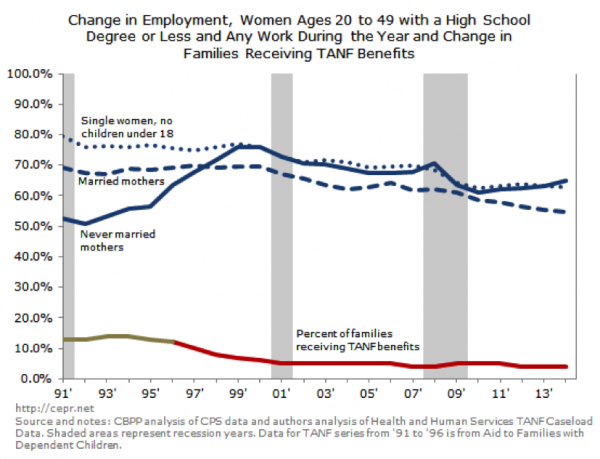
Welfare reform hit 20 last month. The Center for Economic and Policy Research has done much work examining how full employment in the 1990s shaped employment, income, and poverty. In observation of this 20th anniversary, CEPR prepared a graph that tells an important, often neglected, piece of the story:

CCF Barber Rutter Fig 1

Using data from the Current Population Survey and Department of Health and Human Services TANF Caseload report, the figure tells a simple story. Never-married mothers with a high school degree or less increased their rate of work from the early to the late 1990s by nearly 30 percentage points. As Philip Cohen also discusses, this trend began well before the 1996 welfare reform, suggesting that the policy was not the source of the rise, but that other macroeconomic forces were helping these families do better.

As the graph also demonstrates, the rise in employment is associated with a decline in reliance on the welfare program, Temporary Aid to Needy Families (TANF). The line at the bottom of the chart shows a steady decline in the late 1990s that corresponds to the rise in women’s work in the line above.

Here’s the catch: Employment stopped rising, and began to fall by the early 2000s. Yet, TANF, as part of the so-called safety net, did not move upwards as less-skilled jobs disappeared. Instead, the TANF rolls continued to decline, as Shawn Fremstad details in his report on millennial parents.

What does this mean? CEPR director Dean Baker has written extensively about how to fight poverty through full employment. This chart suggests that the current system of welfare is not part of the solution, and stands as a reminder that data, not ideology, will help us reduce poverty.

Alan Barber is the Director of Domestic Policy at the Center for Economic and Policy Research. Virginia Rutter is a sociologist at Framingham State University. For more information, please contact Dr. Barber at barber@cepr.net.

Marriage promotion doesn't fix poverty. More usefully, classes might focus on couples' strategies to handle the chronic stress of economic deprivation and insecurity on families. Image by Bill Strain/Flickr CC.
Marriage promotion doesn’t fix poverty. More usefully, classes might focus on couples’ strategies to handle the chronic stress of economic deprivation and insecurity together. Image by Bill Strain/Flickr CC.

“Marriage is the foundation of a successful society.”

“Promotion of responsible fatherhood and motherhood is integral to successful child rearing and the well-being of children.”

These were the assumptions that most members of Congress made as they designed the 1996 law that became the Personal Responsibility and Work Opportunity Reconciliation Act. Welfare reform’s strategy to decrease poverty involved increasing the number of children raised in two-parent, married families.

In the 20 years since President Bill Clinton signed that bill into law, Congress has earmarked $150 million of welfare money annually for marriage promotion and responsible fatherhood programs. Federal funding has been continuously renewed through 2016. That’s almost a billion dollars spent on marriage programs alone since welfare reform. Funding continues to mount through current “Healthy Marriage and Relationship Education” and “New Pathways for Fathers and Families” grants. These grants support state, local government, and community-based programs that provide marriage/relationship and parenting education and services believed to increase the economic stability of participants, mostly low-income parents. more...

Photo by John W. Schultze, Flickr CC.

Part 2 of the Council on Contemporary Families’ Symposium on Welfare Reform at 20

Twenty years ago this month, Congress passed the Personal Responsibility and Work Opportunity Reconciliation Act (PRWORA), which repealed the cash assistance program, Aid to Families with Dependent Children (AFDC), and replaced it with a program called Temporary Assistance to Needy Families (TANF).

Myths about welfare at the time

Hostility toward AFDC had been building since the early 1980s, as Philip Cohen explains. While some of the criticisms were legitimate, much opposition was spurred by myths about the history of poverty programs. As President Reagan memorably summed up those myths, “We fought a war on poverty, and poverty won.”

The reality is that the War on Poverty was remarkably successful, even though successive administrations fought it with one arm tied behind the back and retreated in the face of economic challenges that should have elicited heightened efforts, such as the oil crisis of 1973, the stock market crash of 1974, and the 1979 energy crisis.

Between the mid-1960s and 1980, poverty rates were almost halved. Poverty rose again in the 1980s in response to deteriorating economic conditions and Reagan-era cutbacks, but economists calculate that in the early 1990s poverty would have been nearly twice as widespread if government programs had not been available.

Racism as well as historical misrepresentation fueled the attack on AFDC. Most Southern states and many Northern ones had successfully excluded Blacks from New Deal jobs and postwar economic assistance programs. As the Civil Rights movement gained clout, this became harder to do and African-Americans, who had long been more likely than whites to experience poverty, now became highly visible on the welfare rolls. more...

Illustration by Bill Strain, Flickr CC.

Part 1 of the Council on Contemporary Families’ Symposium on Welfare Reform at 20

The welfare reform bill that emerged in 1996, after a back-and-forth struggle between President Bill Clinton and the Congress (both houses of which were controlled by Republicans), imposed a two-year continuous term limit, and a five-year lifetime limit, on poor cash welfare recipients. It ended Aid to Families with Dependent Children (AFDC), an entitlement program, and replaced it with Temporary Assistance to Needy Families, a state block-grant program. The policymakers who engineered this change took advantage of a growing popular expectation that mothers should be in the labor force. There was widespread resentment against those (perceived to be mostly Black) who used welfare payments to shirk the obligation to work, choosing dependence on the state rather than getting married or refraining from childbearing.

This policy reform, motivated and supported at least in part by racist ideas and stereotypes, set out to fundamentally alter the relationship between work, parenthood, and marital status for U.S. women. Instead, despite some increase in employment rates, it mostly increased the hardship – and reduced the support – for poor families and their children, who are disproportionately people of color. Reflecting on this anniversary, it now appears this was a tragic misdirection, and we lost an important opportunity to change work family policy for the benefit of all women and poor families. more...

The rapid rise in nonmarital fertility is arguably the most significant demographic trend of the past two decades. The proportion of births to unmarried women grew 46 percent over the past 20 years so that more than four in ten births now occur to unmarried women. Nonmarital fertility is quickly becoming a dominant pathway to family formation, especially among the disadvantaged. This is worrisome because decades of research show that children raised in single-parent homes fare worse on a wide range of outcomes (e.g. poverty, educational attainment, nonmarital and teen childbearing) than children raised by two biological parents. The poverty rates of single parent households are particularly striking. According to recent data from the U.S. Census Bureau, approximately 46 percent of children in single mother households were living in poverty in 2013 compared to 11 percent of children living with two married parents.

How can we improve the lives of the growing numbers of unmarried mothers and their children? So far, a dominant approach has been to encourage their mothers to marry.  At first glance, the logic makes sense. If growing up in a two-parent home is best for children, then adding a second parent to a single-mother home should at least partially address the problem. The 1996 welfare reform legislation and its subsequent reauthorization institutionalized this focus on marriage by allowing states to spend welfare funds on a range of marriage promotion efforts. more...

Photo via VelvetTangerine, Flickr CC.

Reprinted from Beggruen Insights, Issue 4, with permission.

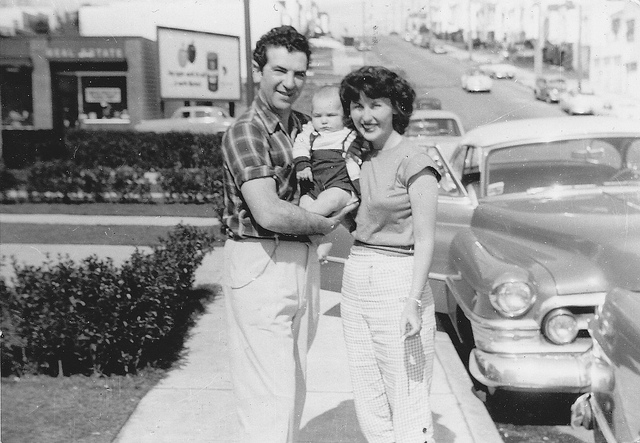
Nostalgia often arises out of a real experience of loss. It needs to be addressed and redirected, not ridiculed or denounced. And that applies to the nostalgia that motivates a considerable number of Trump supporters.

I have spent most of my career pointing out the dangers of imagining a Golden Age in the past that we should try to recapture. Nostalgia offers a warped explanation of what actually did work in the past and airbrushes out what did not. It leads to the scapegoating of those who supposedly ruined “the good old days” while providing no tools for coping with the new realities that underlie contemporary challenges.

That said, nostalgia often arises out of a real experience of loss. It needs to be addressed and redirected, not ridiculed or denounced. And that applies to the nostalgia that motivates so many Trump supporters.
more...

educational policy For all of its craziness and scariness, the 2016 election campaign has hammered home for millions of Americans the degree to which massive inequities permeate our daily lives and threaten our democracy.

Unfortunately, understanding how inequalities affect us has yet to permeate the education policy world. While the transition from narrow, punitive No Child Left Behind Act to the Every Student Succeeds Act represents real progress, there is still a widespread belief that schools are the main drivers of achievement gaps and that they can, and should, be responsible for closing them. Correcting this fallacy is critical to getting the education system we need – one that is both equitable and excellent – and will help correct some of those larger inequities as well.

In reality, the same systemic forces that have sucked most of the income and wealth from the bottom half of our population in recent decades and channeled it into the top one percent have substantially widened income-based achievement gaps. Without intentional measures to direct a broad range of educational and other resources to reversing that trend, gaps will continue to grow. And because big disparities in parents’ – and society’s – investments in children begin at birth, those resources need to be channeled early.

Many of us know that students from poor families, and especially low-income students of color, are often two to three years behind by the time they begin high school. What is far less widely known is that those same students began school that far behind. In other words, our highly inequitable school system, which consigns students with the greatest deficits to the least credentialed and experienced teachers, is doing more to maintain gaps that children brought with them on their first day of kindergarten than to create them.

A study by my colleague, Emma Garcia, finds that, in fact, students in the bottom social class quintile lagged their highest-social class peers by a full standard deviation in both reading and math at kindergarten entry. Those same students were about half a standard deviation behind on such social emotional skills as persistence, self-control, and social interactions, which are equally critical to academic, and life, success. Mind you, education researchers typically translate that “standard deviation” into two or three years of schooling. Let that sink in: one in five students start kindergarten one to three years behind, whether behaviorally or academically.

When we looked across racial groups, the gaps were smaller, and could be explained substantially by social class. Given that nearly half of black five-year-olds who started school in 2010-11, and almost two thirds of English-Language Learner Hispanic children, versus just 13 percent of their white peers, are living in poverty, however, shifting the comparison groups doesn’t improve those students’ real life contexts.

Schools didn’t start these problems. And the evidence tells us that schools alone can’t fix them.

Early fixes that will work.

Luckily, there is also some very good news on this front. Unlike fixes for our bigger, broader societal inequities, strategies for closing these early childhood gaps are well understood, extensively documented, and, miraculously, have fairly wide support across the political spectrum. A paper just published by five EPI researchers lays out both the multiple societal problems created by our failure to make the needed public investments in quality early child care and education, and the broad set of benefits to be reaped from righting that wrong.

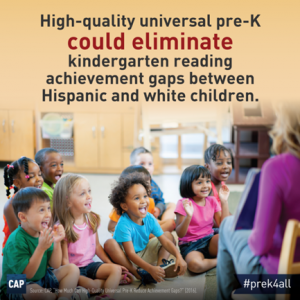
First and foremost, an ambitious national investment in early childhood care and education would help get all our children to the starting gate in much better shape. Another recent study, conducted jointly by the National Institute for Early Education Research and the Center for American Progress, suggests that universal pre-k alone would narrow math gaps by between 45 percent and 78 percent (black- white and Hispanic-white gaps, respectively) and virtually eliminate pre-kindergarten reading gaps.

But the benefits to the investments we propose extend much further. Ensuring a living wage for child care providers would not only improve their quality of life and enhance their contributions to the economy, but help stabilize the workforce and, ultimately, benefit the children they care for. Because child care is such a burden for young families – as expensive as rent or more so in many cases – making high-quality child care available would provide a benefit of about $11,000 annually for Florida families with an infant and a preschool-aged child who are earning the state median income. And removing this barrier to women’s workforce participation would help bring American women in line with their international peers, with potential gains to the gross domestic product of as much as $600 billion annually.

As the election comes closer, we must continue to push all candidates in both parties to focus on the severe problems working Americans face. Let’s make the early childhood investments we suggest front and center. By our analysis they are low hanging fruit—politically and economically.

Elaine Weiss is the National Coordinator for the Broader Bolder Approach to Education, where she works with four co-chairs, a high-level Advisory Board, and multiple coalition partners to promote a comprehensive, evidence-based set of policies to allow all children to thrive in school and life.  Major publications for BBA include case studies of diverse communities across the country that employ comprehensive approaches to education. She has also authored two studies with EPI economist Emma Garcia on early achievement gaps and strategies to reduce them.