media: tv/movies

Dmitriy T.M. sent us a report from the Nielsen company of time spent watching TV and using the internet.

We do, of course, want to take into account possible sample bias–the data are based on answers from Nielsen TV and internet panel participants and a survey of cell phone users, and there’s likely some self-selection bias there, with some groups being more likely to participate than others. I know I’ve read about concerns with Nielsen’s data within the entertainment industry.

That said, while I would be cautious about reporting the data as representative of the U.S. overall, the general trends are interesting. People 65+ watched over 47 hours of traditional (non-recorded) TV per week? Can that be possible? The only 65+-year-old whose TV-watching habits I know is my grandma, and she does tend to have the TV on at all times, even when she’s in the kitchen and is just listening, not watching.

According to these data, among those of retirement age, TV watching is basically more than a full-time job. Kids aged 2-11, on the other hand, only have a part-time job watching TV, at about 25 hours per week.

I, of course, had to sit down and calculate my own TV watching, which came out at a little over 6 hours per week when my friends and I have our Friday night TV watching get-together, 3 hours when we don’t. Less than I thought, overall. I am, however, that advertising nightmare, the person who watches 100% of TV online or DVRd, thus reducing the number of commercials I’m exposed to. You can blame me and others like me for the increasing number of product placements you see in TV shows, a way to try to incorporate sponsorship directly into the content rather than in separate commercials that people are finding more ways to skip.

Gwen Sharp is an associate professor of sociology at Nevada State College. You can follow her on Twitter at @gwensharpnv.
A few days ago, a mini-controversy erupted when this vidcap from the sports network RDS started making the rounds. Here’s the Deadspin article. Two Montréal Canadiens fans {nicknamed Habitants or Habs} donned the jersey of a hot prospect, P. K. Subban, who happens to be Jamaican Canadian. They also painted their faces black and wore afro wigs.

Toronto Mike blogged about the incident and one of the Habs fans came on to comment. The words got pretty heated, but in the end, the fan apologized and Habs and Leafs fans once again could resume their hockey-based hatred of one another.

What struck me as interesting was how this drama played out. The French language cable network covering the 11 March game against the Edmonton Oilers chose to air 10 seconds of the two friends. Was the intent to be controversial? Was the intent to be a facepalm moment?  The back-and-forth on Toronto Mike’s blog was interesting, as the polarizing effect of race brought up assumptions about the Habs fan and his intent by commenters. In the end, I thought the Habs fan handled himself well, given how people were responding and what was being said. Toronto Mike did a good job of not divulging the fan’s name. This was one of those rare moments where Web 2.0 seemed to actually foster a dialogue and didn’t degenerate into a protracted flame war. That said, it wasn’t always pretty, but a lot prettier than what one typically sees on news article comments on issues of race, which are often tantamount to text equivalent strangers yelling at each other at the top of their lungs in an open hall.

Here on ThickCulture, we have examined race in the post-racial era. Racism isn’t dead, it’s just gotten to a late stage where there is a consciousness about what is offensive and debates of this now enter into the public discourse space. I get a sense that race gets so intertwined with speech and knowledge structures that it often becomes a confusing and convoluted morass for many. This impinging upon liberties of speech, in terms of what one can and cannot say or should and should not say, creates a tension, which may result in a backlash.

Where are the lines in the post-racial era? Here in Toronto, last fall there was a party where a group of guys dressed up as the Jamaican bobsled team, depicted in the film, Cool Runnings {1993}. This story caused a stir and points were argued through social media comments on whether or not this was racist.

Four guys darkened their skin and one guy lightened his. The Torontoist chronicles how the story unfolded and offers a tutorial on what blackface is and its cultural significance. The students offered their explanation for their choice of costume:

First and foremost we would like to apologize if anyone was offended…Throughout our childhood, Cool Runnings was something we reflected on with fond memories and therefore in the process [of] choosing Halloween costumes, seemed to be a promising candidate. With this idea in mind, we took notice of how the primary cast, consisting of four black characters and one white character, coincided with our group ratio of four white and one black member. This sparked the idea to add another comedic element to the costume, and have the black student go as John Candy and the white students going as the four bobsledders. At this point, several of us was already of aware of what blackfacing was and therefore took out various means of investigation to further our knowledge of the topic and ensure that what we were doing be doing may not be considered similar in anyway. The conclusion that we came to that simply painting our faces dark brown would not be a portrayal of blackface….understand that we did not act in a negative or stereotypical manner [at the party]. We acted ourselves the whole night, and did not internalize the characters.

Here’s the theatrical trailer for Cool Runnings:

University of Toronto Sociology professor Rinaldo Walcott offered a different take:

I think that in particular [Cool Runnings] became a part of the popular culture imagination of [white] Canadians in a way that [they] took responsibility for that film as though it was somehow an extension of them. And one of the reasons that I think Canadians identified with that film so deeply is because that film weathered something that many white Canadians come to believe strongly—that black people don’t actually belong here. That we are an insertion into a landscape that is not actually an landscape where we naturally fit.

For black people who understand this history [of blackface], Cool Runnings was never a funny film; it in fact replicated all of the techniques of blackface. It is in fact one of the ways that we have come to see that blackface does not require painting of blackface anymore. Just look at the work of Marlon Riggs. We know that in North America there is a deep resonance around producing images of black people that make black people look disgusting. Cool Runnings is a milder version of that. So we should ask… why do they remember Cool Runnings so fondly?

Post-racial means navigating these choppy waters where intent collides head-on with history and its interpretations. Not to get all postmodern here, but while the metanarrative is dead, social media is a site where clashing mini-narratives that structure perceptions of the world, culture, society, etc. battle it out. I think the fellow Contexts blog Sociological Images is a social media site where clashing mini-narratives are de rigueur. I’m wondering if we will ever “get over” issues of race. I’m beginning to think we won’t, given globalization, etc., but perhaps it’s due to the fact that what this is really all about is identity.

What troubles me more than this is when the “right” language is used by individuals doing so strategically. The talk is talked, but the walk isn’t walked. That’s a topic for another blog.

—————————

Kenneth M. Kambara interests and expertise include social media, innovation strategy, environmental sustainability, business and marketing, sociology, urbanism, critical theory and economic sociology.  His insights (and unexpected pop culture segues) can be found on the fellow Contexts blog, ThickCulture, and on his own blog at rhizomicon. Like every good social media guru, he also tweets.

If you would like to write a post for Sociological Images, please see our Guidelines for Guest Bloggers.

Lisa Wade, PhD is an Associate Professor at Tulane University. She is the author of American Hookup, a book about college sexual culture; a textbook about gender; and a forthcoming introductory text: Terrible Magnificent Sociology. You can follow her on Twitter and Instagram.

Kevin, XM, and Laura let me know about an interesting article in the Guardian about acceptable vocabulary in tampon commercials. Kotex recently came out with a new ad campaign that makes fun of some of the usual tropes of tampon commercials–the euphemisms, the dancing around in fields of flowers, and so on. The ads also address the embarrassment or discomfort many people feel about tampons.

In this spot from the Kotex website, a guy asks for help picking tampons for his girlfriend:

Here’s one commercial intended for TV that parodies tampon commercials in general:

The original version didn’t go over well, apparently, and several TV networks rejected the commercial. From the NYT via Gawker:

Merrie Harris, global business director at JWT, said that after being informed that it could not use the word vagina in advertising by three broadcast networks, it shot the ad cited above with the actress instead saying “down there,” which was rejected by two of the three networks. (Both Ms. Harris and representatives from the brand declined to specify the networks.)

So a TV commercial poking fun of the euphemisms in tampon commercials is rejected by not being euphemistic enough…and apparently even the phrase “down there” is too specific. We can talk about erectile dysfunction or leaky bladders, but “down there” just crosses a line.

Related posts: tampons are modern, Tampax ad features menstruating teen male, concerns about tampons and virginity, weird Australian tampon ad, and tampons and female workers during World War II.

Gwen Sharp is an associate professor of sociology at Nevada State College. You can follow her on Twitter at @gwensharpnv.
In this video, sent in by Martha, Lindsay Ellis asks why it is that female characters in general-audience cartoons, if present at all, are always plot points for the male characters. Her point is clearly sound, but damn does she marshal the evidence!  She appears to have really done her homework… but I have no doubt that those of you who are experts in My Little Pony, Transformers, Scooby Do, and She-Ra will have something to add.

Here’s another video on the same topic:

For more on the phenomenon in which women are women and men are people, see our analysis of the “Human” Bodies exhibit, girls as an afterthought, dinosaurs are for boys (and girls), traffic lights with female figures, stick figures and stick figures who parent, and default avatars.

Lisa Wade, PhD is an Associate Professor at Tulane University. She is the author of American Hookup, a book about college sexual culture; a textbook about gender; and a forthcoming introductory text: Terrible Magnificent Sociology. You can follow her on Twitter and Instagram.

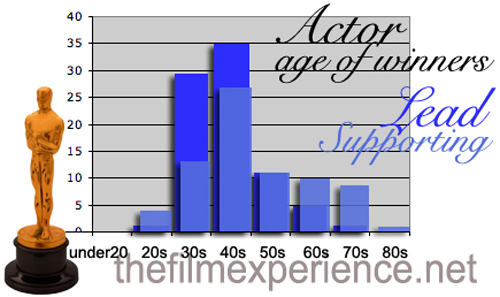
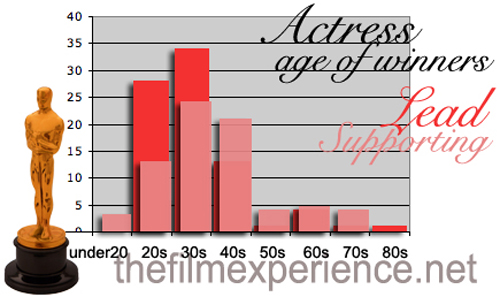
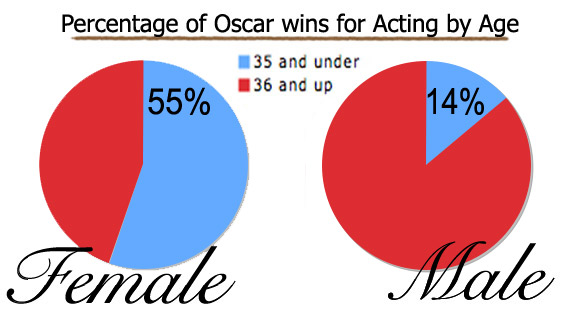
Nathaniel Rogers of The Film Experience tracked down the age at which all Oscar winners in the Academy’s 82 year history won their awards.  He found that men who won Best Actor and Best Supporting Actor were typically in their 30s and 40s.  In contrast, women who won were typically in their 20s or 30s.

Men:

Women:

Looking at it another way, 55% of the women who have been awarded Oscars were 35 and under, whereas only 14% of men were the same:

Perhaps we’re seeing an age bias in award nomination and granting.  It’s reasonable to expect that older actors would be much more likely to win awards, given all their years of experience acting.  But this is not what we see for women or men.  Alternatively, there is an age bias in casting such that the only men and women available for an award are in these age groups.  Disaggregating the data by decade might also reveal some interesting patterns or trends that are invisible in this data.  There is, then, much room for speculation.

Lisa Wade, PhD is an Associate Professor at Tulane University. She is the author of American Hookup, a book about college sexual culture; a textbook about gender; and a forthcoming introductory text: Terrible Magnificent Sociology. You can follow her on Twitter and Instagram.

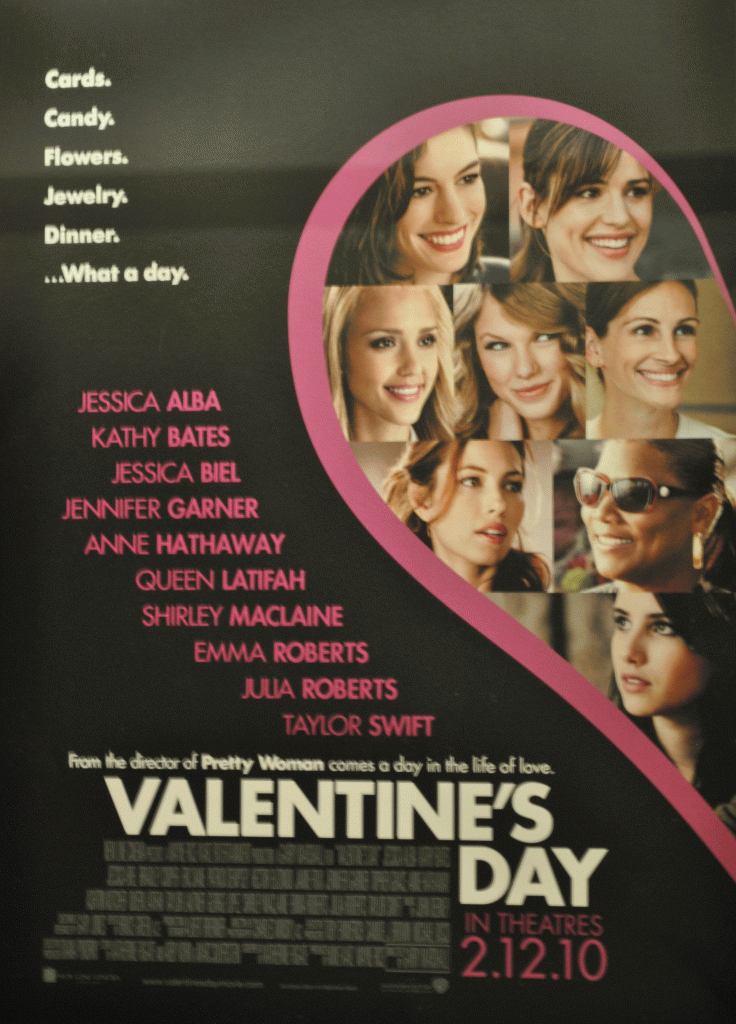
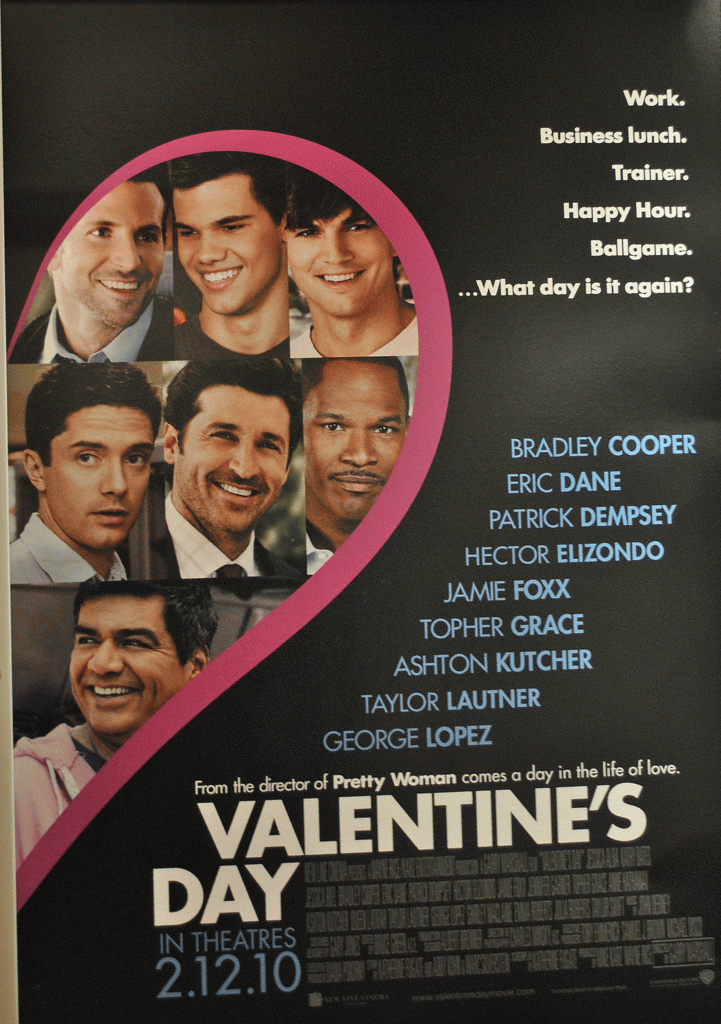
Marie-Claire has been seeing these movie posters for Valentine’s Day all over Toronto and decided to send them in. She writes:

…Hollywood manages to keep a firm grip on the roles men and women play in society (working vs being worshiped), how they spend their time (being social, doing active/productive thing vs passive consumption and adorning themselves), and how they feel about Valentine’s Day (what day is it? The best day of the year!)

“Cards.  Candy.  Flowers.  Jewelry.  Dinner.  …What a day.”

“Work.  Business lunch.  Trainer.  Happy Hour.  Ballgame.  …What day is it again?”

Lisa Wade, PhD is an Associate Professor at Tulane University. She is the author of American Hookup, a book about college sexual culture; a textbook about gender; and a forthcoming introductory text: Terrible Magnificent Sociology. You can follow her on Twitter and Instagram.

The BBC TV show Newswipe makes hilarious fun of common, trite elements of news reports in this video, which has replaced the tickle kitten as my current favorite video:


Kelly V. sent in a video by Alisa Miller of Public Radio International about the impact of news coverage on what we know about. In particular, she argues that changes in the U.S. news media, such as shutting down expensive foreign bureaus, have led to less coverage of events or issues in other countries:

For other examples of the role of media outlets in signaling what’s worth talking about, check out our posts on media outlets covering celebrity stories while chastising us for caring, presenting polls in the media, what stories get covered?, people are more interested in Tiger Woods than Afghanistan, meaningless statistics, U.S. and international versions of magazine covers, “us and them,” which missing kids get news coverage?, covering Obama and McCain, covering Obama and Clinton, and what’s worth covering in a slideshow?