media: tv/movies

Lester Andrist, at The Sociological Cinema, alerted me to a 9-minute short film revealing “Hollywood’s relentless vilification and dehumanization of Arabs and Muslims.”   Created by Jaqueline Salloum and Dr. Jack Shaheen’s book, Reel Bad Arabs, it is a stunning and disturbing collection of clips.  The depictions are grossly prejudiced and relentlessly violent.  Andrist summarizes:

It demonstrates the way Arabs and Muslims are consistently depicted as religious fanatics, perpetual terrorists, backwards, and irredeemably tribal… [T]he media consistently propagates the idea that the Muslim or Arab terrorist is not only a threat to life, but also Western civilization.
Taking the analysis a bit further, I think the clip also allows one to contemplate how these depictions of Arabs and Muslims are simultaneously about constructing an American national identity, and in particular, a masculine one. In several places, one sees how an American masculinity, characterized by stoicism and poise, is set in contradistinction to an irrational, Islamic fanaticism.
It’s really a worth a watch, but very disturbing.  Consider yourself warned:

The Media Education Foundation also made a full length documentary based on Shaheen’s book.  The 5-and-a-half-minute trailer is a good indication of its content.  It contains many similar disturbing depiction, including a discussion of Disney’s Aladdin, but also points to how Arabs are frequently shown as buffoons (“rich and stupid,” “oversexed,” and “uncontrollably obsessed with the American woman”).

See also our posts on how Arabs are portrayed in video games and Reel Injun, a documentary about the representation of American Indians in Hollywood.

Lisa Wade, PhD is an Associate Professor at Tulane University. She is the author of American Hookup, a book about college sexual culture; a textbook about gender; and a forthcoming introductory text: Terrible Magnificent Sociology. You can follow her on Twitter and Instagram.
Talking Points Memo posted an article about a study recently released by the Program on International Policy Attitudes at the University of Maryland. The study looks at misinformation about issues related to the 2010 election among the U.S. electorate. The survey sampled 616 individuals who reported that they voted in the November elections, and according to their methodology, was chosen to be representative of the overall U.S. population. After individuals were chosen to take part, they were asked to complete an online survey; those who didn’t have access to a computer were provided with a laptop and internet access. You can read more about this method of collecting data, which uses an online program called Knowledge Networks, here.

Of course, any study of misinformation brings up the tricky question of how to identify what is “true,” and how to do so in a way that isn’t itself political. The authors explain at length:

…we used as reference points the conclusions of key government agencies that are run by professional experts and have a strong reputation for being immune to partisan influences. These include the Congressional Budget Office, the Department of Commerce, and the National Academy of Sciences. We also noted efforts to survey elite opinion, such as the regular survey of economists conducted by the Wall Street Journal; however, we only used this as supporting evidence for what constitutes expert opinion. In most cases we inquired about respondents’ views of expert opinion, as well as the respondents’ own views…in designing this study we took the position that some respondents may have had correct information about prevailing expert opinion but nonetheless came to a contrary conclusion, and thus should not be regarded as ‘misinformed.’

On some issues, such as climate change, there is a vocal dissenting minority among experts. Thus questions were framed in terms of whether, among experts, more had one or another view, or views were evenly divided.

The researchers first asked if respondents believed they had seen or heard misleading or incorrect information during the fall campaign. Overall, a majority of voters said they had encountered misinformation during the election, and over half said there was more misinformation this time than usual.

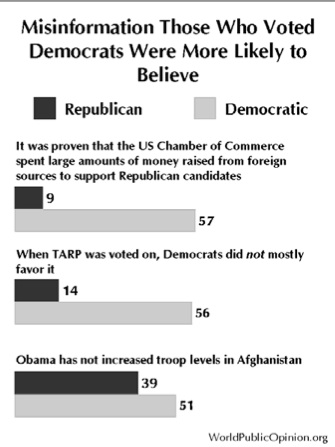
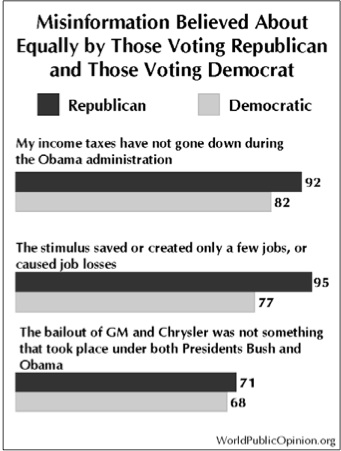
The results also indicated relatively high levels of misinformation on a number of questions. For instance, 40% thought the Trouble Assets Relief Program (TARP, or the bank bailout) was passed under President Obama, when it was actually passed under President Bush; 43% didn’t know that President Obama has increased the number of U.S. troops in Afghanistan. And overall, respondents seemed quite confused about financial policies, with overwhelming majorities of both Republicans and Democrats getting questions about taxes, the stimulus, and the auto maker bailout wrong:

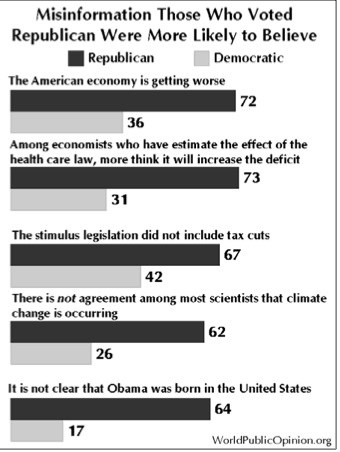
However, for most items, Democrats and Republicans tended to differ on which issues they were misinformed about, in fairly predictable ways:

Finally, the study found that source of information seemed to play a role. Those who said they watched Fox News were more misinformed than any other group, and the more they watched it, the more misinformed they were — whereas with most other news sources, the more news individuals consumed, the less misinformed they were. Viewers of Fox News were more likely to believe the following (incorrect) statements (from p. 20 of the report):

  • most economists estimate the stimulus caused job losses (12 points more likely)
  • most economists have estimated the health care law will worsen the deficit (31 points)
  • the economy is getting worse (26 points)
  • most scientists do not agree that climate change is occurring (30 points)
  • the stimulus legislation did not include any tax cuts (14 points)
  • their own income taxes have gone up (14 points)
  • the auto bailout only occurred under Obama (13 points)
  • when TARP came up for a vote most Republicans opposed it (12 points)
  • it is not clear that Obama was born in the United States (31 points)

This pattern persisted regardless of political affiliation — Democrats who reported watching more Fox News were more misinformed than other Democrats, though less so than Republicans who watch the same amount of Fox News.

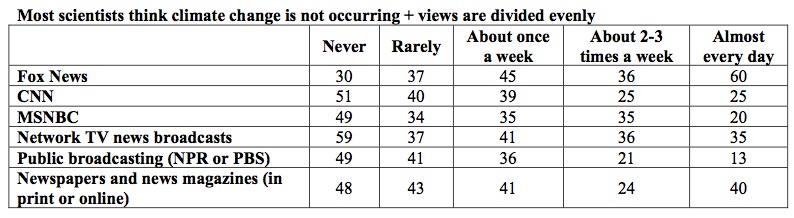
This table shows the number of respondents who said most experts believe climate change either isn’t occurring or that the scientific community is evenly split, by source of news and how often they view that source (p. 21):

They have the same breakdown of data for each question. In general, the lowest levels of misinformation were found among those who reported high levels of consumption of news from MSNBC and/or PBS/NPR. However, as the study authors point out, for a number of questions (such as those about the effects of the stimulus program), all groups had quite high levels of misinformation.

Of course, this leaves a number of questions unanswered: are people more misinformed because they watch Fox News? Or are misinformed people more likely to watch Fox News at least in part because it is more likely to reinforce ideas they already have?

And how does the choice of these particular questions, out of all the potential questions we could ask to judge how well- or poorly-informed people are, affect the results? I suspect critics might say that many of these questions are ones liberals are more likely to get right simply by answering based on political ideology, regardless of actual knowledge — for instance, someone who is Democratic might be more likely to say the health care bill wouldn’t add to the deficit, and thus be “right,” but answer that way because health care reform was a Democratic-backed policy and thus something they supported, not because they have any concrete knowledge about it. As we see with the question about the Chamber of Commerce, when a question doesn’t fit so well with liberal-leaning views (the Chamber of Commerce tends to be more popular among conservatives), Democrats showed high levels of misinformation as well. If we asked more of those sorts of questions, would we find that Democrats (or, say, those who report PBS or NPR as their main source of information) were more misinformed than Fox viewers?

Thoughts?


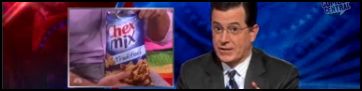
Stephen Colbert reports, and mocks, some pretty stunning product placement on Days of Our Lives:

Thanks to Dmitriy T.M. for the tip!

Lisa Wade, PhD is an Associate Professor at Tulane University. She is the author of American Hookup, a book about college sexual culture; a textbook about gender; and a forthcoming introductory text: Terrible Magnificent Sociology. You can follow her on Twitter and Instagram.
Larry Harnisch, of The Daily Mirror, sent in a link to a story at the NYT regarding study released by the Geena Davis Institute on Gender in Media about the under-representation of women and girls in “family” movies — that is, movies rated G, PG, and PG-13. The authors looked at all English-language fictional G-rated films released in the U.S. or Canada between September 2006 and September 2009 (a total of 22 movies). They also looked at the 50 highest-grossing films for both PG- and PG-13-ratings, meaning a total of 122 movies is included in the analysis. They focused on characters that were either mentioned by name or spoke at least one word in the movie, leading to a sample of 5,554 characters. Of those, 70.8% were male and 29.2% were female.

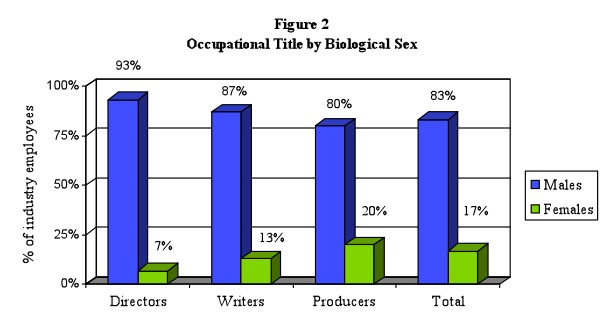
Consistent with patterns in Hollywood in general, women made up a small proportion of directors, writers, and producers in the movies studied:

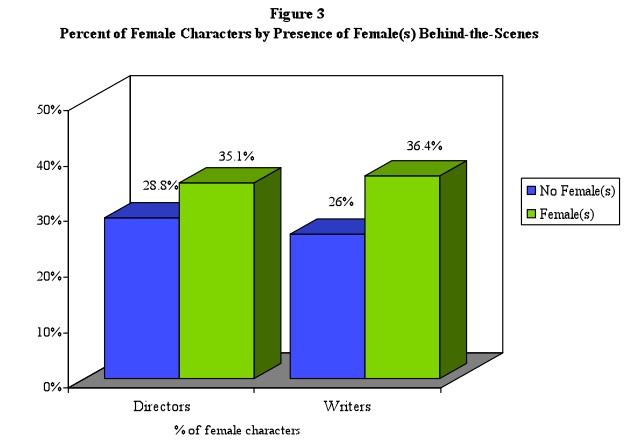
The authors found that movies with female directors and/or writers had more female characters than those with male directors/writers, with writers seeming to have a stronger effect than directors:

Of course, this could be because female directors/writers actively try to incorporate female characters into movies or because studios are simply more comfortable hiring female directors/writers to work on movies with female characters than they are other types of films, leading to a concentration of women working on such projects.

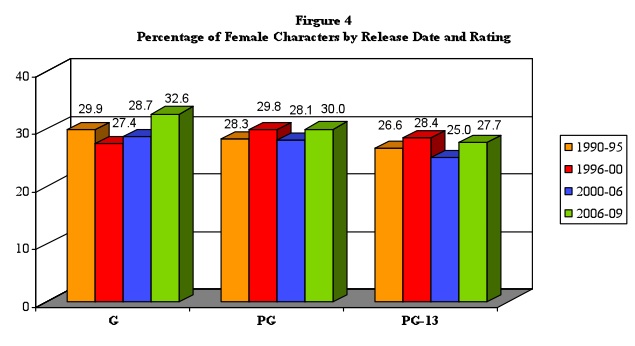
Comparing the results of this study to an earlier analysis of films from 1990-2006, we see that the gender imbalance isn’t improving over time (though since the methodologies differed slightly, the data aren’t absolutely comparable and so are more indicative of a general trend; the authors did make statistical adjustments for the methodological differences):

Of course, none of this gets at the content of the films. The study found that female characters were generally younger than male characters, made up only 17% of group or crowd scenes, and often had plotlines that centered entirely around interests in romance.

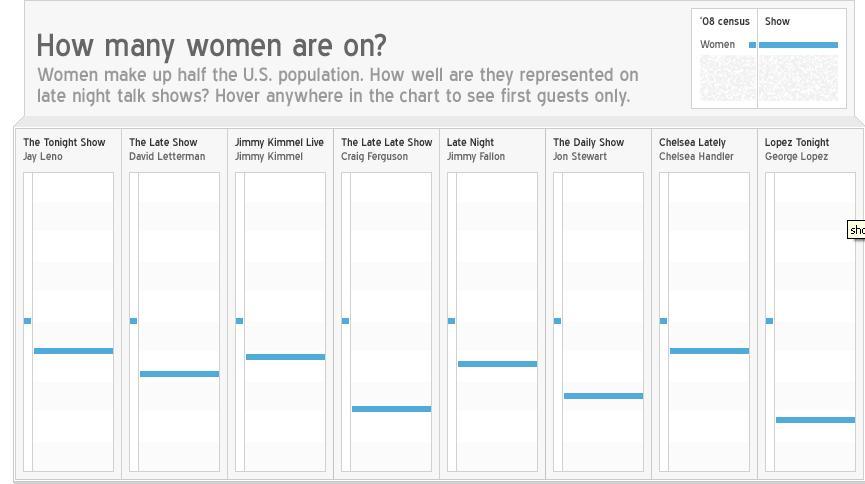
Dmitriy T.M. sent in a link to an interesting breakdown of the race/ethnicity and gender of guests on a number of late-night talk shows, found at Edlundart.

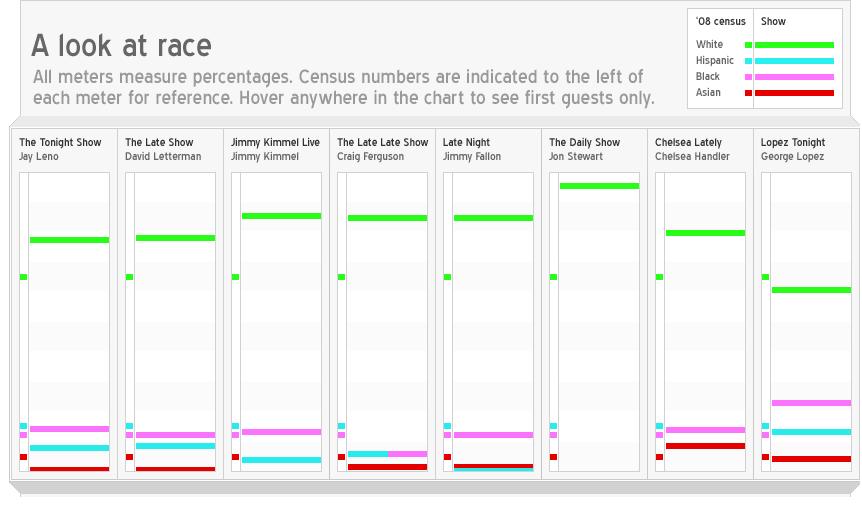
Edlund explains the methodology:

The data for this graphic was gathered over 6 weeks in August and September of 2010. Numbers are based on guest lists as presented on Late Night Lineups. Determining race/ethnicity can be a rather dicey and imprecise activity, and it’s also worth noting that the relationship between census and guest numbers is not a pure one – for example, some of the guests I counted as white are British white people who are visiting the United States.

Of course, a few guests were neither White, Hispanic, Black, nor Asian. These guests were left out, as their numbers were insignificant on the whole…

Edlund also points out that since The Daily Show only has one guest per night, it has a much smaller dataset than the others, so the lack of diversity may be somewhat overstated due to such a small sample.

Here are the results for race (presented as % of all guests); the small dots show the percent in the Census, the wider bars the percent on the show:

Here is the same data but for the top-billed guests only, where the over-representation of Whites goes up even more for most of the shows:

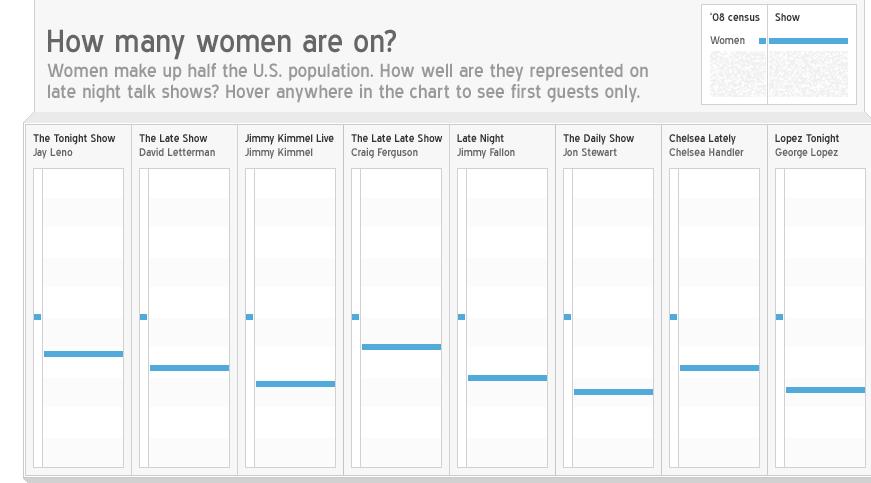
Here’s equivalent data for women:

And, again, for just top-billed guests:

As Edlund says, these data both reflect and reinforce broader cultural patterns. Given that Whites still dominate the political system, for instance, it’s not surprising that political guests would be disproportionately White; and if more movies have male stars than female stars, guest spots will reflect that as well. But at the same time, these shows include people from a range of industries/careers, and their selection of guests helps raise the profile of some individuals more than others, potentially contributing to more opportunities and star power for them. So they don’t just reflect existing realities; they amplify them.

It would be great to get more info on how an individual is selected when there are multiple possibilities — say, you have a movie with several prominent cast members. In that case, are there patterns related to race/ethnicity and gender in which person is most likely to get booked?

Larry Harnisch (of The Daily Mirror) and Jimi Adams sent in a story in the New York Times about ESPN’s plans to roll out espnW, a brand aimed at women. The brand will apparently mostly consist of a website, Facebook pages, and the like for now, with possible expansion to TV in the future.

Responses have been mixed, with some excited at the idea of women’s sport, and female sports fans, being taken seriously, and others fearing it’ll be a condescending attempt that will serve to segregate those groups from “regular,” i.e., men’s, sports and fans.

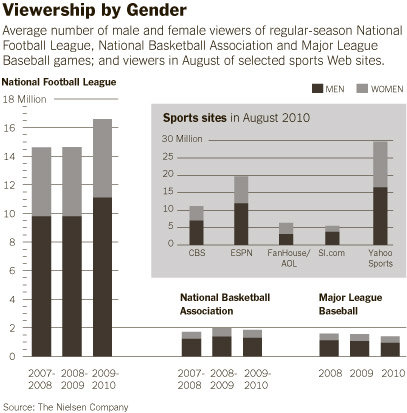
While women may be interested in watching women’s sports in particular, the article also notes that women make up a minority, but significant, portion of the viewership of the NFL, NBA, and MLB, as well as a number of sports-related websites:

From the article:

Women make up 44 percent of football fans, 45 percent of baseball fans and 36 percent of professional men’s basketball fans, according to research conducted by the sports leagues. During the 2009 season, an average of 4.2 million women watched the N.F.L. on ESPN, according to the network.

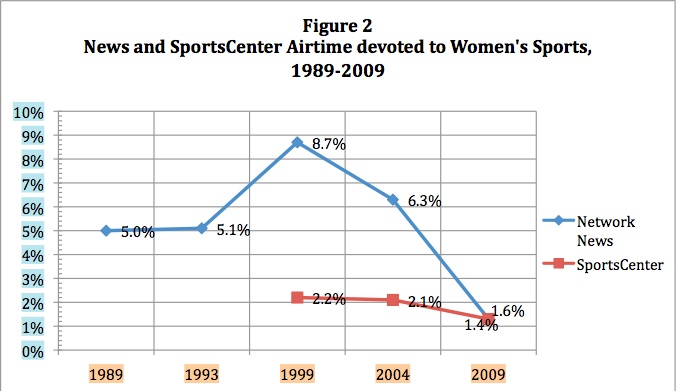
The NYT article includes a link to a study by Michael Messner, Cheryl Cooky, and Robin Hextrum shows that over time, ESPN’s coverage of women’s sports during SportsCenter, its headline sports show, has gone down, generally remaining well below the portion devoted to women’s sports on broadcast news sports segments (the report includes a full description of the methodology):

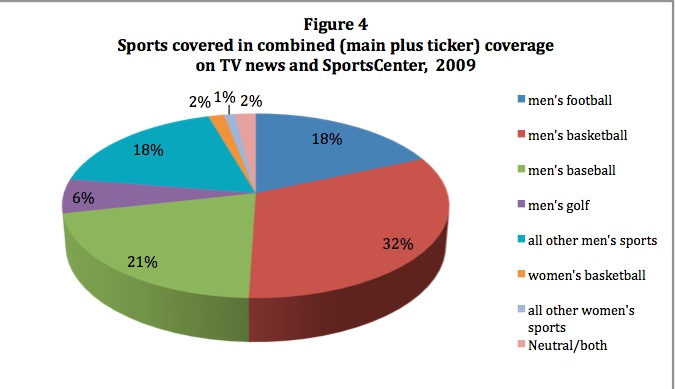
Women’s basketball gets the most coverage among women’s sports:

On the upside, since the total coverage of women was down in 2009 compared to previous years, the researchers found less ridicule of female athletes and fewer sexualized joke stories (i.e., a story about a bra that unfolds into a golf putting green). So, you know…woo! If programmers just completely erase women from TV, they can’t ridicule, sexualize, or belittle us! We’ve found the answer to negative portrayals of women!

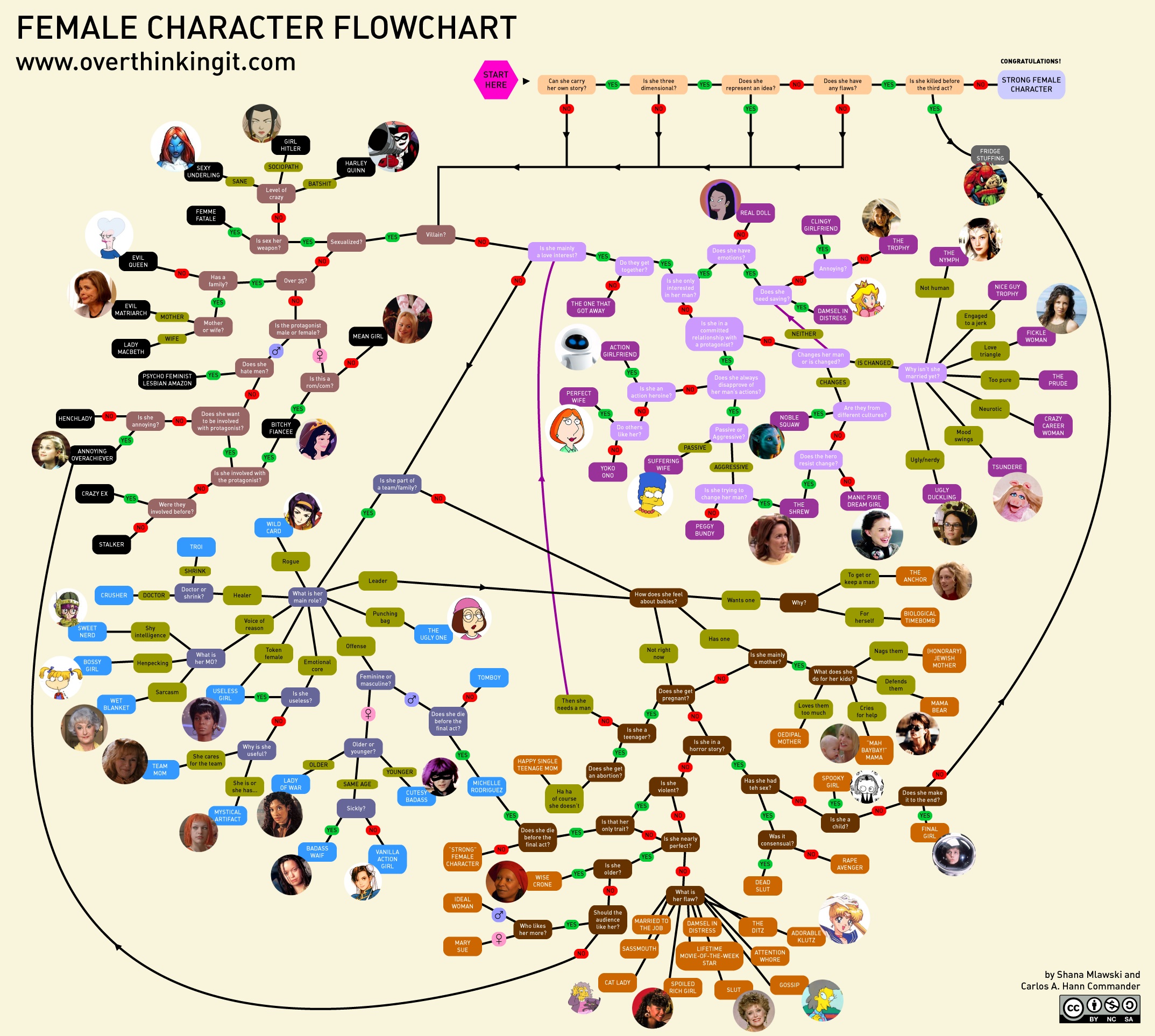
Allison M., Liz B., and G.Z. sent in a link to a post at Jezebel that highlights stereotypical female characters in movies and on TV. The image takes the form of a flowchart, created by Mlawski at Overthinking It (which is currently experiencing technical difficulties). Mlawski says, “Hollywood has a significantly harder time writing non-stereotypical female characters than male ones, so I made this chart to help out.” Click to enlarge, then hit “full size” at the bottom of the larger image to see an easily-readable version:

Of course, many of these characters wouldn’t be inherently problematic — men are often portrayed in one-dimensional roles, etc., and I personally adore Lucille Bluth — if it weren’t for the fact that they’re so pervasive compared to female characters shown as complex, interesting protagonists who aren’t either bitchy shrews or unfulfilled until they can find the right man/have a baby.

Also check out our post on the Bechdel Test.

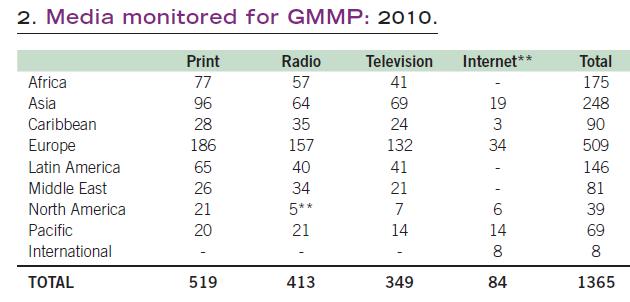
Flavia Dzodan, of Red Light Politics, sent in a link to the Global Media Monitoring Project’s new report, Who Makes the News? The document looks at the gender imbalance in news production, based on an analysis of 1,281 newspapers, TV, and radio stations in 108 countries on November 10, 2009.The results indicate that women are still under-represented as news subjects, and that stories about women often reinforce stereotypes (focusing on women in family roles, using women for “ordinary person” quotes rather than experts, emphasizing women in stories about criminal victimization, birth control, and so on but not economic policy or politics, etc.).

A note on the methodology:

The research covered 16,734 news items, 20769 news personnel (announcers, presenters and reporters), and 35,543 total news subjects, that is people interviewed in the news and those who the news is about.

Internet sources were analyzed separately.

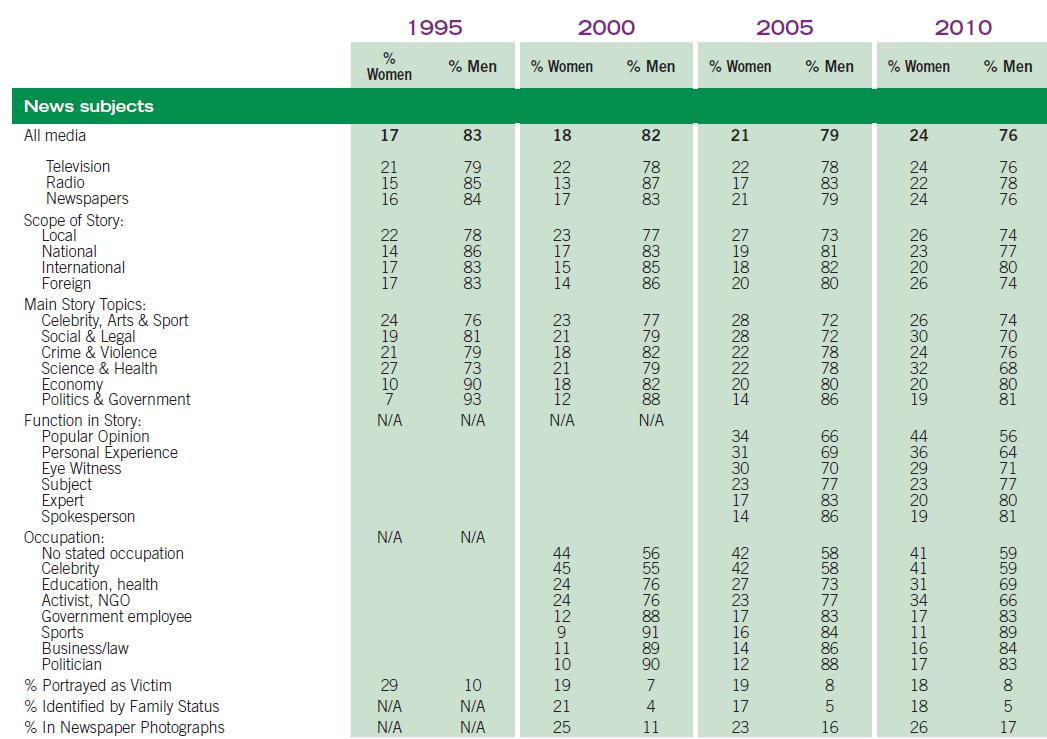
Overall, the analysis shows that both local and international news show a world in which men are highly over-represented as subjects, though women are more likely to be represented as victims, to have their family status mentioned, or to be in newspaper photos:

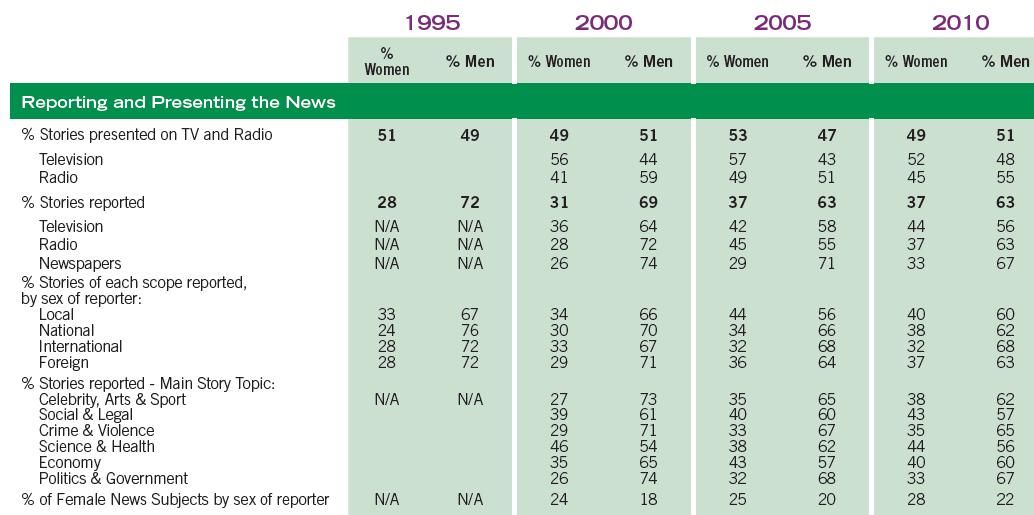
Interestingly, those reporting the news are more gender balanced, indicating that having more women producing the news doesn’t lead to an automatic reduction in under-representation of women in the news:

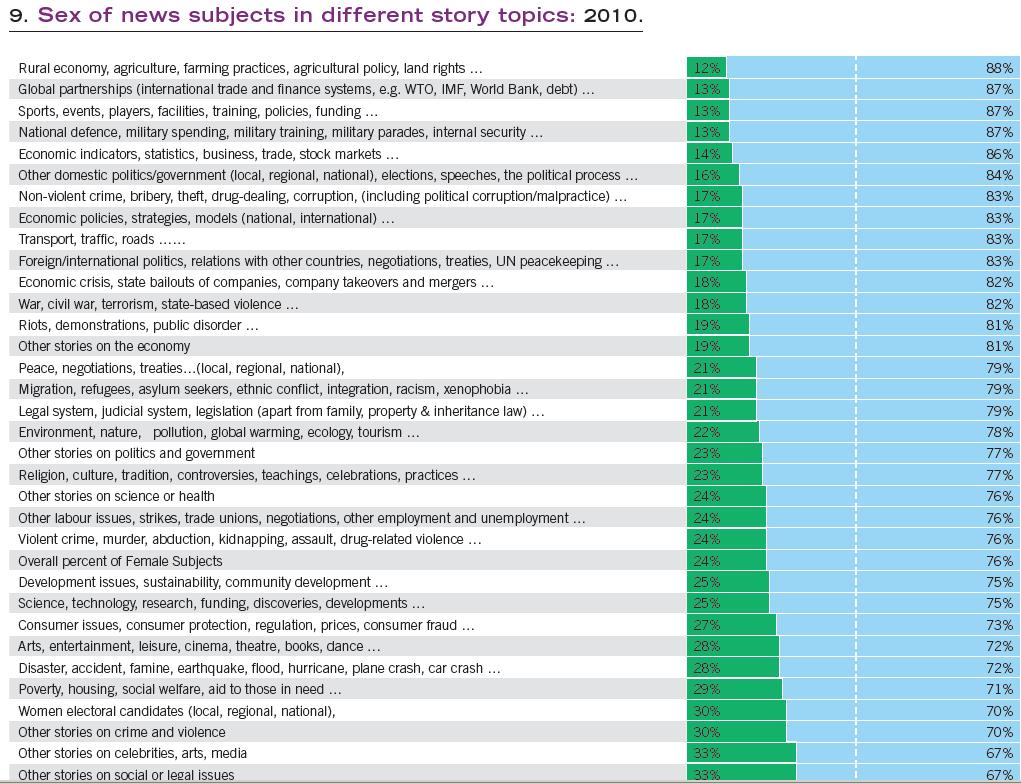
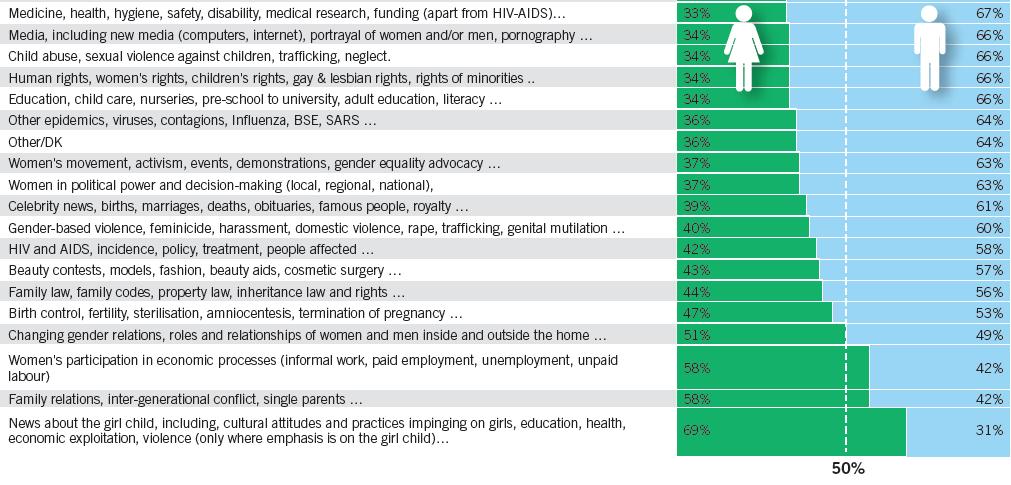
The representation of women as news subjects differs widely by category of news, from 12% of subjects in stories about agriculture to 58% in stories about family relations or single parenting (and 69% in a category they called the “girl-child,” stories about cultural practices impinging on or harming specifically female children, as opposed to children in general):

I’ll put the rest after the jump since there are quite a few images.

more...