media: tv/movies

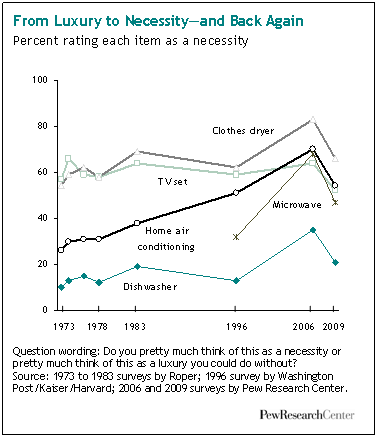
While I was at my grandma’s house this week I read Buying In: What We Buy and Who We Are, a fascinating book by Rob Walker. There will be more posts to come in the next few weeks, but for starters, I was struck by the results of a 2006 survey Walker mentions by the Pew Research Center. The survey asked people if various items were luxuries or necessities. Here are the results from 2006 and 1996:
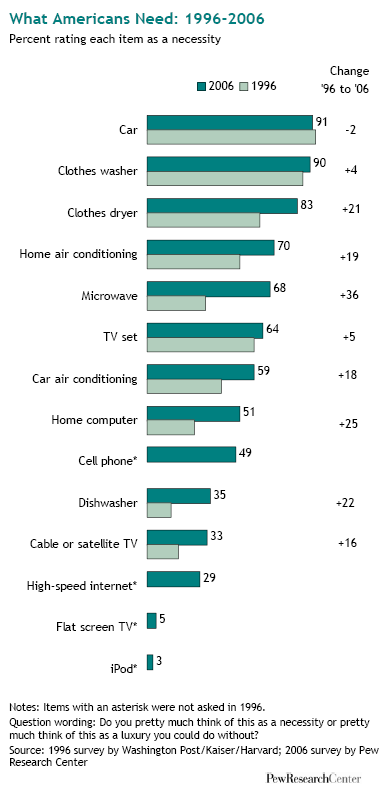
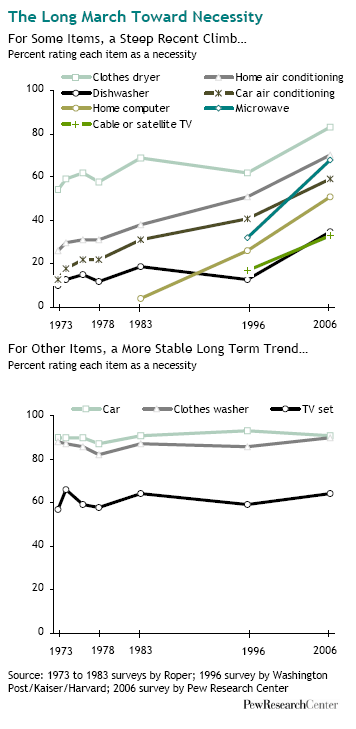
Clearly, over time we’re defining more and more items as necessities rather than luxuries:
A breakdown of some results by age:
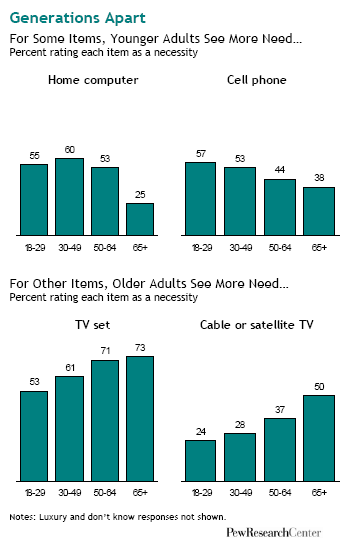
If I had to guess, I’d think the fact that younger people are less likely to say a TV is a necessity than older people is due not to less concern about TV but more willingness to watch content online. Does that seem reasonable? Other explanations?

The survey found that the higher a person’s income, the more items they define as a necessity:
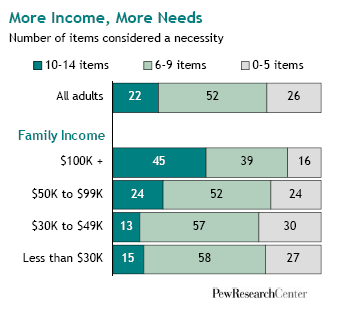
The biggest differences by income were for dishwashers, cell phones, computers, and high-speed internet, which are more likely to be defined as a necessity as income increases.

The Pew Center’s website has links to more detailed breakdowns, as well as full info on the question wording, methodology, etc. And as the authors say in the summary, the results show only a one-way change: in no case did they find that the overall percent defining something as a necessity decreased between 1996 and 2006. As they put it,

The old adage proclaims that “necessity is the mother of invention.” These findings serve as a reminder that the opposite is also true: invention is the mother of necessity. Throughout human history, from the wheel to the computer, previously unimaginable inventions have created their own demand, and eventually their own need.

The income data would seem to back this up: what we have, we often come to define as necessities.

I would love to see an international comparison of some sort. I’ll see what I can find.

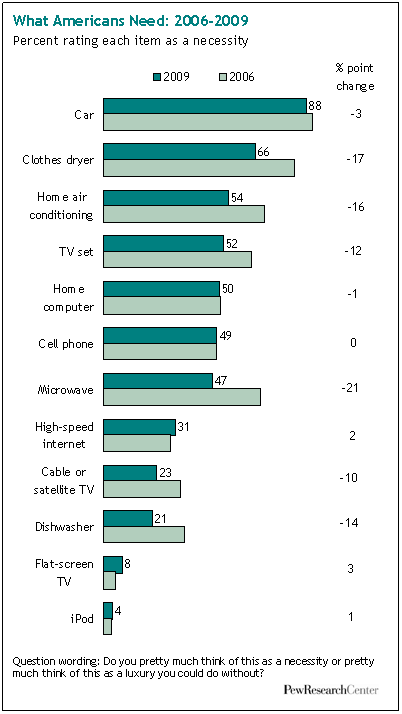
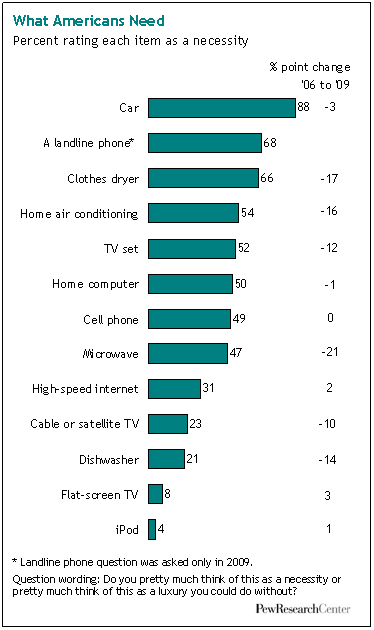
UPDATE: I haven’t found an international comparison yet, but I discovered that the Pew Research Center conducted the survey again in 2009 to see if attitudes had changed during the recession. Quite a striking change for several items:
d
In this video they posted at Feministing, Chloe and Samhita discuss Sex and the City 2. Enjoy!

This being the opening weekend for Sex and the City 2, it seems like a perfect time for this video of sociologist Tracy Scott, from Emory University, discussing the cultural impact and contradictions of the SATC franchise. Enjoy!

Thanks to Nicole J. for sending it in!

This cute two-minute video explains it:

Feminist Frequency, via my friend Ronke O.

Lisa Wade, PhD is an Associate Professor at Tulane University. She is the author of American Hookup, a book about college sexual culture; a textbook about gender; and a forthcoming introductory text: Terrible Magnificent Sociology. You can follow her on Twitter and Instagram.

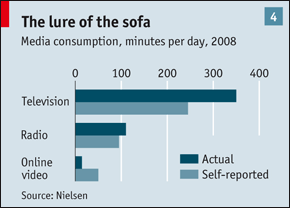
An article at The Economist summarizes the research of Sarah Pearson, who has spent almost 100,000 hours watching British people watch television. People underestimate how much time they spend watching television and listening to the radio (especially the first one), but they overestimate how much time they spend watching online videos.

Pearson found that they also underestimate how much time they spend watching shows as they are being broadcasted. Despite the many ways that shows can now be recorded and rebroadcast, most of our television watching is just like it was 50 years ago. “Even in British homes with a Sky+ box,” she finds, “…almost 85% of television shows are viewed at the time the broadcasters see fit to air them.”

Why? Because television is a social activity. People sit down to watch things together and then they “see what’s on.” And, even when people watch television alone, they like to watch shows at the same time as other people are watching it, or as soon as possible afterward.

Via BoingBoing.

Lisa Wade, PhD is an Associate Professor at Tulane University. She is the author of American Hookup, a book about college sexual culture; a textbook about gender; and a forthcoming introductory text: Terrible Magnificent Sociology. You can follow her on Twitter and Instagram.

Jose Marichal, who blogs at Thick Culture, forwarded us this compilation of Bob Barker’s infantilizing and harassing behavior on The Price is Right during the 1970s.  It’s pretty stunning:

I’d like to say that men don’t call women “girls” these days… but I’m watching Jaime Oliver’s Food Revolution.

Source: FourFour via The Daily Dish.  More examples of calling women girls, both vintage and contemporary.

Lisa Wade, PhD is an Associate Professor at Tulane University. She is the author of American Hookup, a book about college sexual culture; a textbook about gender; and a forthcoming introductory text: Terrible Magnificent Sociology. You can follow her on Twitter and Instagram.

Or, as Angry Asian Man noticed, the white cast of Glee.

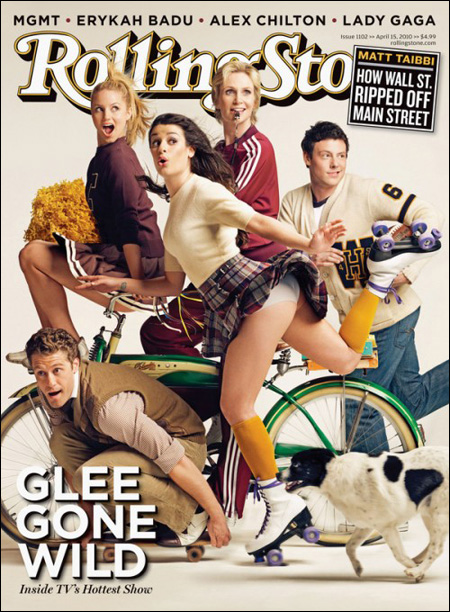
I get it, these are the show’s main characters. It’s just a obvious reminder that it’s awesome to see such great diversity on Glee… but never forget who the show’s real stars are supposed to be, and who usually gets relegated to the periphery.

With panties, of course.  Because without panties, there would be nothing at all going on on this cover.  Booooriiiiiiing.

Lisa Wade, PhD is an Associate Professor at Tulane University. She is the author of American Hookup, a book about college sexual culture; a textbook about gender; and a forthcoming introductory text: Terrible Magnificent Sociology. You can follow her on Twitter and Instagram.

At Racialicious, Arturo R. García lodges a complaint against the modern makeover of Speedy Gonzales which is, apparently, underway.  Actor and Comedian George Lopez is scheduled to voice the character in a feature cartoon.

Starting in 1955, Speedy was a recurring character in Warner Brothers cartoons.  Dubbed “The Fastest Mouse in all of Mexico,” Speedy wore a sombrero and spoke in broken English.  In the cartoon below, he helps other Mexican mice steal cheese from across the Mexico/U.S. border guarded by a “Gringo cat” (Sylvester):

Lopez’s wife is on record saying that the new Speedy will not be the same racist caricature, but instead a Mexican boy who “…comes from a family that works in a very meticulous setting, and he’s a little too fast for what they do.”  But García isn’t convinced.  He writes:

The thing is, it’s not just about Speedy, but about the universe he inhabited. If this new film strays from the original Andale! Andale! schtick, critics will decry that the character was neutered by “the PC Patrol.” If it doesn’t, the couple has resurrected a very problematic cartoon character (two, if Slowpoke Rodriguez is also brought back.) What would be the next step – the return of Heckle & Jeckle? Is bringing back an “established brand” like this really a better option than creating an original character and building something positive from the ground up?

He also points out that Lopez’s success has rested largely on his own reproduction of racist stereotypes (of the whites-and-Latinos-are-so-different-hahaha! and Latinos-are-so-Latino-hahaha! varieties). For example:

Yeah… so I can’t imagine that that guy would ever participate in a project stereotyping Latinos.

I guess we’ll have to wait and see but, like García, I’m skeptical.

Lisa Wade, PhD is an Associate Professor at Tulane University. She is the author of American Hookup, a book about college sexual culture; a textbook about gender; and a forthcoming introductory text: Terrible Magnificent Sociology. You can follow her on Twitter and Instagram.