nation: United States

Screenshot_1Earlier on SocImages, Lisa Wade drew attention to the tourism industry’s commodification of Polynesian women and their dancing. She mentioned, briefly, how the hula was made more tourist-friendly (what most tourists see when they attend one of the many hotel-based luaus throughout the islands is not traditional hula).  In this post, I want to offer more details on the history and the differences between the tourist and the traditional hula.

First, Wade states that, while female dancers take center stage for tourists, the traditional hula was “mostly” a men’s dance.  While it has not been determined for certain if women were ever proscribed from performing the hula during the time of the Ali’i (chiefs), it seems unlikely that women would have been prevented from performing the hula when the deity associated with the hula is Pele, a goddess. Furthermore, there is evidence that women were performing the dance at the time of Captain James Cook’s arrival in Hawai’i.

Second, while the traditional dances were not necessarily sexualized, they were very sensual.  The movement of hips and legs that are seen as sexual by some visitors, and showcased as such by the tourism industry, certainly existed in early practices.

In fact, the supposedly lascivious and blasphemous nature of the hula prompted missionaries to censure the public practice of hula, and in 1830 Queen Ka’ahumanu enacted a law prohibiting the public performance of the hula. This law was highly ineffective, however, and when King Kalakaua ascended the throne he actively encouraged public hula performances and other expressions of Native Hawaiian culture, earning him the moniker “Merrie Monarch.”

Eventually, a modernized dance emerged that did not incorporate much religiosity and employed modern music rather than chants. This is closer to what you would find at a hotel luau, but differs drastically in costuming and lacks the uncomfortable cloud of objectification associated with hotel-style hula (that is, the focus is on the dance rather than the dancers).  Below are some examples of the evolution.

Hula (men’s dance, traditional):

Hula (contemporary):

These examples of hula, and other Polynesian dances, are vastly different from what one finds in a hotel’s “Polynesian Revue” luau.

Hula (hotel):

In conclusion, it is true that the hula dances, and other dances of Polynesia, have been usurped by the tourism industry and commodified.  The culturally authentic forms, however, still thrive. Native dances are impressive enough without the ridiculous costuming and disrespectful bending of the islands’ histories seen at hotel luaus; unfortunately, it is difficult to find any culturally sensitive displays of Polynesian culture due to the huge influence of tourism over these locations.

*The information in this post was gleaned from various courses I’ve taken at the University of Hawai’i at Manoa. For more information on hula and the commodification of the Hawaiian culture, see Haunani-Kay Trask’s From A Native Daughter.

Sarah Neal is currently working on obtaining her M.A. in English at North Carolina State University.
Cross-posted at Montclair Socioblog.

We got another reminder last week that despite complaints about federal government programs that give money to the poor, when it comes to taxes, the government is much more generous to the wealthy.  The news came from a report from the Congressional Budget Office on tax expenditures.

These are the ways that the government uses the tax system to give money to people. Some expenditures are tax credits, which can take the form of cash payments.  Others are tax breaks — taxing people less than the going rate. For example, if I am in the 35% tax bracket, but the government charges me only 15% on the $100,000 I made playing the stock market, the government is giving me $20,000 it could otherwise have had me pay in taxes. That’s an expense. The preferential rate for my luck in the market costs the government $20,000.

The justification for these expenditures is that they are a way the government can encourage people to do something that it wants them to do.  With tax breaks, the government is basically paying people by not charging them full tax fare — encouraging them to buy a house or give to charity or get health insurance at their work.  Similarly with the tax credits that go mostly to the poor. We want people to hold a job and to care for their kids.  The child tax credit gives people more money to care for their children.  The Earned Income Tax Credit pays them for working, even at jobs that pay very little.  By the same logic, the government is paying me to invest my money in companies — or put another way, to play the stock market.

This government largesse, however, benefits some people more than others:

1

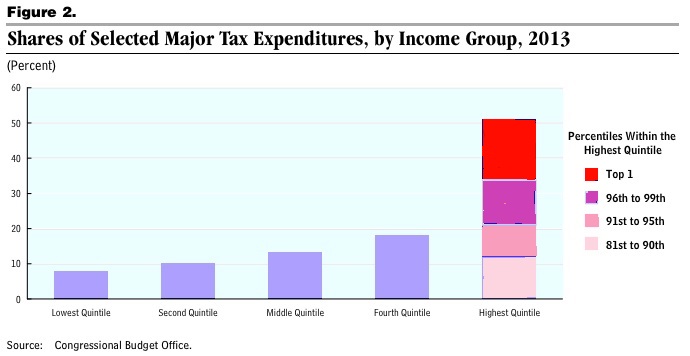
About half of all tax expenditures go to the top quintile (top 20% of income earners).  The bottom 80% of earners divide the other half.  And within that richest quintile, the top 1% receive 15% of all tax expenditures (this distribution of tax breaks roughly parallels the distribution of income). Were you really expecting Sherwood Forest?

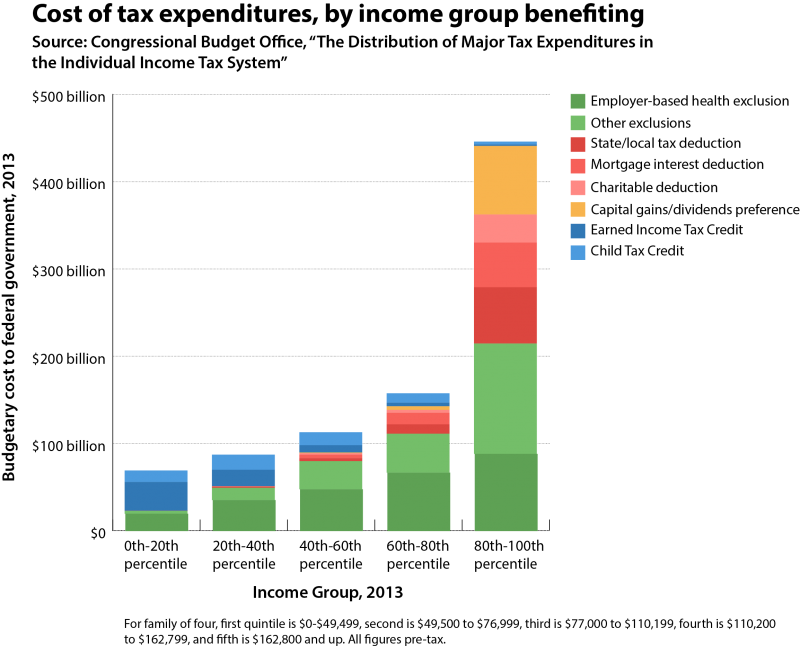
Here is a breakdown of the costs of these different tax expenditures:

2

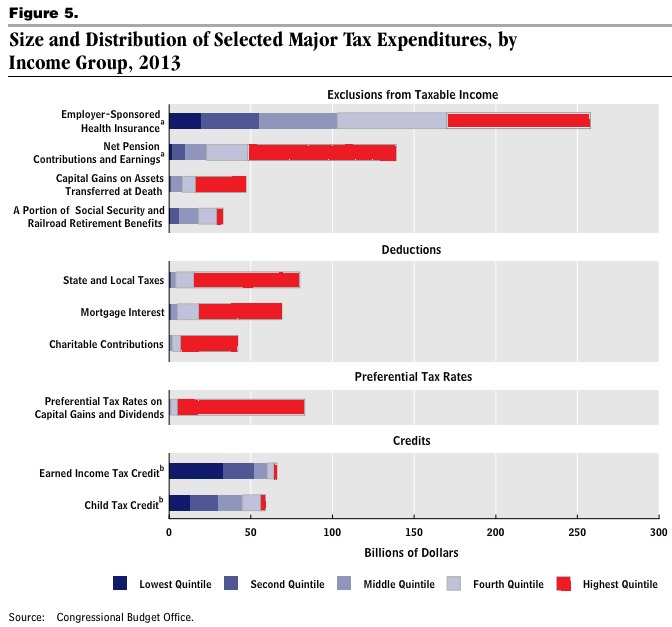
The Earned Income Tax Credit, which benefits mostly the poor, costs less than $40B.  The tab for the low tax on investment income (capital gains and dividends) is more than twice that, and nearly all of that goes to the top quintile.  More than two-thirds goes to the richest 1%.

Dylan Matthews at the Washington Post WonkBlog regraphed the numbers to show the total amounts overall plus the amounts in each category for each income group:

3

The point? People complain about government payments to the poor, but tax breaks are also payments, though less obviously so, to the rich.  And those tax breaks cost the government a lot more money.

Jay Livingston is the chair of the Sociology Department at Montclair State University. You can follow him at Montclair SocioBlog or on Twitter.

1The phrase “social construction” refers to the fact that things, symbols, places, sounds — basically everything — is devoid of meaning until we, collectively, agree as to what something means.  Once that happens, it has been “socially constructed” and we can refer to it as a “social construct.”

The fact that gestures have any meaning at all, and that they can have different meanings in different places, is a simple example of this basic sociological concept.  Enjoy this one minute compilation of examples!

Via Blame It On The Voices.

Lisa Wade, PhD is an Associate Professor at Tulane University. She is the author of American Hookup, a book about college sexual culture; a textbook about gender; and a forthcoming introductory text: Terrible Magnificent Sociology. You can follow her on Twitter and Instagram.

Cross-posted at Montclair SocioBlog.

Forty years ago Richard Easterlin proposed the paradox that people in wealthier countries were no happier than those in less wealthy countries.  Subsequent research on money and happiness brought modifications and variations, notably that within a single country, while for the poor, more money meant fewer problems, for the wealthier people — those with enough or a bit more — enough is enough.  Increasing your income from $100,000 to $200,000 isn’t going to make you happier.

It was nice to hear researchers singing the same lyrics we’ll soon be hearing in commencement speeches and that you hear in Sunday sermons and pop songs (“the best things in life are free”; “mo’ money mo’ problems”).  But this moral has a sour-grapes taste; it’s a comforting fable we non-wealthy tell ourselves all the while suspecting that it probably isn’t true.

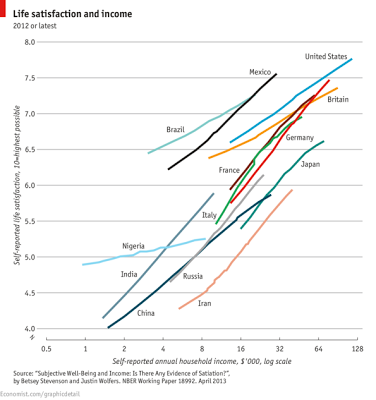
A recent Brookings paper by Betsey Stevenson and Justin Wolfers adds to that suspicion.  Looking at comparisons among countries and within countries, they find that when it comes to happiness, you can never be too rich.

1

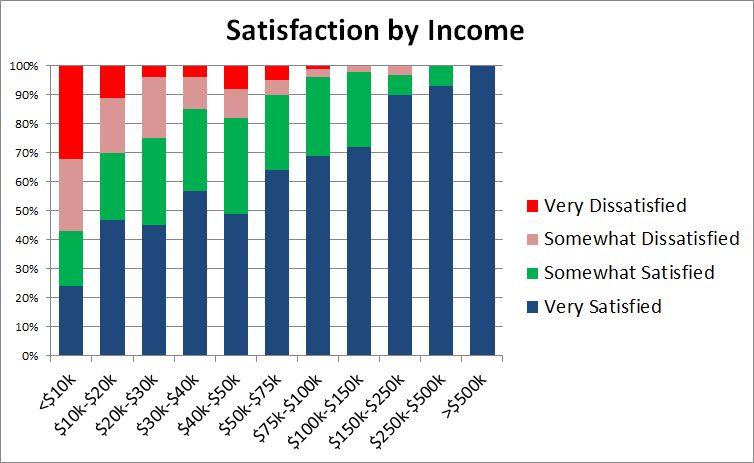
Stevenson and Wolfers also find no “satiation point,” some amount where happiness levels off despite increases in income.  They provide US data from a 2007 Gallup survey:

2

The data are pretty convincing.  Even as you go from rich to very rich, the proportion of “very satisfied” keeps increasing.  (Sample size in the stratosphere might be a problem: only 8 individuals reported annual incomes over $500,000;100% of them, though, were “very happy.”)

Did Biggie and Alexis get it wrong?

Around the time that the Stevenson-Wolfers study was getting attention in the world beyond Brookings, I was having lunch with a friend who sometimes chats with higher ups at places like hedge funds and Goldman Sachs.  He hears wheeler dealers complaining about their bonuses. “I only got ten bucks.”  Stevenson and Wolfers would predict that this guy’s happiness would be off the charts given the extra $10 million.  But he does not sound like a happy master of the universe.

I think that the difference is more than just the clash of anecdotal and systematic evidence.  It’s about defining and measuring happiness.  The Stevenson-Wolfers paper uses measures of “life satisfaction.”  Some surveys ask people to place themselves on a ladder according to “how you feel about your life.”  Others ask

All things considered, how satisfied are you with your life as a whole these days?

The GSS uses happy instead of satisfied, but the effect is the same:

Taken all together, how would you say things are these days – would you say that you are very happy, pretty happy, or not too happy?

When people hear these questions, they may think about their lives in a broader context and compare themselves to a wider segment of humanity.  I imagine that Goldman trader griping about his “ten bucks” was probably thinking of the guy down the hall who got twelve.  But when the survey researcher asks him where he is on that ladder, he may take a more global view and recognize that he has little cause for complaint.  Yet moment to moment during the day, he may look anything but happy.  There’s a difference between “affect” (the preponderance of momentary emotions) and overall life satisfaction.

Measuring affect is much more difficult — one method requires that people log in several times a day to report how they’re feeling at that moment — but the correlation with income is weaker.

In any case, it’s nice to know that the rich are benefitting from getting richer.  We can stop worrying about their being sad even in their wealthy pleasure and turn our attention elsewhere.  We got 99 problems, but the rich ain’t one.

Jay Livingston is the chair of the Sociology Department at Montclair State University. You can follow him at Montclair SocioBlog or on Twitter.

Here at SocImages, we typically use the phrase “cultural appropriation” to describe rather frivolous borrowing of cultural practices and objects for the purposes of fun and fashion.  We’ve posted on examples ranging from the appropriation of American Indian fashion,  the mocking of the Harlem Shake, and an Orthodox Jew-inspired fashion show.

A slideshow of members of the punk scene in Burma, however, offers another version of cultural appropriation.  Their fashion is clearly inspired by the punk scenes of Britain and the U.S., which started in the 1970s. Accordingly to an interview with Ko Gyi at Vice and an article at Spiegel Online, some members of the sub-culture believe themselves to be rebelling against an oppressive state, others are interested in “non-political anarchism.”  While their music has to pass through state censors, they are talented in pushing their lyrics right up to the limit and deft in using metaphor to get their point across.

This is a fully different kind of appropriation, the kind that is about fighting the establishment, not spicing it up with “colorful” bits of marginalized groups.  It is more akin to feminists and gay liberation activists borrowing the tactics of the civil rights movement.  Alexander Dluzak writes:

In Burma, punk is far more than just a superficial copy of its Western counterpart. Here, what is probably the most rebellious of all subcultures in the Southeast Asian country is going up against one of the world’s most authoritarian regimes.

Cultures can borrow from one another, then, in ways that both empower and disempower.  It will be fascinating to see if this particular appropriation can shape the future of Burma.

Lisa Wade, PhD is an Associate Professor at Tulane University. She is the author of American Hookup, a book about college sexual culture; a textbook about gender; and a forthcoming introductory text: Terrible Magnificent Sociology. You can follow her on Twitter and Instagram.

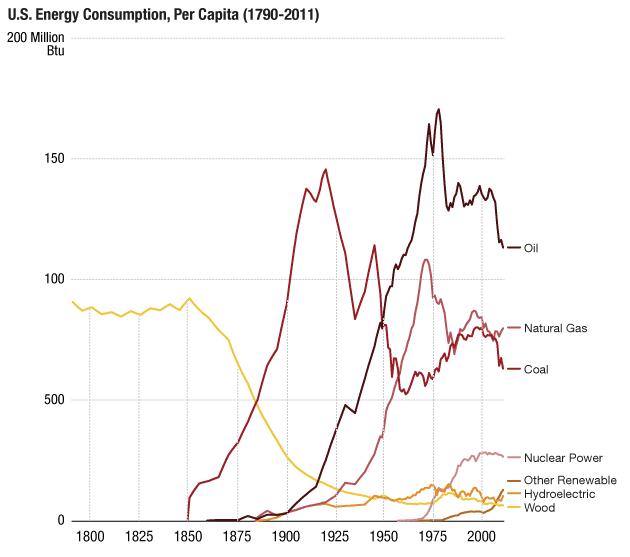
Planet Money’s Jacob Goldstein and Lam Thuy Vo offered some interesting data last week about the history of energy consumption in the U.S.  First they offered data on the rise and fall of alternative energy sources.

1

Coal, the first to replace wood, became a common energy source largely thanks to the railroads.  Wood was more or less everywhere, but coal had to be transported.

The invention and spread of the internal combustion engine drove the demand for oil.  According to this site (PM doesn’t say), natural gas becomes common in the ’50s thanks to the improvement of techniques for making metals and welding. This facilitates the building of oil pipelines, hence the rise of oil.

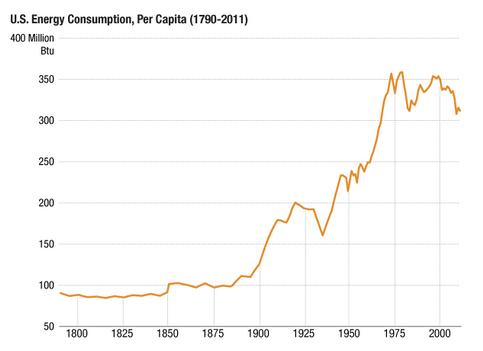
The overall rise in energy consumption per capita is worrisome, but it has fallen off since the mid-70s.  Thanks to high prices that encourage lower use and greater efficiency of appliances, our appetite for energy seems to have leveled off.

2

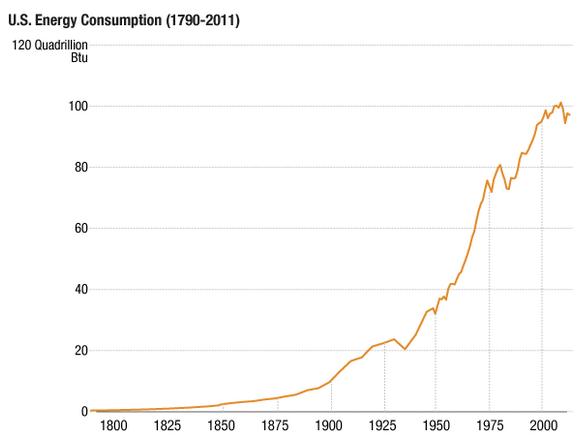
Not to end on an optimistic note, though.  That data is per capita.  Because our population has been rising, our overall energy use has continued to go up.

3

Lisa Wade, PhD is an Associate Professor at Tulane University. She is the author of American Hookup, a book about college sexual culture; a textbook about gender; and a forthcoming introductory text: Terrible Magnificent Sociology. You can follow her on Twitter and Instagram.

1In an article titled “Egos Inflating Over Time,” psychologist Jean Twenge and her colleagues show that rate of narcissism among U.S. college students has risen significantly. Narcissism is a “positive and inflated view of the self.” Narcissists are attention-seeking extroverts who have a high opinion of their value, importance, and physical attractiveness. They feel entitled to admiration from others and may act aggressively if they don’t receive the attention they feel they deserve.

Twenge and her colleagues found a 30% increase in narcissism between 1979 and 2006; almost 2/3rds of college students in the mid-2000s were above the mean score reported in the early ’80s.

I can’t help but think of her research every time I see a current commercial for the iPhone 5. What strikes me is the message that every moment of our lives is so amazing that it would be a horrible shame to not share it with everyone:

We can share every second… a billion roaming photojournalists uploading the human experience, and it is spectacular…

And that we should feel entitled to the technological ability to share ourselves:

I need to upload all of me.  I need — no, I have the right — to be unlimited.

Wow. I mean, that’s some pretty serious self-importance there.

Twenge and her colleagues argue that the increase in narcissism is related to the fact that American culture has increasingly celebrated individualism.  This is exactly the kind of message that they might point to as reflecting the cultural dimension of this personality shift.

Lisa Wade, PhD is an Associate Professor at Tulane University. She is the author of American Hookup, a book about college sexual culture; a textbook about gender; and a forthcoming introductory text: Terrible Magnificent Sociology. You can follow her on Twitter and Instagram.

Cross-posted at Asian-Nation and Racialicious.

1
Photo by Lulu Vision (Flickr/Creative Commons)

As an undergraduate majoring in linguistics, I was fascinated with the concept of endangered languages. Colonization, genocide, globalization, and nation-building projects have killed off untold numbers of languages. As linguist K. David Harrison (my undergrad advisor) tells NPR, speakers of stigmatized or otherwise less-favored languages are pressured to abandon their native tongue for the dominant language of the nation and the market (emphasis mine):

The decision to give up one language or to abandon a language is not usually a free decision. It’s often coerced by politics, by market forces, by the educational system in a country, by a larger, more dominant group telling them that their language is backwards and obsolete and worthless.

These same pressures are at work in immigrant-receiving countries like the United States, where young immigrants and children of immigrants are quickly abandoning their parents’ language in favor of English.

Immigrant languages in the United States generally do not survive beyond the second generation. In his study of European immigrants, Fishman (1965) found that the first generation uses the heritage language fluently and in all domains, while the second generation only speaks it with the first generation at home and in limited outside contexts. As English is now the language with which they are most comfortable, members of the second generation tend to speak English to their children, and their children have extremely limited abilities in their heritage language, if any. Later studies (López 1996 and Portes and Schauffler 1996 among them) have shown this three-generation trend in children of Latin American and Asian immigrants, as well.

The languages that most immigrants to the U.S. speak are hardly endangered. A second-generation Korean American might not speak Korean well, and will not be speaking that language to her children, but Korean is not going to disappear anytime soon — there are 66.3 million speakers (Ethnologue)! Compare that with the Chulym language of Siberia, which has less than 25.

Even if they’re not endangered per se, I would argue that they are in danger. While attitudes towards non-English languages in the U.S. seem to be improving, at least among wealthier and better educated people in some more diverse cities and suburbs, the stigma of speaking a non-English language still exists.

How many of you have:

  • been embarrassed to speak your heritage language in front of English speakers?
  • been reprimanded for speaking your heritage language in school?
  • been told to “go back to [country X]” when someone overhears you speak your heritage language?

I’ve heard innumerable stories about parents refusing to speak their native language to their children. Usually, the purported rationale is that they do not want the child to have language or learning difficulties, a claim that has been debunked over and over again by psychologists, linguists, and education scholars.

I’m sure that these parents truly believe that speaking only English to their children will give them an edge, though the reverse is true. What I wonder is how much this decision had to do with an unfounded belief about cognition and child development, and how much it had to do with avoiding the stigma of speaking a language that marks you as foreign, and as “backwards and obsolete and worthless”?

Calvin N. Ho is a graduate student in sociology at the University of California, Los Angeles studying immigration, race/ethnicity/nationalism, and Asian diasporas.  You can follow him at The Plaid Bag Connection and on Twitter.