Search results for embed


Hope H. sent a link to Riese’s excellent discussion of Jessie J’s new music video at Autostraddle.  Jessie J is already a superstar, writing songs for the likes of Justin Timberlake, Chris Brown, and Christina Aguilera.  But this is her first album where she writes for herself, and Riese describes the video for the song “Do It Like a Dude” as infused with “fuck you i’m fucking your face with my fucking song” energy.  I can’t disagree.

The song asserts it’s title, suggesting that Jessie J is as much a man as any man, as a sample of the lyrics shows:

Boom Boom, pull me a beer
No pretty drinks, I’m a guy out here
Rollin’ rollin’ rollin’ rollin’ money like a pimp
My B I T C H’s on my d*ck like this

Riese asks:

…“Do It Like a Dude” is, on the surface, an anthem of independence — the only reaction Jessie J expects from your wannabe-boyfriend is his acknowledgment that lesbian sex doesn’t need him.  But does singing that she can do “it” “like a dude” just play into the idea that a thing must be “male” to be valid? Or can “dude” be a term independent of its ascribed meaning — is she… employing “dude” as an adjective encompassing “male” traits like strength/power/aggression, freeing the term from its traditional application as a noun for “person with penis”?

That is, does valorizing masculinity in women liberate women?  Or would it be better to try to elevate femininity to match our admiration of masculinity?  And is it possible to liberate the word from its patriarchal trappings?

What say you?

Lisa Wade, PhD is an Associate Professor at Tulane University. She is the author of American Hookup, a book about college sexual culture; a textbook about gender; and a forthcoming introductory text: Terrible Magnificent Sociology. You can follow her on Twitter and Instagram.
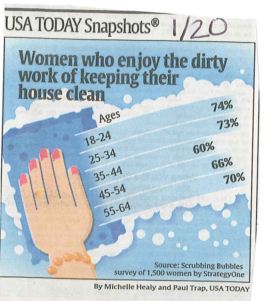
Heather Downs, an Assistant Professor at Jacksonville University, pointed out a post by Sadie Stein at Jezebel about a recent graphic from the USA Today Snapshots feature; we’re pleased to repost it here, with some additional comments from me below.

———-

Women just love, love, love housework! Says a survey. Conducted by cleaning product.

Apparently under the impression that we also believe cigarettes are soothing to the throat and little kids love laxatives, Scrubbing Bubbles (or rather, the impartial survey they commissioned) informs us (via USA Today) that an overwhelming percentage of women in every age group “enjoy the dirty work of keeping their house clean.”

Now, I know there are indeed women — and men, for that matter — who do indeed find satisfaction in the tangible rewards of cleaning (although I can’t pretend to be one of them.) But…why is this survey for and about women exclusively? Maybe because it comes from the same universe in which women — exclusively — scrub and sweep and swiffer with expressions of cheerful serenity in pastel-hued V-necks.

That said, in their defense, at least as of 1978, the bubbles themselves seem to have been masculine. And do not appear to be perverts:

[Via: Scrubbing Bubbles Says: All women are cleaning ladies (Mislabeled)]

Send an email to Sadie Stein, the author of this post, at Sadie@jezebel.com.

———-

Aside from the gendered element, it’s also a great example of the conflation of marketing-type materials with the surrounding, presumably non-advertising, material. Without having to buy advertising space, Scrubbing Bubbles gets a mention next to an item that says women think cleaning is awesome!

Also see how excited Kelly Ripa is to do laundry and product placement on Days of Our Lives.


We owe the term “sociological imagination” to C. Wright Mills, a fundamental figure in sociology. He defined it as the intersection of history and biography. In his book by the same name, he writes:

The sociological imagination enables us to grasp history and biography and the relations between the two within society

I couldn’t help but think of Mills’ words when I came across this video at Crooked Timber.  In it, French children are asked to interpret technologies that, though just a few years out of date, pre-date their biography. While their guesses are creative and humorous, they also neatly demonstrate that, no matter how unique we are, we are also products of our time.

UPDATE: Unfortunately the version of this video that had English subtitles has been made private and we haven’t been able to find another version. Here’s a version without any subtitles:

Lisa Wade, PhD is an Associate Professor at Tulane University. She is the author of American Hookup, a book about college sexual culture; a textbook about gender; and a forthcoming introductory text: Terrible Magnificent Sociology. You can follow her on Twitter and Instagram.

Dmitriy T.M. sent in a link to a 13-minute video in which Van Jones discusses the problems with patting ourselves on the back too much every time we put a plastic bottle in the recycle bin instead of the trash, and the need to recognize the link between environmental concerns and other social issues:

Also see our posts on the race between energy efficiency and consumption, exposure to environmental toxins and social class, race and exposure to toxic-release facilities, reframing the environmental movement, tracking garbage in the ocean, mountains of waste waiting to be recycled, framing anti-immigration as pro-environment, and conspicuous environmentalism.

Full transcript after the jump, thanks to thewhatifgirl.

more...


In their article, The Male Consumer as Loser, Michael Messner and Jeffrey Montez de Oca try to explain the recent rash of advertising featuring mediocre men.   These ads, and their film and television counterparts, skip the hunky-manly-hunk-dude in favor of less hunky men: young, heterosexual, usually white males who are short on cash, low on maturity, and have a penchant for irresponsibility. They dominate Judd Apatow “bromances” (e.g., Knocked Up), frequent TV sitcoms (e.g., The Drew Carey Show), and are used to sell everything from Mike’s Hard Lemonade to Twix candy bars. These are not studs. They are moderately good-looking, but small, skinny, chubby, or otherwise uncool compared to real hunks.

On the face of it, the mediocre man is a self-deprecating character who undermines idealized masculinity by being likeable despite being decidedly non-ideal.  Messner and Montez de Oca, however, show that the mediocre man, nevertheless, reproduces notions of men’s superiority over women.  The women in these narratives tend to be of two types: “sexy fantasy women” and “real women.”  The men bond over the unattainability of the sexy fantasy women and the burden of maintaining relationships with real women, their girlfriends, wives, and mothers.  The “real women’ are usually portrayed as bitches, harpies, and nags, while the “sexy fantasy women,” upon interaction, often turn out to be just as bad.

The viewers are meant to identify with the mediocre men, who revel in each others’ company, happy to be dudes free from the clutches of the women in their lives, even if they aren’t sleeping with supermodels.  The mediocre man may be kind of a loser, indeed, but he can thank God he’s a man. P.S.: Women suck.

Dmitriy T.M. sent in an example of the “mediocre man” narrative, the trailer from the movie, Hall Pass:

(Probably in the end they realize they love their naggy wives, but whatevs.)

Lisa Wade, PhD is an Associate Professor at Tulane University. She is the author of American Hookup, a book about college sexual culture; a textbook about gender; and a forthcoming introductory text: Terrible Magnificent Sociology. You can follow her on Twitter and Instagram.

Nicole sent in this Australian commercial for P&O Cruises. Nicole was struck by the obvious racial divide, in which the privileged customers are all White, while non-Whites serve them, either literally (and with a smile!) or as a form of cultural entertainment:

It’s another example of a common tourism marketing theme, in which supposedly “traditional” and/or “native” cultures are provided as cultural experiences to “modern” tourists. This commercial just stands out because of the particularly stark division of the world into those who are entertained and attended to, and those who do the attending.


Sociologists have noted that wives of men with very high-paying, high-status job often serve as a non-official, auxiliary employee to the company for which their husbands work. They do so not only by ensuring that his house is clean, his clothes washed, his belly full, and his kids are raised, but by supporting his actual work. For example, they may act as a second secretary in the evenings: typing or editing his writing, keeping his calendar, and screening his calls.

The commercial for Kraft Mac ‘n Cheese is a great example of this kind of relationship. In the video, a man surprises his wife by bringing a “client” home for dinner. The wife is pissed off at the lack of notice, but the idea that women should be entertaining men to lubricate their husbands’ work relationships is taken-for-granted. This dinner is work, for both the husband and the wife, but only the husband is on the payroll.

Thanks to my good friend Nils for sending along this video.

Lisa Wade, PhD is an Associate Professor at Tulane University. She is the author of American Hookup, a book about college sexual culture; a textbook about gender; and a forthcoming introductory text: Terrible Magnificent Sociology. You can follow her on Twitter and Instagram.

Cross-posted at Love Isn’t Enough.

Brandy B. let us know about an interesting article by Isis the Scientist at Science Blogs on the apparent whitening of a children’s cartoon character for the Christmas toy market. PBS’s cartoon, “Super Why!”, includes a female character, Princess Presto, who has the power to spell. Here’s what she looks like:

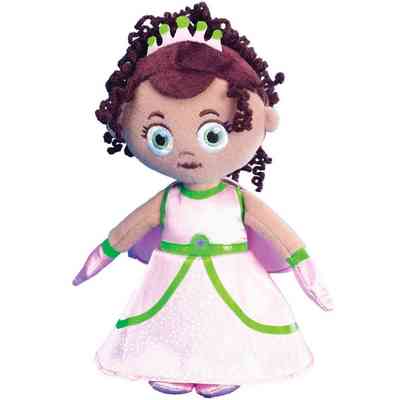
Yet the plush doll version of Princess Presto (who is supposed to have one White and one African American parent) looks significantly different:

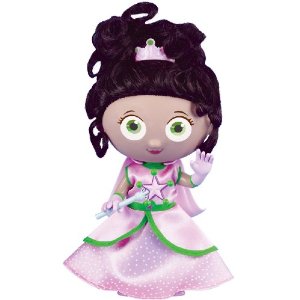
I found another Princess Presto doll online as well:

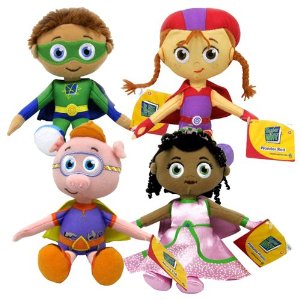
I did find one set where she looks more like the original:

Isis the Scientists says that in comments to an article on the topic at the Orlando Sentinel, someone claiming to represent the company says the plush doll looks more like the original in person than the pictures online and says the following:

…The hair on the doll is more purple than black and this was an aesthetic choice…The placement of the facial features was intentionally tweaked to make the embroidered beanies look cute, so there is a slight difference from the onscreen character. The alterations were similarly made across all characters in the line, not just Princess Presto. There are almost always slight differences when translating the onscreen characters to off-air product especially with regard to colors because we have to use PMS or CMYK color choices for products.

Isis says BS — that having seen an actual version of the plush toy, it looks like it does in the photo, with very light skin, and that aside from that, other manufacturers seem to be able to make African American dolls just fine. And saying you changed things for “aesthetic” purposes doesn’t explain why you thought her existing characteristics were insufficiently aesthetically pleasing. Of course, we also don’t know for sure the person writing the comment was from PBS.

I tend to side with Isis here: the idea that technical limitations prevent making a more accurate representation of a dark-skinned doll is…sketchy, to say the least, and makes me think PBS needs to partner with a better toy design firm. And the choices about what the Princess Presto doll should look like in doll form put PBS in the position of appearing to think that a mixed-race character needs to be whitened to sell. PBS’s dolls exist in a marketplace where we’ve seen controversies about African American dolls being literally valued less than White dolls, and whatever their supposed reasons, it’s hard to get around the fact that all of the choices made in the name of aesthetics added up to a doll that looks awfully White.