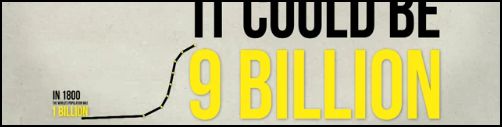
Well, it’s 2011. Sometime this year, the global population will pass the 7 billion mark. Jessica B. sent in this video, from National Geographic, that puts that into some perspective, showing the rapid increase in the pace of population growth over time:
Lester Andrist, at The Sociological Cinema, alerted me to a 9-minute short film revealing “Hollywood’s relentless vilification and dehumanization of Arabs and Muslims.” Created by Jaqueline Salloum and Dr. Jack Shaheen’s book, Reel Bad Arabs, it is a stunning and disturbing collection of clips. The depictions are grossly prejudiced and relentlessly violent. Andrist summarizes:
It demonstrates the way Arabs and Muslims are consistently depicted as religious fanatics, perpetual terrorists, backwards, and irredeemably tribal… [T]he media consistently propagates the idea that the Muslim or Arab terrorist is not only a threat to life, but also Western civilization.
Taking the analysis a bit further, I think the clip also allows one to contemplate how these depictions of Arabs and Muslims are simultaneously about constructing an American national identity, and in particular, a masculine one. In several places, one sees how an American masculinity, characterized by stoicism and poise, is set in contradistinction to an irrational, Islamic fanaticism.
It’s really a worth a watch, but very disturbing. Consider yourself warned:
The Media Education Foundation also made a full length documentary based on Shaheen’s book. The 5-and-a-half-minute trailer is a good indication of its content. It contains many similar disturbing depiction, including a discussion of Disney’s Aladdin, but also points to how Arabs are frequently shown as buffoons (“rich and stupid,” “oversexed,” and “uncontrollably obsessed with the American woman”).
This Tide commercial with Kelly Ripa, sent in by Joyce L., is an excellent example of one of the common themes in the marketing of cleaning products. Of course, cleaning products are almost entirely marketed towards women but, more, women are often portrayed as being absolutely OVERJOYED at the prospect of cleaning.
Indeed, Ripa is thrilled at the fact that a man spilled red wine on her white table cloth. She is so pumped that he has given her an opportunity to use her washing machine, that she cannot wait. She literally sweeps the table cloth out from under the party so that she can wash it immediately. And she is so excited that she invites the entire dinner party to partake, managing to communicate, in the process, her absolute adoration for Tide. I don’t know about you, but this is what it’s like at my house.
Dmitriy T.M. sent in this Dodge ad that associates cars with liberty and, by extension, America itself:
There are a few problems with this conflation of Dodge with patriotism and Americanness. For one, Dmitriy says,
Washington ( as the general) would’ve never been leading the charge. The commanders always stayed back ( preferably on the high ground) so that they could observe the progress and give commands ( and get away as quickly as possible in case of a loss).
So the image of the brave leader charging ahead of his troops into battle is misleading.
In addition, many Dodge vehicles aren’t made in the U.S. So Dodge wants us to associate its brand with the U.S. in a symbolic way that makes irrelevant, and invisible, where the car is made. What’s important is that Dodge, founded in the U.S., builds cars that represent a masculinized, tough version of “freedom,” and of course, freedom is uniquely American. It reminds me a lot of the symbolic identification Pabst Blue Ribbon drinkers often feel with blue-collar workers, an identification that has little to do with the actual production process.
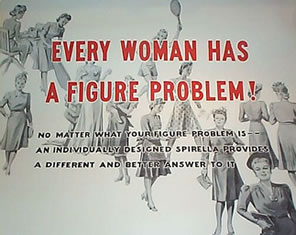
Anna J., a student at Rensselaer Polytechnic Institute, sent in this vintage ad for Spirella girdles that provides a good reminder of how women are repeatedly told that our bodies are never, ever acceptable as they are, but are always in need of “improvement” through the use of products (found at The Great Fitness Experiment):
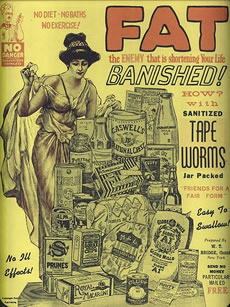
But hey, if you don’t feel like wearing a girdle, perhaps some tapeworms are your solution:
UPDATE: Reader Syd says the tapeworm ad is a hoax, though other readers disagree, and the practice itself definitely occurred. I don’t know how to find out, but since there’s at least some question about it, I’d take it with caution. However, commenter Angela pointed out that Tyra Banks recently had a story on tapeworms on her show:
As Anna points out, “It’s really interesting how ads have changed over time, but the expectation of culture that women be dieting has remained the same.” Certainly more people wouldn’t tell women to eat a tapeworm — sanitized or not — these days, but plenty of questionable products out there still promise weight loss with “no diet” and “no exercise,” and my bet is you could pick up any women’s magazine currently on the shelf and get a range of advice on how to make sure you lose any weight you might have gained over the holiday season.
Today I’ve got another of my occasional posts of various items related to gender and technology. All of these examples either reflect the male gaze in tech-related media or reinforce the idea that the primary creators and users of science and technology are males.
Morgan A. pointed out a recent cover of Wired, which she read about on Cindy’s Take on Tech:
In her post, Cindy points out that Wired often sexualizes or trivializes women when it puts them on the cover, or uses women to illustrate stories about other topics rather than focusing on their accomplishments. A few examples:
So the first one mentions being naked, the second has a woman displayed synthetic diamonds, the third uses a woman to illustrate a story about being famous even if you’re a “nobody,” and Uma Thurman appeared because she played a character in a movie based on a novel by Philip K. Dick.
I looked at all Wired covers from 2005 through 2010. Of those, 46 had people on them, in either human or cartoon form (including body parts, such as the boob cover), whose sex could be fairly well inferred. And 12 of those, or 26%, had a woman (or female character, as with the manga cover) either alone or pictured with men. Those 12 included several of the covers pictured above, as well as one showing the lower half of a woman’s face as she puts a pill in her mouth. The accompanying text is for an article titled “The Thin Pill.” When I went to the article, I found this set of photos:
So we have part of a naked woman’s body to represent the idea of thinness itself, one image of a male scientist quoted in the story, and another image of a clothed man who isn’t identified.
The twatterr post has a link to archives to see covers of back issues of a number of digital photography magazines, and as she points out, they tend to use lots of sexualizes images of (very thin) women. Passive, sexualized female robots/cyborgs are another common theme.
Merve G. sent in this video, titled “The Power to Create,” made by the University of Copenhagen. In the video, women are sexualized, and we see the male = active, female = passive dichotomy: men have the “power to create,” while women are the things being created by them:
Barbara B. N., a Research Fellow at the Technical University of Lisbon, sent in this Nokia video in which the woman describing the features of a Nokia product first makes sure to describe herself — she’s hot — and at the end of the video tosses her head seductively and invites you to choose another video to “see more of” her:
And finally, an anonymous reader let us know about the “Geek and Gamer Girls” video, a parody of Katy Perry’s “California Girls” created by four actresses who called themselves Team Unicorn:
As the sender-inner says, she feels conflicted about the video. On the one hand, the song does celebrate girls being geeky and into science and technology and other elements of geek culture often associated mostly with guys. But on the other hand, “the difference between the message I got from the song lyrics and the message I got from the video left me rather uncomfortable. I guess it’s only cool to be a geek girl if you’re really really pretty.”
(NOTE: I am writing this post on January 2nd, 2010… almost a year before it will publish. As I write it… I wonder if the wars in Iraq and Afganistan will still be ongoing.)
Last year Christmastime, Gin and Tacos highlighted this Walmart commercial:
He writes:
That commercial has nothing to do with Wal-Mart. It tells you nothing about its products, services, prices, or policies. It’s just sentimental pap, a cheap effort to bypass logic and score points on an emotional level.
Indeed, Walmart is attempting to associate its company with the admiration inspired by those risking their lives in war. Why this doesn’t result in a strong and consequential backlash is lost on me.
E.C.S. sent along this clip from Keeping Up with the Kardashians in which the world is introduced to Kim’s wax figure, to be installed at the famous Hollywood wax museum, Madame Tussauds. E.C. asks, and suggests and answer to, the question: What has Kim Kardashian done to earn a spot beside historic presidents and renown musicians? Kardashian, she explains, is being honored for her capitulation to patriarchy. She explains:
Using her attractiveness, and her sexual and social capital as tools, Kim has made herself both a career and fame by winning the attention of men…
E.C. is referring, here, to Kardashian’s patriarchal bargain. A patriarchal bargain is a decision to accept gender rules that disadvantage women in exchange for whatever power one can wrest from the system. It is an individual strategy designed to manipulate the system to one’s best advantage, but one that leaves the system itself intact.
Indeed, this is what Kardashian has done, and very successfully. So, for what is she famous? For making this bargain and getting such a good deal for herself. “Congratulations, Kim,” E.C. writes, “for being patriarchy’s perfect woman.”
Sociological Images encourages people to exercise and develop their sociological imaginations with discussions of compelling visuals that span the breadth of sociological inquiry. Read more…