Search results for embed


Many Americans are familiar with “female genital mutilation.”  The term is typically applied to practices occurring in some parts of Africa, Asia, and the Middle East, but not to genital cutting practices that happen in the U.S. and other Western societies (including cosmetic surgeries on the genitals, surgeries on children with ambiguous genitalia, and transsexual surgery) and, by definition, not to genital cutting practices that happen to men in both Western and non-Western countries (male circumcision and other rare but more extreme practices).  “Female genital mutilation” elsewhere, then, is widely condemned by Americans, but rarely condemned in light of these other genital cutting practices, nor America’s own history of genital cutting.  In fact, it was not unusual to subject women in the U.S. to proper circumcision (removal of the clitoral prepuce, or foreskin) until the 1960s and these procedures remained legal until 1996 (though, as far as I’m concerned, their legality is still up in the air).

In any case, RabbitWrite gives us a glimpse into this era in American history. Reading from a Playgirl published in 1973, she recounts the confessions of a woman who chose to be circumcised and offers a short critique.

Lisa Wade, PhD is an Associate Professor at Tulane University. She is the author of American Hookup, a book about college sexual culture; a textbook about gender; and a forthcoming introductory text: Terrible Magnificent Sociology. You can follow her on Twitter and Instagram.
Nils G. drew my attention to a fascinating now-abandoned America educational practice that nicely illustrates how ideas about ideal parenting shift over time.  Between 1919 and 1969, the Home Economics departments of about 50 colleges and universities served as foster homes for orphans. Writes Emily Anthes at Wonderland:

During this time, homemaking… was considered to be something that could be conquered by science. Running a home based on instinct was considered to be woefully old-fashioned; the idea that raising a child and maintaining a home could be optimized by following a set of scientific rules was gaining currency.

Accordingly, getting a degree in Home Economics included a labratory set up exactly like a home: “practice apartments.”  And what better to fill these homes with than “practice babies!”  Students would practice applying the latest science-endorsed parenting techniques on orphans.  An article published in the Journal of Home Economics in 1920, by Elizabeth Vermilye, explained the rotation of care:

Each girl, in rotation, carried the work of “baby manager” for one week… The “baby manager” assumed the entire responsibility for the care of the child during her period. She herself did the actual work of caring for him between the hours of 6.00 to 8.00 a.m. and from 4.30 to 6.00 p.m. During the day the child was in the care of three or four other students during the time they were not in class, the manager making the program for this care, giving instructions regarding food and other matters needing attention. The baby manager did the baby’s laundry work.

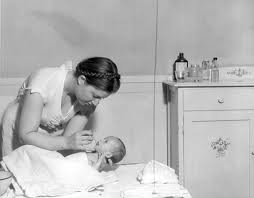
A student taking care of a practice baby:

Far from being exploited, it was believed that these babies would get not just excellent, attentive care, but the best, most scientifically-valid care.  Vermilye claims that the examining physician was highly impressed with the children’s development during their stay with the students.  She quotes him saying, “The improvement in the condition of these children speaks highly for your cooperative motherhood.”

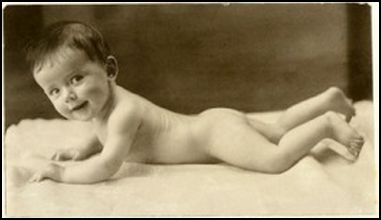
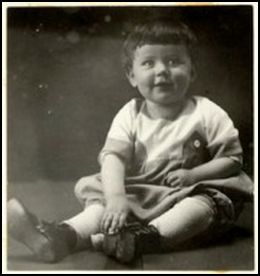
These pictures of orphan and practice baby Bobby Domecon (surnamed after his role in the Domestic Economics department) reveal his chubbification.

A skinny 6 pounds at 2 months old:

Perking up at age 10 months:

Nice and chubby 5 months later:

Because these children were believed to be benefiting from the latest science of parenting, they were highly adoptable; many couples were eager to get their hands on a child that had such a good start in life (source).

Eventually, however, ideas about mothering began to change.  In particular, scholars began to talk about Attachment Disorder and argue that a child’s development required that it strongly bond to one unique person.  In 1954, a short Time magazine article on the subject included experts suggesting that the program was harmful.  Starting with the Superintendent of the Illinois State Child Welfare Division, the author writes:

“It is not a normal family setting,” said he. “There are just too many persons involved in the handling of that child.”  Heaven only knows, added the superintendent, how many neuroses little David might develop. Other officials seemed to agree. “Imagine.” cried Mrs. Babette Penner, director of the Women’s Services Division of United Charities, “what anxieties there are in a child who is given a bottle in twelve or more pairs of arms.”

The scientific consensus eventually changed and, as a result, by 1969, then, “practice babies” were a thing of the past.

In this video from ABC Doris Mitchell, Cornell University graduate and Home Economics major, sweetly remembers her experience helping raise a practice baby at Cornell University:

For another fantastic example of historic management of children without parents, see our post on the Orphan Trains.

Lisa Wade, PhD is an Associate Professor at Tulane University. She is the author of American Hookup, a book about college sexual culture; a textbook about gender; and a forthcoming introductory text: Terrible Magnificent Sociology. You can follow her on Twitter and Instagram.

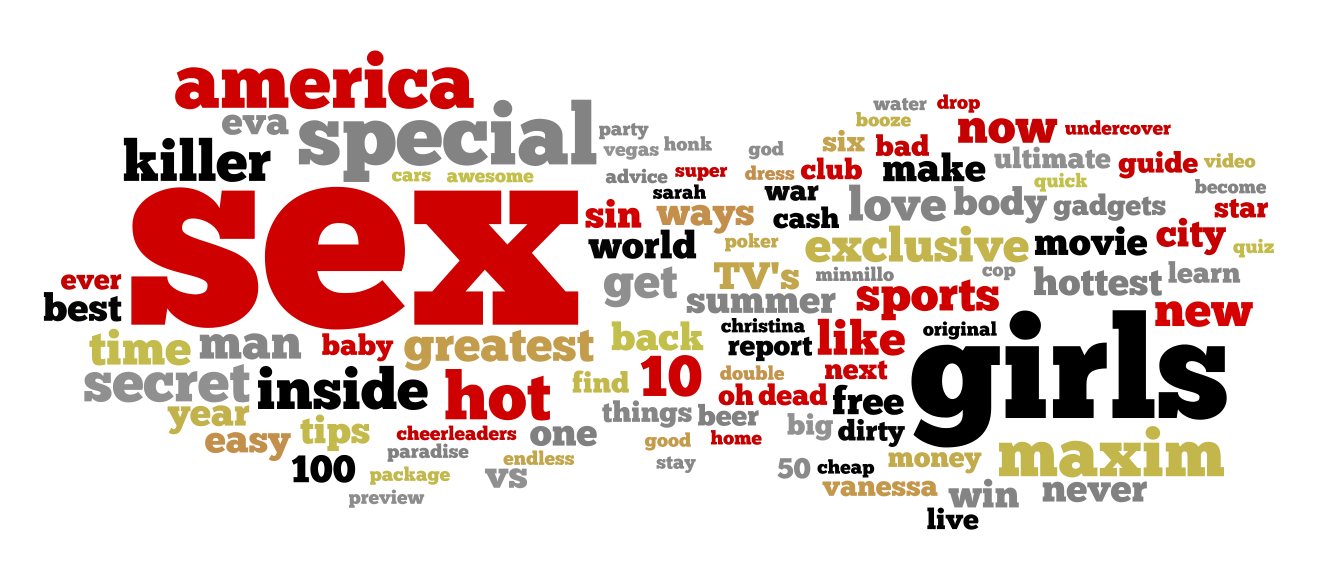
Jacqueline S. told us about a post at DarrenBarefoot comparing the words that appears most frequently on the covers of Cosmo and Maxim. Darren typed a list of every word that appeared on the covers for three years (2007-2010 for Cosmo, 2005-2008 for Maxim; he doesn’t explain why he chose different time periods) and then made word clouds to illustrate frequency. The results for Maxim:

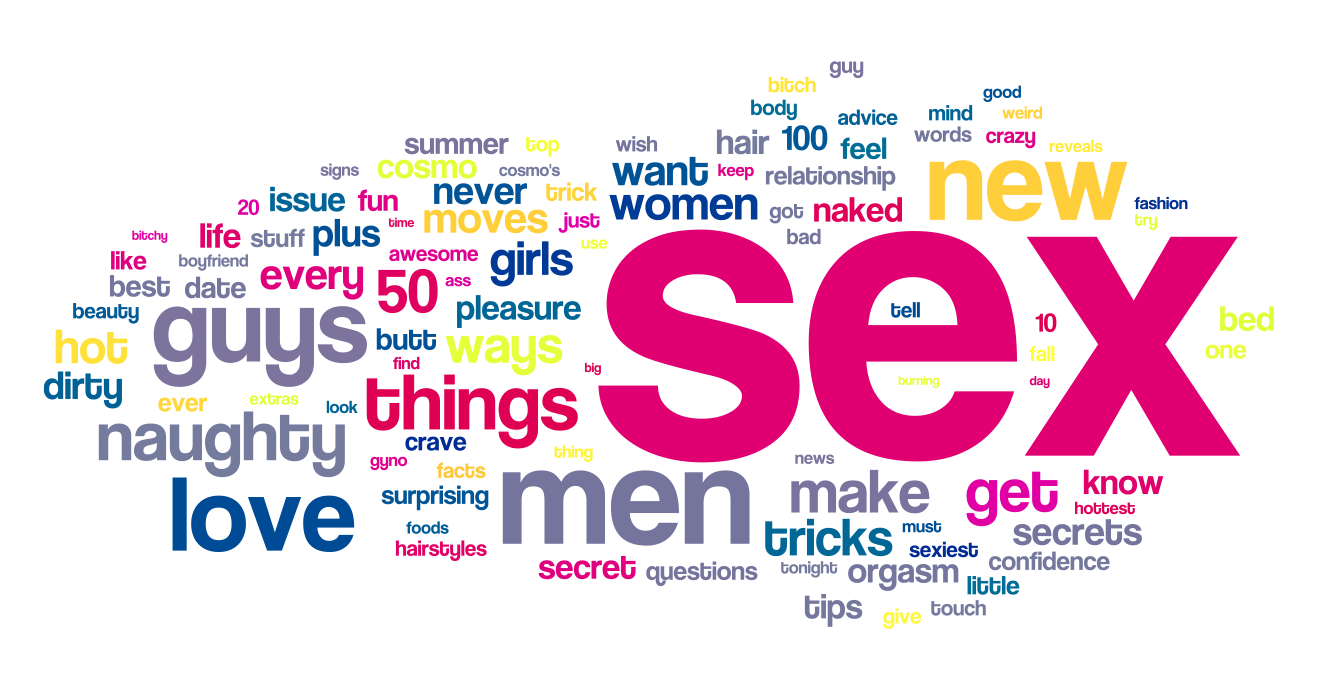
And Cosmo:

So in both cases, sex rules, followed by a reference to the category of people you’re supposedly interested in having sex with (since both magazines pretty much exclusively assume heterosexual relationships). The word “sex” or “sexy” appeared at least once on ever single Cosmo cover in the 3-year span, and most Maxim covers as well.

But notice how much more the language on Cosmo covers focuses on sex and relationships than Maxim‘s does, with more frequent use of words that explicitly refer to men and/or sex. Of course, those familiar with Cosmo, or most other women’s magazines, know that its headlines about sex make it clear what the point is: various ways to please your man, which translates into increasing your own pleasure. Maxim, on the other hand, focuses less attention on relationships (or health/fitness) and more on money, travel, and pop culture (sports, TV, movies).

To highlight how dominant sex is on Cosmo covers, Darren made a 15-second video of them in rapid succession, back and forth:

I doubt any of you are shocked by his findings, but it’s a nice illustration of the way magazines aimed at women reinforce the idea that our primary goal should be finding, pleasing, and keeping a heterosexual partner to a degree not usually found in men’s magazines.

Lee D.T. sent in an Australian ad for Fernwood Fitness. It’s a great example of the sexualization of women of color, specifically (compared to white women). Notice that the white women in the ad simply exercise, but the ambiguously-raced woman with darker hair and skin gyrates, pumps, and poses.

See also a history of the hypersexualization and exploitation of black women by white people, the hot Latina, the fetishization of black women’s butts as symbolic of their (supposed) hypersexuality, the only thing important about black people is their butts, and the frequent exposure of black women’s bodies.

Lisa Wade, PhD is an Associate Professor at Tulane University. She is the author of American Hookup, a book about college sexual culture; a textbook about gender; and a forthcoming introductory text: Terrible Magnificent Sociology. You can follow her on Twitter and Instagram.

Sam J. and Elizabeth H. sent in these commercials for the Toyota Highlander.  In both an (ungrateful brat of a) son explains that parents who don’t drive the Highlander — all of which, inexplicably, drive wooden-sided station wagons or minivans — are “lame” “geek[s]” who ooze “dorkiness” and are “utterly humiliat[ed].”  Somehow the words seem to distract from the real message: if you’re too poor to buy a brand new mid-range SUV, you suck.

Lisa Wade, PhD is an Associate Professor at Tulane University. She is the author of American Hookup, a book about college sexual culture; a textbook about gender; and a forthcoming introductory text: Terrible Magnificent Sociology. You can follow her on Twitter and Instagram.
Sometimes we save up submissions on a particular topic so we can show several examples at once. And today, ladies and gents, I thought I’d present a few items that, to greater or lesser extent, glamorize brutality toward women or use images of dead women as props. Yes, I know — happy day!

On the less graphic end of the scale, way back in June 2010, Rei sent in these two trailers for the A&E show The Glades, where women exist just as props who manage to remain sexy, despite the deadness:

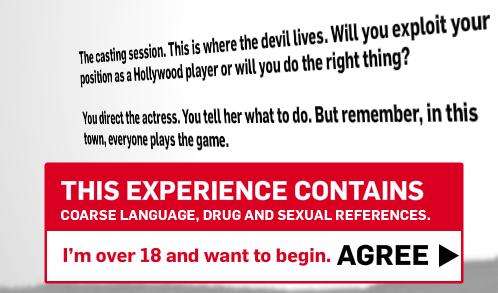
And some time ago Stefan Mesch, who writes for Die Zeit, let us know about the promotional website for Bret Easton Ellis’s new novel, Imperial Bedrooms. The website includes an interactive game where you’re a casting director and interact with a young woman who wants a part. From the homepage:

So theoretically, you have a choice — you can “exploit your position” or “do the right thing,” which presumably means not degrading or using a woman just because you can. But as Stefan explains, the options in the game are actually quite limited:

The game gives you options to talk to (and “encourage”) her, but they all lead to abuse, sexual harassment…The game rewards you for harassing the girl, and you’re supposed to drive up your personal score of “evil” by making her submit as much as possible.

Here are your first set of options:

I selected “encourage her.” The game then plays out a few seconds of dialogue and then leads to a second decision point, where I have these choices:

At least the first time I had one option to be a decent human being, other than not hiring her at all. I suppose that, in theory, giving someone booze might be a nice thing to do, but I think in this situation, probably nothing good can come of it. I selected that option; the director encourages her to drink when she doesn’t want to, and to drink more than she wants to. And then…

The “make her strip” option isn’t quite as bad as it might seem; when I chose it, she takes off her cardigan, but nothing else. At that point I felt like I’d pretty much gotten the point of the game, and wasn’t particularly interested in exploring how much of an asshole I could theoretically be, so I quit.

But both of those pale in comparison to our finale, readers. Dmitriy T.M. and Hope H. told us to check out Kanye West’s video for “Monster,” in which, among other things, Kanye casually rearranges the lifeless bodies of two women in bed with him:

Images of dead-looking women’s bodies appear throughout the video (which also features Jay Z and Nicki Minaj). I’m putting the rest of the images after the jump, as they might be particularly upsetting to some readers:
more...


On today’s SportsCenter, ESPN closed out showing their “This is SportsCenter” commercials. As described on ESPN’s official YouTube, “This is SportsCenter” channel:

This is SportsCenter is the name of a series of comical television commercials run by ESPN to promote their SportsCenter sports news show. The ads are presented in a deadpan mockumentary style, lampooning various aspects of sports, and sports broadcasting. The commercials debuted in 1994.

As of tonight (December 24, 2010), ESPN’s YouTube channel profiles 77 of these short videos. Not every “This is SportsCenter” commercial is profiled, but I’m just going with what is up on this page now as the sample data set. I generally enjoy these commercials. Many of them are witty, and they are all short (around 30 seconds). Here are a few examples:

As can be seen, the commercials typically profile a famous athlete and/or a SportsCenter anchor, and on occasion a non-sports-related celebrity (e.g., Richard Simmons). In examining what athletes the commercials profile on ESPN’s YouTube page, a highly predictable trend emerges. Here are the individual athletes the commercials profile (note: when no athletes are profiled and only anchors, gender of anchors profiled noted instead):

  1. Dwight Freeney (football; male)
  2. Derek Jeeter (baseball; male)
  3. Floyd Mayweather (boxing; male)
  4. Tim Lincecum (baseball; male)
  5. Wayne Gretzky (hockey; male)
  6. Dwight Howard (basketball; male)
  7. David St. Hubbins (musician; male)
  8. Arnold Palmer (golf; male)
  9. Oregon Duck (football; gender neutral)
  10. Usain Bolt (track & field; male)
  11. Larry Fitzgerald (football; male)
  12. Matt Ryan (football; male)
  13. Brett Favre (football; male)
  14. Adrian Peterson (football; male)
  15. Joe Mauer (baseball; male)
  16. Adrian Peterson (football; male)
  17. Manny Ramierz (baseball; male)
  18. Josh Hamilton (baseball; male)
  19. SportsCenter Anchors (all male)
  20. Jimmie Johnson (car racing; male)
  21. SportsCenter Anchors (all male)
  22. Manny Ramirez (baseball; male)
  23. David Ortiz & Jorge Posada (baseball; male)
  24. David Wright (baseball; male)
  25. Chad Ochocinco (football; male)
  26. Chad Ochocinco (football; male)
  27. Ladanian Tomlinson (football; male)
  28. Chad Ochocinco (football; male)
  29. Tony Romo (football; male)
  30. Paul Pierce, Kevin Garnett, & Ray Allen (basketball; male)
  31. Michael Phelps (swimming; male)
  32. Ladanian Tomlinson (football; male)
  33. Jim Kelly (football; male)
  34. Dale Earnhardt Jr. (car racing; male)
  35. Chad Ochocinco (football; male)
  36. Stephen King (writer; male)
  37. Michael Phelps (swimming; male)
  38. Jimmy Rollins (baseball; male)
  39. Richard Simmons (fitness pro; male)
  40. Maria Sharapova (tennis; female)
  41. Steve Smith (football; male)
  42. Jose Reyes (baseball; male)
  43. Pat Summit (basketball; female)
  44. Dale Earnhardt Jr. (car racing; male)
  45. Carmelo Anthony (basketball; male)
  46. Chris Paul (basketball; male)
  47. Keyshawn Johnson (football; male) & Kobe Bryant (basketball; male)
  48. “Moving the Franchise” (all male anchors)
  49. “Yahtzee” (male anchors)
  50. Kerri Strug (gymnastics; female)
  51. “Talent Search” (male anchors)
  52. Globetrotters (basketball; male)
  53. Dan O’Brien (track & field; male)
  54. “Journalistic Integrity” (male anchors)
  55. “Sportscaster Celebrities” (male anchors)
  56. “Live on the Set” (predominantly male anchors; female anchor at end)
  57. Michael Andretti (car racing; male)
  58. Gordie Howe (hockey; male)
  59. “Reading Lips” (all male anchors)
  60. “Makeup Buddies” (all male anchors)
  61. “Athletes Bribing” (multiple male athletes from different sports)
  62. George Mikan (basketball; male)
  63. Mary Lou Retton (gymnastics; female)
  64. “Tour” (all male anchors)
  65. “One Track Mind” (predominanty male anchors; female anchor at start)
  66. “Shoot” (female anchor)
  67. “Paws” (all male anchors)
  68. “Serious Journalism” (all male anchors)
  69. “Write Your Own Stuff” (all male anchors)
  70. “Sweet Science” (predominantly male anchor; short appearances by a female anchor)
  71. “Potty Talk” (male anchor)
  72. “Memories” (all male anchors)
  73. Keshawn Johnson (football; male) & Kobe Bryant (basketball; male)
  74. Glenn Robinson (basketball; male)
  75. Barry Melrose (hockey; male)
  76. Landon Donovan (soccer; male)
  77. Jimmie Johnson (car racing; male)

When going through the data set, we find that out of the 77 commercials, women only appear 8 times (10.4%), in some cases in relatively peripheral roles. When looking specifically at athletes, only 3 female athletes are profiled, all 3 of whom represent historically “acceptibly feminine” sports: Mary Lou Retton and Kerri Strug (both gymnasts) and Maria Sharapova (tennis). One commercial profiles Pat Summit, the famous women’s basketball coach from the University of Tennessee. All other commercials featuring athletes have males.

Examining the content of the commercials is also important. For instance, the commercial with Sharapova clearly relies on Sharapova’s status as a femininized beauty figure in athletics. And while all the commercials are “presented in deadpan mockumentary style,” the humor clearly calls upon dominant notions of heterosexual masculinity — take for example the commercials that mock femininity among males, such as those in which the male anchors share makeup and mock Richard Simmons as a conditioning coach.

The trends shown here are highly predictable. It is hardly surprising that males are over-represented numerically in the commercials, both as athletes and anchors. Likewise, it is unsurprising that the humor utilized in these commercials so often mocks femininity among males in the sporting world or uses female athletes as sexualized figures.

What we see here in ESPN’s “This is SportsCenter” commercials is the typical way that gender is constructed in sport — patriarchy is reified within an institution historically reserved for heterosexual males.

———————————–

David Mayeda is an Assistant Professor in the Department of Sociology and Legal Studies at Hawaii Pacific University.  His recent book publications include Celluloid Dreams: How Film Shapes America and Fighting for Acceptance: Mixed Martial Artists and Violence in American Society.  He also blogs at The Grumpy Sociologist.

If you would like to write a post for Sociological Images, please see our Guidelines for Guest Bloggers.

In the 22-minute short film below, titled MouseTrapped 2010, employees of Florida’s Walt Disney World plead with Disney to negotiate a fair contract with their Union. The film is interesting on two accounts. First, is a good example of the low wages in many service industries. Sociologists refer to the “working poor” to describe people who work full-time and yet still cannot make ends meet. Some of the employees in this video take second jobs, live with their parents or siblings, routinely take food from church food banks, or receive food stamps.

Second, it is an example of a new bargaining tactic: widespread public pressure. This tactic is possible only because of developments in the last decade: the affordability and accessibility of the technology required to put together a short video like this and the medium of youtube that allows the employees to reach potentially millions of viewers for free. It’s working too; Jordan G. spotted this video at Boing Boing, one of the most widely read sites on the web.

Part I of II:

Part II of II:

Lisa Wade, PhD is an Associate Professor at Tulane University. She is the author of American Hookup, a book about college sexual culture; a textbook about gender; and a forthcoming introductory text: Terrible Magnificent Sociology. You can follow her on Twitter and Instagram.