Search results for embed

The California Milk Processor Board, the group responsible for the Got Milk? and Happy Cows ad campaigns, produced “Medusa,” a commercial about a princess whose “ugly hair” destroys her chances for love…until, of course, a  man comes along who knows how to tame her hair, make her beautiful, and “conquer her love,” allowing her to finally get married:

I get that her hair is made up of snakes, but as a person with incredibly curly, unpredictable, shall we say boisterous hair, I can’t help but notice that the beauty ideal espoused here clearly calls for sleek, straight, controlled hair.

Sarah Haskins takes on the fairy tale trope in commercials aimed at women, including my favorite, a milk ad in which the princess’s PMS mood swings cause a tidal wave of her tears that threatens her entire realm:


Nicole S. sent in this great example of the way that differences in bodies are used to infer a wide-range of non-anatomical differences between boys and girls (or, in this case, the other way around).

Lisa Wade, PhD is an Associate Professor at Tulane University. She is the author of American Hookup, a book about college sexual culture; a textbook about gender; and a forthcoming introductory text: Terrible Magnificent Sociology. You can follow her on Twitter and Instagram.

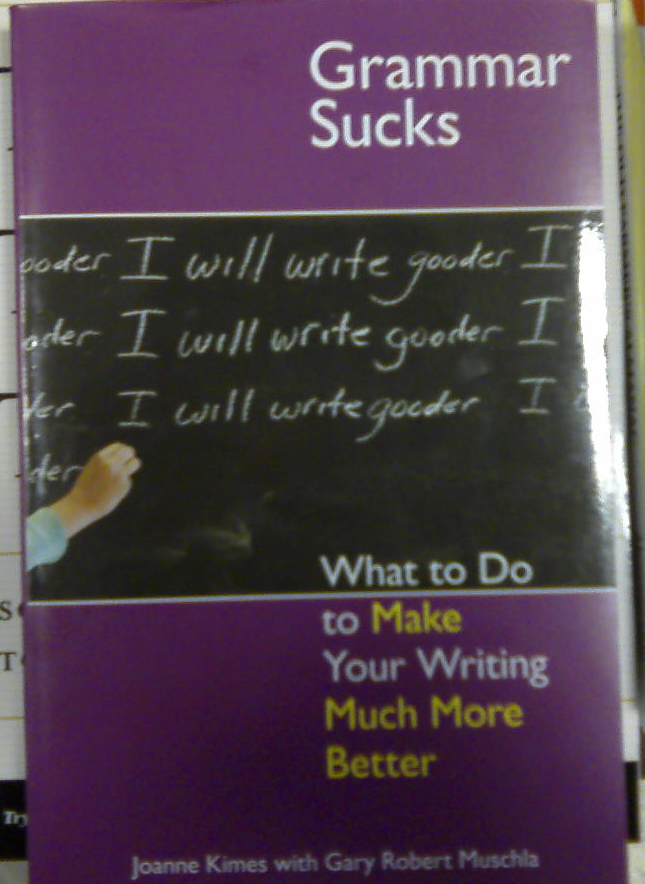
I was walking through the University bookstore today to pick up beginning of the semester office supplies, when this book, Grammar Sucks: What to Do to Make Your Writing Much More Better, caught my eye:


Back cover text:

Do you suffer from grammar phobia because…

  • You’re so used to IMing, you’ve forgotten how to write a normal sentence. :- )
  • You’ve started thinking in rap lyrics.
  • Last time you gave a report, your handout got you laughed out of the room.

What made this book seem blog-worthy to me is the not-so-subtle coded language used to refer to those speakers who the book cover authors (maybe not the book authors) feel are culpable for the degradation of language.  I want to consider the second point specifically: “…thinking in rap lyrics.”

Ok, of course not all rappers are black, but it is an art form that is so solidly identified with the African American community.. And, of course, they’re not really talking about “rap lyrics,” they’re talking about AAVE (African American Vernacular English). This is an offensive and transparently coded throwback to the linguistic inferiority of African Americans.

AAVE is a dialect of English just like all dialects, and has a fully articulated syntax, morphology and phonology. It is NOT a broken or mislearned form of the dominant dialect. And people certainly don’t speak AAVE because they failed to learn arbitrary writing conventions in school (e.g. “Don’t start a sentence with a conjunction”) , which appear to be the topic of this book.

But, let’s take them at their word. Maybe you have grammar phobia because you’re thinking in rap lyrics. Do you mean, like, you’re freestyling in your head all the time? Do you mean you’re kind of like this guy?

You mean, all your thoughts have flow, and rhyme, are creative, and drop properly formed Spanish imperative verbs? To the book cover authors: you fucking wish. I mean, I wish I could do that.

In the context of the book, it makes a clear point: If you are young, and black (and your hat’s real low), you’re not worthy of social respect, or economic achievement.

Needless to say, I went on to go buy my office supplies, and didn’t read the body of the book. I can’t really tell you if it gave any good advice that made any sense. This book is just another case where supposed discussion of language isn’t really about language. It actually ties in nicely with my previous post on how people discuss language in terms of morality. Here, the book cover authors are laying blame on the same groups of people that are accused of leading moral decay: youth, and racial and ethnic minorities.

——————————-

Josef Fruehwald is a graduate student in Linguistics at the University of Pennsylvania. His research focuses on theoretical models of language variation and change. He frequently blogs about the relevance of linguistic research to language attitudes (among other things) at Val Systems.

If you would like to write a post for Sociological Images, please see our Guidelines for Guest Bloggers.

Lisa and I have posted before about the way that food products are often marketed by conflating them with women’s bodies and reinforcing that the desirable female body is thin, but with the right type of curves. Non-food items are marketed this way too — for example, in one ad, Sunsilk Shampoo’s packaging underwent “a little nip, a little tuck” and came out a bit curvier.

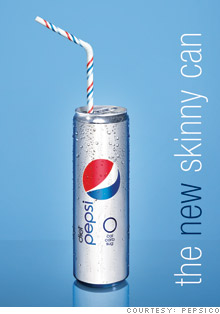
In another perfect example of this, Mary R., Megan D., and Carey Faulkner, who is a Visiting Assistant Professor of sociology at Franklin & Marshall College, let us know about a new container from Pepsi. The new Diet Pepsi “skinny” can is, according to the company, “sassier” and a “celebration of beautiful, confident women.” The can will debut this month, in conjunction with New York’s fashion week. Reinforcing the conflation of thinness, beauty, and fashion, their chief marketing officer, Jill Beraud, said, “Our slim, attractive new can is the perfect complement to today’s most stylish looks”:

Just so we don’t miss the point, the Pepsico press release refers to the can as “attractive” three times, twice with the phrase “slim, attractive.” Because ladies, never, ever forget: thin = beautiful. Always.

Pepsi has also partnered with a number of designers for the advertising campaign, including everything from a window display by Simon Doonan to a t-shirt “inspired” by Diet Pepsi by Charlotte Ronson to giving away Diet Pepsi in the skinny can at a number of fashion boutiques in several major cities.

Don’t worry, though — CNN reports that if you prefer your soda “short and fat,” the regular cans will remain on shelves.


Following up on our cartoon poking fun at the skimpiness of battle gear for women, Lindsey V. sent in a considerably-humorous skit in which two great sports are dressed in the sexy outfits of two genuine-video-game-characters and set to battle.  Hijinks and wardrobe malfunctions insue:

Lisa Wade, PhD is an Associate Professor at Tulane University. She is the author of American Hookup, a book about college sexual culture; a textbook about gender; and a forthcoming introductory text: Terrible Magnificent Sociology. You can follow her on Twitter and Instagram.

Josh Leo brought our attention to something he started thinking about recently: the use of the word “hobo” among kids. This started when he saw a video of kids reacting to the Ted Williams, the man who became famous after a video of him panhandling at an intersection and displaying his “golden voice” went viral. Josh was struck with the way the kids talk about individuals who become homeless and, in particular, the repeated use of “hobo” to describe him (they discuss Williams in the first 2 minutes):

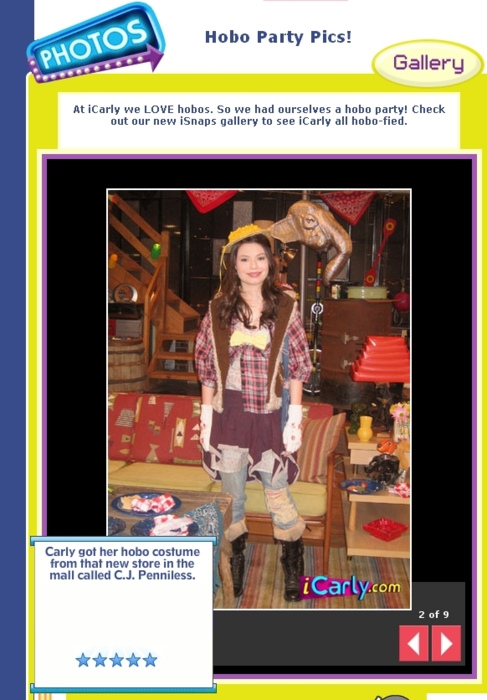
Since one girl attributed her use of “hobo” to the TV show iCarly, Josh did a little searching and discovered that the show’s official website contains a set of photos of the cast dressed up for a Hobo Party, complete with captions that make fun of or trivialize poverty and homelessness, including this first one that refers to the store “C.J. Penniless”:

A quick google search turns up lots of images of and suggestions for throwing hobo parties (including a video of a “Hobo House Party,” in which four people in costume dance in a cardboard box). Now, my guess is a lot of people would argue that references to hobos today aren’t really about homelessness now, since it’s a term often associated with the Great Depression. Indeed, a lot of the hobo party sites I found referred to the Depression or suggested 1930s-type clothing. But the video of the kids’ reactions certainly shows that they don’t just see it as a term for people in the past; they clearly connect it to homeless people today.

This trivialization of homelessness and poverty isn’t just on kids’ shows, though. It reminded me of a segment The Daily Show did recently about a news affiliate in Indianapolis that decided to see if any local homeless individuals could be the city’s own “golden-voice” (the segment starts at about 1:30 in):

Such a news story could humanize homeless individuals, of course. Instead, the news segment treats the two women as sources of entertainment whose value comes only from the possibility that they might surprise us by having a “hidden talent.” The idea that it would be shocking to find a homeless person with an amazing gift presumes that people who have skills or talents don’t become homeless, while also presenting the solution as very individualistic: if you’re the next Ted Williams, you can have a house and a job too!

Gwen Sharp is an associate professor of sociology at Nevada State College. You can follow her on Twitter at @gwensharpnv.

Coverage of the Egyptian protests this week disproportionately interviewed and photographed male protestors, occasionally using the terms “Egyptian men” and “protestors” interchangeably (excellent example here).  What images we did receive of women depicted them as separate from the demonstrations if not dependent on male guardianship.  The paucity of images or stories about women activists excludes them from the national uprising and silences their protests.

Outside of the mainstream media a widely circulated photo album, available to anyone with Facebook, collected over a hundred pictures of Egyptian women demonstrating. Curation of this album during the internet blackout, when nearly all images were filtered through the media, serves as a testament to the value of diaspora and transnational networks.  Additionally, placing these images side by side becomes a powerful counter to women’s media invisibility and highlights diversity of backgrounds, opinions, and forms of protest undertaken by Egyptian women.

It might be worth nothing that we’re seeing more stories about women since a You Tube video (below) of a woman calling for people to join her in protest on January 25th caught the attention of the media.  Namely this excellent NPR story and an AFP article.  Lastly, anyone interested in social media should visit this Facebook group.

April Crewson is completing her masters in Gender Studies at the School of Oriental and African Studies, University of London.

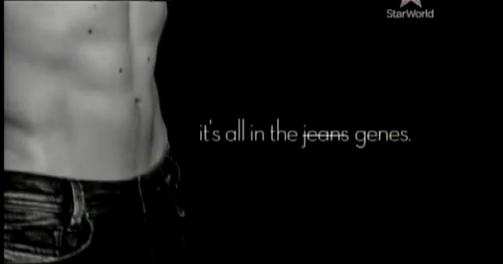
“You can’t be taught the skills to model, because first and foremost, skill doesn’t matter.  It’s all in the jeans genes.”

So notes a shirtless man, a self-described “male mannequin” in commercials for Next Top Model in Vietnam:

My sociological knee-jerk reaction is to point to the ways in which models’ labor is deliberately rendered invisible, masking performance as mere appearance, in much the same way social categories are naturalized to appear like states of being instead of products of social organization — think gender, ethnicity, class, and yes, beauty.

As concerns the category of beauty, there is considerable work involved in pulling it off.  Like retail service workers, models do “aesthetic labor,” as documented by sociologists Elizabeth Wissinger and Joanne Entwistle and more recently by Christine Williams and Catherine Connell.  Aesthetic labor is the work of manipulating one’s physique and personality to embody a company brand.  In the modeling market, some people easily have that physique, as the shirtless guy claims to have, but most models have to fight for it, and they’re fighting against the clock of aging.  If they don’t have to work for cut abs and narrow hips, they most likely still feel compelled to work at it, given the rampant uncertainties facing them in their daily grinds of auditions and rejections.  All of this work gets carefully tucked behind the scenes of fashion and beauty images — a clandestine world NTM purports to expose for voyeuristic consumers around the world.

But instead of exposing it, the NTM franchise caricatures it.  In the American version, Tyra Banks insists that effort is everything, and she axes candidates left and right because they didn’t “want it badly enough.”  She just didn’t work hard at it, goes the usual dismissal, or she lacked the determination to keep smiling when Jay Manuel told her that her face is weird.  It’s not that you’ve got the wrong look, the show tells contestants, but that you didn’t put in the work to get the right one.  NTM sticks close to an individualistic ethos:  if you fail, it’s because you lacked the individual effort needed to succeed.

Success in any culture industry is a mix of both hard work and the luck of being the “right” contender at the right moment, which is somewhat arbitrarily decided in any given fashion season.  Saying that success is “all in the genes” renders the “look” into a natural state of being, when like all culture industries, modeling is a complex social production.

Saying it’s all in the jeans is also pretty funny.  Let’s not overlook this guy’s self-deprecating humor:  here’s a man surrendering himself (and his manhood) to the whims and preferences of fashion, an industry widely believed to be controlled by women and gay men.  In other ads he mocks his talent and wryly notes the biggest hazard in his line of work: wearing leopard print g-strings (to say nothing of occupational challenges like the precarious nature of freelance labor, the lack of health and retirement benefits, or the unpaid labor of castings and magazine shoots).  What’s most striking about this guy and his seductive black-and-white commercial is not the sociological back story, it’s his own silliness.  He’s playing on the ironic gap between social expectations of masculinity and the realities of being featured as a passive visual object.  We probably wouldn’t be so charmed if the commercial featured a young woman laughing about her job title: “I’m a professional model!”  We’d probably roll our eyes.  The source of that silliness—unequal cultural expectations about the display value of men and women—is as problematic as it is good fodder for comedy.

Ashley Mears is a former model and current Assistant Professor of sociology at Boston University who is doing fantastic work on the modeling industry.  In her book, Pricing Beauty: Value in the Fashion Modeling World (UC Berkeley Press), she examines the production of value in fashion modeling markets.

Gwen Sharp is an associate professor of sociology at Nevada State College. You can follow her on Twitter at @gwensharpnv.