Search results for embed

Dolores R. sent in a story at about a recently-released internet campaign ad in the CA-36 special election that Talking Points Memo has called “Willie Horton on steroids,” referring to the infamous racial-fear-mongering ad released by George H.W. Bush in the 1988 presidential campaign. The CA-36 ad was released by a new super-PAC (able to raise unlimited funds), Turn Right USA. (The guy who produced it also produced a striking ad for a candidate for Alabama Agriculture Commissioner in 2010.) It attacks Democratic candidate Janice Hahn over her support for gang intervention programs. And it’s a doozy. It is definitely NSFW:

Aside from the just over-the-top racist and sexist nature of the ad, it’s also interesting because of the issues it brings up about technology and democratization of ad campaign materials. Turn Right USA isn’t directly linked to or affiliated with the campaign of Hahn’s Republican rival in the race, Craig Huey. Huey’s campaign has reacted with dismay, condemning the content and distancing themselves from it. They clearly fear a backlash that will hurt Huey’s chances (and he’s already the underdog in the race). And yet, they didn’t create the ad, there’s no evidence that I’ve seen that they worked with Turn Right USA, and they don’t have any ability to take it down or symbolically fire the producer to show how little they think of it. We saw a similar situation recently in Florida, with a mailer apparently intended to discredit a candidate who had nothing to do with it.

While non-campaign-funded attack ads clearly helps candidates in a lot of situations (for instance, the Swift Boat Veterans for Truth ads against John Kerry in 2004), they can also hurt the candidate they’re meant to help. Campaigns can’t control their content and they can’t retract them if they sense a public backlash. Voters may blame candidates for content they didn’t approve and can’t fix. And the increasing number of third-party advocacy groups, combined with the ability to distribute materials widely over the internet instead of buying TV time, seems likely to increase the danger to campaigns of these types of ads ostensibly meant to “support” them.


In a capitalist economy, one way for an entrepreneur to succeed is by creating an insecurity and offering a product to address it.  I’m going to call “need creation” on You Go Girl, sent in by Clare.  The marketing for You Go Girl revolves around the “plume” released by your toilet.  Beware, it says, while you attempt to flush it your urine is actually rising from the toilet to descend on your toothbrush and your boyfriend’s nostrils.

The commercial suggests that you should use the product both for our health and because we should be embarrassed if someone can tell we’ve urinated.  Only women, however, who are stereotyped as being both cleaner and more concerned with hiding bodily functions, are targeted (note the name of the product).

This isn’t the only product aimed at reducing the odor associated with urination.  Fresh Drop Bathroom Odor Preventer is another option for those of us worried about our urine clouds, and this one is for men too!

Lisa Wade, PhD is an Associate Professor at Tulane University. She is the author of American Hookup, a book about college sexual culture; a textbook about gender; and a forthcoming introductory text: Terrible Magnificent Sociology. You can follow her on Twitter and Instagram.

A few weeks back, Forbes named Pittsburgh as the most livable city in the U.S. The description of the city talks about its “art scene, job prospects, safety and affordability,” and presents a picture of Pittsburgh as a city that has rebounded from both its industrial past and the current economic crisis to become a cultural and intellectual hotspot:

Forbes ranked cities based on unemployment, rates of income growth in the past 5 years, crime rates, cost of living, and cultural/artistic opportunities (according to Sperling’s Best Places Arts & Leisure Index). The final score is an average of the different elements, each of which are weighted equally, though I can’t help but think a lot of people might think some of those factors are more important in how they evaluate a location than others. Also, I have some reservations about rankings from Sperling’s Best Places, as they have a “manliest cities” ranking commissioned by Combos snacks that includes “sales of salty snacks/crackers” and deductions for “emasculating” criteria like sushi restaurants.

But I digress. As it turns out, this glowing report is only part of the story of Pittsburgh. The city also tops the charts in terms of African American poverty. African Americans in the region haven’t benefited from the economic turnaround Forbes discussed.

In light of this fact, Jasiri X, a rapper from Pittsburgh, wrote “America’s Most Livable City.” In the song (lyrics here) and video he questions who, exactly, the city is livable for, contrasting the image portrayed in the Forbes article with the region’s neglected and under-developed African American neighborhoods:

There are also three videos featuring Jasiri X interviewing residents of poor neighborhoods. All are worth a watch, but I think the best is the 2nd segment. A local resident discusses how what he sees as exaggerated media reports of the crime and danger in some areas — some created by well-meaning people trying to bring attention to the needs of the community by, he believes, playing up the bad aspects — served to justify abandoning Black neighborhoods in desperate need of economic opportunities:

For another discussion of very different experiences of economic crisis and recovery, see our guest post about Forbes ranking Stockton, CA, as the most miserable city in the U.S.

Thanks to Abby Kinchy for the link.

Cross-posted at Jezebel.

Earlier this week I posted about the Badminton World Federation’s attempts to change the dress code to require women to wear skirts or dresses as an effort to give a more “attractive appearance.” The changes emphasized certain standards of femininity over concerns about how the clothing changes might impact players’ performance. Rodeo queen competitions illustrate this tendency to value feminine appearance over the skill or physical prowess the women are ostensibly there to perform.  A rodeo queen competition is sort of an amalgam of a beauty pageant and rodeo or riding competition; the winners serve as ambassadors, promoting rodeo, riding in parades, and so on. Though the events usually have many of the trappings of a standard beauty pageant — appearance and personality are both judged — the riding elements (which may include barrel racing, reining demonstrations, etc.) provide a sense that this isn’t just about meeting standards of femininity, but also athletic ability.

But a video Lisa sent me about a recent rodeo queen competition in Utah New Mexico makes it clear where the emphasis lies. If you don’t care greatly about horse-related things, you may not know that there has been an outbreak of equine herpes in the western U.S., which is extremely contagious, may be fatal, and spreads through nose-to-nose contact. As a result, many horse-related competitions have been canceled or postponed. But the Davis County Sheriff’s Mounted Posse Junior Queen Contest in Farmington, Utah, found a way to continue with the competition — they had the contestants ride stick horses around the arena, something I can’t imagine being done with, say, roping competitions and other male-dominated rodeo events that could be altered to create a horseless version:

Some images from the story at KSL:

I can’t help but feel this undermines efforts to separate rodeo queen competitions from beauty contests. In fact, the Miss Rodeo USA site says that appearance and personality make up 80% of the competition, and riding skills only 20% — and personality and appearance count when judging the riding, too. And while having women ride children’s toys around an arena may still test the women’s knowledge of the patterns, and requires them to show physical stamina, it also seems infantilizing and silly. It makes it clear that rodeo queen competitions have little to do with horse riding skills, which are entirely dispensable in a pinch.

UPDATE: Well, I stand corrected. Reader Zula did find a video of another competition (cutting) in which the men used stick horses due to a 2001 equine herpes outbreak, with a lot more falling in the dirt than in the clip above:

UPDATE 2: Reader Megan says,

I have zero experience with rodeo, but I do ride hunters and foxhunters on the East coast. I know that there are a lot of technical points that could easily be demonstrated while on a stick horse. Obviously, completing certain movements is a lot easy when you have direct control over your legs rather than asking a 1000 pound animal to step to the side with a careful nudge. Despite the “challenge” being removed, these contestants can still demonstrate a large amount of knowledge and understanding on stick horses. I watch lots of kids playing “horse” when they can’t be riding: cantering around, changing leads, and jumping jumps. Those kids take turns and critique each other’s forms, working on learning cadence, balance, timing, and adjustability.When I was a kid, I did the same thing.

So, I absolutely must state that I understand the idea behind the substitution and it didn’t entirely degrade the competition.

UPDATE 3: Alexandra Hinton wrote a humorous reply over at Fem Pop that’s worth a look.

David Banks, who blogs at Cyborgology, let us know that Gawker has posted an anti-union video Target shows to new hires. Apparently as some Target stores have started carrying groceries, some grocery workers’ unions have made efforts to unionize some stores, a move that Target, along with its larger big-box sibling, Wal-Mart, finds very threatening. The video includes a lot of common arguments — we’re all a family here, the union just wants your dues, etc. — along with some I found more unusual:

Full transcript here.

What I found especially striking was the segment starting at about 3:10, where they argue we don’t need unions because, basically, they were so effective in the past, they already fixed everything! There’s no more child labor, you can get worker’s comp if you’re injured…what more could you need a union for? So on the one hand, today unions are useless, empty organizations that just take your money and give you nothing, but in the past, they were great. Presumably employers only had to be told once to clean up, and then for all time everything is fixed.

I also liked David’s point about the video’s use of the idea of communal vs. individual action. On the one hand, the video repeatedly stresses the rights of the individual and suggests that unions interfere with an individual’s ability to make their own choices (and implying that all union contracts are identical and will be imposed on workers, rather than the outcome of negotiations). But as David points out, the video includes rather contradictory messages about individual and collective action, with the union presented as the bad collective but Target as the good, familial, happy collective:

The video manages to seamlessly contradict itself: the company is a communal entity while simultaneously granting each individual total autonomy. The union does the opposite- it pressures you into collective action while you’re trying to be a neoliberal individual, and it makes you break away from the “Target Family” when they’re trying to be communal.

Target has often avoided the negative publicity aimed at Wal-Mart about labor practices, treatment of workers, and anti-union activity; I know when I was an undergrad back in the ’90s, and anti-Wal-Mart activism was one of the topics of the day, some of my friends and I thought that shopping at Target instead of Wal-Mart meant we were really doing something meaningful in terms of opposing bad labor practices. But as this video illustrates, Target has fairly similar labor policies to Wal-Mart, whatever you think of them, just with less global market power to throw around.

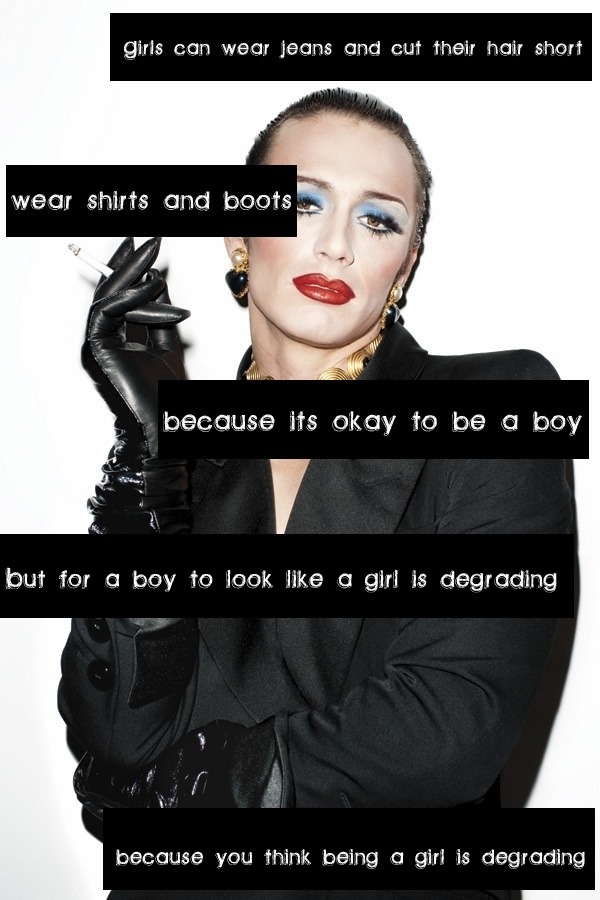
Sociologists use the term “androcentrism” to refer to a new kind of sexism, one that replaces the favoring of men over women with the favoring of masculinity over femininity. According to the rules of androcentrism, men and women alike are rewarded, but only insofar as they are masculine (e.g., they play sports, drink whiskey, and are lawyers or surgeons w00t!). Meanwhile, men are punished for doing femininity and women… well, women are required to do femininity and simultaneously punished for it.

Illustrating this concept, much more concisely, is this altered photograph of James Franco in drag. Sent along by Stephanie V., the photo was originally for the cover of Candy, a “transversal style” fashion magazine.  I’m not sure who added the copy,* but I like it:

* So Caro Visi, where I found the image, credits Virus, but I can’t find it there.  I’m happy to properly credit if someone can point me in the right direction.

UPDATE: Sarah and John, in the comments thread, pointed out that the language is borrowed from a movie titled The Cement Garden.  Jennifer points out that Madonna used it, as well, in her song What it Feels Like For A Girl.

Clip from The Cement Garden:

More posts on androcentrism: “woman” as an insult, making it manly: how to sell a car, good god don’t let men wear make up or long hairdon’t forget to hug like a dude, saving men from their (feminine) selvesmen must eschew femininity, not impressed with Buzz Lightyear commercialdinosaurs can’t be for girls, and sissy men are so uncool.

Lisa Wade, PhD is an Associate Professor at Tulane University. She is the author of American Hookup, a book about college sexual culture; a textbook about gender; and a forthcoming introductory text: Terrible Magnificent Sociology. You can follow her on Twitter and Instagram.

In response to my post yesterday about tourism ads presenting local (often, though not always, non-White) residents of vacation hotspots as tourist attractions and amenities for relatively privileged travelers to enjoy, Lauren J. sent in a Heineken ad that pokes fun at the expectations visitors to Jamaica often have about how Jamaicans would act, and how local residents may feel obliged to play along and give tourists (with their cash) the “authentic” experience they desire:

We have posted in the past about non-Whites being used as props in tourism and travel ads, there for the enjoyment and convenience of tourists, like other tourist attractions. Rhiannon J. sent in another excellent example of the residents of vacation areas being treated like just another amenity. In this ad for Travelocity, a White family enthuses about the many pleasures of their vacation spot — including the sun, the sand…and “the Rodrigo”:

As Rhiannon pointed out, the family discusses Rodrigo, who apparently loves carrying fruits for White tourists, the way you might discuss a stray dog.

UPDATE: Reader Chorda correctly points out that, while my use of race as the dividing point made sense when viewing these ads as a group, in this particular case “ethnicity” would probably be a more appropriate term to use.