Search results for embed

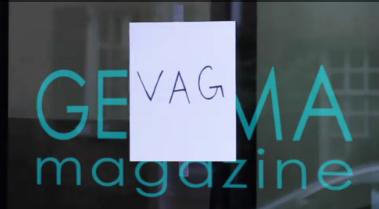
Recently while reading the feminist magazine Bitch, I came across an interview with Leila Cohan-Miccio and Caitlin Tegart, creators of the web series Vag Magazine. The series focuses on three women who buy a fashion magazine and recreate it as a feminist magazine, a la Bitch or Bust. The young women, Bethany, Fennel, and Sylvie, are stereotypical third-wave feminists. The series pokes fun at them specifically and third-wave feminism in general, highlighting the differences between a vision of feminism as empowering women as a group (Meghan, the “normal” character used to ground the viewer, defines feminism as the idea that men and women should be equal) and the idea that empowerment means individual women are free to do “whatever they want” and “have fun”:

The series reveals some of the limitations of “catch-phrase feminism” (to use a term from Brittany Shoot’s Bitch article). These catchphrases echo throughout American culture: “You go girl!” “It’s about choice!” Vag Magazine’s theme song informs the audience, “A girl is a girl, because she is power. Power is power because it’s a girl.” Another prominent pop culture feminist, Lisa Simpson, sums up this vision of feminism: “Well, as a feminist, virtually anything a woman does is empowering” (“The Blue and the Gray,” originally aired February 13, 2011). A viewpoint like this is inclusive, but can also shut down meaningful conversation. For example, the young women have trouble getting anything done (Fennel hires an intern because “We don’t believe in hierarchies, but we also don’t have time to get our own coffee.”) In another instance, Bethany, Fennel, and Sylvie tell Meghan that the skirts she wants to write about aren’t feminist enough, but are unable to clearly articulate what a feminist skirt would be.

Third-wave feminism is sometimes viewed with disdain because it can seem empty: if any choice a woman makes can be construed as feminist, then perhaps no act can be truly called feminist. At the same time, third-wave feminists can be more inclusive than previous generations: stay-at-home moms, working mothers, sex workers, and scientists are all embraced. However, there can be less of an emphasis on organizing and fighting for equality (though recent efforts to support Planned Parenthood and organize Slut Walks shows that third-wave feminists are interested in more than mere slogans).

Various episodes also address the available media options for those looking for a feminist perspective. The main rival to Vag Magazine is Cunt, a magazine staffed by more stereotypically aggressive feminists. The series shows how often women can feel like they are stuck with only two images of feminism: New Age-y “I honor you as a woman” feminists who seem spacey and ineffectual, or the stereotype of the radical man-hater. Episode 4, “Feminist Sweepstakes,” delves into this dichotomy . The episode starts with Fennel wanting to read her poem; she is asked to wait until the designated poetry hour; these women feel so much that they must have an entire poetry hour. Later, the audience is introduced to Jaybird, the editor of Cunt. Jaybird and her followers wear leather vests and jeans, which contrasts with the dresses, pastel colors, and feathers favored by the Vag staff. Only Meghan, the audience stand-in, gets to be “normal” – that is, reasonable.  During the two magazines’ confrontation, Jaybird yells and talks about the patriarchy; Bethany and Fennel use poetry and talk about honoring Cunt’s place. Meghan is the only one who can speak clearly and without rhetoric, transcending common feminist stereotypes, doing so by being clever and critical.

But Vag Magazine is not about putting women down or just laughing at them or feminism. Indeed, there is a lot of love in this series, and a lot to celebrate. The cast is all-female, and all funny. The women are able to buy the magazine thanks to their efforts at selling crafts on Etsy.  They do publish an issue of their magazine: they are, ultimately, successful. Indeed, the women of Vag Magazine act out the inner turmoil about how to present themselves as feminists to the world. The series humorously highlights the bind modern feminists often find themselves in: how to be inclusive without embracing everything, how to be forthright and challenging of inequality but not bullying.

The rest of the series is after the jump. more...
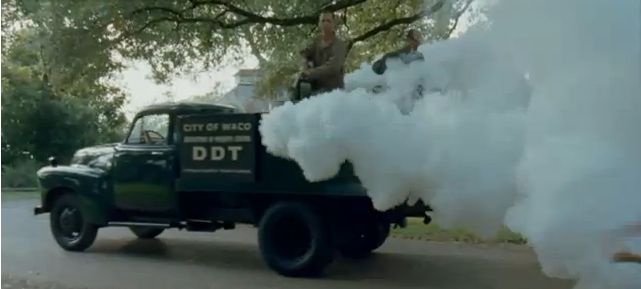
In the 1940s and ’50s dichlorodiphenyltrichloroethane, a synthetic pesticide better known as DDT, was used to kill bugs that spread malaria and typhus in several parts of the world.  DDT was argued to be toxic to humans and the environment in the famous environmental opus, Silent Spring.  It was banned by the U.S. government in 1972.

Before all that, though, it was sprayed in American neighborhoods to suppress insect populations. The new movie Tree of Life has a great scene re-enacting the way that children would frolick in the spray as the DDT trucks went by. Here are two screen shots from the trailer:

Searching around, I also found some vintage footage (the person who uploaded the clip doesn’t specify the documentary):

The scene reminded me of an old post we’d written, below, featuring advertisements for the pesticide, one with the ironic slogan “DDT is good for Me-e-e!”

—————————

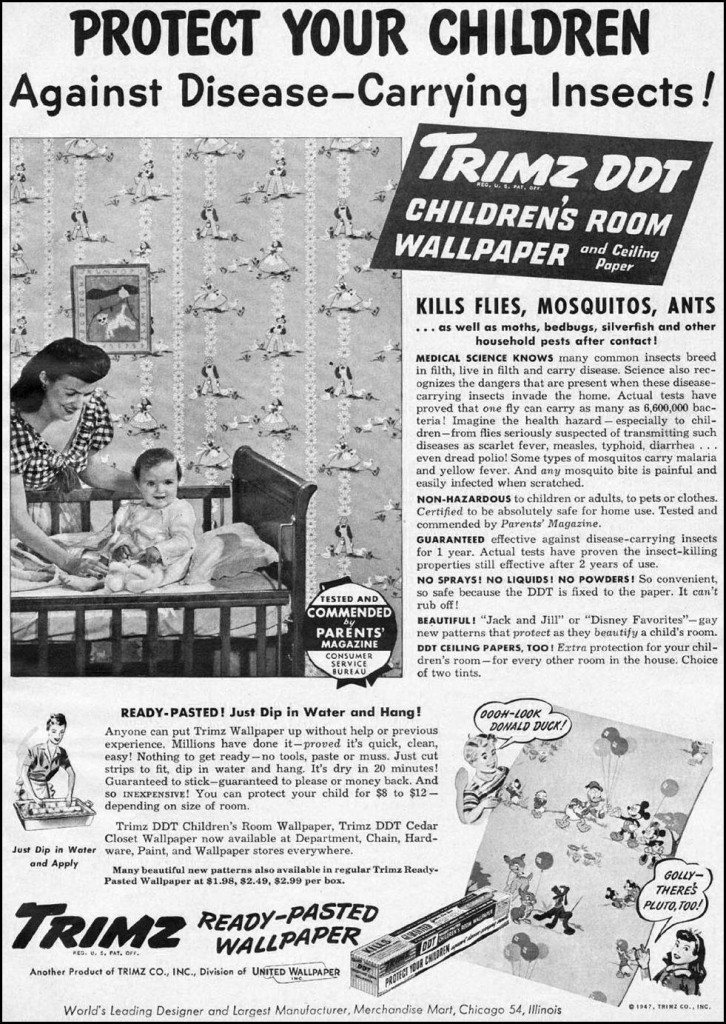
DDT was a pesticide marketed to housewives (and many others). We later discovered it to be an environmental toxin. Below are three of the advertisements (via Mindfully and KnowDrama and noticed thanks to John L.):

DDT-laced wallpaper, from Copyranter:

(text for this final ad after the jump)

more...


Last month I posted a video of Mike Rowe, from Dirty Jobs, testifying before Congress about the need to support training programs for the types of difficult, but essential, jobs he highlights on his show. Commenter Annabe let us know about Rowe’s TED talk, in which he discusses some of the lessons he’s learned from doing the show. It’s worth a watch:

A few months ago Lisa wrote about bulletin boards posted in New York City that racialize the abortion debate by presenting it as a particular danger to African American children. The new anti-abortion film Gates of Hell takes this racialization a step further, presenting a future world in which the Black Power movement has begun a domestic terrorist movement against providers of abortion services for what they see as genocide against African Americans. Here’s the trailer, sent in by Dolores R.:

Partial transcript available at Feministing.

The official description, from the film’s website:

Black power. Abortion. Terrorism. “Prophetic fiction”. Three years in the making, “Gates of Hell” is a documentary from the year 2016 that chronicles the crimes of a band of domestic terrorists known as the Zulu 9. Finnish filmmaker Ani Juva travels to the United States to better understand the mysterious black power assassins, the bizarre eugenics conspiracy theory that drove them to commit extreme acts of violence and how America’s political landscape was transformed forever. Blending real history and real public figures with a fictitious (yet plausible) future, it is safe to say that you have never seen a film like “Gates of Hell”.

As yet, the film doesn’t have a distributor; they have an online call for funding to help screen the film. The production company behind it, Illuminati Pictures, is headed by Molotov Mitchell, a contributor to popular conservative website World Net Daily, which posted a promotional video about the movie.

In her earlier post, Lisa questions the apparent concern for African Americans expressed in this framing of the abortion debate, pointing out that in some cases they seem to blame Black women for having abortions and totally ignore the structural factors at play. In a similar vein, this anti-abortion film, while ostensibly sympathetic to the idea of African Americans fighting what they see as genocide, draws on the stereotype of African American men as particularly violent and willing to kill, even while presenting them as possibly justified in this case.

And over at Feministing, Vanessa pointed out that we might question Molotov Mitchell’s genuine concern for oppressed groups given a video he appeared in back in 2009 supported Uganda’s anti-gay bill, which allowed the death penalty for repeat offenders:

As Lisa pointed out, there are very good reasons to be concerned about African American women’s reproductive freedom and the structural inequalities that might push them into making decisions about whether or not to end a pregnancy regardless of their personal preferences. But some of these anti-abortion messages presenting abortion as genocide seem to use racialization as a convenient tool that has little to do with more widespread concern about racial (or other forms of) inequality, discrimination, and even violence more broadly.

What makes top news today: a Southwest pilot’s homophobic, sexist, and vulgar commentary; it was kept quiet for some three months.  This happened on March 25th, 2011, broadcast accidentally over the air route traffic control frequency during the flight.  It’s now almost July.  The FAA, the pilot community and Southwest Airlines kept this under wraps for eighty-nine days.  Amazing.

Here’s the transcript of exactly what was said (trigger warning):

Southwest Pilot: “Well, I had Tucson to Indy all four weeks and, uh, Chicago crews…11 out of 12 …there’s 12 flight attendants, individual, never the same flight attendant twice.

“Eleven fucking over the top fucking, ass-fucking homosexuals and a granny.” (silence)

“Eleven. I mean, think of the odds of that. I thought I was in Chicago, which was party-land.”

“After that, it was just a continuous stream of gays and grannies and grandes…”

“Well I don’t give a fuck. I hate 100 percent of their asses.”

“So, six months, I went to the bar three times. In six months, three times.”

“Once with the granny and the fag, and I wish I hadn’t gone.”

“At the very end with two girls, one of them that was part do-able, but we ended up going to the bar and then to the crew at St. Louis, and all these two women wanted to do was, one wanted to berate her sister and the other wanted to bitch about her husband.”

“Literally, for three hours, me and the F.O. (First officer). When that was done, got back to my room, I’m like why the fuck did I stay up?”

ATC: “OK, whoever is, uh, transmitting, better watch what you’re saying.”

Southwest Pilot continues: “They’re still both (inaudible), you know what I mean? I still wouldn’t want anyone to know if I had banged them.”

“So, I mean it was a complete disaster for six months.”

“Now I’m back in Houston, which is easily where the ugliest bases. I mean it’s all these fucking old dudes and grannies and there’s like maybe a handful of cute chicks.”

In interview with Tom Costello on the NBC Today Show this morning, Aviation Analyst, John Cox defended the airline industry, saying the pilot’s comments are a throw-back to a different age in the cockpit: “It was more common in the past, but in today’s environment you see a lot more focus on the professionalism and you don’t hear these kinds of things very often anymore.”

Really?  Mr. Cox, you don’t hear these kinds of things often, anymore?  Spend one moment to Google “Southwest stuck mic”; you will find pilot aviation forums yucking it up already in defense of the pilot saying, “Well, at least he was honest!”

Is it any wonder only six percent of all commercial pilots are women?  The cockpit is not a place of equal opportunity.  Never was.  Isn’t today.  What’s more, there’s a cover-up.  Outside of what airlines now call a “flight deck”, the pilot fraternity defends itself saying, “yeah it used to be like that, we’re more professional now.”

Try to find the pilot’s name.  You can’t.  Southwest will not identify the pilot.  He was initially suspended without pay, but is now back in the cockpit under the good-‘ol-boy protection program and after involuntary “diversity” training.

Aviation market studies indicate women make up 26% of the prospective pilot population.  Only 7% of all pilots are female.  Unless serious action is taken, I doubt anything will change soon.

Audio:

More on the subject here: Sexism in Aviation, Then and Now.

Stephen Wilson is an aircraft salesperson, flight instructor, and former air safety investigator who takes interest in his profession from a sociological viewpoint.  He posts aviation and personal commentary on his blog, from where we borrowed this post.


In Fair and Foul: Beyond the Myths and Paradoxes of Sport, Stanley Eitzen discusses a number of contradictions in modern sports. One of the most prominent is the way that sports is both unifying and divisive in ways that can be extremely strong. Fans often feel a sense of solidarity simply because they like the same team — whether the local football team or a specific nation’s representative athletes at the Olympics. Individuals who might have little else in common, and might in other aspects of their lives be in conflict, can form a sense of affiliation and friendship through sports fandom.

This is true because fans identify with their teams, talking about “our” team, “our” win, and so on (though, oddly, when the team loses, it’s often “their” loss), often despite the lack of any direct connection to a team (I have relatives involved in constant low-level battles with their spouses about the placement of University of Oklahoma vs. Oklahoma State University memorabilia in their houses, cars, yards, and even pets and children, thought neither spouse attended either school).

Jay Smooth at Ill Doctrine recently put up a video about fan reactions to the NBA finals that awesomely addresses the joy fans take in their love of sports, the social constructedness of these affiliations, and how comments by LeBron James bring this all into view:

Cross-posted at Montclair SocioBlog.

Is a university admissions office the same as the basketball team?  Should selecting an entire student body for the college be like selecting players for the varsity?

Remember that kid at UC Merced, the one who argued that the graduated income tax was like redistributing GPA points? He found students who supported a graduated income tax and programs for the poor but who wouldn’t sign his petition to redistribute GPA points from the A students to those with lower GPAs. None of the students could articulate, on the spot, their reasons for not signing the GPA petition (assuming that he didn’t edit out any who did offer a reasonable explanation). (My earlier post on it is here.)

He’s baaaack. This time he’s asking students to sign a petition for affirmative action in sports – specifically to give preference to whites trying out for the team. Get it? If you support affirmative action in college admissions but not in sports, you’re a hypocrite. As before, students support one use of race preference but not the other, and as before none can give a convincing reason. The students all say, “It’s different,” but they can’t explain why.*

(To save time, I’ve set the video to start near the end – most students say the same thing. To see the whole thing, just drag the slider back to 0:00.)

Nyahh, nyahh – you’re for preferences for blacks where they’re a minority but not for whites where they are the minority. You’re a hypocrite.** Either that, or your thinking has been muddled by liberal ideas, which is pretty much the same thing, isn’t it?

The video concludes with the dictum that college admissions and sports should be the same. “Race-based preferences are wrong.” Ah, moral clarity.

Is college really the same as a sports team? They are certainly different in their consequences. If you’re a student now, in the coming years when you apply for a job, will HR ask you if you played varsity? Maybe. But unless the job you’re applying for is power forward, your answer won’t matter very much. But HR will absolutely want to know if you have a college degree. And your answer will matter. A lot.

Sports and school are different in another important way. Schools seek out minorities more for the sake of campus diversity than for the benefit of individuals. Yale probably gives preference to applicants from Montana or Mauritania over those form Manhattan. (Yale also might give preference to a power foward if the team this year is short of guys who can work the low post.) The purpose of this admissions policy is not to benefit Montanans (or power forwards) but to provide other students with the experience of living with a diversity of people (and to provide the basketball team with the right diversity of skills).

That same goal of demographic diversity does not apply to the competitive teams or the glee club or orchestra for that matter because those groups have a much more narrowly defined task. It’s that difference in purpose, rather than the difference in which race gets helped, that underlies the responses in the video. Take those same liberal students who support admissions policies that bring more blacks to campus; ask then if they would also support race-based preferences to get more blacks into crew, the glee club, or the chess team. I’m sure they would say no. As in the actual video, they would probably be unable to explain why giving preference to African Americans is acceptable in admissions but not activities.

They’ll say that the two are different, even though they can’t immediately explain why. Does that make them hypocrites, natural or un-?

The next time someone shoves a microphone in your face and asks for a justification for some distinction you make, smile at the camera and say, “As Michael Polany wrote in The Tacit Dimension, ‘we know more than we can tell,’ an insight that Richard Nisbett later developed with much social science evidence in his book Knowing More than We Can Tell.” See if you make it into the version that gets posted on YouTube, or into Robin Hanson’s blog.**

————————-

*I had assumed that the petitioner and his camera people were students at Merced. But in this new video, he’s at UCR.

** As with the previous video, Robin Hanson, on whose blog Overcoming Bias I found both of these, files the students’ attitudes in the folder marked “natural hypocrisy.”


I am always suspicious of invocations of the phrase “human nature.”  It is not necessarily because I think there is no such thing, it’s simply that it is typically invoked with little consideration of the vastly diverse physical, cultural, and physical-cultural contexts in which human beings find themselves, and have found themselves.  This 3 1/2 minute introduction to a BBC special, Human Planet, sent in by (my mom) Kay West, illustrates some of this diversity.  While I’m a little anxious about the exotification that the clip might include (especially of “the primitive”), I still think it does a wonderful job of hinting at the wildly different contexts in which humans live:

Also, this (Gwen, do not watch!):

Found at Blame it on the Voices.

Lisa Wade, PhD is an Associate Professor at Tulane University. She is the author of American Hookup, a book about college sexual culture; a textbook about gender; and a forthcoming introductory text: Terrible Magnificent Sociology. You can follow her on Twitter and Instagram.