Search results for embed


Dmitriy T.M. sent in this hilarious 2-minute rap about first world problems. The idea is to draw attention to how the daily frustrations faced by those of us in the most advantaged and developed countries in the world are really, really, like really small.

Edit: Sociologist Michael Kimmel reminds me that, though in certain ways the above is definitely true, it’s also not useful to trivialize the ways in which advantaged and developed countries still create suffering. Some of us benefit from our overall advantage more than others.

Lisa Wade, PhD is an Associate Professor at Tulane University. She is the author of American Hookup, a book about college sexual culture; a textbook about gender; and a forthcoming introductory text: Terrible Magnificent Sociology. You can follow her on Twitter and Instagram.

If you’re not writing a dissertation or taking care of twins, you might have heard that News of the World, a tabloid newspaper in the U.K., has been gathering news by illegally listening to people’s voicemail messages. News of the World is owned by Rupert Murdoch’s firm News Corporation, the second largest media company in the world. News Corporation also owns Fox. This is a great natural experiment testing the potential problems with media consolidation, the fact that more and more media outlets are owned by fewer and fewer companies.

So how does Fox report on this scandal? Rob Beschizza, writing for BoingBoing, highlighted a segment on Fox News in which the host and guest agree that “hacking scandals” are a “serious… problem” and imply that, in this instance, News of the World was the victim, not the perpetrator.  More, the guest “expert” is not a politician, scholar, or even a pundit, he’s actually a public relations professional who specializes in spinning scandals to obviate the negative consequences for corporations. Says James Fallows at The Atlantic:

He is Robert Dilenschneider, former head of Hill and Knowlton and now head of the Dilenschneider Group, who recently was featured in an interview, “How to Manage a PR Disaster.”

So Fox is having an expert on spin as a guest, who just so happens to spin the scandal about their parent corporation:

Partial transcript:

The NOTW is a hacking scandal, it can’t be denied. But the real issue is, why are so many people piling on at this point? We know it’s a hacking scandal, shouldn’t we get beyond it and deal with the issue of hacking? Citicorp has been hacked into, Bank of America has been hacked into, American Express has been hacked into, insurance companies have been hacked into, we’ve got a serious hacking problem in this country, and the government’s obviously been hacked into, 24,000 files.

The bigger issue is really hacking and how we as the public going to protect our privacy and deal with it. I would also say, by the way, Citigroup, great bank. Bank of America, great bank. Are they getting the same attention for hacking that took place less than a year ago, that News Corp is getting today?

Of course, as Beschizza at BoingBoing points out, Citigroup and Bank of America were hacked into, whereas News of the World did the hacking.  It’s also an interesting use of the word “hacking.”  Beschizza continues:

Though we all use the term “hacking” broadly, punching in a default PIN number isn’t quite the same thing as the skills required to hack into banks and governments. You can’t pretend these are the same class of problem, unless you’re happy being ignorant of the crisis management issues on which you are being presented as an expert.

Use of the term, then, makes the illegal activity seem more like the mischief of a techy teenager or the nefarious work of anti-establishmentarians, not the plain ol’ straightforwardly criminal behavior it is.

See also: Shameless promotion of the movie, Tinkerbell, at Good Morning America.

Lisa Wade, PhD is an Associate Professor at Tulane University. She is the author of American Hookup, a book about college sexual culture; a textbook about gender; and a forthcoming introductory text: Terrible Magnificent Sociology. You can follow her on Twitter and Instagram.

Trigger warning: this post contains examples of negative comments used in attempts to rhetorically negate the evidence of Ragen’s physical abilities, and they may be upsetting or triggering for some readers.

——————

Society hides people like me – fat, healthy people.  We don’t fit into the popular misconception that you can look at somebody and tell how healthy they are, we don’t make the diet industry any money, and we won’t just loathe ourselves like they want us to. I’ve found that when people are faced with a real live healthy fat person they often try to solve their cognitive dissonance. Sometimes they do this by just calling us liars, as in this comment from a total stranger on my blog:

5’4 and 280 pounds is not healthy and you’re just deluding yourself if you think it is. There is no way that you can work out the way you say you do and eat the way you say you do and still be that fat.  You are not healthy and you need to get real, stop gorging yourself and get to the gym.

Sometimes they use the VFHT (Vague Future Health Threat). This occurs when people try to convince me that it’s less likely that I’m fat and healthy and more likely that they are psychic and that my “fat will catch up with me someday.”  My fat’s already here.  What is there to catch up with me – my healthy eating?  My exercise?  My numbers, strength, stamina and flexibility in the top 5% of the country?  For the record I know plenty of old, healthy fat people, but even if I’m wrong I still feel that I’m making the right choice.

Finally, if you are a fat person who says you are healthy or physically active, you will frequently be asked to prove it.

After working for a year to obtain a level of flexibility that I didn’t even have as a (relatively thin) kid, I was thrilled to accomplish this heel stretch:

[Photo by Richard Sabel]

Among the supportive comments were a group of very prolific writers who make a total of 127 comments in three hours.  One comment that was fairly representative of the group stated,

You are a stupid bitch.  You are a liar to say that you are fat and healthy, there’s no such thing. Nobody cares how flexible you are (this move isn’t even that hard) or how well you dance because you’re still a fucking fattass.  I bet your ankle shattered 5 seconds after this was taken.  If I see you in the street I will slap you across your triple chins you dumb fat bitch.

Someone posted information about me on a listserve of people who, at first, were being reasonable and curious. I was e-mailed and challenged to state my numbers to prove beyond doubt that I am, in fact, healthy.  I posted my cholesterol, triglycerides, blood pressure etc., all in the exceptionally healthy range. But, a random stranger on the internet asked, what could I do physically?

So I posted pictures of my strength and flexibility:

They said that holding that same 284 pound body (the one that surely shattered my ankle) up in an arch and doing suspended pull ups isn’t that hard.  They said I must be flexible because I’m all fat and no muscle. They asked why I didn’t show something more athletic.

After several other attempts to counter their arguments, I posted a video of me dancing:

They got mean. They called me a whale, they called me a hippo, they said that it doesn’t matter because I’m still fat.

Several things about this incident stand out to me. First, many of the people who posted weren’t satisfied with disagreeing with my Health at Every Size lifestyle or calling me a liar, but actually felt the need to diminish my accomplishments. I can only assume that they were trying to avoid some sort of cognitive dissonance. In addition, the comments reflect an intense desire to convince me that no amount of accomplishment is enough if I am fat — as if being fat is such an utter failure that it eclipses anything else that I could possibly accomplish. Their core belief is that accomplishments only count if you’re thin, so since I’m fat no amount of proving it will ever be enough.

At first I was shocked by these comments. But I wonder if they are simply the end result of the constant marketing messages that the diet industry makes billions of dollars imbedding into our collective consciousness: The idea that anyone who chooses to focus on healthy habits rather than having a smaller body must be stupid and should be ridiculed. The idea that no accomplishments matter until you are thin because, if you are fat, you aren’t worthy of feeling happy or successful. (Remember Jennifer Hudson’s commercial where she said “Before Weight Watchers, my world was can’t” even though before Weight Watchers she had won a Grammy for her first CD and an Oscar for her first film?) Finally, the image of trainers like Jillian Michaels physically, verbally, and emotionally abusing fat people and treating them as subhuman “for their own good” might even make these people feel like they are somehow good Samaritans rather than run-of-the-mill judgmental abusers.

In the end, I’m over it. Don’t like what I write? Don’t believe me? Fine. I’m not here for you. When I do something that is counter to someone’s stereotypes, I’m not asking for their approval — I’m doing them the courtesy of giving them the opportunity to challenge their preconceived notions. I’m not trying to tell anyone how to live. I believe that every person of every size deserves respect. After that it’s all about presenting options, letting people make their own choices, and respecting those choices just like I expect mine to be respected.

Ragen Chastain, of Dances with Fat is a corporate CEO, choreographer for and a principle dancer in Fat Bottom Cabaret, and a three-time National Champion partner dancer currently seeking her first World Professional title;  but all of that pales in comparison to her greatest accomplishment – learning to love her body.  She is a strong advocate for Health at Every Size, and she unwaveringly believes (and is living proof!) that health is not about body size and that every body deserves respect.

Ragen agreed to write a post about her own personal experience with an issue facing many fat people: the insistence of other people that anyone who says you can be fat and healthy is mistaken, deluded, or actively lying, and the hostility and aggression often aimed at fat people who challenge these social assumptions (including on previous posts on our blog). She has previously posted parts of this article here and here.

Em sent in a 3-minute video by Lernert & Sander, at Nowness.com.  In an attempt to draw attention to the “cosmetic overkill” that characterizes modern societies, they put one year’s worth of make-up on all at once.  It took 9 hours; the model, Hannelore Knuts, drank from a straw.  They used 7 bottles of foundation, two bottles of eye shadow, three lipsticks, and two bottles of blush.  It’s super creepy. Thanks to Em for sending it in!

Lisa Wade, PhD is an Associate Professor at Tulane University. She is the author of American Hookup, a book about college sexual culture; a textbook about gender; and a forthcoming introductory text: Terrible Magnificent Sociology. You can follow her on Twitter and Instagram.

Dolores R. sent us this Saturday Morning Breakfast cartoon commenting on conspicuous consumption.  The phenomenon is often described with things like Hummers and high-priced purses.  The cartoon, though, suggests that intellectuals have their own breed of conspicuous consumption, even as they criticize the Hummer drivers: the conspicuous consumption of intellectual products, the more obscure and dense the better.

It reminds me of this hilarious clip from the sketch comedy show Portlandia in which friends end up in an inadvertent competition over who is more informed/has read more of the right stuff lately.

See also: conspicuous conservation.

Lisa Wade, PhD is an Associate Professor at Tulane University. She is the author of American Hookup, a book about college sexual culture; a textbook about gender; and a forthcoming introductory text: Terrible Magnificent Sociology. You can follow her on Twitter and Instagram.

Comedians exercise a curious privilege, which allows them to peddle controversial conclusions and uncomfortable insights without suffering the usual scorn and admonishment that comes with challenging systems of power or bringing indelicate knowledge about the world to the surface. For instance, the suggestion that Americans are deeply divided by race and class usually causes people to fidget, yet Chris Rock was greeted with laughter and applause when he unabashedly criticized the racialized wealth gap in the United States. Similarly, Louis C.K. received a rousing applause when he discussed his privilege as a white male, and Hari Kondabolu made an entire room burst into laughter by exposing the nonsensical logic underlying stereotypes aimed at Mexican immigrants.

But comedy is just as likely to reinforce stereotypes as it is to criticize them. Consider Jeff Dunham’s act featuring his popular dummy, “Achmed the Dead Terrorist.” In the clip below, from a 2007 performance, Dunham draws upon a number of stereotypes of Arabs and Muslims, many of which have been around since well before the attacks on September 11th, 2001:

Dunham is not deploying social criticism, but is instead uncritically drawing on racist representations for laughs. Arabs and Muslims, like the Achmed character, are typically portrayed as religious fanatics. They are often depicted as irrationally angry, even as self-proclaimed terrorists. But if they are dangerous, they are dangerous buffoons and are often too incompetent to pull off their own deadly plots.

Comedians can be understood as articulators of knowledge about the world. They contribute to the persistence of stereotypes at times, but can also articulate convincing arguments against them. This holds for other types of comedic performance as well. Political cartoons, comedy sketches, and even situation comedies all peddle indelicate knowledge about the racialized Other. For instance, in “Ali-Baba Bound,” a Looney Tunes cartoon from 1940, Porky Pig runs up against Ali-Baba and his “Dirty Sleeves.” The humor is constructed around a basic scaffolding of the Arab as dirty and sneaky. They are too primitive to competently use rockets and must strap explosives to their heads:

The sneak attack on Pearl Harbor the following year ignited a discursive explosion surrounding the Japanese, those living in America and abroad; for a time Arabs and Muslims occupied a relatively small sliver of American concern. It is striking how eerily similar representations of Japanese persons were to those of Arabs and Muslims. However, fed by photographic evidence of the destruction of Pearl Harbor and the tangible realities associated with the American war machine, dominant representations of the treacherous Japanese Other went further and faster. Each representation of the “Jap” became more and more fanciful, each illustration seemingly emboldened by the last to push the caricature even further.

Celebrated children’s author Dr. Seuss published a cartoon only weeks before the United States would forcibly relocate 120,000 ethnic Japanese persons living in the United States to internment camps. The cartoon depicts a buck-toothed, fifth column of Japanese Americans lining up from Washington to California for their very own box of TNT. A man scales the rooftop of the explosives depot “waiting for the signal from home.”

Or consider a Looney Tunes cartoon from the period, “Tokio Jokio,” which similarly presents Japanese people with buck teeth and buffoonish behavior:

Whereas the Seuss cartoon presents extant fears about a treacherous Japanese enemy living among us, the Looney Tunes cartoon lampoons them as bumbling idiots. In the Seuss cartoon, their tribal-like loyalties to the Emperor mean they are capable of doing just about anything, but in the Looney Tunes cartoon they are too incompetent to prevent their own Fire Prevention Headquarters from burning to the ground. Such seemingly contradictory representations permeated the American imagination of the time, alternately stoking anxieties while assuring Americans of their national and even racial superiority.

These racist representations aimed at the Japanese were not buried by the detonation of two atomic bombs over Japanese cities; they have proven to be free-floating and transferable to our emergent enemies. Today, Arabs and Muslims are routinely depicted in comedy as incompetent. They are again the bumbling idiots, simultaneously too stupid to successfully perpetrate an attack and just stupid enough to commit truly heinous crimes. The imagined fifth column has become the terrorist sleeper cell. In 1942 we feared Japanese Americans were blindly loyal to “their” Emperor. Today we are bombarded with ideas about the tribal loyalties of American Muslims. So powerful are these loyalties, it is often suggested, Muslims would happily kill themselves to bring about the demise of Western civilization. The fanatical Middle Eastern suicide bomber is the new banzai charger and Japanese Kamikazi pilot.

A joke making the rounds of the internet goes something like this: “A friend of mine has started a new business. He’s manufacturing land mines that look like prayer mats. It’s doing well. He says prophets are going through the roof.” This joke, Dunham’s comedy sketch, and the Looney Tunes cartoons all mark historical moments when the racialized Other became so thoroughly demonized and devalued in the public consciousness, our undifferentiated “enemies” became so feared for their treachery and immorality, that it became possible to make light of hypothetical and real violence perpetrated against them. One might speculate that it is strangely intoxicating to spot the boogieman tripping on his shoelaces, embarrassing himself, or dying by his own venom. The Achmed character’s tired threat, “I kill you!” is funny, perhaps, because his voice cracks like a thirteen-year-old boy, and we are entertained by the irony that someone so evil could appear so weak.

This comedy, which uncritically trades in the negative stereotypes aimed at Arabs and Muslims and is able to make an audience laugh at references to suicide bombing, is only possible because Arabs and Muslims have been successfully demonized and devalued. Comedians write jokes to get laughs, but they also operate from a space which grants them temporary license to openly discuss controversial ideas. Comedians contribute to the discourse, just as readily they respond to it, and their sets are just as capable of exposing hidden discrimination as reinforcing it.

Lester Andrist is a Ph.D. candidate at the University of Maryland, College Park, specializing in the role of social capital and personal networks in finding jobs in India and Taiwan and cultural representations of groups in indefinite detention. He is a co-editor of the website The Sociological Cinema, where a longer version of this post first appeared.

Gwen Sharp is an associate professor of sociology at Nevada State College. You can follow her on Twitter at @gwensharpnv.

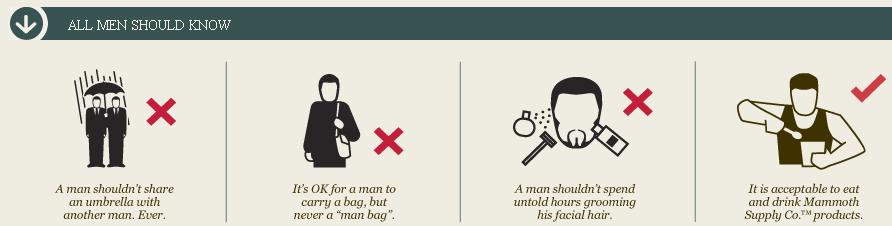
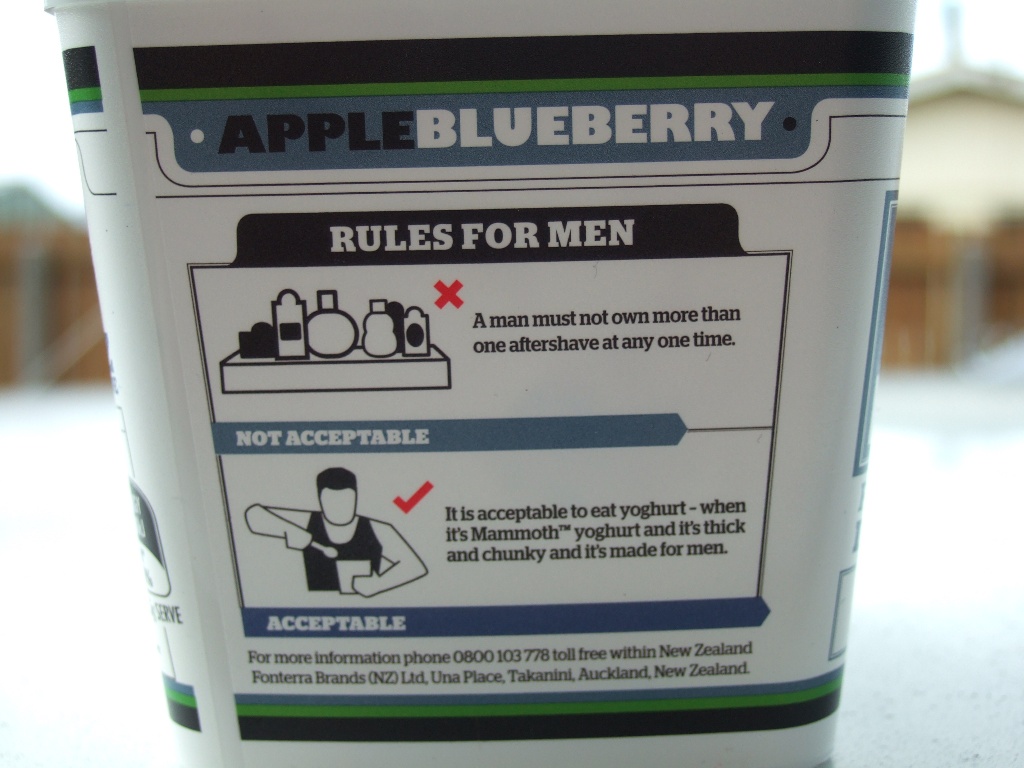
Jeremiah, Sarah S., Nikki R., and Erin H. sent us a great example of a company trying to make a feminized food safe for men. New Zealand’s Mammoth Supply Co. (a subsidiary of the multinational dairy giant Fonterra) is trying to convince men that yogurt is super manly and tough, “built to tame a man’s hunger.” The ads reinforce a whole range of rules about masculinity, which Erin nicely sums up as “the same old mythbashing that men need things that are big, tough, substantial, strong and rugged, and that coded-feminine activities (crying, being too involved in one’s personal appearance, coming into physical contact with people of the same sex) are inferior and weak”:

Via Copyranter.

The website, which assures the reader that this is “real man food, man,” as well as each carton of yogurt includes additional helpful tips:

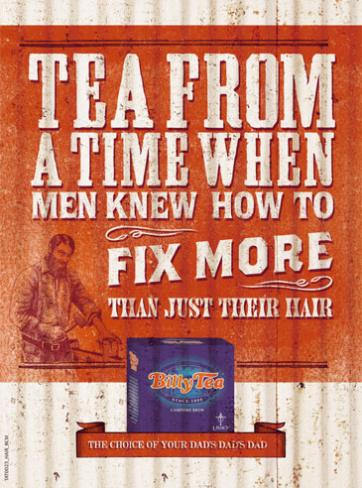
Lisa K. recently saw an ad for Billy Tea in a newspaper that implies men and women are no longer sufficiently masculine and feminine, unlike the good old days when the tea was first produced:

Here’s another one of their ads:

Sarah B. sent in this Miller High Life ad (which she blogged about at Adventures in Mediocrity) that makes it clear that the only types of salad men should eat are the type without, you know, girly vegetables:

In another example of gendering foods, Lisa R. pointed out Applebee’s commercials for its set of dishes with under 550 calories. Women love eating low-calorie meals:

The commercial aimed at men, titled “Manly Man,” presents ordering from the 550-calorie menu as something men might be a bit embarrassed about, but don’t worry — once the guys see your huge plate of food, your masculinity will once again be unquestioned:


Are you confused about what “Great Britain” really is?  Do you become perplexed when asked to discern the difference between Britain, England, and the U.K.?  And what the heck is Wales!?  (Apologies to Wales.)  You are not alone!  CGP Grey offers an entertaining explanation that both clears up the questions, and makes us feel less stupid for not understanding them in the first place.  And you’ll learn some stunning facts about the residuals of empire.  Enjoy:

And if that wasn’t enough, here’s Grey’s historical rendering of how Scotland became a part of Great Britain.

Via Blame it on the Voices.

Lisa Wade, PhD is an Associate Professor at Tulane University. She is the author of American Hookup, a book about college sexual culture; a textbook about gender; and a forthcoming introductory text: Terrible Magnificent Sociology. You can follow her on Twitter and Instagram.