Search results for embed

Yesterday I posted some videos from a story Anderson Cooper did about so-called “sissy boy” therapy, meant to train boys not to act in gender non-conformist ways and, thus, to keep them from being gay (I have now updated the original post with the final segment from the series). The videos provide a horrifying look into the damage that can be done when children are brutally punished and criticized for any signs that adults interpret as evidence of homosexuality.

This type of therapy is still available, and some of the researchers Cooper discusses continue to have lucrative careers assuring parents they have the key to preventing, or eliminating, gayness in their kids. But that said, it’s also clear the cultural attitudes about gays and lesbians have shifted greatly, both within the psychiatric community (the APA no longer defines homosexuality as a mental disorder and does not advocate therapies meant to “cure” gays and lesbians) and among the general public.

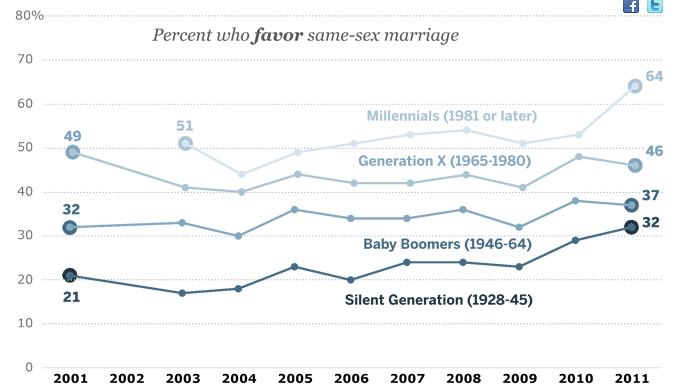
For instance, Peter N. sent in a link to a set of graphs by the Pew Forum on Religion & Public Life illustrating the major changes in attitudes toward gay marriage. Overall support for same-sex marriage has gone up significantly over the last few decades (with polls increasingly showing more people favoring it than opposing it and a few even showing a slim majority of respondents supporting same-sex marriage rights). Attitudes toward same-sex marriage vary widely by age; among those born since 1981, support is quite high:
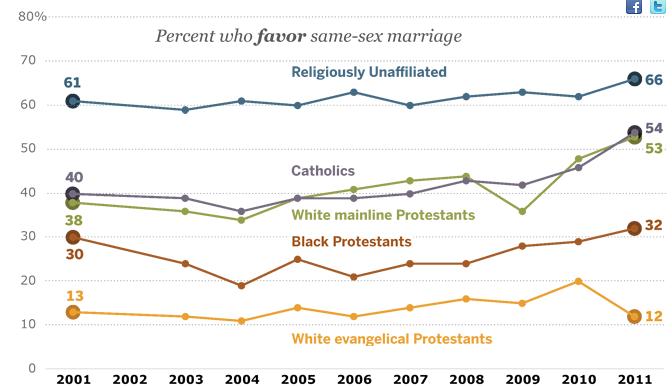
Not surprisingly, support also varies by religious affiliation:
The Pew Forum also has graphs of differences by political affiliation, etc.

We can also see this change in some instances of corporate marketing that include gays and lesbians or discuss gay rights — something that would have been unthinkable for mainstream corporations to do openly until fairly recently for fear of public backlash. David F. sent in Google Chrome’s contribution to the “It Gets Better” series of videos:

Similarly, Megan B. was struck by this Sealy mattress ad, which, though not unambiguous, she thought would be interpreted by many viewers as implying support for same-sex couples:

Finally, Jacob G.sent in a segment from the ABC News “What Would You Do?” series, in which a waitress openly harasses a lesbian couple to see how other customers will react, and found that about half of onlookers actively intervened:


Katrin and Danny sent in a heart-breaking video that highlights the damage that has sometimes been inflicted on children, with the guidance of researchers, because of adult concerns about behavior that deviates from socially-accepted gender norms. In this segment with Anderson Cooper, two siblings and their mother discuss the treatment their brother suffered, with the approval and encouragement of UCLA researchers, as a form of “anti-sissy” therapy:

It would be nice to be able to write this off as completely debunked practices of an earlier time, based on premises that would never recur today. But as the video makes clear, the publications that resulted from this study continued to be cited by those who argue that through therapy, gays and lesbians can be “cured.”

Here’s the second part of the story:

There will be a third installment tonight; I’ll update the post once the final segment is available online.

UPDATE: Here’s the third segment, about a boy who underwent anti-gay therapy in the ’90s:

UPDATE 2: Also, Danny was wonderful enough to type up transcripts of the first two videos! They’re after the jump.

more...


Jay Smooth posted a 2-minute clip of rapper Brother Ali discussing why he, as a White rapper, decided not to use the “N-word,” and the need to be sensitive to the fact that being friends with African Americans, or being social disadvantaged in some ways (economically, due to a disability, etc.) doesn’t erase White privilege. The visual effect is sort of wonky, but it’s an interesting conversation:

Partial transcript, available at Jay Smooth’s website:

The thing with the ‘n word’: it’s very very confusing for white kids who have a lot of black friends and are accepted. And I can’t stand here and say that when I was 9 years old, and all my friends were black, and they were telling me ‘you’re basically black,’ that I didn’t believe that. Now I’m at a place where I’m just like ‘not everybody knows me and nobody should ever have to, like, why should I impose on other people to have to confront that question in their mind?’ You know what I mean?


Michael M. sent in a news segment from WBTV, a CBS affiliate, about the video game Portal 2. The segment focuses on a scene in which a character is ridiculed for being adopted, with another character saying kids who were adopted suffer from a “lack of parents.” In addition, the game includes the line, “Alright, fatty. Adopted fatty. Fatty, fatty no parents” (at 55 seconds in). The news crew expresses dismay as they introduce the segment (and again at the end), which features a father who was upset when his family, including his adopted daughter, encountered the scene:

What struck Michael was the framing of this story by the news outlet, and the focus on ridiculing adopted children while entirely ignoring the use of “fatty” as a put-down, implying that insults based on body size aren’t problematic or hurtful. As Michael puts it,

In a story entirely about insensitivity, this statement, which is even subtitled on screen, seems to be parsed to only be an insult to the adopted. For some reason the weight-based [insult] is completely ignored…What makes one outrageous and another not even cause us to blink?

Poet and musician Gil Scott-Heron died Friday. I thought you might enjoy this video, sent to me by my friend Pete, of clips from YouTube set to Scott-Heron’s most famous piece, “The Revolution Will Not Be Televised”:

NOTE: For the record, reader Azizi believes that this video, and my posting of it, trivializes Scott-Heron’s point. Azizi points us to an interview with Scott-Herson posted at Racialicious.

Emma M.H. sent us a commercial for Cougar Life, a dating site that promotes itself as a place to meet older (but still sexy!) women interested in dating younger men. Despite the name, the site actually welcomes women of all ages. When you go to the website, you specify whether you’re looking for a “cub” (women aged 18-35) or a “cougar” (aged 35-65). Similarly, Emma was struck by how young the women in the ad look:

So though the company brands itself as a site about cougars — which would imply an emphasis on middle-aged and older women — here it markets itself almost entirely with women who would fall into no more than into the “cub” category or the very lowest end of 35-65 age range that defines cougars on the site, while the song declares they’re “all cougars.” It’s possible the company thought that women who look older than 40 would be unacceptable even to potential customers of a dating website specifically promising the ability to meet such women. But it also seems like the term “cougar” is being used to apply to a wider array of women than when it first entered pop culture — not just older women who date younger men, but practically any woman past her early 20s who has a voracious sexual appetite. Cougar Life draws on this, assuring us it was recently voted the “wildest dating service in America.” The defining feature may be less age than the idea that a woman is not just sexually available, but almost predatory in her search for sex — that is, that she seeks sex in a way we generally find acceptable only for men.

UPDATE: Reader Anna caught a mistake I made. The “cub” category was for the men seeking women on the site, not for younger women. She explains,

If you look at the site carefully, the “cubs” category means men the ages of 18-35, not women of these ages. Choose “looking for a cub” and the pictures are all male, and that term is often used for the younger male partner of an older women. The only women “available” on the site are 36 years old and over, so the site in effect bans both middle aged men and young-ish women from participating.

Thanks, Anna!

Feminist Frequency’s Anita Sarkeesian is back with another trope. In this one she covers the “evil demon seductress.” Sarkeesian argues that the trope reproduces the stereotype that women use their sexuality to manipulate men. This encourages us to always view their sexual expression with suspicion such that we deny women authentic sexualities.

Thanks to Anita for linking to our post about the femme fatal praying mantis.

Lisa Wade, PhD is an Associate Professor at Tulane University. She is the author of American Hookup, a book about college sexual culture; a textbook about gender; and a forthcoming introductory text: Terrible Magnificent Sociology. You can follow her on Twitter and Instagram.

We have posted in the past about the controversy surrounding the casting of the movie The Last Airbender. Many fans of the original series were upset that Asian characters were recast as White, with the main cast initially containing no non-White characters at all. This fits in with a more general lack of Asian main characters in Hollywood.

More recently, a different controversy about race and casting emerged when African American British actor Idris Elba was cast as the Norse god Heimdall in Thor, though this character was always White in the comic book series.

Anthony N. sent in a video by MovieBob at The Escapist that discusses concerns over race in casting Thor and why recasting a White character with a non-White actor doesn’t have the same implications as recasting a non-White character with a White actor does:

,/p>