Search results for embed

W.W. Norton has released a fun little animation answering this thorny question. It has to do with abundance and hoarding, and the technological innovations that underlie these things, as well as government’s willingness to redistribute wealth.

Enjoy:

See more of Norton’s videos at their YouTube channel.

Lisa Wade, PhD is an Associate Professor at Tulane University. She is the author of American Hookup, a book about college sexual culture; a textbook about gender; and a forthcoming introductory text: Terrible Magnificent Sociology. You can follow her on Twitter and Instagram.

Cross-posted at PolicyMic.

In this clip from a campaign rally, Vice Presidential nominee Paul Ryan argues that “traditional marriage” is a “universal human value.”

Ryan could not be more wrong. In fact, few practices have undergone more fundamental transformation.

For thousands of years, marriage served economic and political functions unrelated to love, happiness, or personal fulfillment.  Prior to the Victorian era, love was considered a trivial basis for marriage and a bad reason to marry.  There were much bigger concerns afoot: gaining money and resources, building alliances between families, organizing the division of labor, and producing legitimate male heirs.

These marriages were patriarchal in the strictest sense of the term.  Men were heads of households and women were human property, equivalent to children, slaves, servants, and employees.  Women didn’t choose to enter a marriage that defined her as property, she was entered into the marriage by her father, who owned her until he “gave her away.”

Ultimately, in response to feminist activism as well as other forces, marriage would change.  By the 1950s, a new kind of marriage would become ideal.  This is the one that Ryan likely means when he uses the terms “traditional” and “universal.”  In this model, men and women married by choice and were expected to find sustenance in their relationship.  Women were not legally subordinate to their husbands (that is, she was no longer property).  But the rights and responsibilities of husbands and wives continued to be defined differently.  Women owed men domestic services (cleaning, cooking, childcare, and sex); in return, men were legally required to support their wives financially.

This type of marriage signed its own death warrant, a story I’ll tell in another post, and was relatively short-lived (and not at all universal, even at its peak in the U.S.).  It was soon replaced by an ideal of marriage based on gender-neutral roles that spouses could work out for themselves. Today married couples are free to organize their lives however they wish.  And they do.  Stephanie Coontz, famed historian of marriage, writes:

Almost any separate way of organizing caregiving, childrearing, residential arrangements, sexual interactions, or interpersonal redistribution of resources has been tried by some society at some point in time.  But the coexistence in one society of so many alternative ways of doing all of these different things—and the comparative legitimacy accorded to many of them—has never been seen before.

Ryan is right, then, in that “traditional marriage,” however you define it, is not normal in the U.S.  He’s completely wrong, though, it calling it universal.  Even a quick review of American history reveals it not to be so.

Sources:

  • Coontz, Stephanie. 1992. The Way We Never Were: American Families and the Nostalgia Trap.  New York: Basic Books.
  • Coontz, Stephanie.  2004. The World Historical Transformation of Marriage. Journal of Marriage and Family66, 4: 974-979.

See also The Daily Show on nostalgia, the “traditional” age of marriage, and mocking “traditional marriage.”

Lisa Wade, PhD is an Associate Professor at Tulane University. She is the author of American Hookup, a book about college sexual culture; a textbook about gender; and a forthcoming introductory text: Terrible Magnificent Sociology. You can follow her on Twitter and Instagram.
Katrin sent in a delightful video by the 1491s, a sketch comedy troupe that frequently skewers popular representations of Native Americans and their various cultures. The group recently released a new video featuring footage of 1491s member Ryan Red Corn dancing at the Santa Fe Indian Market interspersed with shots of visitors to the market and examples of appropriation of Native cultures, all set to Irving Berlin’s “I’m an Indian Too,” from Annie Get Your Gun. It’s a great send-up of the whole Native-culture-as-fashion-statement trend:

Last week a secretly-taped video of Romney made headlines. In it, he said that 47% of America believes that they are “victims,” is “dependent” on the government, and likes it that way.  SocImages, like many places around the web, did some talking about who the 47% of people who pay no income taxes really are.

In this post, however, I’d like to make a different kind of point about framing and the sociological imagination, inspired by Ill Doctrine‘s Jay Smooth and Slate’William Saletan.

Reacting to the release of the video, the media returned to a similarly clandestine video of Obama that had made the rounds during his first run for the presidency.  In it, Obama refers to Americans who are “bitter” and “cling to guns or religion, or antipathy toward people who aren’t like them, or anti-immigrant sentiment…”  So, six-of-one, half-dozen-of-the-other right?  Both statements are equally tone deaf and biased right?

No. In fact, one is embedded in a deep empathy and an understanding that circumstance (i.e., that thing that sociologists study) can shape one’s outlook, sometimes in negative ways.  The other is a straightforward criticism of a group’s character, with a lack of empathy and understanding.

Let’s take a closer look at how Obama introduced his (fairly criticized) comment about the bitter clinging to guns (transcript).  He begins by saying that people have a good reason to be unhappy with politicians:

In a lot of these communities in big industrial states like Ohio and Pennsylvania, people have been beaten down so long, they feel so betrayed by government, that when they hear a pitch that is premised on not being cynical about government, there’s a part of them that just doesn’t buy it…

Then, instead of writing off these people as bad people who will never vote for the right guy, Obama argues that he wants to reach them (calling it a “challenge”), further validating how they might feel given the circumstances of their lives:

…our challenge is to get people persuaded that we can make progress when there’s no evidence of that in their daily lives. You go into some of these small towns in Pennsylvania, Ohio — like a lot of small towns in the Midwest, the jobs have been gone now for 25 years, and nothing’s replaced them. And they fell through the Clinton administration and the Bush administration. And each successive administration has said that somehow these communities are going to regenerate. And they have not. So it’s not surprising then that they get bitter, and they cling to guns or religion, or antipathy toward people who aren’t like them, or anti-immigrant sentiment, or, you know, anti-trade sentiment [as] a way to explain their frustrations.

In contrast, Romney’s comments are dismissive and accusing (transcript).   His targets — the 47% of people who are exempt from paying income taxes — aren’t embattled, fighting for a decent life despite political neglect, they’re “entitled” to something they haven’t earned.  They’re happy to be dependent on the government and don’t want it any other way.  They’re leeches, parasites, freeloaders, bums.

And, instead of saying that its his job to help those people see life a different way, Romney dismisses them entirely:

 [They’ll] vote for the [current] president no matter what… my job is not to worry about those people — I’ll never convince them that they should take personal responsibility and care for their lives…

So, while some are arguing that Romney’s comments are just a politically-right version of Obama’s — equally biased and cynical — nothing could be farther from the truth.   Obama looks at Americans who will not likely vote for him and sees social structural reasons that their negative emotions are valid (even when they’re aimed at him), he expresses empathy for their plight, and seeks to connect with them.  Romney does nothing of the sort.  Instead, he condemns them as individuals and blows them off as potential constituents; and he encourages others to do the same.

In short, Obama has a sociological imagination that enables, even presses him to see the bigger picture.  He sees both individuals and the circumstances they live in.  Romney, for whatever reason, does not exercise a similar imagination.

Wanna hear it straight from Jay? I would too:

Lisa Wade, PhD is an Associate Professor at Tulane University. She is the author of American Hookup, a book about college sexual culture; a textbook about gender; and a forthcoming introductory text: Terrible Magnificent Sociology. You can follow her on Twitter and Instagram.
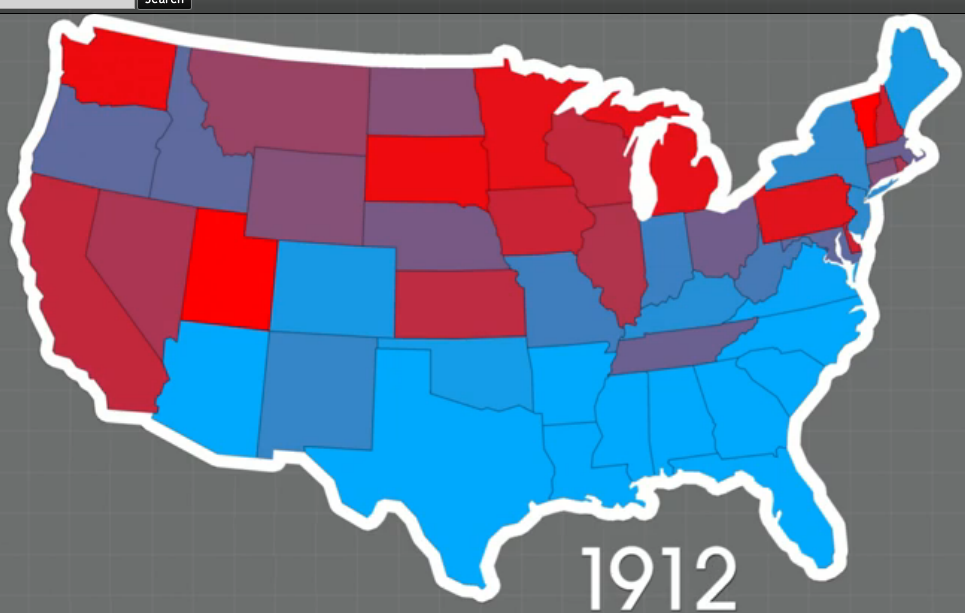
Salon posted a video by Benjamin Wheelock that illustrates changing voting patterns in the U.S. over the last century. He assigned each state a color based on voting for presidents, governors, and Congress for each year there were elections. Red indicates Republican, blue is Democratic; the darker the color, the more overwhelming the vote was for that party.

The video starts with 2011 and moves backward to 1912. What’s perhaps most striking today is that through the late 1970s, the South was a swath of Democratic blue. In the 1980s much of it turns purple, as presidential elections increasingly go Republican but Dems remain competitive in state elections. By the 2000s, it becomes much more solidly, and brightly, red as Republicans consolidate their popularity in the region.

It’s a quick way to highlight many major trends and turning points in U.S. political history, including changing stances on racial issues within the parties, the Democrats’ overwhelming dominance during the late ’30s as the country struggled to emerge from the Great Depression, and the clear shifts in the South and on the coasts over time.

Thanks to my colleague Pete for pointing it out!

In “Rule Enforcement without Visible Means,” Theodore Caplow discusses conformity to the norms that guide the practice of celebrating Christmas. These norms are informal — that is, they aren’t enforced in any official way and aren’t encoded in policy — yet Caplow found consistent agreement on expectations, as well as conformity to them. Some of these are easily identifiable, such as the Wrapping Rule, which requires that gifts be wrapped in Christmas-appropriate wrapping paper (or at least marked with a bow if they’re too large or irregularly-shaped to be wrapped).

Others aren’t so readily apparent. For instance, Caplow discusses the Scaling Rule, which guides our purchases of gifts based on the relationship with the recipient. Everyone agreed that a spouse should get the single most valuable gift you buy; kids come next (and should have equal amounts spent on them), then parents/in-laws (who should get similarly valuable presents), and so on. There is a widely-accepted unspoken hierarchy for giving gifts. While we say “it’s the thought that counts,” we also believe that the gifts we give carry social messages about how much we care. Regardless of intent, giving a gift that is perceived as nicer or more expensive to a coworker than to your spouse, or spending more on friends than your kids, would likely be taken as a sign of inappropriate or misplaced loyalties.

Caplow’s point is that social interactions are highly regulated by informal norms, ones we learn and follow often without ever openly recognizing them. Will LaSuer sent in a video that illustrates this point. The video explains etiquette in men’s restrooms: proper spacing when selecting a urinal, flushing, making eye contact or speaking to others in the restroom, and so on. It’s an explicit discussion of the usually taken-for-granted norms of daily life.

One note: The first 4:40 of the video covers these basic norms. After that, it goes on to a long scenario that you may want to skip. While, as Will says, the language and imagery is nothing you wouldn’t see in, say, South Park, if you’re thinking of using the clip in class to illustrate norms, I’d definitely stop at the 4:40 point, both because of the content and because I don’t think the rest of the video contributes anything to the basic sociological point.

Will suggests using the video along with John Paul’s “urinal game” to help students grasp the concept of informal norms.

Caplow, Theodore. 1984. “Rule Enforcement without Visible Means: Christmas Gift Giving in Middletown.” American Journal of Sociology 89(6): 1306-1323.

Paul, John. 2006. “‘Flushing’ Out Sociology: Using the Urinal Game and Other Bathroom Customs to Teach the Sociological Perspective.” Electronic Journal of Sociology. ISSN: 1198 3655.

Cross-posted at Caroline Heldman’s Blog.

On Monday, Mother Jones released a video recorded in May of presidential candidate Mitt Romney speaking at a $50,000-a-plate fundraiser in the Boca Raton home of “private equity party boy” and “sexy party” host, Marc Leder. A hidden camera caught controversial remarks about IsraelIran, and a joke about being more electable if his parents had been born in Mexico, but the topic of this post is Romney’s use of the 47% Meme.

The 47% Meme is the idea that half of Americans take from rather than contribute to tax coffers. It sometimes surfaces in the form of the “takers vs. makers” frame. I have encountered this “argument” for years on Fox News, so it is surprising to see it gaining national attention now. Romney did a superb job articulating the 47% Meme in response to a question of how he might win in November:

There are 47 percent of the people who will vote for the president no matter what. All right, there are 47 percent who are with him, who are dependent upon government, who believe that they are victims, who believe the government has a responsibility to care for them, who believe that they are entitled to health care, to food, to housing, to you-name-it. That that’s an entitlement. And the government should give it to them.

Many myths start with a kernel of truth. The 47% Meme is loosely based on the statistic that 47% of Americans pay no income tax (down to 46% in 2011). This meme is wildly dishonest since people pay a host of other federal, state, and local taxes. It’s about as honest as saying a person doesn’t eat vegetables because she only eats carrots, celery, bell peppers, cucumbers, and cabbage, but not broccoli.

So who is paying taxes, and what taxes are they paying?


Federal Income Tax

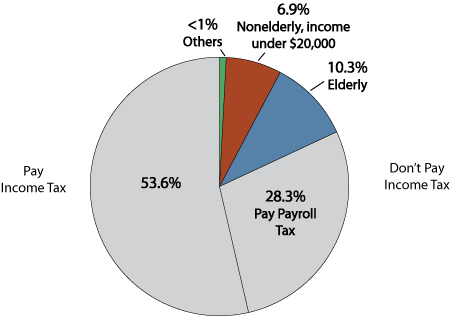
The Tax Policy Center finds that two main groups comprise the 46% who do not pay federal income tax: (1) The poor whose subsistence-level income is not taxable, and (2) those who receive tax expenditures. This chart shows that the lion’s share of tax expenditures goes to senior citizens, children, and the working poor, with the notable exception of 7,000 millionaires who paid no income tax in 2011.


Other Federal Taxes

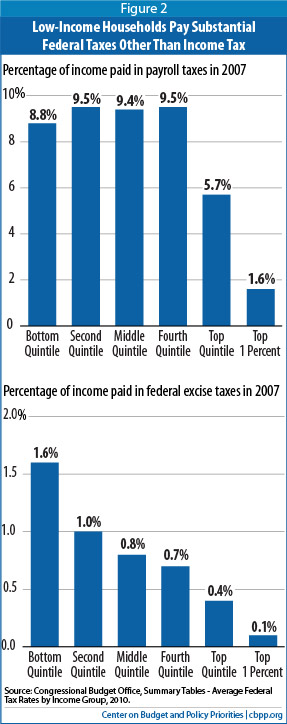
But enough about income tax since this narrow focus only serves to further the misleading 47% Meme. The chart below shows a more accurate picture of who pays federal taxes. If we don’t count retirees, only 8% of Americans pay no income or payroll taxes.

Americans also pay federal excise tax on gas, liquor, cigarettes, airline tickets, and a long list of other products, so virtually every American pays federal taxes in some form. And contrary to the 47% Meme, poor and middle-class Americans actually pay a greater percentage of their income in federal payroll and excise taxes than wealthier Americans.

State and Local Taxes

When it comes to state and local taxes, the Institute on Taxation and Economic Policy finds that the poor pay more in state and local taxes in every state except Vermont. As the chart below indicates, state and local taxes are regressive, meaning that those who can least afford to pay, pay more.

Romney has apologized for the inelegance of his statements, but stands by their substance, despite ample data debunking the dependency (above) and entitlement bases for the 47% Meme. I don’t believe that Romney believes that half of the people in the U.S. are pathetically entitled “victims.” He is a smart person, and this is a ludicrous line of reasoning. But what does it say about our bitterly partisan nation that heaping unmitigated scorn on the poor brings in big bucks from the base?

In Wayward Puritans: A Study in the Sociology of Deviance, Kai Erikson states,

 …the agencies built by society for preventing deviance are often so poorly equipped for the task that we might well ask why this is regarded as their “real” function in the first place. (p. 14)

He notes that the amount of deviance and crime found in a society is largely related to how many resources we commit to looking for it. And once we’ve created institutions and industries to deal with particular types of deviance, we tend to continuously find enough deviance to continue to justify the system’s existence. If we’ve built a large criminal justice system, that system takes on a self-sustaining life of its own. Even if we eradicated all major crime as we know it, Erikson suggests, the agencies would turn their attention to behaviors we’ve previously ignored or treated as relatively unimportant, finding a new reason for the system’s existence and access to resources.

In the past several decades, fighting the War on Drugs has become an important role of the U.S. criminal justice system. Drug infractions are a major cause of the growth in imprisonment rates and, especially, the racial gap in incarceration.

I thought of Erikson’s insights when I recently saw the trailer for The House I Live In, an upcoming documentary about the impact of the War on Drugs. The trailer highlights the way that low-level drug dealers and addicts are fed as raw material into the criminal justice system. Law enforcement agencies often benefit directly from seizures of cash or property during drug busts, which then becomes property of the agency; additionally, agencies that design programs to target drug use/sales often get access to federal funds for training and equipment that they’d have no way to purchase otherwise:

The War on Drugs is an industry, one with vested interests with a powerful motivation to ensure its continued existence and expansion, regardless of any objective cost-benefit analysis of the consequences of incarcerating such a large proportion of the population or even of the effectiveness of our policies for actually decreasing drug use.