Search results for embed

Jarrah Hodge, the woman behind the Canadian feminist blog Gender Focus, has started a new video series called Feminism F.A.Q.s.  They’re short videos aimed at addressing myths about gender inequality and the people who care about it.  She’s already got 10 videos up, but here are a couple of my favs.

What Have Women Been Told They Can’t Do?

Ride bicycles (’cause of “bicycle face”), get a credit card, run marathons, and much more.

Did Feminists Burn Bras?

Answer: Nope!

Lisa Wade, PhD is an Associate Professor at Tulane University. She is the author of American Hookup, a book about college sexual culture; a textbook about gender; and a forthcoming introductory text: Terrible Magnificent Sociology. You can follow her on Twitter and Instagram.

Confirmation bias is the tendency to search for or interpret information in a way that reaffirms our pre-existing beliefs. We may selectively notice information; for instance, if we think the full moon makes people act weird, we’re likely to notice and remember strange things we see people doing during a full moon better than strange things we observe at other times (or than all the people we see acting perfectly normally during a full moon). We tend to perceive what we expect to see, our brains struggling to come up with reasons that justify what we already think.

Dmitriy T.C. sent in a video that illustrates this particular type of selective thinking. Jimmy Kimmel gave people on the street an exclusive look at the iPhone 5 and asked what they thought of it. Except, of course, the iPhone 5 isn’t available yet. What he actually gave them was an iPhone 4S. But when told they’re looking at a new version of the iPhone, everyone immediately perceives clear improvements that make it better than the iPhone 4.

You might expect this from people who don’t have much knowledge of iPhones; they don’t have a clear basis for comparison, so whatever features seem neat, they assume are new. But even people holding their own iPhone 4 up for direct comparison perceive the “iPhone 5” Kimmel hands them to be superior, noting a range of details — it’s lighter, faster, just clearly better. They think a new version of a gadget must be way more awesome than the previous version, and Apple has an aura of coolness that leads people to expect their new products should be extra amazing. Since people expect a new iPhone to be awesome, they notice, or invent, features that confirm that it is, indeed, awesome.

It’s a really fun demonstration of this cognitive bias:

Cross-posted at Jezebel.

In 2009 R&B singer Chris Brown pled guilty to assaulting singer Rihanna.  At the time of the incident, photographs of her bruised and swollen face were passed all over the internet.  This week we learned that Brown has tattooed the face of a battered woman on a very public part of his body, his neck.

I was particularly impressed by Amanda Marcotte’s analysis of his decision, sent in by Tom Megginson.   I encourage you to read it at Pandagon, but I’ll also summarize here.

People, Marcotte begins, are “… scrambling to claim that Brown’s tattoo is somehow not what it seems. But it is what it seems.”

What it is, she contends, is a way of bragging about the beating.

Men who beat and rape women want to feel powerful. They want to feel manly. And because hitting women and raping women makes them feel these things, they want to brag about it… A tattoo commemorating beating down your girlfriend is a trophy.

A desire to brag is the reaction of violent men — instead of, say, shame — because they don’t feel ashamed.  Citing research by psychologist David Lisak, who found that certain men will happily tell stories about successful sexual assaults, Marcotte argues that batterers and rapists are proud of what they’ve done because they believe that they are right.

[Many perpetrators] are defiant. They believe they are entitled to dominate women, and they feel victimized by a world that doesn’t give them what they believe is theirs. They act out, looking for little ways to assert the right to dominate they believe is theirs.

Because they believe that they are in the right, they aren’t troubled by other people’s outrage.  Marcotte again:

…telling others about it and watching them recoil basically means reliving the power trip… Not only did they dominate the victim, but they have provoked anger and disgust in you, and that makes them feel powerful all over again.

As a further example, she includes a two-minute clip of TV evangelist Pat Robertson recommending, gleefully, that a man beat his wife into submission:

Robertson’s advice here is plain: Women should be subordinate to their husbands and, if they are not, husbands have a right to beat them into subordination.  Husbands can get together and chuckle about this; getting women into line is a good thing, not a bad thing.  Actor Sean Connery — and many other people — agree that it’s “absolutely right” to slap a woman.  It’s part of being a real man.  Those men who might object to your treatment of women?  They’re pathetic and weak and upsetting them makes us laugh.

In sum, while it might be hard to believe, I think Marcotte’s analysis here is right on.  The tattoo — especially on such an exposed and public part of the body — is a giant “fuck you” to everyone who thinks he shouldn’t have beaten Rihanna.   It seems that way and “it is what it seems.”

Lisa Wade, PhD is an Associate Professor at Tulane University. She is the author of American Hookup, a book about college sexual culture; a textbook about gender; and a forthcoming introductory text: Terrible Magnificent Sociology. You can follow her on Twitter and Instagram.

Earlier this month, Lisa posted about the objectification of female beach volleyball players at the Olympics, discussing the types of photos and poses that are used when reporting on different types of sports, including gendered differences.

Autumn B. sent in another over-the-top example of the objectification of female athletes. The commercial is for RoadID, a company that sells “identification gear.” Autumn saw it while watching the Tour de France; she found this shortened version online, which she says actually features less objectification than the original did.

The main focus of the ad is a slow investigation of various aspects of cyclist Jenny Fletcher’s body. The camera travels slowly up her leg, then shows her full profile before zooming in on her breasts as she zips up her shirt:

Jenny Fletcher has no dialogue. She exists as a body to be broken down into eroticized parts for the consumption of the viewer. As Autumn put it, it’s frustrating that, a fan of the “the male-centric Tour de France,” that “when they do FINALLY feature a female cyclist, it is as a sexual object.”

For other posts on this topic, see Serena Williams’ patriarchal bargain, Sports Illustrated covers, feminizing female athletes, Serena Williams in ESPN magazine, and media portrayals of female athletes.

Elisabeth R. sent in a commercial that, I admit, I kinda like.   As the ad progresses, a Mustang driven through urban streets gets a new paint job as a diverse group of people project their personalities onto the car.  At the very end a little girl holding the hand of her father, wearing a pink ballerina get-up, spies the car.  The car turns pink and then goes black.  As it drives by her, she’s reflected in the mirror as a bad-ass black angel pictured above.

What I like about the commercial isn’t the fact that they portray the girl as resisting girliness.  Suggesting that girls who are less girly are better than those who aren’t is just another form of sexism, one that demeans femininity.  Likewise, the characters are diverse, but that’s par for the course these days, especially when an item is being marketed as urban and modern.

What I like, instead, is just the fact that the ad has an ounce of creativity, that it ends with a twist.  Advertising is so stereotypical today and relies so strongly on tropes, that I find it exhausting to watch.  So, while the twist wasn’t totally subversive, I was relieved that the marketing team for Mustang did something interesting.  Really, at this point my standards for not-horrible are pretty low.

Lisa Wade, PhD is an Associate Professor at Tulane University. She is the author of American Hookup, a book about college sexual culture; a textbook about gender; and a forthcoming introductory text: Terrible Magnificent Sociology. You can follow her on Twitter and Instagram.

Sociological Images owes a great debt to Jean Kilbourne, a pioneer in the feminist critique of advertising.  She’s most famous, probably, for her video series, Killing Us Softly.

In those videos, she offers a typology of ways that women are subordinated in media content.  One of those is silencing.  Sometimes this means actually covering a woman’s mouth (forcibly, but also playfully), other times copy simply says that she need not (or shouldn’t) speak.  Below are a series of images we’ve collected that illustrate this.  Some of them are dated, but they give you an idea of what the mechanism of silencing looks like.

Canada’s Next Top Model (Cycle 3), sent along by Julie C., included a photoshoot in which the models’ mouths were covered with duct tape.

Erin S. sent in a link to a set of fashion photos in New York Magazine that show faceless women.

Reanimated Horse sent us an American Apparel ad in which the woman’s body is highlighted but her face is obscured:

-1

The next two ads are examples of one’s that suggest that women need not speak, that products can speak for them.

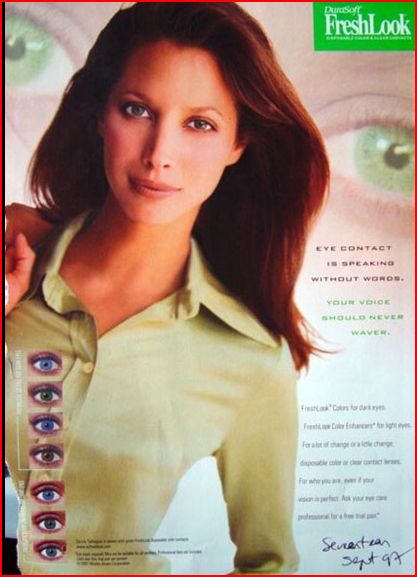
“Eye contact is speaking without words”:
capture111

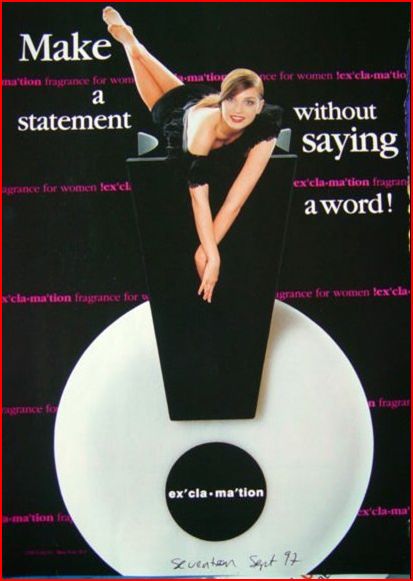
“Make a statement without saying a word”:
capture221

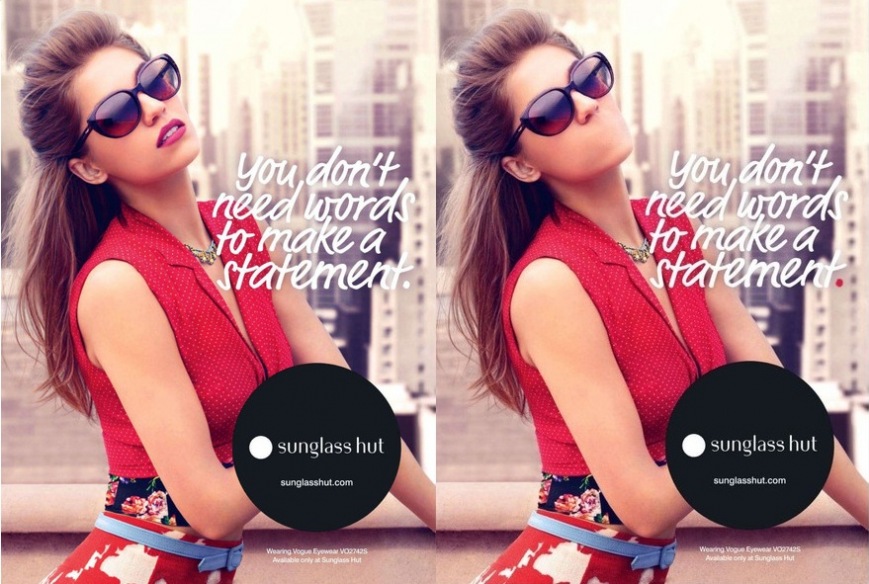
Finally, Sarah B. sent along a form of resistance to these kinds of images.  Colin von Heuring, who just started a brand new blog on media subversion, saw an ad with the copy  “You don’t need words to make a statement.”  He decided to “ma[k]e it explicit” (original on the left, modified on the right):

For more on Jean Kilbourne and the subordination of women in advertising, here’s the trailer to Killing Us Softly 4:

Lisa Wade, PhD is an Associate Professor at Tulane University. She is the author of American Hookup, a book about college sexual culture; a textbook about gender; and a forthcoming introductory text: Terrible Magnificent Sociology. You can follow her on Twitter and Instagram.

Well, crap. It turns out I might be a terrorist. I wasn’t aware of this, but then Dave A. sent in a video from Houston’s Make the Call anti-terrorism initiative, and it isn’t looking good.

The evidence:

  • I sometimes walk off and leave bags unattended in public spaces.
  • I gather information about routines in public spaces, often sending operatives out to stand by entrances and exits. They covertly take notes, and I specifically tell them not to draw attention to themselves. Occasionally they even take photos of the layouts of public places or ask employees detailed questions about the inner workings of the organization. I have cleverly disguised these surveillance activities as sociology assignments.
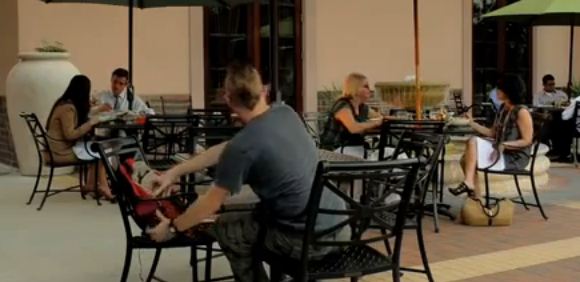
  • I sometimes carry small electronic gadgets that might not be immediately recognizable to every single person sitting at a cafe.
  • I get cold easily and often wear sweaters or bulky hoodies in summer, even in Vegas.
  • I can be kind of hyper and nervous-acting, which probably makes me “sketchy”.
  • I always forget the security code at my friend Robin’s housing complex, so I usually just sneak in behind someone else.
  • I have been known to park in prohibited areas.

Watch the video and see for yourself:

This method of fighting terrorism is extremely unrealistic. The behaviors listed in the video are things people do all the time, in a variety of contexts. If every citizen of Houston reported every incident they see that is mentioned in this video, the Houston PD would be overwhelmed and unable to function because of the number of calls they’d have to investigate. I’d have to call the police every time I saw a woman wearing Ugg boots in Vegas, because it’s never cold enough here to justify them.

The video tells viewers not to ignore their “instincts.” But do we have an instinct for detecting “sketchy” people or behavior? Given what we know about stereotyping and selective perception, the reality is that people will view behavior through their pre-existing beliefs. Their interpretations of behavior as unusual or inappropriate will be influenced by how comfortable they otherwise are with the person engaging in it, which is impacted by race/ethnicity, class, and many other social categories. A guy leaving a backpack unattended is scary if that guy has a mohawk or, you know, looks scary and stuff, but when I do it, no one bats an eye. This video basically legitimizes turning anyone who makes you at all uncomfortable in public in to the police, on the argument that you are simply following your “instinct.” When you ask every citizen to become an intelligence agent, reporting every incident they perceive as odd, the result is the increasing stigmatization and semi-criminalization of those who can’t or won’t conform to pretty narrow standards of physical appearance, dress, and behavior.

UPDATE: There’s an interesting discussion in the comments about how you balance the need to avoid paranoia with the fact that, for instance, some rapes on college campuses would be prevented if people didn’t leave dorm doors ajar or let people in without knowing who they are, and that’s a conversation worth having. However, I’m also interested in the issue of feasibility here: If all the citizens of Houston literally did what this video suggests, law enforcement would grind to a halt and response times would slow for everyone.

As for why I sometimes leave bags unattended in public…Because there’s nothing of value in it and I left it on an outside table while I go inside to order, or because I’m gathering a lot of books at the library and I get sick of lugging my bag while I do this and leave it on a table while I go into the stacks, or because I realize I forgot to grab something on another aisle at the grocery store and I run around the corner to grab it without thinking to grab my bag. My point isn’t that any of the things I do are laudable or even smart, but rather that people do these things, sometimes on purpose, sometimes because we get distracted or make mistakes, and it’s going to take a massive increase in law enforcement if we really want citizens to start vigilantly reporting them.

In Gay Rights at the Ballot Box, I analyze the long history of transgender smear tactics used by the Religious Right, a large social movement that opposes LGBT rights. One area where this occurs is the production of campaign ads addressing attempts to protect transgender individuals from discrimination. The ads almost always focus on either children or bathrooms.

Back in April, voters in Anchorage, Alaska, rejected Proposition 5, which would have created a law protecting residents from discrimination based on sexual orientation or gender identity. Such laws are primarily to protect lesbian, gay, bisexual and transgender (LGBT) residents. Transgender inclusion in the potential law was the focus of two commercials by the organization Protect Your Rights.

In both of these political ads, figures of large, hairy male-bodied individuals in dresses, described as “transvestites”, represented transgender inclusion. They present transgender individuals as grotesque and threatening. At the heart of these ads and other transgender smear tactics is anxiety about bodies in gender-segregated spaces that are typically occupied by women.

The women’s bathroom in particular is a site where gender conformity is policed. According to scholar Judith Halberstam in her book Female Masculinity, women’s bathrooms “operate as an arena for the enforcement of gender conformity…a sanctuary of enhanced femininity, a ‘little girl’s room’ to which one retreats to powder one’s nose or fix one’s hair” (p. 24). In this ad, the locker room operates in parallel way, as a space where gender conformity and bodies are strictly policed:

The other ad focused on the possibility of a “transvestite” getting hired at a daycare facility:

In addition to the use of stereotypically-presented “transvestites” to represent all transgender individuals as grotesque and laughable, the ads also argue that employers should have the right to discriminate if they think their customers are prejudiced toward a particular group or uncomfortable with them in certain jobs — an argument that has been used to resist allowing racial minorities and women into various careers. The ads also suggest that Anchorage is already sufficiently tolerant and thus doesn’t need to address the issues Proposition 5 supporters claimed were a problem.

Ads that raise fears about transvestites teaching in the classroom have been used since the 1970s during ballot measure campaigns, and the Religious Right has been raising concerns about transgender women in women’s bathrooms since the late 1980s. These two ads from the Anchorage Proposition 5 campaign are among the newest additions to the long tradition of ads that rely on stereotypes of LGBT individuals as predatory, dangerous to have around children, and having ulterior motives.

—————

Amy L. Stone is an associate professor of sociology at Trinity University in San Antonio, Texas.