Search results for embed


Kelly V. sent in a video by Alisa Miller of Public Radio International about the impact of news coverage on what we know about. In particular, she argues that changes in the U.S. news media, such as shutting down expensive foreign bureaus, have led to less coverage of events or issues in other countries:

For other examples of the role of media outlets in signaling what’s worth talking about, check out our posts on media outlets covering celebrity stories while chastising us for caring, presenting polls in the media, what stories get covered?, people are more interested in Tiger Woods than Afghanistan, meaningless statistics, U.S. and international versions of magazine covers, “us and them,” which missing kids get news coverage?, covering Obama and McCain, covering Obama and Clinton, and what’s worth covering in a slideshow?

Tilly R. sent in the clip below of Bill Maher attempting to illustrate the oppressiveness of the burqa by staging a fake fashion show in which every model comes out in an identical burqa. You only need to watch the first couple models to get the idea (starts at about .20 sec.):

The comedy is tasteless, at best. And it brings out two interesting assumptions: that measures of women’s liberation include (1) the right to show skin and/or your body’s shape and (2) the choice to express your individuality through your clothes.

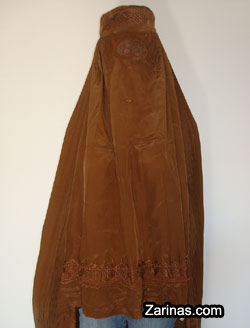
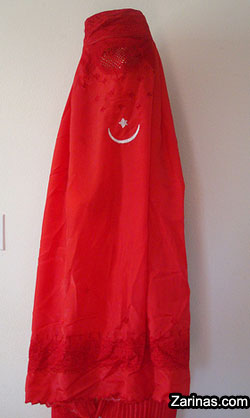
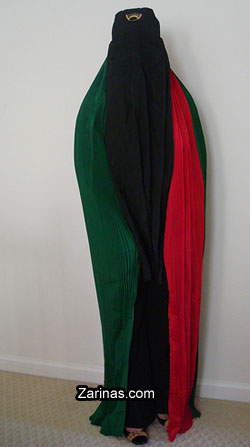
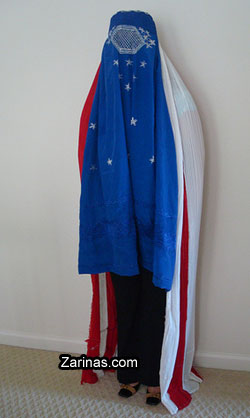
It is with a focus on the latter that I introduce a website submitted by K.L. The website, Zarina, sells burqas. While most of the burqas we see in Western media are blue or black, this website sells burqas of all stripes.

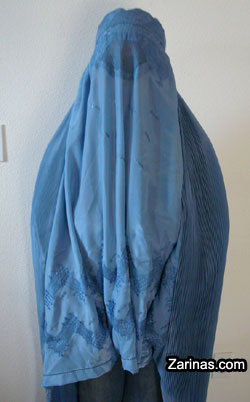
A blue, embroidered burqa:

A “hot pink” burqa:

A saddle brown burqa:

A Turkish flag burqa:

An Afghan flag burqa:

An American flag burqa:

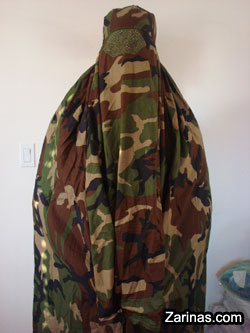
A camouflage burqa:

I have no idea if this website is legitimate (though it seems to be) and I have no idea whether women in (which) different burqa-requiring/encouraging societies can actually choose to wear these. I really have no idea.

But I do think it prompts us to interrogate our own assumptions about what women’s liberation looks like and if being able to choose your own style really is a good measure of it.

I’d bet that most Western women feel like being able to choose her clothes is a central part of her sense of freedom. Does that translate in this context? That is, if women were required to wear burqas, but could wear any burqa they like, does this mediate how oppressive the burqa seems to you? Conversely, does the seeming freedom that comes with choosing your clothes become less convincing once you think about it in this context?  I know this is tough to think about, but I think it’s an interesting thought experiment.

For related posts asking us to think about the relative freedoms represented by the burqa and the power of the male gaze, see here, here, and here.

Lisa Wade, PhD is an Associate Professor at Tulane University. She is the author of American Hookup, a book about college sexual culture; a textbook about gender; and a forthcoming introductory text: Terrible Magnificent Sociology. You can follow her on Twitter and Instagram.

We talk about a lot on this blog about how things that having nothing to do with genitals are, nonetheless, gendered. Some sociologists are noting that a cluster of ideas related to intellectualism–liking school, studying hard, being smart, reading, and even caring about ideas–have become feminized. As a result, boys and men express less interest in and invest less in school, and girls and women are kicking their asses, scholastically speaking.

We previously featured an advertising campaign for Wrangler that told men to “stop thinking.” And this week Monika P. and Kat B. sent in an ad campaign for Deisel with the slogan: “be stupid.”

There’s a whole commerical (embedded below), but the general thrust is that smart people are doin’ smart stuff, but Diesel is “with stupid.” Because “stupid is the relentless pursuit of a regret free life.”  And while smart people may have “the brains,” stupid people have “the balls.” Besides, they say, “if we didn’t have stupid thoughts, we’d have no interesting thoughts at all.” Which doesn’t make the slightest bit of sense, but whatever.

And in case that doesn’t convince you, they concede that “smart has the authority,” but stupid has “one hell of a hangover.” Sign me up.

Ultimately the message is that smart people are repressed and confined, they have no fun, and nothing exciting ever happens to them.  So being smart is framed as (but isn’t) the opposite of all these things.   They leave you with the thought: “You can’t outsmart stupid.”


UPDATE! That said, Reader Kyle Munkittrick offers a compelling rebuttal at his blog, Pop Transhumanism.

Lisa Wade, PhD is an Associate Professor at Tulane University. She is the author of American Hookup, a book about college sexual culture; a textbook about gender; and a forthcoming introductory text: Terrible Magnificent Sociology. You can follow her on Twitter and Instagram.

Christina S. sent along a link to the British commercial below for Twingo. There’s a twist ending, so I’ll let you watch it:

Notice that, at the very end, the narrator refers to how “we live in modern times,” meaning that we drive socially responsible cars and tolerate cross-dressing.

The idea embedded in that commercial is: now that we’re “modern,” there is no more prejudice and intolerance. Or, “modern” people are tolerant of social differences. Things like bias, hate, and discrimination are “in the past,” confined to those who are “traditional” or otherwise somehow regressive.

This makes sense to us (and the commercial, therefore, works) because many of us have a model of history that assumes that everything will, inevitably, always get better… or at least not get worse. This is a linear model where the line for “progress” keeps going higher and higher over time.  However things are today, we assume, things must have been worse before.  Thinking like this makes invisible the possibility that people were more tolerant in the past as well as the possibility that we could become increasingly intolerant in the future.  As I wrote in a previous post about cavemen:

There are serious problems with this idea:  (a)  We may stop working to make society better because we assume it will get better anyway (and certainly never get worse) with or without us.  (b) Instead of thinking about what things like gender equality and subordination might look like, we just assume that equality is, well, what we have now and subordination is what they had then.  This makes it less possible to fight against the subordination that exists now by making it difficult to recognize.

History doesn’t move along in a linear or predictable way.  And it certainly doesn’t produce equality just by plodding along.  We need to do the hard work of figuring out what an egalitarian society looks like and how to get there.  Conflating “modernity” with social tolerance makes it seem as though the work is already finished.

UPDATE! Ashleigh V. sent in another Twingo commercial.  This one conflates modernity with sexual permissiveness:

Lisa Wade, PhD is an Associate Professor at Tulane University. She is the author of American Hookup, a book about college sexual culture; a textbook about gender; and a forthcoming introductory text: Terrible Magnificent Sociology. You can follow her on Twitter and Instagram.

Gwen M. sent in a story about a performance by Oksana Domnina and Maxim Shabalin at the Russian National Figure Skating Championships:

The pair won first place and plan to use the routine at the Vancouver Olympics next month. They explained that the routine (video below) was inspired by clips of Australian Aboriginal dance on the internet. About the idea, Domnina wrote: “I thought it was just crazy, but once we have tried it, we immediately fell in love with it.”

Bev Manton, the chair of the New South Wales Land Council thinks it’s less “crazy” and more offensive. She says:

I am offended by the performance and so our other councillors… Aboriginal people for very good reason are sensitive about their cultural objects and icons being co-opted by non-Aboriginal people – whether they are from Australia or Russia.

It’s important for people to tread carefully and respectfully when they are depicting somebody else’s culture and I don’t think this performance does.

The routine:

Sources (text; image).  Via Racilicious.

Lisa Wade, PhD is an Associate Professor at Tulane University. She is the author of American Hookup, a book about college sexual culture; a textbook about gender; and a forthcoming introductory text: Terrible Magnificent Sociology. You can follow her on Twitter and Instagram.

p.j. sent in a link to the trailer for the movie “Demographic Winter,” which apparently educates us about the coming downfall of humanity, or at least humanity in developed nations:

Thus, gay rights, women’s rights, and non-marital sexuality are not just immoral, they’re literally threatening the very survival of the human species.

Well, maybe not the human species. Certain members of the human species, those that live mainly in Europe and the U.S. Of course, what we’re really getting at here, ultimately, is the fear that Whites in developed nations are not reproducing sufficiently. For another example of this, see our post on the Louisiana Senator who proposed paying “these people” and “illegal aliens” $1,000 to be sterilized.

In both cases, women’s reproductive capacity would ultimately be targeted as a means to a social goal–one group of women will need to give up their silly concerns about women’s equality and start having more babies (and gay men gotta start impregnating women!), while other women must be discouraged from having them. It’s a story we’ve heard many, many times before.

Gwen Sharp is an associate professor of sociology at Nevada State College. You can follow her on Twitter at @gwensharpnv.

Even the most cursory discussion of the history of women’s paid employment in the U.S. will include the importance of World War II, when the scarcity of men meant many jobs became available to women for the first time.

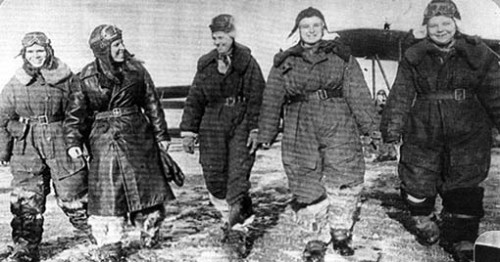
The U.S. wasn’t the only place this happened, of course. In the face of a massive attack by the Nazis, the Soviet Union allowed women to occupy combat positions, including setting up three regiments to fly night bombing raids (according to Wikipedia, it was the first nation to allow women to do so). The regiments became known as the Night Witches:

“We slept in anything we could find—holes in the ground, tents, caves—but the Germans had to have their barracks, you know. They are very precise. So their barracks were built, all in a neat row, and we would come at night, after they were asleep, and bomb them. Of course, they would have to run out into the night in their underwear, and they were probably saying,—Oh, those night witches!’ Or maybe they called us something worse. We, of course, would have preferred to have been called ‘night beauties,’ but, whichever, we did our job.”

Members of the 588th Night Bomber Regiment:

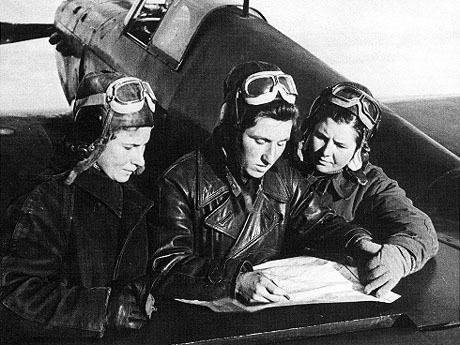
Lilya Litvyak:

In this video, Lidiya Gudovantseva recalls working as a sniper, including the first time she had to kill a German soldier and later being injured herself:

When the war ended, many women in the U.S. were pressured to leave their jobs; similarly, female Soviet soldiers found that opportunities for promotion dried up during peace time. They were apparently even barred from military colleges, closing off many positions to them altogether, though the military’s draft policies stipulated that women should be called up next time there was a war. Women served as a reserve labor force for the military, to be called up when needed (and praised on Soviet propaganda posters) but pushed out of the ranks to provide room for men the rest of the time.

Tara C. sent in this video about why big blockbuster video games haven’t tended to appeal to women, and what might need to change to make the (non-casual?) gaming world more interesting to women in general:

Apparently the creators of this trailer for Record of Agarest War, sent in by Goku S., hadn’t seen the video (NSFW):

Nor, presumably, did the creator of the Pocket Girlfriend iPhone app, sent in by Suzanne B.:

You’ll be excited to know that she’s real!

Pocket Girlfriend moves, she’s interactive, and most importantly she’s real. YES SHE’S REAL!!!! She’s not some 3D rendered mannequin. Seriously, why would you want to buy an application of a dancing mannequin?

Looks like Yahoo didn’t get the message either when it hired lap dancers to attend an event to recruit developers to build things for Yahoo.com, and then posted images of the dancers on the Yahoo Developer Network blog:

Yahoo later apologized.

[And for the record, yes, I realize these are just some examples and don’t represent the entire gaming community, especially the Yahoo thing. That’s true of anything we post–they’re specific examples that we try to fit into a larger context.]

On a related tech-and-gender note, Brigid told us that Wired magazine recently described a study that suggested the stereotype of computer scientists as “unwashed nerds” may be off-putting to women and discourage them from going into computer programming:

Cheryan and colleagues tested this idea by alternately decorating a computer science classroom with objects that earlier surveys pegged as stereotypically geeky—Star Trek posters, videogames and comic books — or with objects that the surveys found to be neutral— coffee mugs, plants and art posters. Thirty-nine college students spent a few minutes in the room, then filled out a questionnaire on their attitudes toward computer science.

Women who spent time in the geeky room reported less interest in computer science than women who saw the neutral room. For male students, however, the room’s décor made no difference.

UPDATE: Comments closed. Sorry, but it was turning into a big fight that wasn’t constructive.

UPDATE 2: Upon request that I rethink closing comments, I’ve cleaned out some problematic ones and am reopening the comment thread. Please remember–no personal attacks or insult wars. Play relatively nice.