Search results for embed

Dan Ariely, in this great talk, describes some of his surprising research on cheating.

He finds that almost everyone will cheat, but only a little bit.  People are less likely to steal money, than other things (e.g., office supplies).  “Priming” works, too: If people are reminded to be moral, they are less likely to cheat.

If we see people we think are like us cheat, we are more likely to cheat than we would have otherwise (but we have the opposite reaction to cheaters that we see as not like us).  Ariely then applies his findings to the Enron scandal.

A fun and fascinating 16 and a half minutes:

Lisa Wade, PhD is an Associate Professor at Tulane University. She is the author of American Hookup, a book about college sexual culture; a textbook about gender; and a forthcoming introductory text: Terrible Magnificent Sociology. You can follow her on Twitter and Instagram.
Anna sent us links to this 1967 British health awareness film, “A Cruel Kindness,” about children and obesity:

I was really struck by how little mention fresh fruits and vegetables get in the discussion of a balanced diet at the end of the first segment (about 3:45)–you just need a little of them to get the vitamins you need. Today, of course, much more emphasis would be placed on them, and fats would get much less.

Anna points out that the fault for childhood obesity is placed squarely on mothers, either for overindulging their children out of love or being too busy or lazy to get their kids enough exercise and healthy meals.

And oh, poor Valerie! She’s from a broken home. Destined to be handicapped for life, a social outcast who will grow up to be like Mrs. Brown, abandoned by her husband.

Of course, while our attitudes toward foods have changed to focus on more fruits and vegetables and fewer fats, other elements of the film would fit in with anti-obesity campaigns today with a little updating. We still often focus on individualistic causes of obesity over structural ones (what types of foods governments subsidize, for instance), implicitly blame mothers for not taking the time to cook wholesome meals at home, and treat fatness as a social death sentence. We usually try to sound nicer when doing it, though.

Gwen Sharp is an associate professor of sociology at Nevada State College. You can follow her on Twitter at @gwensharpnv.

I’ve got a special treat for you today: an interview with artist Nathan Meltz about his pieces on industrial food production. Nathan has shown his art in group shows around the country.  He received a Master’s degree in Art from the University of Wisconsin-Madison and is currently a graduate student at SUNY-Albany, where he will be graduating this spring with his MFA.  He lives in upstate New York with his wife, Abby Kinchy, and their infant son Aldo. His artistic and musical exploits can be followed at The House of Tomorrow.

I went to grad school with Abby, so that’s how I knew about Nathan’s work. As a sociologist who specialized in food issues and rural communities, I immediately loved these pieces and thought many of our readers would too, so I convinced Nathan to let me post an interview and some of my favorites. (And be forgiving of my amateurish interview questions. I am not a Creative Type, and my general reaction to art I like is “You made a pretty!”)

—————————-

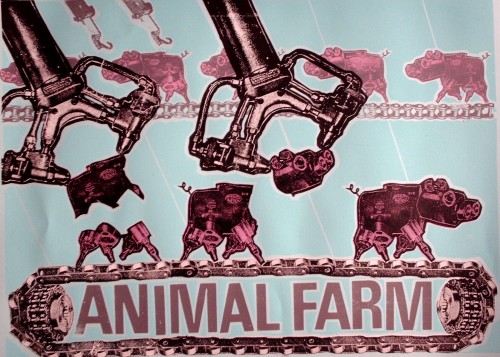
Animal Farm
ANIMALFARMBLUE

What drew you to the issue of food?

I have to give a lot of credit to Abby, who is a sociologist at the Rensselaer Polytechnic Institute, and has done a lot of research on controversies surrounding genetically-modified corn and canola. [She’s currently working on a book about conflicts over genetically modified crops in Canada and Mexico.–Gwen].  A lot of the themes in my art developed from kitchen-table discussions we had while in grad school in Madison.  What was technology doing to agriculture? And then, from my end, what would it look like?

How did you come up with the idea of representing food products as machines?

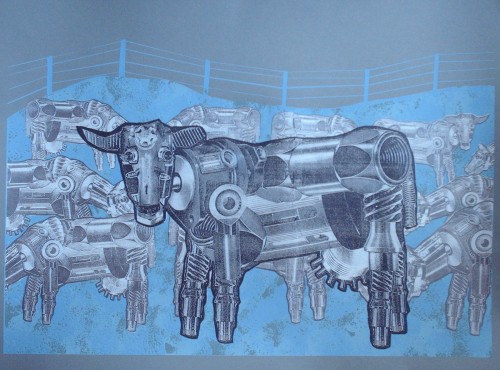
I wanted a visual metaphor that would reveal tech taking over plants and animals.  Unfortunately, our most current tech can be hard to visualize.  A series of ones and zeros?  Some sort of digital technology?  I decided to combine elements of Dada collage with early modernist German machine aesthetic [Oh, yes, the early modernist German machine aesthetic! Of course!–Gwen]  to create my own visual vocabulary. One that, while not exactly 21st century, would act as a symbol of science and technology for the viewer/audience.

What does your Animal Farm series convey about our modern food system?

Waiting for My Mechanical BullCOWs

Enviropig
enviropig_paper

In my machine world, animals are put on assembly lines, cramped together in feed lots, and, in the case of the chickens in The Chicken Coup animation, reside in an agricultural system designed by sadists.  They all look the same because there is no diversity on the factory farm.

    The Chicken Coup, pt. 1

    The Chicken Coup, pt. 2

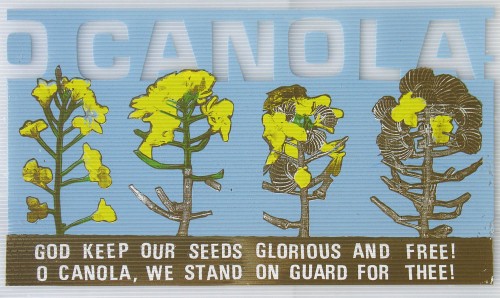
Many people have at least some knowledge of slaughterhouses and the treatment of animals, so the Animal Farm series is probably fairly accessible. But O Canola! is, I think, more complex and harder to understand if you’ve never thought much about bioengineering before, or why the song “O Canada” would be particularly meaningful in the context of discussing canola and bioengineering.

O Canola!
Ocanola

O Canola! was a project long in the making, very much piggybacking on the research Abby was doing at the time. I try to tell the story of Canada’s GMO [genetically modified organism] canola contamination* in a visual form. The clever riffing on the Canadian National Anthem (which Abby thought of) is meant to reflect the nationalist tensions inherent in the controversy, where a hybrid plant created by the Canadian government during WWII to produce a mechanical lubricant at the local level would years later be threatened by GMOs produced by agribusiness.

What about Food for Fuel?

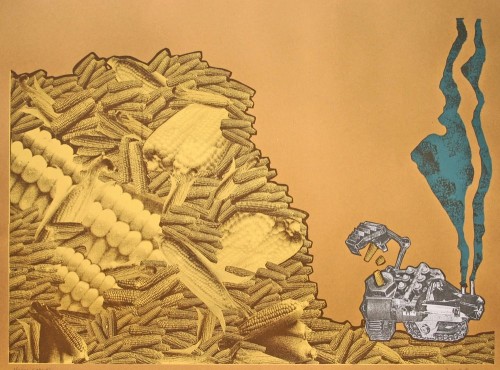
Food for Fuel
3

Food for Fuel came after news reports kept coming in about food shortages around the world, particularly in Mexico, because so much edible food was being turned into fuel for vehicles.  The message on this one is pretty straightforward.

Food for Fuel, along with Animal Farm, definitely reflects my interest in Agitprop.  At the time I made these, I was sharing a studio with printmaker/activist Josh MacPhee, a member of the Just Seeds print collective, which promotes socially activist printmaking.  A lot of the work he was doing really influenced me, and I think these two prints reflect my desire to have a clear social message.

How have people reacted to the series? Do you get a sense that people react more forcefully, or emotionally, to the ones about animals than the ones about crops?

Reaction has been positive, or at least the reaction I hear about.  A lot of the prints have traveled around in various shows.  I think the animation The Chicken Coup has maybe received a little more attention than the prints among the art audience.  Static prints on paper have a hard time competing with moving images with sound, music, etc.  And I don’t think people care any less about the crop-based works than the animal ones.  I find people who are really into food/agriculture issues care just as forcefully about what is happening to corn as they do cows.

—————————–

* GMO contamination occurs when genetically modified seeds migrate to fields that were not intentionally planted with them, an increasingly common occurrence. Aside from the problems this can cause farmers who want to sell their products as specifically not GMO, and concerns about the ecological effects that could occur if modified genes spread into other varieties (or even related wild species), it also puts farmers at legal risk. GMO crops such as marketed under the Roundup Ready label and engineered to be immune to the effects of Monsanto’s weedkiller Roundup, are patented. Farmers are not allowed to plant them without buying a license (including saving seeds from their own crop to plant the following year, a traditional practice of many farmers to eliminate the cost of buying seeds each year; so-called “terminator” varieties are even engineered to produce only sterile seeds, thus ensuring farmers must buy fertile seeds from the manufacturer annually). Monsanto has sued farmers for patent infringement in cases where a field was contaminated with Monsanto’s GMO seeds when they blew in from a neighboring field. Conversely, a group of Canadian organic farmers sued Monsanto on the grounds that genetic contamination had made it impossible for them to sell their products as organic.

If you’re interested in the topic, you might try to get a copy of Abby’s new article, “Anti-Genetic Engineering Activism and Scientized Politics in the Case of ‘Contaminated’ Mexican Maize,” Agriculture and Human Values.

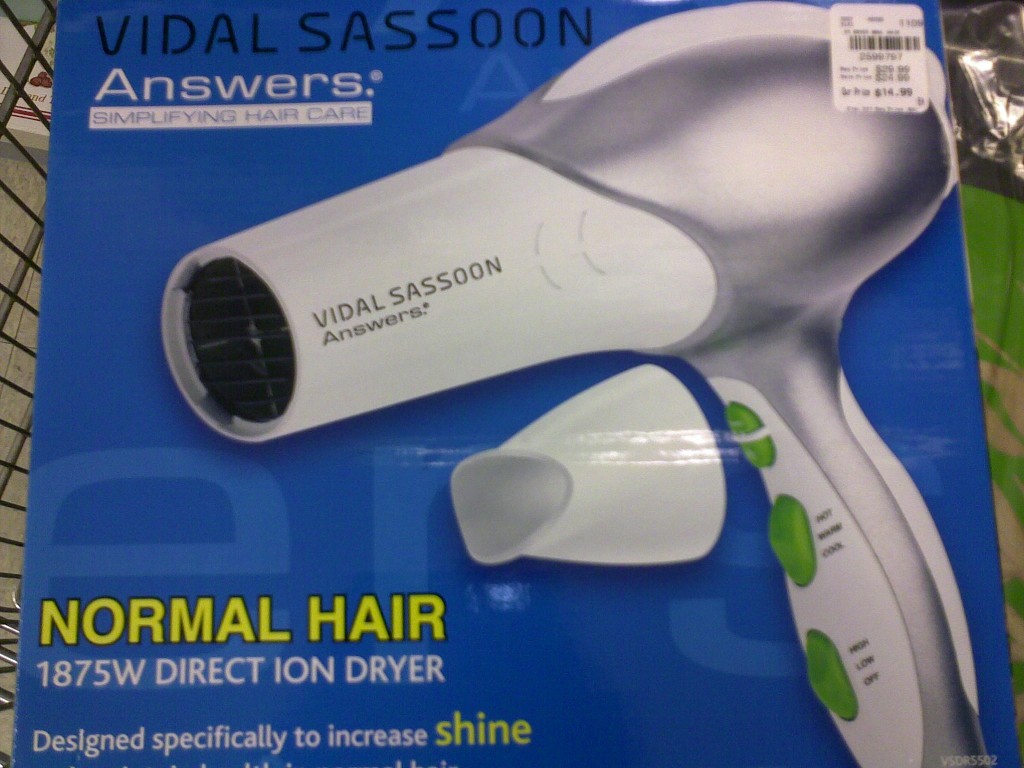
Rudo M. sent us a great example of how “normal” is socially constructed. The photos below are of the box containing a Vidal Sassoon hair dryer for “normal” hair:

1

It’s also, “good” hair, as is said, in so many words, the blurb on the box said so:

Not too fine or coarse,  normal hair is the most manageable hair type with the largest range of possible styles.  Though it’s fun to experiment, even the easiest-to-care-for hair requires a regimen of regular maintenance.  Proper styling tools with varying heats are crucial for keeping a healthy-looking shine, maintaining balance, and adding…

Yeah, so just in case it wasn’t clear already, “normal” hair is the bestest!  It’s “not too fine or too coarse,” has the “largest range of possible styles,” is “fun,” and is totally the “easiest-to-care-for”!

Rudo is an African woman who wears her hair natural, so she knew right away that Vidal Sassoon didn’t count her hair as “normal.”  So, what were the other options?  If you’re not normal, what are you? Well, according to Vidal Sassoon, you are, of course, “fine” or “coarse.”

But a lot of good this does Rudo, since even the models on the “coarse” box are white with essentially straight hair!  So much for a range of hair types!  Well, at least we know that even white women with straight hair can be abnormal!

And, just in case you didn’t know already that being abnormal means being WRONG, coarse hair is “hard-to-style,” fine hair is limp, and both tend to “frizz.”   What a difference from Vidal Sassoon practically falling over itself praising normal hair.

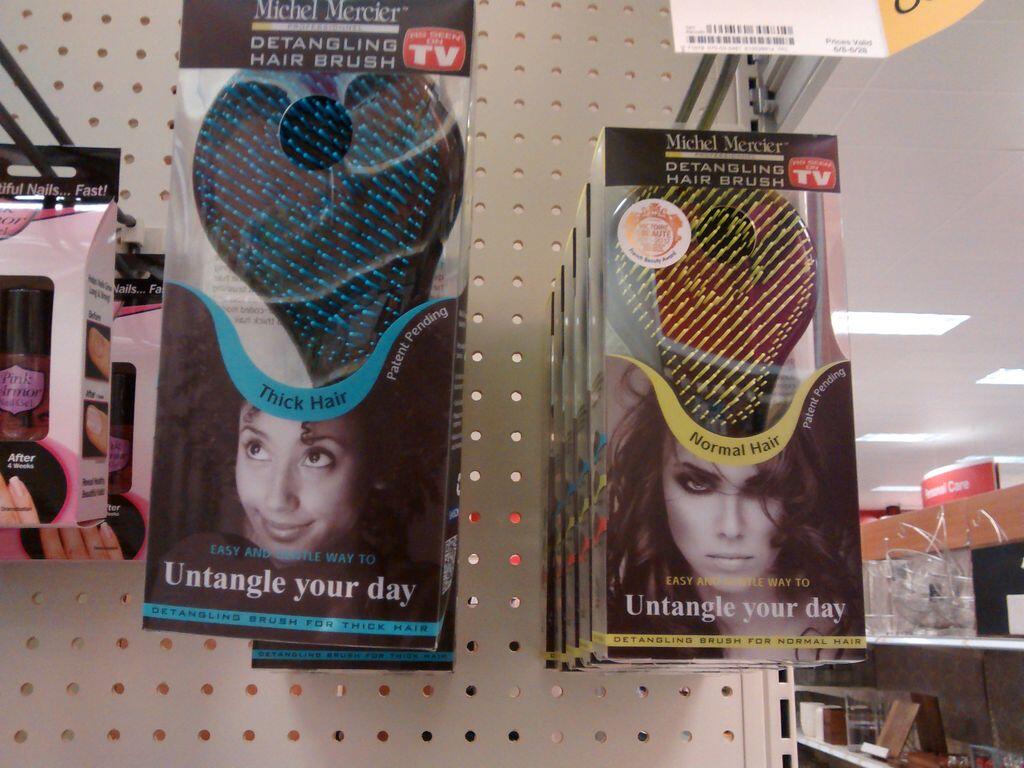
Here’s another example, sent in by @adentweets.  There’s “normal” and there’s “thick” hair.

1

Cara McC. sent us a Covergirl commercial selling foundation for “normal,” “oily,” and “sensitive” skin. Again, they include a range of skin types (and probably include women who represent three different races) in order to point to the diversity of skin types, but nonetheless label one “normal” (the one represented by the white woman).

For more examples of whiteness as normal and people of color as deviant (or, if we measure by Vidal Sassoon, non-existent), see our posts on Michelle Obama’s “flesh-colored” gown, Johnson’s lotion for “normal to darker skin,” bandaids and other “flesh-colored” things, why Sotomayor may be “biased,” families vs. ethnic families, and people of color add “spice.”

Lisa Wade, PhD is an Associate Professor at Tulane University. She is the author of American Hookup, a book about college sexual culture; a textbook about gender; and a forthcoming introductory text: Terrible Magnificent Sociology. You can follow her on Twitter and Instagram.
Sociologist Stephanie Coontz, in her acclaimed, fascinating, and fact-dense book, The Way We Never Were, illustrates the way that what is considered “traditional” must be socially constructed. For example, when people say “traditional marriage,” do they mean marriage between a man and his property? Between a man and more than one woman? Is the ideal age for marriage 13, 20 or 27? Is it for love, political maneuvering, survival, babies, or kitchens?  How you answer these questions depends on when, exactly, in history you’re talking about.  (See here for some humorous takes.)

The point: Since all of history is potentially a source of tradition, identifying any given period of time as The Traditional, and therefore deserving of our nostalgia, is arbitrary.

The Daily Show did a great job of illustrating this idea this week:

Lisa Wade, PhD is an Associate Professor at Tulane University. She is the author of American Hookup, a book about college sexual culture; a textbook about gender; and a forthcoming introductory text: Terrible Magnificent Sociology. You can follow her on Twitter and Instagram.

Keely W., Sophie J., and Austin C. sent in this 20-second commercial for KFC in which a white guy surrounded by black people makes the “awkward” situation all better by giving them fried chicken:

So, first of all, feeling awkward because you’re the only person with your particular racial make up in a group is called white privilege.  Most racial minorities find themselves the only or one of the only members of their group all of the time.  Calling the situation “awkward” just suggests that white people are, or should be, uncomfortable around black people.

But, second, is it racist that the guy soothes the situation by sharing fried chicken?  In the U.S., the idea that black people eat a lot of fried chicken is a stereotype (applied recently to Obama).  But this is an Australian commercial and KFC is saying that there is no such association in Australia.

I don’t know if that’s true.  But if it is, it raises interesting questions as to (1)  just how cognizant companies should have to be about various stereotypes around the world and (2) whether the biased histories of some countries must be more attended to than others.

A Guardian article quotes a professor arguing that the U.S. has “…a tendency to think that their history is more important than that of other countries.”

Ouch.  Does it hurt because it’s true?

I think these are tough questions.  What do you think?

Lisa Wade, PhD is an Associate Professor at Tulane University. She is the author of American Hookup, a book about college sexual culture; a textbook about gender; and a forthcoming introductory text: Terrible Magnificent Sociology. You can follow her on Twitter and Instagram.
Chrissy B., Dmitriy T.M., and Lindsay sent in videos regarding Brit Hume speaking on Fox News about the Tiger Woods scandal, arguing that he needs to convert to Christianity, rather than his current Buddhist beliefs, if he’s going to get back on the right moral track:

Transcript of the main point:

The extent to which he can recover seems to me depends on his faith, he’s said to be a Buddhist, I don’t think that faith offers the kind of forgiveness and redemption that is offered by the Christian faith, so.. my message to Tiger would be, “Tiger, turn your faith–turn to the Christian faith, and you can make a total recovery and be a GREAT example to the world.”

It’s an interesting example of how many Americans treat Christianity as the default, “normal,” and the best religion for everyone. Can you imagine Fox News, or any other news outlet, intentionally giving air time to a person saying that Tiger Woods needs to convert from Christianity to Buddhism (or any other religion) if he’s going to change his behavior? Can you imagine the outcry if the suggested religion was Islam?

The Daily Show aired a segment that addressed this issue, and then a day later had another segment about Brit Hume’s claims that Christianity is under attack in the U.S.:

The Daily Show With Jon Stewart Mon – Thurs 11p / 10c
The Best F**king News Team Ever – Tiger Woods’ Faith
www.thedailyshow.com
Daily Show
Full Episodes
Political Humor Health Care Crisis
The Daily Show With Jon Stewart Mon – Thurs 11p / 10c
The Temple of Hume
www.thedailyshow.com
Daily Show
Full Episodes
Political Humor Health Care Crisis

None of this, of course, even addresses the irony of suggesting that Christianity is the only religion that can help save you from infidelity, given the number of conservative Christian politicians who have been caught cheating on their wives in the past couple of years. But I don’t think irony is Hume’s strong suit.

UPDATE: Rosa S. of Newsy sent in this segment about the issue:


Binyavanga Wainaina does an excellent job, in this 3-minute video, describing ways that “Africa” tends to be written about in the West. See how many of the tropes you recognize:

To paraphrase Jose, at Thick Culture, it’s important to be engaged with the world, but our engagement shouldn’t be entirely on our terms. And, especially, not terms in which the Western world gets to construct itself as the savior of the less fortunate (e.g., Avatar).

Such ideas make it seem as if underdeveloped parts of the world are somehow inherently deficient (culturally or otherwise). When, in fact, insofar as underdeveloped parts of Africa or other continents need saving, it is partly (largely?) because of (1) a history of colonialism that stole their resources and disrupted their societies and (2) the current global economic system that continues to put them at a devastating disadvantage.

See also: The Single Story of “Africa”

Lisa Wade, PhD is an Associate Professor at Tulane University. She is the author of American Hookup, a book about college sexual culture; a textbook about gender; and a forthcoming introductory text: Terrible Magnificent Sociology. You can follow her on Twitter and Instagram.