Search results for embed

Asa D. sent in an animated 1958 Disney segment titled “Magic Highway USA.” The cartoon extols the virtues of the highway system of the future (the interstate highway system was authorized by President Eisenhower in 1956). Apparently it is farther into the future than 2010, as my windshield does not have a radar, and road construction around here doesn’t seem to be instantaneous:

The segment of course illustrates gender expectations of the time — dad goes off to work while mom and the kid(s) go shopping. But as Asa points out, this example of the “techno-utopianism” of the post-World War II era, with faith that modern technologies will lead to a happy future that increasingly frees us from unpleasant work, boredom, wasted time, and so on, is truly fascinating.

Providing a nice contrast to that earlier vision, Dmitriy T.M. let us know about the stop-motion short video Metropolis by Rob Carter. The entire video, which is 9 1/2 minutes long, gives an abridged history of Charlotte, North Carolina.

Here are the last 3 minutes (you can see the entire video here). In this segment, we see the unfolding of a large highway system and urban construction/destruction/reconstruction. At about a minute in, “the video continues the city development into an imagined hubristic future, of more and more skyscrapers and sports arenas and into a bleak environmental future” (quote found here):

Metropolis by Rob Carter – Last 3 minutes from Rob Carter on Vimeo.

NEW! (May ’10): Kris H. sent in another example of envisioning the future. The Futurama, an exhibit at the 1939 World’s Fair, promised a future in which interstate highways will allow people to bypass slums, relieving us of the work of fixing them (found at Neatorama):

Jose Marichal, who blogs at Thick Culture, forwarded us this compilation of Bob Barker’s infantilizing and harassing behavior on The Price is Right during the 1970s.  It’s pretty stunning:

I’d like to say that men don’t call women “girls” these days… but I’m watching Jaime Oliver’s Food Revolution.

Source: FourFour via The Daily Dish.  More examples of calling women girls, both vintage and contemporary.

Lisa Wade, PhD is an Associate Professor at Tulane University. She is the author of American Hookup, a book about college sexual culture; a textbook about gender; and a forthcoming introductory text: Terrible Magnificent Sociology. You can follow her on Twitter and Instagram.

Orion submitted this gorgeous music video for the song, Tightrope, by Janelle Monae, featuring Big Boi. It’s a great example of how dancing doesn’t have to be sexualized or gendered by movement or attire. It’s just creative and interesting and mesmerizing!

On a completely different note: Any dance historians out there? To me this looks to be inspired by the adaptations of Charleston in Black America (Trankey Doo, Shim Sham, etc), like in this clip featuring Al Minns and Leon James (it’s filmed in 1961, but these dances emerged in the ’30s and ’40s):

I’d love to hear more about the evolution of this kind of movement.

UPDATE!  Thank you so much to our Reader, Anna, who is also a dance scholar and was able to give us some history in the comments thread:

Dance scholar here! I really enjoyed the dancing in the Janelle video. It should be read as an homage to rhythm dancing of African-descent from the 1920s through new Jack Swing (kidding, not sure there is a cut off date). The historical footage is in fact cited in Janelle’s video and as one poster pointed out, the dancing in her video is stylized as if it were being done on a tight rope… In my opinion (cause other scholars might see different things based on their training) her dance has some Camel Walkin’ mixed in with some dancehall hip articulation and a big dose of James brown, to be sure.

As for the claim that you cannot get from Al Minns and Leon James to 2010, that is shortsighted, very short! We get James and poppin and lockin and jazz itself from a peculiar mix of Bambara ethnic dances (modern-day Senegal, The Gambia, & Mali) and dance cultures of the people of the Kongo region (Angola, DRC, Congo among others) that intersected in New Orleans during the slaving period. You can also add in there “shipping music,” hybridized forms of music that emerged on slave ships with their transnational crews drawn from Europe, Africa, and the Mediterranean.

The hips and 6/8 syncopated shenanigans come to us from Kongo culture (but the Irish had some there, too). The Charleston, jitterbug and other high kicking dances come from the Senegal region and still reflected patterns from mandjiani in particular. Origins are always tricky, I try to avoid staking big claims based on them, but this conversation string was peculiar in that discussions of ethnic origin were not possible because race and gender were eliding the historical work done in Jenelle’s video. Yes I know the question was about gendered movement. And like a lot of the other folks, I am wondering while a male normative is held as neutral.

That said, from a dance perspective, the moves in Janelle’s video are without gender assignment, but there is an expectation that one’s gendered identity will be, must be expressed through the execution of the moves. That is the evolution of these forms which still have strong gender-based repertoire in Senegal. The Congo, people tend to do the same moves. The men MOVE their hips. It is de rigeur in pop as well as “traditional” dance music.

The last bit of the two guys dancing together was a comedy routine, a send up of a very famous dance riff from a couple in Harlem. I think that original “duet” appears in “Stormy Weather,” but I am not sure.

Thank you for putting up the two videos!

Thank YOU for your insight Anna!

Lisa Wade, PhD is an Associate Professor at Tulane University. She is the author of American Hookup, a book about college sexual culture; a textbook about gender; and a forthcoming introductory text: Terrible Magnificent Sociology. You can follow her on Twitter and Instagram.

It’s all over the web: Fox and ABC have resisted airing Lane Bryant’s new lingerie ad featuring plus-sized women (e.g., Adweek).  But I don’t think it’s, straightforwardly, because of a bias against fat women.  I think it’s a little more complicated than that.  I think it’s because the ads are scandalous… that they seem more overtly sexual than they would if they featured very thin models.

Think about it. In the media, the thin, young, beautiful, able-bodied white woman is the idealized woman. And the idealized woman is sexy, indeed, but not sexual. Sexy women attract attention; they inspire desire, but they don’t have desires of their own.  A sexy woman hopes that a man will like the look of her and take action.  But she’s not sexual.  She doesn’t take the action herself.  Doing so immediately marks her as suspiciously unfeminine.

Sexual women — women who have desires and express and act on them — are almost always presented as deviant in some other way. They’re working class, they’re Black or Latina, they’re mentally ill, or… they’re fat. Fat women are often characterized as sexual threats.  How many comedies have relied on the scary fat woman (of color) trying to get some?  It’s so funny, right?  Because she’s gross and aggressive!  She wants you and she doesn’t care what you want and so the fact that she’s fat doesn’t stop her.  Scary!

So, there is something innocent and asexual about very thin women.  As the feminine ideal, they are sexy, not sexual.  They incite desire, but they do not have it.

In contrast, fat marks a woman as overtly sexual.  She is a woman with appetites and, you better watch out, she might just eat you up.

This, I contend, is what is so scandalous about plus-sized women in lingerie. They are just too damn hot for TV.

Here’s the commercial:

What do you think?

UPDATE: Maura Kelly, a PhD Candidate in the Department of Sociology at the University of Connecticut, let us know that Fox did air the commercial on April 28th. Thanks for the update!

Lisa Wade, PhD is an Associate Professor at Tulane University. She is the author of American Hookup, a book about college sexual culture; a textbook about gender; and a forthcoming introductory text: Terrible Magnificent Sociology. You can follow her on Twitter and Instagram.

In “Women and Their Hair: Seeking Power through Resistance and Accommodation,” Rose Weitz* discusses how women use their hair — its color, how they style it — to send messages about themselves. For instance, some women with professional careers (lawyers, etc.) talked about cutting their hair shorter because they felt they’d be taken more seriously if they downplayed their femininity. African American professionals said they often straightened their hair to counter the stereotype of the “angry Black woman.” Hair styles may also send signals about our political views or religious affiliations.

I thought of that article when I saw a video sent in by Tom Megginson (author of the blog Change Marketing). The video was produced by HairLoss.com; they describe it as a public service announcement. From a story at PRWeb:

HairLoss.com, the Internet’s most comprehensive resource for unbiased consumer information and education concerning hair loss solutions and conditions, has released the second of a series of animated, one-minute-long public service announcements titled “Hair is Important”.

According to Michael Garcia, spokesman for HairLoss.com, this second video release “aims to illustrate to the public that men and women who are trying to restore their hair are really trying to restore much more than just their hair.”

Here’s the video:

The video illustrates Weitz’s point: hair is presented here as a way to “project who we are, what we believe in…and how we view the world.” The right hairstyle — which clearly means having hair — gives you the confidence to do something extraordinary. A lack of hair keeps us from “looking like ourselves and feeling like ourselves again.” If you go bald, you’ll lead a sad, lonely life and won’t get married.

HairLoss.com sponsors a video contest. Part of the description:

Create a 60-second “Public Service-Style Announcement” that captures one or more of the following ideas and concepts:

  • Hair Loss is no Laughing Matter.
  • Restoring Hair is about Restoring Life
  • Hair is important.
  • Accept Your Hair Loss (I am More than my Hair)
  • You may also create a video designed around your own compassionate and positive message.

The fourth option in that list — Accept Your Hair Loss (I am More than my Hair) — is an interesting contrast to the others. Clearly hair loss is presented as problematic by the organization; it’s “no laughing matter,” getting it back “restor[es] your life,” and hair loss may require compassion…something you generally feel toward people facing a serious difficulty. Throwing in the option of accepting hair loss feels like women’s magazines that have a one-page article on accepting your body, surrounded by pages of articles on dieting and using fashion to camouflage your “problem areas.”

A HairLoss.com rep also warns that you may not realize how miserable you are if you’re experiencing hair loss until you find a cure to your sad condition:

“Restoring hair is about restoring self-confidence and self-esteem,” said Garcia. “There’s an emptiness that follows losing one’s hair. Oftentimes, the hair loss sufferer doesn’t even realize just how much they have lost, besides hair, until they find a solution to their hair loss and get it all back.”

In his post about this “PSA,” Tom points out individuals with bald heads (voluntarily or otherwise) who still managed to inspire, entertain, lead, express a political viewpoint, and so on.

This emphasis on the need for men to have a full head of (not-too-grey, of course, definitely not grey) hair is interesting given that men are increasingly told they need to eliminate hair on other parts of their bodies (when not being ridiculed for doing so).

It also illustrates how we think about aging. The “real” you is a youthful you, before any signs of hair loss appeared. Hair loss robs you of your essential personhood, turning you into another person; getting your hair back makes you look and feel like yourself again. The message here is that aging isn’t a natural process that you go through. An aging you isn’t really you at all. Signs of aging steal your true self, turning you into a different, inferior, person. The way you looked in, say, your 20s and 30s, is the essence of you, and you must maintain/regain that look to remain truly you.

* In The Politics of Women’s Bodies: Sexuality, Appearance, and Behavior, 3rd edition (2010), p. 214-231.


French sociologist Pierre Bourdieu popularized the notion of the habitus. The term refers to both the knowledges and physicalities that maintain distinctions between groups (examples in a sec). It’s a great concept for helping us understand the reproduction of class differences without relying strictly on economics. It takes more than money to make money, it also takes knowing the right things, the right people, and the right way to act.

The habitus, then, is one way to show that you “belong” to the group. Imagine being on a really fancy job interview for a really fancy job. Can you talk knowledgably about what vintage of which wine was really excellent in any given year? Do you know which fork is the salad fork? What parts of your body are allowed on the table? When? How quickly do you eat? What is the sign that you are finished with your food?

People who grow up in wealthy families that prioritize these things tend to absorb this knowledge naturally while growing up, just as a kid who grows up on a farm knows how to wrassle a lamb for fixin,’ mend a barbed wire fence, and spot a good steer at the auction. Both of these types of knowledges are useful, but they don’t transfer; my colleagues, for example, are forever unimpressed that I can tell the breed of most horses just by looking.

In any case, while these examples refer to class and rural or urban upbringings, Missives from Marx offered a great example of the habitus as a marker of religious belonging.

In the video below, made by evangelicals, the evangelical habitus is satirized. “Lost at an evangelical meeting?” the video asks, “Here’s how to do evangelicalism!”

* Title, post idea, and video stolen from Missives From Marx.

Lisa Wade, PhD is an Associate Professor at Tulane University. She is the author of American Hookup, a book about college sexual culture; a textbook about gender; and a forthcoming introductory text: Terrible Magnificent Sociology. You can follow her on Twitter and Instagram.


With tax season upon us, it is almost obligatory for Americans to complain about what they’re shelling out to Uncle Sam. According to Gallup polls, 46 percent of Americans think their taxes are too high.

The good news is that figure is near rock-bottom for the past 50 years; the bad news is that tax-related violence has been on the rise for the same period. The most recent example of this trend occurred last month, when software engineer Joe Stack, enraged by disputes with the Internal Revenue Service going back to the 1980s, flew a small plane into an IRS building in Texas.

In a lengthy essay/suicide note posted on his website, Stack styled himself after the early American patriots of “no taxation without representation” fame, reminding us all of the unique prestige of tax revolt in American history. As Stack points out, some of the first lessons American children receive about their nation’s history equates taxes to oppression, and revolt against those taxes to the struggle for liberty and justice for all. This probably contributes to Americans’ widespread distrust of taxation, and the acceptance of that distrust as normal and natural.

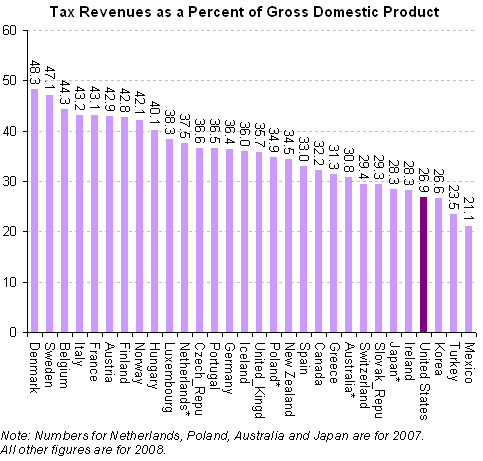
But that view of taxation is not shared worldwide. In fact, citizens of some countries are actually happy about paying taxes. If you’re an American reading these words, that statement probably sounds pretty far-fetched. But consider this: the citizens of Denmark pay the highest income taxes in the world (an average of 48.3 percent), and are also the happiest people in the world.

It’s not just that Danes pay those high income taxes: they also pay a Value Added Tax of 25 percent on every cup of coffee or pair of sneakers they buy, making the outcry in my hometown of Chicago over having the highest sales tax of any major city in the US (a whopping 10.25 percent) look picayune by comparison. And then there’s Denmark’s tax on new cars: a heart-stopping 180 percent. So if you buy a car with an MSRP of € 20,000 , you’ll pay an additional € 36,000 to get the car registered and licensed.

The Danish car tax, in and of itself, would probably be enough to provoke armed rebellion in the United States. So why do the citizens of Denmark not only tolerate the array of taxes they pay, but appear downright happy about them?

And just to be clear, Danes aren’t just generally happy, or happy despite the taxes they pay. Rather, they are specifically happy about paying taxes! Take this exchange, for example, from a recent series of “person in the street” interviews from Copenhagen by United States National Public Radio:

KESTENBAUM [Ed—NPR reporter]: You think paying taxes is terrific?

Ms. BAUOLASON [Ed—resident of Copenhagen]: I do actually think it is terrific.

From an American perspective, Denmark “seems to violate the laws of the economic universe.”

The key to this attitude seems to lie in Danes’ trust in government and each other—something I noted in an earlier post. As this video interview with a pair of Danish sociologists suggests, this trust stems from several factors. Among the most important is the widely-shared belief that their society is just, and that socio-economic goods are equitably distributed. As a result, many Danes seem satisfied that they are getting their money’s worth–that is, they enjoy tangible benefits of the taxes they pay in terms of universal health care, tuition-free education through the university level, and employment benefits and security far beyond anything available in the United States.

Meanwhile, things could not be more different in the United States, which ranks 23rd in the world happiness rankings, and where distrust of government has been virtually axiomatic since the Reagan era—if not before. This helps account for a paradox: while the United States has among the lowest income tax rates in the world, and we have nothing like the VAT and auto registration taxes that Danes pay, Americans rarely challenge each others’ complaints about “high taxes.”

In fact, one of the remarkable things about Joe Stack’s anti-tax rant/suicide note is how much it resembles what now constitutes “mainstream” rhetoric on taxation in America—particularly in the aftermath of the government bailout of financial firms following the 2008 economic crisis.

Stack wrote:

Why is it that a handful of thugs and plunderers can commit unthinkable atrocities (and in the case of the GM executives, for scores of years) and when it’s time for their gravy train to crash under the weight of their gluttony and overwhelming stupidity, the force of the full federal government has no difficulty coming to their aid within days if not hours?

Compare this to CNBC newsman Rick Santelli’s now legendary on-air rant of February 2009, in which he sounds many of the same notes as Stack, using virtually identical arguments and references to American history:

So while Stack’s violent actions took this rhetoric to the extreme, the evidence suggests that he was no outlier in his  perspective on taxation in America: his basic views are apparently shared by a wide swath of his fellow citizens, from television news reporters to the Tea Party movement to think tanks like the conservative Cato Institute.

What accounts for this extreme disparity between American and Danish attitudes toward taxes? And what does this have to do with the differences between the two countries in terms of happiness?

The evidence suggests that both phenomena stem from perceptions of fairness. While—as the two video interviews from Denmark suggest—many Danes believe that they benefit personally from their tax contributions, the rhetoric of people like Stack, Santelli and others suggest that many Americans believe they get little to nothing in return for their tax contributions. Instead, they believe their taxes benefit the “free riders” in US society—whether conceived as “welfare queens” at the bottom of the socio-economic ladder, or as corporations and executives at the top.

Thus, Stack signed off with this bitter epigram: “The capitalist creed: From each according to his gullibility, to each according to his greed.” For him, it was a bitterness unto death; for like-minded Americans, these beliefs contribute to a sense of pervasive injustice that frustrates their “pursuit of happiness” and makes April 15 a day of national resentment rather than a simple administrative deadline.

——————————

Brooke Harrington is Associate Professor of Economic Sociology at the Copenhagen Business School. She is the author of two books: “Pop Finance: Investment Clubs and the New Investor Populism” (Princeton University Press, 2008) and “Deception: From Ancient Empires to Internet Dating” (Stanford University Press, 2009). She is currently doing research on offshore banking.  Harrington blogs at our fellow Contexts blog, Economic Sociology.

If you would like to write a post for Sociological Images, please see our Guidelines for Guest Bloggers.

At Racialicious, Arturo R. García lodges a complaint against the modern makeover of Speedy Gonzales which is, apparently, underway.  Actor and Comedian George Lopez is scheduled to voice the character in a feature cartoon.

Starting in 1955, Speedy was a recurring character in Warner Brothers cartoons.  Dubbed “The Fastest Mouse in all of Mexico,” Speedy wore a sombrero and spoke in broken English.  In the cartoon below, he helps other Mexican mice steal cheese from across the Mexico/U.S. border guarded by a “Gringo cat” (Sylvester):

Lopez’s wife is on record saying that the new Speedy will not be the same racist caricature, but instead a Mexican boy who “…comes from a family that works in a very meticulous setting, and he’s a little too fast for what they do.”  But García isn’t convinced.  He writes:

The thing is, it’s not just about Speedy, but about the universe he inhabited. If this new film strays from the original Andale! Andale! schtick, critics will decry that the character was neutered by “the PC Patrol.” If it doesn’t, the couple has resurrected a very problematic cartoon character (two, if Slowpoke Rodriguez is also brought back.) What would be the next step – the return of Heckle & Jeckle? Is bringing back an “established brand” like this really a better option than creating an original character and building something positive from the ground up?

He also points out that Lopez’s success has rested largely on his own reproduction of racist stereotypes (of the whites-and-Latinos-are-so-different-hahaha! and Latinos-are-so-Latino-hahaha! varieties). For example:

Yeah… so I can’t imagine that that guy would ever participate in a project stereotyping Latinos.

I guess we’ll have to wait and see but, like García, I’m skeptical.

Lisa Wade, PhD is an Associate Professor at Tulane University. She is the author of American Hookup, a book about college sexual culture; a textbook about gender; and a forthcoming introductory text: Terrible Magnificent Sociology. You can follow her on Twitter and Instagram.