Search results for The

Sociologist Michael Kimmel and a reader named L.A. sent along a link to a fashion spread on a Bulgarian magazine’s website.  It’s another example of the glamorization and sexualization of violence against women.  Titled, “Victim of Beauty,” the featured photographs have absolutely nothing to offer, short of showing beautiful women who appear to have been beaten, cut, strangled, and burned.   As I’ve written elsewhere:

As much as I’m bored of seeing women appear to be beaten, sick, or dead in fashion spreads, it also really feels like we must hate them.  Why else?  Why else this constant glorification of their abuse?

I’m going to show one image and throw the rest behind the jump.  They’re very disturbing (e.g., women with slit throats and more). Take a morbid tour, if you like, through more examples of violence against women in fashion:  the fear and suffering of women as a sexual turn on, dead and deadish ladies in fashion (herehere, and here), ads with women looking supremely uncomfortableAsian bondage fantasies, two more examples of the sexy black eye trope, and gulf oil spill themed-examples (here, and here).


Lisa Wade, PhD is an Associate Professor at Tulane University. She is the author of American Hookup, a book about college sexual culture; a textbook about gender; and a forthcoming introductory text: Terrible Magnificent Sociology. You can follow her on Twitter and Instagram.
This is the second part in a series about how girls and women can navigate a culture that treats them like sex objects (see also, part One)Cross-posted at Ms. and Caroline Heldman’s Blog.

The “sex wars”  of the 1980s pitted radical feminists, who claimed that female sexual objectification is dehumanizing, against feminists concerned about legal and social efforts to control and repress female sexuality.  Over a decade of research now shows that radical feminists were right to be highly concerned.

Getting back to the “sex wars” and how radical feminists were right, women who grow up in a culture with widespread sexual objectification tend to view themselves as objects of desire for others. This internalized sexual objectification has been linked to problems with mental health (e.g., clinical depression“habitual body monitoring”), eating disordersbody shameself-worth and life satisfactioncognitive functioningmotor functioningsexual dysfunctionaccess to leadership, and political efficacy.  Women of all ethnicities internalize objectification, as do men to a lesser extent.

Beyond the internal effects, sexually objectified women are dehumanized by others and seen as less competent and worthy of empathy by both men and women.  Furthermore, exposure to images of sexually objectified women causes male viewers to be more tolerant of sexual harassment and rape myths.  Add to this the countless hours that most girls/women spend primping and competing with one another to garner heterosexual male attention, and the erasure of middle-aged and elderly women who have little value in a society that places women’s primary value on their sexualized bodies.

Theorists have also contributed to understanding the harm of objectification culture by pointing out the difference between sexy and sexual.  If one thinks of the subject/object dichotomy that dominates thinking in Western culture, subjects act and objects are acted upon.  Subjects are sexual, while objects are sexy.

Pop culture sells women and girls a hurtful lie: that their value lies in how sexy they appear to others, and they learn at a very young age that their sexuality is for others.  At the same time, being sexual, is stigmatized in women but encouraged in men. We learn that men want and women want-to-be-wanted. The yard stick for women’s value (sexiness) automatically puts them in a subordinate societal position, regardless of how well they measure up.  Perfectly sexy women are perfectly subordinate.

The documentary Miss Representation has received considerable mainstream attention, one indicator that many are now recognizing the damaging effects of female sexual objectification.

[youtube=http://www.youtube.com/watch?v=6gkIiV6konY]

To sum up, widespread sexual objectification in U.S. popular culture creates a toxic environment for girls and women.  The following posts in this series provide ideas for navigating new objectification culture in personally and politically meaningful ways.

A version of this post originally appeared at eGrollman.

Over thirty years ago, Black feminist scholars and activists began emphasizing the importance of recognizing every identity and status of which each individual is comprised.  The crux of the perspective known as intersectionality is that we must account for the intersecting nature of our identities and statuses, as well as the intersecting and mutually-reinforcing relationships among systems of oppression, especially racism, sexism, classism, and heteronormativity.  For example, a full understanding of the lives of Black women cannot come from considering their lives as Black people only, as women only, nor as the sum of these two sets of experiences.

There is solid evidence demonstrating that one’s experiences with discrimination are consequential for one’s mental and physical health; however, these studies generally have not examined whether the relationship between discrimination and health depends upon the number of forms of discrimination individuals experience.  Could it be the case that individuals who face sexist and racist discrimination fare worse in terms of health than those who experience sexist discrimination or racist discrimination only?

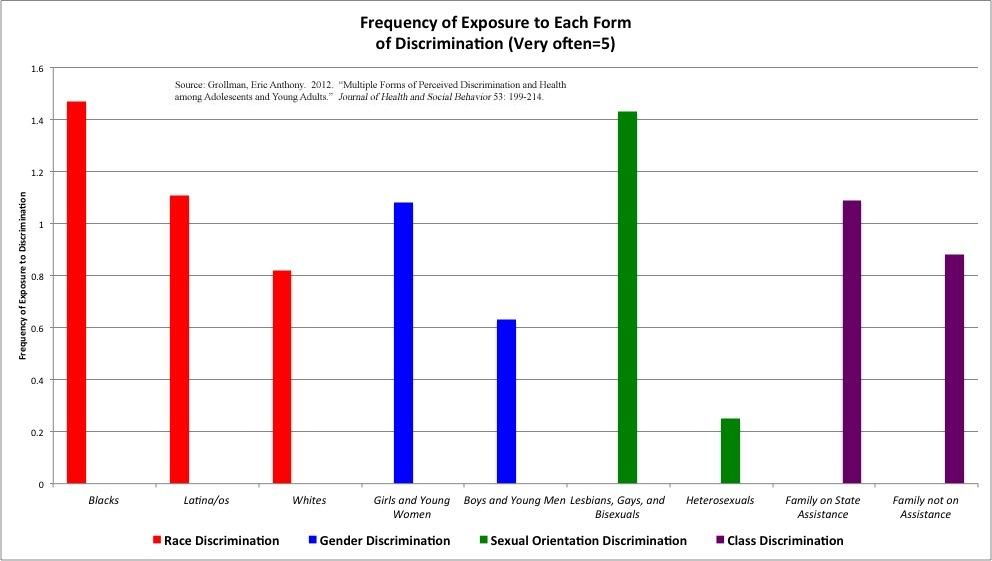
In an article I published in the June 2012 issue of the Journal of Health and Social Behavior, I find that the answer is yes, at least among youth. Using a sample of 1,052 Black, Latina/o, and White youth aged 15-25 from the Black Youth Culture Survey of the Black Youth Project, I looked at patterns in discrimination based on race, gender, sexual orientation, and class.

First, disadvantaged youth report more frequent exposure to their status-specific form of discrimination. That is, Black and Latina/o youth report more frequent race discrimination than White youth, girls and young women report more frequent gender discrimination than boys and young men, and so on:

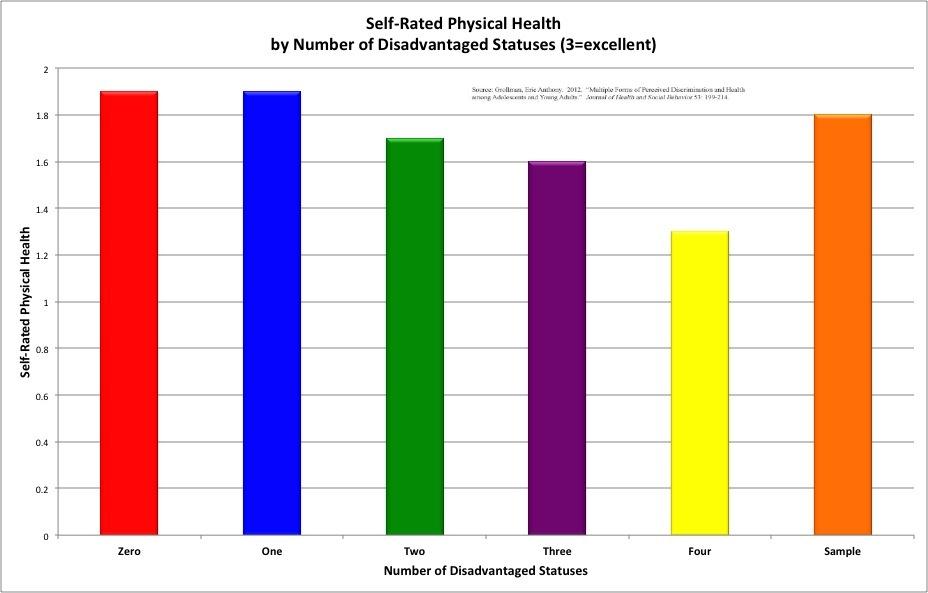
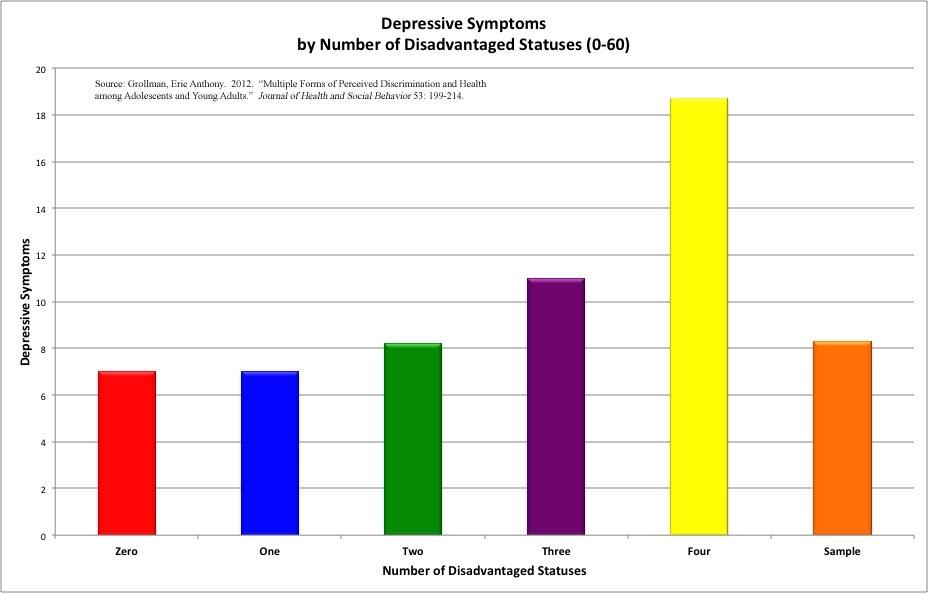
Generally, more frequent exposure to each form of discrimination is associated with worse self-rated physical health and more depressive symptoms in the past month.

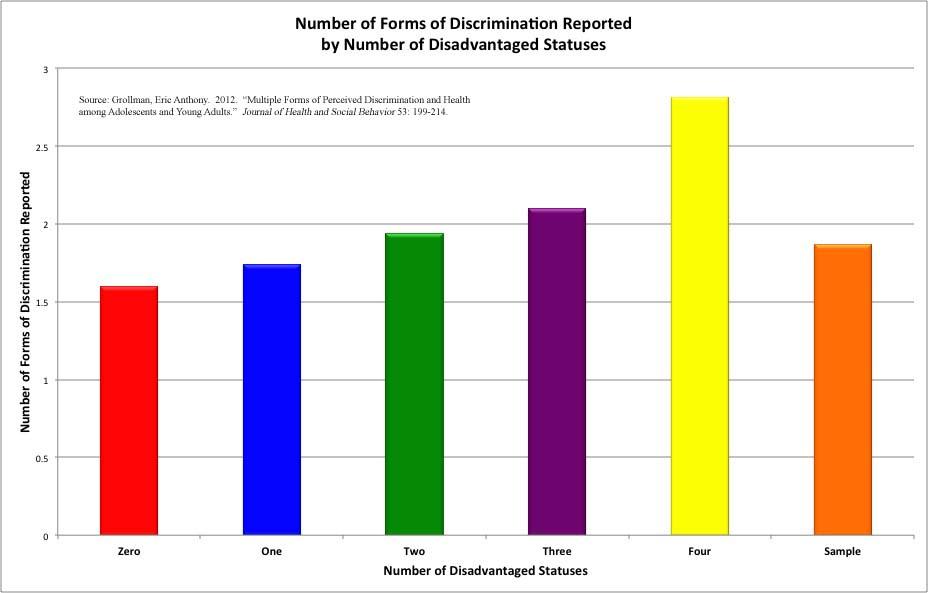
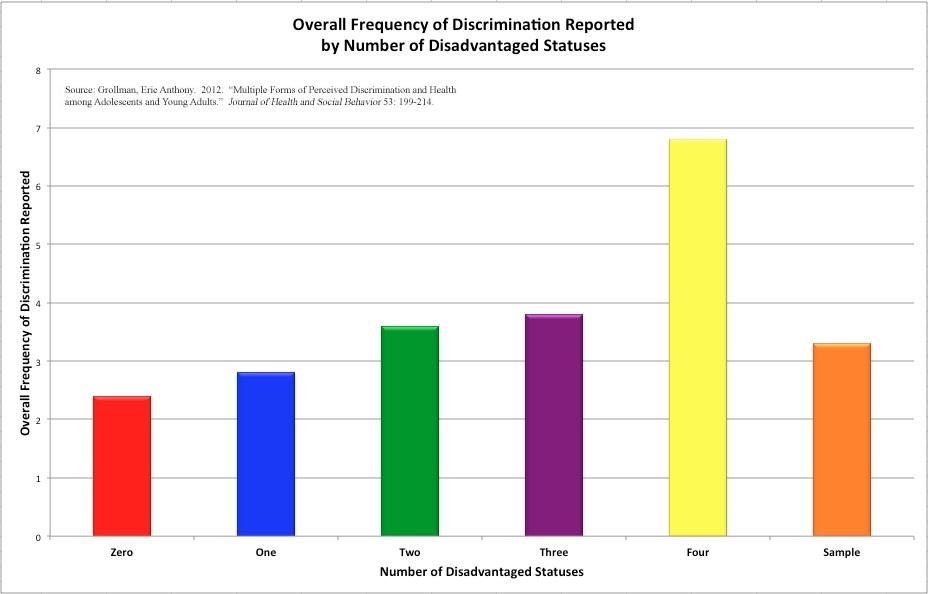
Youth who are disadvantaged due to multiple statuses (e.g., Black working-class boys, Latina lesbian and bisexual girls) report facing more forms of discrimination and more frequent discrimination overall:

Youth who face multiple forms of discrimination and more frequent discrimination report worse self-rated physical health and more depressive symptoms than youth who face fewer forms and less frequent discrimination:

These findings reiterate the importance of examining the intersections among systems of oppression.  Only examining racial or gender discrimination, for example, would miss the fact that youth who are disadvantaged in more than one way face the greatest amount of discrimination.  Unfortunately, scholarship and popular discussions of forms of disadvantage in isolation from one another continue to gloss over the experiences of individuals whose lives are constrained by multiple systems of oppression.

—————

Eric Anthony Grollman is a PhD candidate in sociology at Indiana University.  His research focuses on the consequences of prejudice and discrimination on the health, well-being, and worldviews of marginalized groups.  He blogs for the Kinsey Institute at Kinsey Confidential, and maintains a personal blog.

In the first half of the twentieth century, the black press solidified its role as a pillar of the community and an anchor for popular opinion. In the tumultuous period between the Great Depression and the first stirrings of the Civil Rights Movement, World War II forced black Americans to rethink their struggle for equality as well as their position in the international political arena.* Editorial cartoons became a powerful forum for airing views on the war, a lens through which the readership could view domestic race relations in the context of America’s geopolitical stature and the specter of colonialism and fascism.

Two major black newspapers with national readerships, the Chicago Defender and the New York Amsterdam News, were largely supportive of the war. Black Americans broadly supported World War II. The so-called Double-V campaign rallied black community groups and media under a banner of patriotism, with the aim of encouraging racial integration and equality. But despite the overall pro-war sentiment, the black press also featured cartoons that offered a platform for critiquing blacks’ paradoxical position in the war on a domestic and global scale.

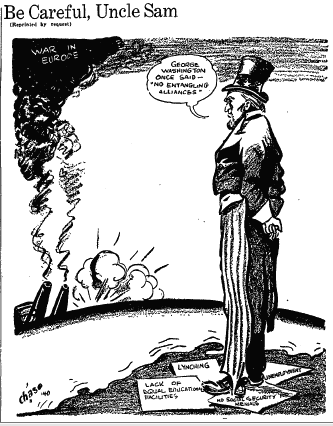
One cartoonist, Bill Chase, reflected early isolationist sentiments among blacks. An Amsterdam News cartoon from June 8, 1940 titled “Be Careful Uncle Sam shows a pensive Uncle Sam staring across the Atlantic at plumes of smoke. He stands upon strewn papers marked “lynching,” “lack of equal educational facilities,” “unemployment” and “no social security menials.” In a pointed reference to past wars and current national priorities, Uncle Sam says, “George Washington once said—’no entangling alliances’”:

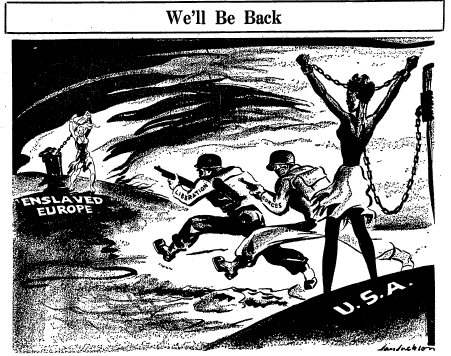
In the June 17, 1944 Defender cartoon, Jan Jackson used a feminine metaphor to portray a double-standard in the politics of government intervention. A half-naked black woman chained to a post, arms outstretched in desperation, watches as two soldiers, labeled “liberation forces,” scurry across the Atlantic toward a mirror image of an endangered white woman on the distant shore of “enslaved Europe”; the headline is the soldiers’ empty promise, “We’ll Be Back”:

That the feminized white Europe is depicted ironically as “enslaved,” while the rescuers turn their backs on a refugee of actual slavery, reveals the absurdity of aiding a “just war” while ignoring a  homegrown humanitarian crisis.

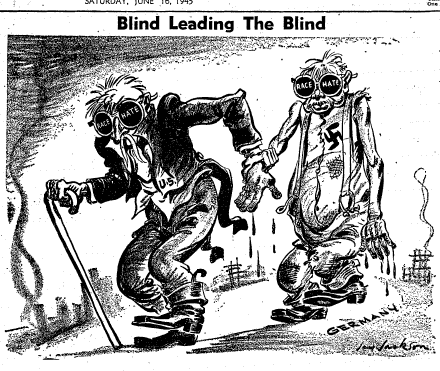
A Defender cartoon published on June 16, 1945, just before the armistice, directly aligns the U.S. with the smoldering legacy of Nazi rule. Under the headline “Blind Leading The Blind,” a haggard America  steps forward from the ashes of bombed-out Europe, leading a disheveled, bloodstained Germany by the hand. Both men wear spectacles with blacked-out lenses displaying the words “race hate”:

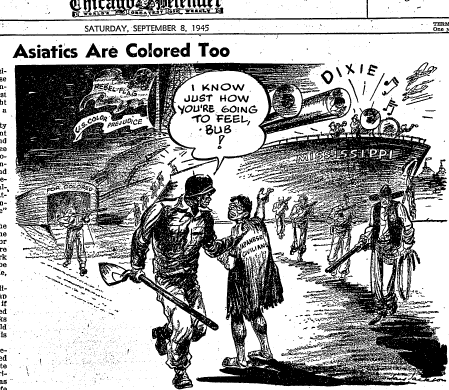
As the war effort shifted from Europe to Asia, editorial cartoons took on an anti-colonial dimension. The Defender‘s September 8, 1945 cartoon elucidates Japan’s dual identity as both a fascist power and a non-white challenge to the global order. The inspiration for the cartoon is a report on the same page that a battleship from Mississippi docked at Tokyo Bay displaying “the Stars and Bars of the Confederacy while on deck the band played Dixie”:

The paper quips that the commander might as well have added “another bit of ‘Mississippi culture’ to the exhibit—perhaps a lynched Negro hanging from the mast or Senator Bilbo filibustering on the poop deck.”

The cartoon displays a hodgepodge of Americana: a ship, a cowboy, a rambunctious marching band, and the offensive flag.  The details expose the irony of a racist America exporting its warped civilization to a non-white country. The black soldiers walk out of a separate entryway marked “for colored.” Heading a parallel procession of white soldiers is a farcical southern vigilante holding rope and a rifle. A black soldier pats a disheveled Japanese civilian on the shoulder and says, “I know just how you’re going to feel, bub!”:

The Japanese rulers may have been fascists, but the visual satire suggests that blacks were in solidarity with Japanese civilians, who were now being invaded by another colonizer. As the cartoon headline notes, “Asiatics Are Colored Too.” Yet the black soldier’s complicity in this metaphorical lynch mob is underscored by the tool he carries: a shovel in lieu of a gun.

Despite broad support for the war in the black press, these editorial cartoons convey America’s peculiar hypocrisy through powerful imagery of suffering and anger. Yet the subtlety of the messages expresses measured, subsurface criticism—perhaps acknowledging that World War II, for all its ethical contradictions, provided a touchstone for concentrating black solidarity and political capital. In deploying these visual idioms to motivate the struggle against fascism, the images succeeded, even if the Double-V campaign itself fell short of redeeming the struggle for “victory at home.” The fight against fascism and Nazism overseas didn’t translate into enlightenment of the American body politic of race. But by mobilizing around the the Allies, black America, and its media, cast a new light on racism in the global context—a perspective later reflected in the strands of pan-Africanism and anti-colonialism in civil rights campaigns. A “white man’s war” could not serve as a real vehicle for black empowerment, but as it stretched to every corner of the globe, the trauma of modern warfare generated a new race consciousness, and new visions, that redefined blackness on the world stage.

—————

Michelle Chen is a doctoral student in history at the City University of New York Graduate Center. In her plebian life, she is a contributing editor at In These Times, a co-producer with New York’s WBAI, and an editor at CultureStrike, a project focused on the intersection of the arts, immigration and activism. Her work has appeared in The Nation, Colorlines.com, Alternet, Ms. Magazine, Newsday, and her old zine, cain.

 References after the jump:

more...

The Stonewall Riots, widely described as the birth of the modern gay and transgender rights movement, occurred on this day in 1969.


Lisa Wade, PhD is an Associate Professor at Tulane University. She is the author of American Hookup, a book about college sexual culture; a textbook about gender; and a forthcoming introductory text: Terrible Magnificent Sociology. You can follow her on Twitter and Instagram.
When asked to contribute to an exhibition about chocolate, photographer James Mollison decided to “explore the disparity between the producer and consumer.”  Chocolate is always a luxury, of course (and is often deliberately marketed this way), and the product, at its finest, can be exceptionally delicious and exceptionally expensive.

Mollison went to Côte d’Ivoire, the country responsible for producing the largest proportion of cacao, to bring the contrast between the product and its producers to life.  The men he photographed, he reports, earned less than $1 a day.

You can see them at his website.

Lisa Wade, PhD is an Associate Professor at Tulane University. She is the author of American Hookup, a book about college sexual culture; a textbook about gender; and a forthcoming introductory text: Terrible Magnificent Sociology. You can follow her on Twitter and Instagram.
For those readers who teach statistics, or methods, or cover the representation of data in their classes, or, like me, are just geeky and unfortunately easily amused, I present to you The World’s Most Accurate Pie Chart.

Gwen Sharp is an associate professor of sociology at Nevada State College. You can follow her on Twitter at @gwensharpnv.

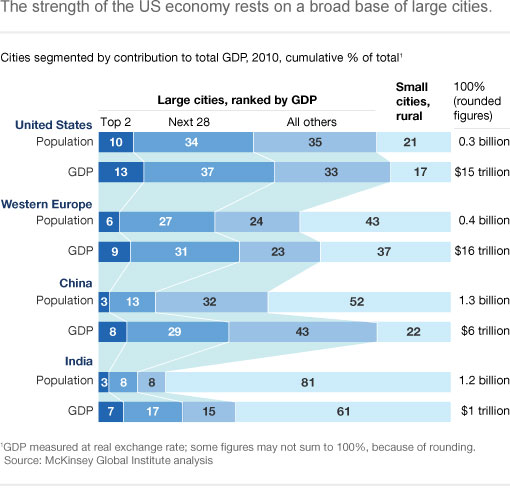
Peter Nardi, from Pitzer College, let us know that the McKinsey Global Institute recently released a report on U.S. cities and the economy. Large cities (those with 150,000+ residents), are more dominant in the U.S. than in Western Europe, China, and India. More of both the national population and economic productivity (measured by GDP) is concentrated in cities in the U.S. than in those other areas, with the exception of the concentration of GDP in large cities in China:

So overall, the vast majority of the U.S. population lives in cities, and they drive economic development and change here. But of course, the fortunes of cities within the U.S. have varied greatly. If we look at the top 30 cities (by GDP) in 1978 and 2010 (in constant 2010 dollars), we can see the decline of many older manufacturing and transportation centers in the northeast and Great Lakes areas. Milwaukee, Indianapolis, Columbus, and Buffalo fell out of the top 30 altogether, while Philly, Detroit, Pittsburgh, Cleveland, and Cincinnati experienced decreases in their contributions to the overall economy, as did three river port cities — New Orleans, Kansas City, and St. Louis. On the other hand, the Sun Belt has become much more prominent, with cities in the South and Southwest entering the top 30 or rising in the rankings (and 6 of the top 30 from California alone):

Most of the economic growth, the study finds, is due to expanding populations. Large cities aren’t becoming much more productive — cities with high overall GDP growth didn’t have higher per capita growth rates than other cities, so it isn’t that their economies are transforming in ways that make workers tremendously more productive individually. They’re growing much faster in terms of population, and that expansion pushes economic growth.

The report also found there’s no single path to successful economic growth for cities. Some with diversified local economies did very well, but others were below average; similarly, some cities that were largely dependent on just one or two economic sectors have suffered, but others did quite well. Check out the full report for a much more detailed analysis on the factors that influence the rise or decline of the economies of U.S. cities, as well as future challenges.

(Via The Atlantic.)