Search results for The

Raised by a racist father, Johnny Lee Clary joined the Klan in 1963 at the age of 14. By 30, he had risen through the ranks and was named the Imperial Wizard, the leader of the entire organization.  He was an outspoken advocate of white supremacy and violence against non-whites, even appearing on the Oprah Winfrey show.

In this four-minute video, he discusses his association with Reverend Wade Watts, a Black civil rights activist and member of the NAACP.  Watts expressed kindness and love towards Clary, even in the face of escalating violence (Clary ultimately set fire to his church).  Deeply affected by Watts, Clary would eventually recant his association with the KKK and join Watts in the fight against racism.

Lisa Wade, PhD is an Associate Professor at Tulane University. She is the author of American Hookup, a book about college sexual culture; a textbook about gender; and a forthcoming introductory text: Terrible Magnificent Sociology. You can follow her on Twitter and Instagram.

The term glocalization — a combination of globalization and local — refers to the tendency of globalizing processes to have to adapt to local peculiarities.  McDonalds is a great example.  It’s a brand recognized around the world, but it responds to local tastes in developing its menu.  So, you can buy a McItaly burger, a Maharaja Mac in India, a McLobster in Canada, and an Ebi Filit-O with Seaweed Shaker fries in Japan (source).

I thought of the concept of glocalization when I came across a set of publicity photos for TV programs in 13 different countries, all modeled after America’s Married with Children.  Each has its own flavor (e.g., the parrot replacing the dog in Chile) and I imagine if we were able to watch them all we’d see great examples of the phenomenon.

The original:

Bulgaria:

Chile:

Croatia:

Germany:

More examples at Neatorama.

UPDATE: Dmitriy T.C. sent me this trailer for a movie called Exporting Raymond, about making a Russian version of Everybody Loves Raymond. It’s along the same theme and looks quite good:

Lisa Wade, PhD is an Associate Professor at Tulane University. She is the author of American Hookup, a book about college sexual culture; a textbook about gender; and a forthcoming introductory text: Terrible Magnificent Sociology. You can follow her on Twitter and Instagram.

Cross-posted at Global Policy TV.

Title IX, an amendment to the Civil Rights Act of 1964, stated that “No person in the United States shall, on the basis of sex, be excluded from participation in, be denied the benefits of, or be subjected to discrimination under any education program or activity receiving Federal financial assistance…”  Passed on this day in 1972, this policy meant that schools and colleges receiving federal funding could not legally give preference to men.  Instead, they had to allocate their resources to men and women in proportion to their interest and enrollment.

The intention of the policy was to change the norms that gave preference to men in all sorts of fields, from medical schools to sports teams.  Because most schools and colleges have extensive athletics departments, sports was included among the resources that the schools were required to dole out fairly.

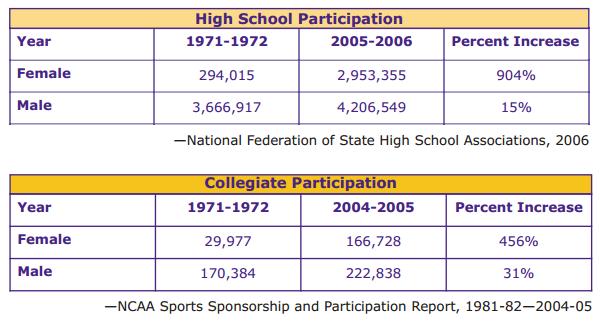
Accordingly, even grudging and partial compliance with the requirements of Title IX dramatically increased the opportunity for women to play sports.  In the next 35 years, women’s participation in high school and college sports would increase by 904% and 456% respectively (source).  Today, 42% of high school athletes and 45% of college athletes are women (source).

Title IX is often mistakenly accused of forcing schools to cut funding for men’s athletics.  In fact, funding for men’s athletics, as well as the number of men who play sports in school, has increased since Title IX.  The chart above also shows that men’s participation has increased by 15% in high school and 31% in college.  It’s not true, then, that Title IX has led to fewer male athletes (especially because some colleges count men as women).  Still, there is great resistance to the Amendment, with a particular emphasis on sports.  Many schools are only marginally compliant, and then only because (tireless) Title IX Officers keep pressure on institutions to follow the law.

It will be fascinating to see how changing college demographics affect the politics around Title IX.  After all, forty years later, people still argue that it’s not right that women’s sports get (almost) as much funding men’s.  Now there are more women on college campuses than men, so proportional funding may mean spending more money on women’s sports than men’s.  Fire and brimstone upon us.

Lisa Wade, PhD is an Associate Professor at Tulane University. She is the author of American Hookup, a book about college sexual culture; a textbook about gender; and a forthcoming introductory text: Terrible Magnificent Sociology. You can follow her on Twitter and Instagram.

In Privileged, sociologist Shamus Khan discusses what he learned by studying one of the most elite boarding schools in the country, St. Paul’s School.  The school molds some of the most privileged members of our society, sending them off into some of its most powerful positions.  So, how do these high school students think of themselves?

Khan argues that new social mandates to diversify elite education may have some pernicious negative effects.  A generation ago, when most students who attended the high school came from rich backgrounds, St. Paul’s students knew that they were there because they were members of the privileged class.  Today about 1/3rd of students do not pay full tuition.  Students, then — both those on scholarships and those who aren’t — learn to think of themselves as individuals who have worked hard to get where they are.

The problem, as Khan articulates it, is that identifying as a member of a class acknowledges that privileged individuals are lucky and may owe some gratitude to a society that has boosted them up.  Thinking of oneself as a uniquely talented individual, in contrast, encourages a person to attribute all of their privilege to their own merits, so they not only feel no gratitude to society, but also fail to notice that our social institutions play a part in disadvantaging the disadvantaged.

And, in the end, students at St. Paul’s School may very be talented individuals who have worked hard, but they’re also members of a class.  Two-thirds of St. Paul’s students pay full tuition — $45,000 per year — so 2/3rds of the students still come from the top 1% of society.  Now, more than ever, they fail to recognize their privilege.

Lisa Wade, PhD is an Associate Professor at Tulane University. She is the author of American Hookup, a book about college sexual culture; a textbook about gender; and a forthcoming introductory text: Terrible Magnificent Sociology. You can follow her on Twitter and Instagram.

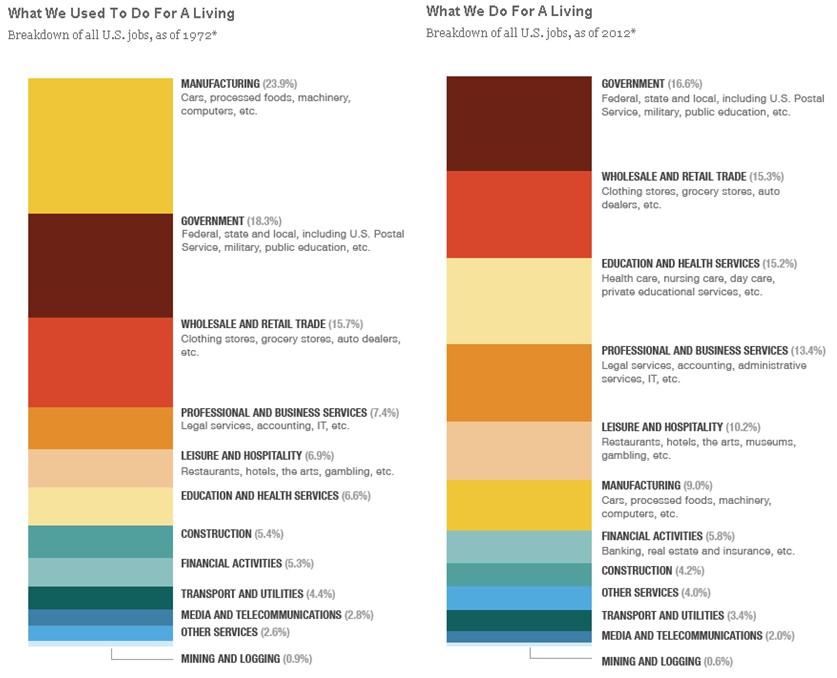
The phrase “service economy” — commonly used to describe the U.S. economic profile these days — refers to a decrease in manufacturing (where we make things for people) and an increase in the service sector (where we do stuff for people).

Planet Money put together stacked bar graphs to illustrate the increasing importance of service in our economy (1972 on the left, 2012 on the right).  Manufacturing (making things) is in yellow, so you can clearly see its decline in prominence.  Service sectors include “professional and business services,” “leisure and hospitality,” and “education and health services.”

So, when people talk about the move to a service economy, these are the changes they’re talking about.  We also see the “servitization of products” (don’t you love academics?), or a tendency for products to come with more and more service.  A restaurant, for example, offers a product (made by the chef), but also a degree of service (offered by the wait staff).  Both the quality of the food and the service vary as you move from fast food restaurants to high end eateries. When we see a servitization of products, we see a ratcheting up of the level of expected service that attends any given product.

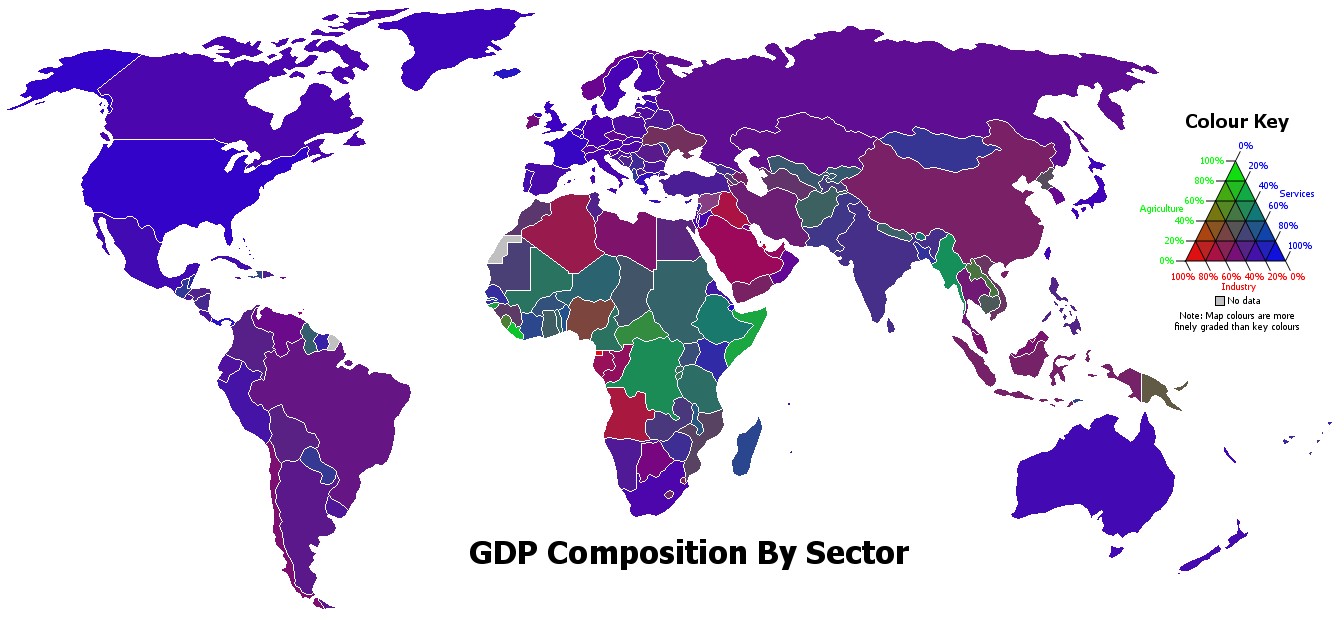
The U.S. economy, by the way, is more heavily characterized by service than most of the world.  The map below is colored to indicate the relative balance between service (blue), manufacturing (red), and agricultural (green) industries in each state.  You can see that the U.S. is among the bluest country on the map:

One of the concerns with the move to a service economy is that service jobs on the low end of the occupational hierarchy tend to be “bad” jobs, while manufacturing jobs, even when they’re on the low end, tend to be “good.”  Service jobs are “bad” in the sense that they tend to have low wages, underemployment, little chance for advancement, and poor or no benefits.  We’re talking, here, about jobs in sales, cashiering, food preparation, and the like.  Because of this tendency, the move to a service economy is taking some of the blame for the shrinking of the middle class.

Lisa Wade, PhD is an Associate Professor at Tulane University. She is the author of American Hookup, a book about college sexual culture; a textbook about gender; and a forthcoming introductory text: Terrible Magnificent Sociology. You can follow her on Twitter and Instagram.

This spring the Chronicle of Higher Education offered an in-depth look at the number of highly educated people receiving federal aid.  Though, on average, they are still doing better than people without college degrees, these populations have not been immune to the recession.

While I sensed an undercurrent of classism in the article (e.g., “how could someone like me be on aid”), it offered an interesting profile of the post-graduate degree job outlook, especially for people with a PhD.  Notably, it reminds us just how risky pursuing graduate work can be; 70% of all faculty are now off the tenure-track.  That often means that they teach part-time, have no benefits, and face semester-to-semester job insecurity.

These faculty could probably do something else, but many of them are trying to realize a dream that they’ve spent 10 to 15 years of their lives working towards.  So, they continue to teach part-time for relatively low pay and participate in a job market that, for the most part, opens up only once a year.

For more on the economics and politics of academic labor, read Keith Hoeller’s The Future of the Contingent Faculty Movement.

Lisa Wade, PhD is an Associate Professor at Tulane University. She is the author of American Hookup, a book about college sexual culture; a textbook about gender; and a forthcoming introductory text: Terrible Magnificent Sociology. You can follow her on Twitter and Instagram.
This weekend I read an article in Bitch magazine about Project Unbreakable. Last fall, then 19-year-old Grace Brown began photographing survivors of sexual assault holding posters with quotes from their attackers (or, in some cases, the police or others they told about the attack). It’s a powerful art project that highlights the emotional manipulation (“I love you,” or “If you tell your mom she’ll hate you for causing us to break up”) that often accompanies rape and sexual abuse. Collectively they illustrate many of the justifications perpetrators give. The quotes chosen by the survivors also make clear that the demands to keep the incident secret and the efforts of abusers to justify their behavior are as much a part of the attack as the physical element.

Gwen Sharp is an associate professor of sociology at Nevada State College. You can follow her on Twitter at @gwensharpnv.

In the Sociology of Gender textbook, I spend a chapter discussing the idea of institutions.  I define the term as “persistent patterns of social interaction aimed at meeting the needs of a society that can’t easily be met by individuals alone.”  These needs  include educating the next generation, providing health care, ensuring safety, and enabling efficient transportation.  These things are done better and more efficiently if we all chip in and put together a system.

What is interesting about institutions from a sociological perspective is that, once they’re in place, it is essentially impossible to opt out.  You can choose not to buy a car, for example, but the government is still going to spend your tax dollars on highway infrastructure.  You can amass as much medical knowledge and experience as you like, but you’ll still be a criminal if you practice medicine without a licence.  You can believe the government is corrupt and stay home on voting day, but Congress is still going to pass legislation to which you will be held accountable.

You get the picture.

In any case, I thought of this when I came across the striking photography of Eric Valli.  Valli seems to specialize in capturing the lives of people living very close to the earth.  In one series, he follows a group of individuals who have decided to live “off the grid.”  That is, they’ve “unplugged” from the social institutions that sustain us.

The photographs reveal people who are committed to being off the grid. It’s no joke.  And, yet, as I scrolled through them, I couldn’t help to notice how many trappings of the rest of the world were part and parcel of their lives (canoes, coats, oil lamps, cooking and eating utensils, halters, firearms, hot sauce, etc).

I’m not questioning, at all, whether or not these people are off the grid. They certainly appear to be.  But it is interesting to notice how much of the grid is still a part of their lives.

Lisa Wade, PhD is an Associate Professor at Tulane University. She is the author of American Hookup, a book about college sexual culture; a textbook about gender; and a forthcoming introductory text: Terrible Magnificent Sociology. You can follow her on Twitter and Instagram.